You are using an out of date browser. It may not display this or other websites correctly.
You should upgrade or use an alternative browser.
You should upgrade or use an alternative browser.
Species we have lost over the last quarter of a century
- Thread starter TeaLovingDave
- Start date


yes they're still there, and they are Zosterops consobrinorum.Does anybody know the status or species of white-eye kept at the Eden Project in Cornwall? Several sources describe this species (alternately described as the Celebes, Sulawesi and pale-bellied white-eye) as being the one present in the rainforest biome there. A photo of at least a pair of them on the species' Wikipedia page taken there around 2015. I noticed that the Eden Project has no entry on Zootierliste - I'm wondering if it may be possible that the species is still present.
Serotine (Eptesicus serotinus) - last held in c.2010 at Kiev Zoo. There are no images of this taxon within the Zoochat gallery.
I saw one at the British Wildlife Centre (Lingfield) last weekend.
I suspect that these are regularly held, albeit temporarily, for rehabilitation.

I saw one at the British Wildlife Centre (Lingfield) last weekend.
I suspect that these are regularly held, albeit temporarily, for rehabilitation.
Interesting; similarly there are a *lot* of bat species listed as current holdings at Brno due to the fact this collection has an onsite rehabilitation centre.
Interesting; similarly there are a *lot* of bat species listed as current holdings at Brno due to the fact this collection has an onsite rehabilitation centre.
Likewise Budapest Zoo has a wildlife rehabilitation centre onsite. Mostly birds are held there but I spotted some bats (unidentified) on a visit last month.
We have lost so many species. Could a similar list for species we've gained?
I think I tried this once (or commented on it or thought about it -on holiday at moment so brain in relaxation mode) -try searching the forums (threads started by me).
I don't think the thread (if it exists) has been as popular as this one -misery loves company.

Let's get another big group or two of passerines done, and go through Starlings and Sparrows.....
Starling taxa lost since 1990
Vinous-breasted Starling (Acridotheres burmannicus) - last held in 2003 at Plzen. Despite several European collections holding this species during the time-span in question, the only images of this taxon within the Zoochat gallery are of captive individuals in Asia.
Singing Starling (Aplonis cantoroides) - last held in 2007 at Vogelpark Avifauna. There are no images of this taxon within the Zoochat gallery.
Nias Hill Mynah (Gracula robusta) - last held in 1994 at Walsrode. There are no images of this taxon within the Zoochat gallery.
Purple-headed Glossy Starling (Hylopsar purpureiceps) - last held in c.1993 at Zoo Hoyerswerda. There are no images of this taxon within the Zoochat gallery.
Burchell's Glossy Starling (Lamprotornis australis) - last held in c.1997 at Zoo Aschersleben. The only images of this taxon within the Zoochat gallery are of a wild individual in Africa.
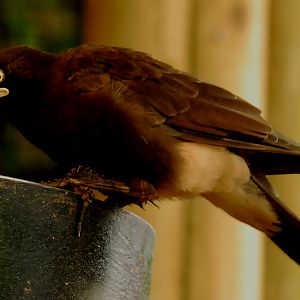
African Pied Starling (Lamprotornis bicolor) - last held in 2016 at Chester Zoo. Despite the fact several European collections have held this taxon within the last decade, there is only a single photograph of this taxon within the Zoochat gallery, taken at Chester Zoo in 2013:
Bronze-tailed Glossy Starling (Lamprotornis chalcurus) - last held in 2011 at
Tiergarten Schönbrunn. There are no images of this taxon within the Zoochat gallery.
Chestnut-bellied Starling (Lamprotornis pulcher) - last held in 2009 at Bioparc Roma. There are no images of this taxon within the Zoochat gallery.
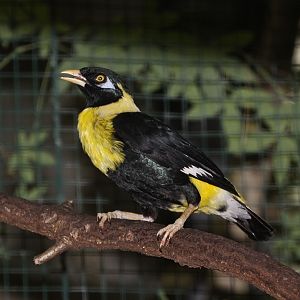
Golden Myna (Mino anais) - last held in c.2014 at Walsrode, one of several collections to hold the species in recent decades. There are a few images of this taxon within the Zoochat gallery, including the following photograph taken at Walsrode in 2010:
Black-bellied Starling (Notopholia corrusca) - last held in 2001 at Tierpark Hellabrunn. There are no images of this taxon within the Zoochat gallery.
Neumann's Starling (Onychognathus neumanni) - last held in 2011 at Paignton. There are no images of this taxon within the Zoochat gallery.
White-cheeked Starling (Poliopsar cineraceus) - last held in 2002 at Parken Zoo. There are no images of this taxon within the Zoochat gallery.
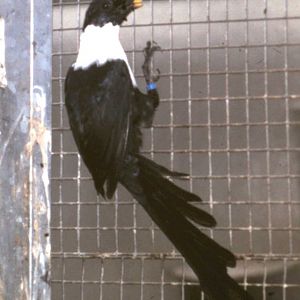
White-necked Myna (Streptocitta albicollis) - last held in 2013 at Plzen, one of several European collections to hold the species in recent decades. The only image of this taxon within the Zoochat gallery is the following photograph taken in 1988 at Walsrode:
Sparrow taxa lost since 1990
Saxaul Sparrow (Passer ammodendri) - last held in c.1997 at Tierpark Berlin. There are no images of this taxon within the Zoochat gallery.
Arabian Golden Sparrow (Passer euchlorus) - last held in c.2005 at Solingen-Gräfrath Tierpark-Fauna. There are no images of this taxon within the Zoochat gallery.
Spanish Sparrow (Passer hispaniolensis) - last held in 1997 at Moscow. There are no images of this taxon within the Zoochat gallery.
Southern Rufous Sparrow (Passer motitensis) - last held in 2005 at Vogelpark Metelen. There are no images of this taxon within the Zoochat gallery.
White-rumped Snowfinch (Pyrgilauda taczanowskii) - last held in 1996 at Tierpark Berlin. There are no images of this taxon within the Zoochat gallery.
Starling taxa lost since 1990
Vinous-breasted Starling (Acridotheres burmannicus) - last held in 2003 at Plzen. Despite several European collections holding this species during the time-span in question, the only images of this taxon within the Zoochat gallery are of captive individuals in Asia.
Singing Starling (Aplonis cantoroides) - last held in 2007 at Vogelpark Avifauna. There are no images of this taxon within the Zoochat gallery.
Nias Hill Mynah (Gracula robusta) - last held in 1994 at Walsrode. There are no images of this taxon within the Zoochat gallery.
Purple-headed Glossy Starling (Hylopsar purpureiceps) - last held in c.1993 at Zoo Hoyerswerda. There are no images of this taxon within the Zoochat gallery.
Burchell's Glossy Starling (Lamprotornis australis) - last held in c.1997 at Zoo Aschersleben. The only images of this taxon within the Zoochat gallery are of a wild individual in Africa.
African Pied Starling (Lamprotornis bicolor) - last held in 2016 at Chester Zoo. Despite the fact several European collections have held this taxon within the last decade, there is only a single photograph of this taxon within the Zoochat gallery, taken at Chester Zoo in 2013:
Bronze-tailed Glossy Starling (Lamprotornis chalcurus) - last held in 2011 at
Tiergarten Schönbrunn. There are no images of this taxon within the Zoochat gallery.
Chestnut-bellied Starling (Lamprotornis pulcher) - last held in 2009 at Bioparc Roma. There are no images of this taxon within the Zoochat gallery.
Golden Myna (Mino anais) - last held in c.2014 at Walsrode, one of several collections to hold the species in recent decades. There are a few images of this taxon within the Zoochat gallery, including the following photograph taken at Walsrode in 2010:
Black-bellied Starling (Notopholia corrusca) - last held in 2001 at Tierpark Hellabrunn. There are no images of this taxon within the Zoochat gallery.
Neumann's Starling (Onychognathus neumanni) - last held in 2011 at Paignton. There are no images of this taxon within the Zoochat gallery.
White-cheeked Starling (Poliopsar cineraceus) - last held in 2002 at Parken Zoo. There are no images of this taxon within the Zoochat gallery.
White-necked Myna (Streptocitta albicollis) - last held in 2013 at Plzen, one of several European collections to hold the species in recent decades. The only image of this taxon within the Zoochat gallery is the following photograph taken in 1988 at Walsrode:
Sparrow taxa lost since 1990
Saxaul Sparrow (Passer ammodendri) - last held in c.1997 at Tierpark Berlin. There are no images of this taxon within the Zoochat gallery.
Arabian Golden Sparrow (Passer euchlorus) - last held in c.2005 at Solingen-Gräfrath Tierpark-Fauna. There are no images of this taxon within the Zoochat gallery.
Spanish Sparrow (Passer hispaniolensis) - last held in 1997 at Moscow. There are no images of this taxon within the Zoochat gallery.
Southern Rufous Sparrow (Passer motitensis) - last held in 2005 at Vogelpark Metelen. There are no images of this taxon within the Zoochat gallery.
White-rumped Snowfinch (Pyrgilauda taczanowskii) - last held in 1996 at Tierpark Berlin. There are no images of this taxon within the Zoochat gallery.

From what I understand now, the rehabilitation centre isn't actually on the same site as the zoo, but located about 5 kilometers away from it. The site may (or may not) belong to the zoo but I'm not sure if it can be seen as a literal part of the zoo.Interesting; similarly there are a *lot* of bat species listed as current holdings at Brno due to the fact this collection has an onsite rehabilitation centre.

There are apparently very few left now, probably single figuresyes they're still there, and they are Zosterops consobrinorum.
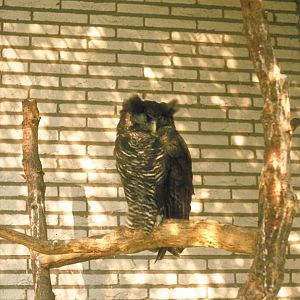
A bunch of very interesting owl photographs have recently been posted to the Zoochat gallery pertaining to the following species discussed previously:
Wassenaar 1972
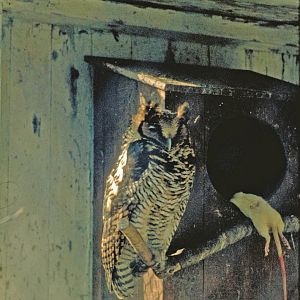
Antwerp 1990
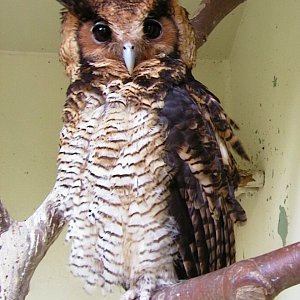
London 1975
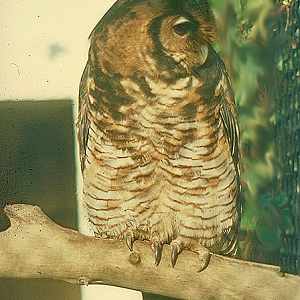
London 1975
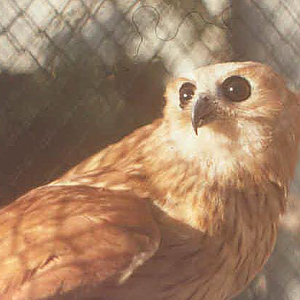
And most significantly, given the fact that until the following photograph was uploaded there was - to the best of my knowledge - only a single image of a living individual of this species known to exist.....
Antwerp 1975
Many, many thanks are due to @Ed Hazebroek , who posted these photographs to the gallery.
Fraser's Eagle-owl (Bubo poensis) - this taxon was held in a number of European collections during the time period in question, with some breeding occurring. The last collections to hold this taxon were Antwerp, until 2002, and Olmense Zoo, until 2012. However, despite the recent loss of this taxon and the number of collections that held it, no photographs of the taxon are present on Zoochat whatsoever, and this post is the first to even mention the taxon.
Wassenaar 1972
Antwerp 1990
Nduk Eagle-owl (Bubo vosseleri) - this taxon was last held by London Zoo, which kept an individual from 1962 until 1997. Although discussed on a number of occasions on Zoochat, and seen by quite a few Zoochatters from what I understand, there are no photographs of this taxon on Zoochat whatsoever.
London 1975
Rufous Fishing-owl
(Scotopelia ussheri) - the only holdings of this taxon in Europe were at London until 1990, and Chester until 1994; the individuals in question have been discussed on Zoochat on a few occasions but no photographs of the taxon have ever been posted to the site.
London 1975
And most significantly, given the fact that until the following photograph was uploaded there was - to the best of my knowledge - only a single image of a living individual of this species known to exist.....
Shelley's Eagle-owl (Bubo shelleyi) - this taxon was last held by Antwerp, with the last individual dying in 1990. No discussion nor photographs of this individual nor taxon are present on Zoochat.
Antwerp 1975
Many, many thanks are due to @Ed Hazebroek , who posted these photographs to the gallery.

This is a fascinating thread and we really need students to take this subject up as projects and analyse the data. Why do these species die out in captivity? Many have small populations that are not viable, but many do well for a generation, or so, and then collapse.
Several of the species I have worked with in zoos have done well for a while, such as Telfair's Skink, Gunther's Gecko, Pink Pigeon, Rodrigues Fody, and then the populations collapse and often die out. Another the Rodrigues Fruit Bat is doing very well in captivity. We need to understand a lot more about the population dynamics of captive animals.
Several of the species I have worked with in zoos have done well for a while, such as Telfair's Skink, Gunther's Gecko, Pink Pigeon, Rodrigues Fody, and then the populations collapse and often die out. Another the Rodrigues Fruit Bat is doing very well in captivity. We need to understand a lot more about the population dynamics of captive animals.
Many have small populations that are not viable, but many do well for a generation, or so, and then collapse.
Another example which has been discussed at some length in this thread being the Gough Island Moorhen - perhaps the species highlighted in this thread which had been represented in the most collections during the timespan under discussion!
This is a fascinating thread and we really need students to take this subject up as projects and analyse the data. Why do these species die out in captivity? Many have small populations that are not viable, but many do well for a generation, or so, and then collapse.
Several of the species I have worked with in zoos have done well for a while, such as Telfair's Skink, Gunther's Gecko, Pink Pigeon, Rodrigues Fody, and then the populations collapse and often die out. Another the Rodrigues Fruit Bat is doing very well in captivity. We need to understand a lot more about the population dynamics of captive animals.
Of course captive populations do not necessarily need to be self-supporting and with common widely spread species it is not a priority. Hence no one need worry about having self supporting captive populations of Red Foxes, Racoons, Tawny Owls or Common Buzzards. Where we do need long-term captive populations is with those species that are rapidly declining in the wild and where we require animals for study and conservation, and also those species that are needed for display but difficult to source from the wild. What is clear is that there is both limited capacity and many species, because of life history characters, are not appropriate to keep in captivity for multiple generations. It is often not realised how many animals are required to sustain zoo populations long-term without running into the problem of inbreeding that affected the Gough Moorhen population.
Hence no one need worry about having self supporting captive populations of Red Foxes, Racoons, Tawny Owls or Common Buzzards.
Of course, one of these species is due for inclusion within this thread within the next decade or two......
I think it unlikely raccoons will be able to be eradicated from Europe. They are found in large populations over numerous different countries. Probably the most that could be hoped for is control rather than eradication.Of course, one of these species is due for inclusion within this thread within the next decade or two......
I think it unlikely raccoons will be able to be eradicated from Europe. They are found in large populations over numerous different countries. Probably the most that could be hoped for is control rather than eradication.
In the wild, yes; however this thread pertains solely to captive collections, and it is these which are now in the process of phasing out the species
 looking at ZTL, of the 422 collections listed as holding Procyon lotor, they break down as follows:
386 holdings are located within countries subject to the new regulations.
27 holdings are located in countries/locations which are not counted as European for the purposes of this thread - the French Overseas Territories, Israel, Kuwait and Russia.
8 holdings are located in countries which are either actively undergoing the process of joining the EU (Serbia) or have started the initial stages of this process (Ukraine) and which therefore are likely to be subject to the new regulations within the next 10-15 years.
1 holding is located in a country - Belarus - which is neither subject to the new regulations nor in the process of applying to the EU.
As such barring any changes in the scope of the regulations in question, and assuming a maximum captive lifespan of 20 years, then the species may well be held in fewer than half a dozen European collections at the end of that timespan.
hmm, I'm sure there had been a provision in the legislation to allow zoos, of Member States in which a relevant species is established in the wild, to hold individuals for certain purposes in a non-breeding condition (so, for example, it would cover raccoons in Germany but not coatis). But I cannot see that at all now, so if it was there (and if it wasn't just my imagination, which seems unlikely) it must have been removed in the finalised version.In the wild, yes; however this thread pertains solely to captive collections, and it is these which are now in the process of phasing out the species...
.
Another example which has been discussed at some length in this thread being the Gough Island Moorhen - perhaps the species highlighted in this thread which had been represented in the most collections during the timespan under discussion!
This is an important example of a species that was apparently doing well and then the population collapsed and the species died out. Since it is an island endemic with a relatively small population, I can see that many collections would have liked to keep it especially when they were rather unusual in collections.
In a previous discussion on this thread, it was suggested that it died out due to inbreeding depression, and was hybridised with the common moorhen, which would have diluted its appeal. A common cause of population collapse in captivity is because of institutional and keeper fatigue, and the urge to keep something different. In my experience zoo marketing people are always looking for new stories. With the Pink Pigeon many zoos tired with it and wanted a species that was more spectacular for the public, and easier to keep, and some shifted to some of the rarer Bleeding-heart Doves.
Zoos will always keep populations of the popular high profile animals, such as giraffes, meercats, gorillas, lions, tigers, macaws and peafowl, but the more obscure species, that appeal to fewer visitors, will I suspect always go through boom and bust cycles.

zoogiraffe
Well-Known Member
@Carl Jones ,Funny you should comment about zoo marketing,as a certain zoo that shall remain nameless,have a zoo marketing department that sat on what to most people on zoochat was very big news,because they deemed another litter of Meerkats and any number of none story's more important,than the first breeding outside of its native New Zealand of a Tuatara,so they sat on it for over 12 months,pity the world where a marketing department that cannot be educated as to what is real news,when you have a new litter of Meerkats. Hopefully the day will come when important story's like this become news,but I don't hold much hope on this happening as they have no wish or desire to educate people or even work for a living by actual making a story become news!

Can add photos of "lost" species from an European collection :
- Saffron toucanet - entitles as Gold toucan - at Wisbroek Breeding Center in the Netherlands. I'm quite sure that it will pop-up in public collections as soon as it is bred in some number at said collection ( BTW took care for this species myself at Walsrode in the 1980-ties, didn't take any photos of it during that time ).
).
See : Gold toucan | ZooChat
-Spot-billed toucanet - also photographed earlier this month at Wisbroek Breeding Center, the first photographs of this species in the Gallery !
See : Spot-billed toucanet | ZooChat
- Saffron toucanet - entitles as Gold toucan - at Wisbroek Breeding Center in the Netherlands. I'm quite sure that it will pop-up in public collections as soon as it is bred in some number at said collection ( BTW took care for this species myself at Walsrode in the 1980-ties, didn't take any photos of it during that time
).See : Gold toucan | ZooChat
-Spot-billed toucanet - also photographed earlier this month at Wisbroek Breeding Center, the first photographs of this species in the Gallery !
See : Spot-billed toucanet | ZooChat