Part II: Last Hours At Tierpark and Final Thoughts
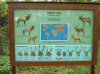
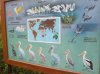
As we approached the Schloss, we found ourselves pleasantly surprised; whilst a handful of days prior the entire pelican collection which is usually displayed on the lawn and moats in front of the Schloss was still off-display, having been kept inside for the winter months, it was apparent that the pelicans were now being gradually reintroduced to their summer grounds with approximately a dozen individuals visible. Even more satisfying, these pelicans were individuals of one of the taxa which represented a lifetick for myself -
Australian Pelican (
Pelecanus conspicillatus), which acted as some consolation for the fact we knew we were still missing several other lifetick pelicans.
However, any disappointment we may have felt was very rapidly forgotten; on the lawn to one side of the Schloss, we knew a handful of
Great Bustard (
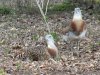
Otis tarda) had recently gone on-display, although Helly and myself had failed to see them on our first visit to Tierpark Berlin. Today, however, we very rapidly spotted all three individuals – as prior to this trip, we had never seen any member of the bustard family and had only recently seen White-Bellied Bustard at Zoo Berlin, we were extremely pleased to see these unusual European native birds which once were commonplace throughout Europe and indeed the UK. I was particularly taken with how attractive and extravagant the plumage of the birds – all male – was, and also how well they blended in with the fallen leaves of the trees under which they were sitting.
We knew there was one final portion of Tierpark Berlin which we had yet to see; the Sun Bear house near to the indoor housing for the Pelicans and the Schloss Gate. However, as we were not far from the “Snake Farm” and Crocodile House, we chose to briefly revisit these areas first in order to obtain further photographs of the treasures within.
As we made our way towards the Sun Bear house, it was very rapidly apparent that this corner of the zoo was little-visited, with a sense of quiet and stillness. The first enclosures we reached were a handful of thickly vegetated exhibits for
Siberian Crane (
Leucogeranus leucogeranus),
Oriental White Stork (
Ciconia boyciana) and
Giant Canada Goose (
Branta canadensis maxima), the first of which represented a lifetick for all of us. Opposite were the outdoor enclosures for the
Malayan Sun Bear (
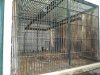
Helarctos malayanus malayanus) held within the collection. These were small, ugly and in my opinion far worse than any of the external enclosures to be found around the Alfred-Brehm Haus, their only saving grace being the fact they *were* reasonably well-planted. However it was apparent that the bears were locked inside at the time of my visit. On entering the Sun Bear House itself, I found that the interior enclosures were somehow much worse again, a row of bare dirty cages with little to no climbing material nor enrichment within, other than the bars and walls of the cages themselves. Moreover, the cages were far too small to hold even the relatively small Malayan Sun Bear, let alone several individuals of said taxon. Having been aware that this house once held multiple species of great ape at a point in time when there was no external enclosure provided, I found myself rather thankful that this was no longer the state of affairs. Nonetheless, this house and the enclosures within was not only the worst that I had seen at Tierpark Berlin, but the worst I had seen on my trip as a whole – worse even than the old big cat cages at Zoo Leipzig.
There was a single glimpse of light in the darkness of the Sun Bear house; a handful of small rodent enclosures very much akin to those found within the Elephant House, which held the following taxa:
Chinese Striped Hamster (
Cricetulus barabensis griseus)
Mongolian Jird (
Meriones unguiculatus)
Himalayan Striped Squirrel (
Tamiops mcclellandii)
The latter of these taxa was a particularly pleasing lifetick, being as the individuals displayed represented the only members of the taxon on public display within a European collection. As such, despite our overall distaste for this area of the Tierpark we did linger a while in order to take plenty of photographs of the Striped Squirrels, knowing that as rodents they are not apt to long life.
Whilst in the Sun Bear house, Helly and myself received a phonecall from her mother, asking us to meet them in the city centre for 7.30pm; as this was only two hours away, and we knew it would take us some time to return to the centre of Berlin, we decided to spend what little time remained to us revisiting final enclosures and taxa we wanted to see one last time. As we made our way past the Great Bustard enclosure, we took the opportunity to take a handful more photographs. However, a minute or two later keepers appeared to move the birds indoors for the night; a task they found difficult as the bustards were curious and kept attempting to approach us! As such, we left the enclosure and discussed where to head next; whilst Helly accompanied Chris and Ang to the Alfred-Brehm Haus, I quickly returned to the highland area of the Tierpark in order to obtain better photographs of the Sichuan Takin and Altai Lynx displayed there. Having been satisfied in this aim, I returned to the ABH and was reunited with the others, spending a final ten minutes or so observing the Palawan Leopard Cats before myself and Helly made our way to the Bear Gate, and caught the U-Bahn back to the centre of Berlin with a heavy heart, knowing we would not return to the Tierpark for some years.
This would be an opportune time to discuss my overall thoughts on Tierpark Berlin, and subsequently to compare the collection with Zoo Berlin in the west of the city; I do not doubt that many of those reading this post will disagree with some of the points and opinions which follow, but I hope that it nonetheless provokes a profitable and enjoyable level of discussion and debate!
As I observed when writing my overall summary of Zoo Berlin, in many ways the key issue is where to begin in order to adequately discuss a massive and world-famous collection such as Tierpark Berlin. As such, I should probably lay my cards on the table; I thoroughly enjoyed my visit, and both Zoo Berlin and Tierpark Berlin have usurped the first-place position in my mental ranking of zoological collections previously held by Chester Zoo. However, that is not to say that there were no facets of Tierpark Berlin which I did not enjoy, or which I thought failed to meet the standard which a collection such as this could – and should – reach. The best way to balance my discussion of Tierpark Berlin, given my admission that I now hold it as the joint-best zoological collection in the world, would therefore be to discuss the failings of the collection before I discuss the triumphs. As noted in discussions of the Alfred-Brehm Haus both elsewhere on Zoochat, and within the pages of this thread, the ABH is possibly one of the most divisive houses within European collections as a whole. As such, this is the best place to begin in discussing the faults of the collection.
In many ways the debate gets simplified to two opposing arguments on the matter – that the ABH is fantastic and should never be changed, and that it is terrible and represents a black mark on the zoo landscape which needs to be expunged. Of course, this black-and-white view does not *truly* represent the viewpoint of either side - barring perhaps a very small number of die-hard individuals – but unfortunately a divisive issue like this tends to make each side think the worst of the other. The resulting dichotomy does not allow for the possibility that there are people who overall enjoy the ABH but recognise it could and should be improved to bring it "up to date" - but who believe this can be done without losing the overall feel of the building as a whole; something which they may fear will happen with the planned changes under the new management. As I have noted elsewhere in this thread, this is more or less the stance on the matter which I hold - I very much enjoyed the ABH, but equally I acknowledge those areas in which it falls regrettably short and believe that these failings need to be addressed, although unlike many on Zoochat I think that it is entirely possible to retain the historic feel and environment of the Alfred-Brehm Haus and still increase animal welfare. Rather than attempting to find new words for those suggestions and observations I have already made, I will quote myself on a handful of key points before returning to the wider discussion at hand:
Discussing the small carnivore and clouded leopard external enclosures to the right of the ABH:
I will say this straight away, though; despite the fact these enclosures could be so much better were they to be given a little care and attention (something which I fear may not be happening in the near future considering the current state of upheaval with the accession of Dr Andreas Knieriem) I still feel that they stand up rather well when compared to so many of the enclosures I am familiar with over here in the UK.
Discussing the external enclosures for big cats along the left-hand perimeter of the ABH:
Something which struck me about these enclosures is that they could easily be improved by merging two sets of the enclosures together - it seems to me that although it is nice to be able to display a non-subspecific and melanistic leopard, if the Tierpark got rid of this animal they could potentially merge this enclosure with either that of the Sumatran Tiger on one side, or the Javan Leopard on the other. Similarly, having two enclosures side-by-side for a melanistic Jaguar and a pair of spotted Jaguar is fine enough if you have larger enclosures, but in this situation is arguably less important than potentially merging the two enclosures and giving the breeding pair more space.
Discussing the internal enclosures for big cats in the ABH:
However my pleasure was tempered, as I knew it would be, by the fact that the indoor enclosures for the carnivores I had seen on my tour of the exterior of the building were indeed insufficent for the purpose. Nowhere near as bad as the indoor enclosures at - for instance - South Lakes Wild Animal Park but nowhere near as good as they could and should have been. Although it will put the inside corridors of the ABH out of commission once again, I do hope that the long-delayed interior work on the cat enclosures goes ahead despite the change in management.
Discussing the internal enclosure for Malayan Tiger in the ABH:
We then reached the indoor enclosure for the Malayan Tiger (Panthera tigris jacksoni), which I rather liked; it was several orders of magnitude bigger than any indoor tiger enclosure I had ever seen in the past, and provided both climbing and swimming opportunities for the inhabitants. I have a sneaking suspicion that were this enclosure to be in any other collection, and not the Alfred-Brehm Haus, it would be much lauded as a world class exhibit - but as it is, it will be stymied by the low quality of most of the other indoor enclosures in the ABH.
Discussing the Asiatic Lion enclosures, and changes I would make regarding them:
These enclosures were all rather similar in design and quality to the indoor tiger enclosure, but I must admit that I found myself thinking that if Tierpark went out of the Asiatic Lions they could either use the enclosures for pure African animals, or as housing for their new Sumatran Tigers, which represent a sorely-needed boost to the European genepool for the subspecies.
However, the ABH is infinitely better than the Sun Bear house which is found at the opposite end of Tierpark Berlin; as such I am somewhat surprised that when the collection is discussed, the former house is met with so much active vitriol whilst the latter house is merely dismissed with contempt. As will have been obvious from my discussion of the Sun Bear house, I have little-to-nothing positive to say about this exhibit – in point of fact I would go so far as to describe this as the single worst exhibit which I observed during my week in Germany, and one of the only portions of Tierpark Berlin which I would *happily* see demolished. The only positive points I can make about the Sun Bear house, in fact, are as follows; it is off the beaten track and easily missed, and at least it does not hold great apes as it once did!
Another facet of Tierpark Berlin which does merit criticism to some degree is the Elephant House; the interior enclosures for the Asian and African Elephants and the Indian Rhinoceros are *far* too small for the taxa in question, with the only saving grace being the decent size and quality of the external paddocks surrounding the house, and the fact that the inhabitants of the house seemed to spend the vast majority of their time outdoors. Some on Zoochat have indicated that in their opinion, the Manatee enclosure is also displeasing, and even the worst in Europe. I would acknowledge that it is by no means ideal, and possibly somewhat on the small side, and as such I would be extremely happy if a superior exhibit were to be developed. However, I would not agree with those who believe that it is bad or detrimental to the welfare of the inhabitants. Overall, I would much rather that a collection like Tierpark Berlin were to have an interior elephant house befitting a world collection. Unfortunately, this would require an entirely new building to be constructed, due to the design and position of the existing house, and as such these improvements would be more difficult to achieve than those I propose for the Alfred-Brehm Haus.
The final major feature of Tierpark Berlin which I would suggest merits criticism is the Monkey House ; as noted elsewhere in this thread, this exhibit is one of the newer buildings at the collection at a shade over ten years old, but nonetheless rather disappointed Helly and myself. The animal enclosures were very “old-fashioned” and in some cases were smaller and even less visually appealing than those which tend to receive so much vitriol in the Alfred-Brehm Haus. Conversely, the public areas of the house were spacious and empty, giving a stark and clinical feel akin to the corridors and rooms of an empty hospital – much like the similar feel I observed at Zoo Berlin when visiting the newly-opened Bird House, in point of fact. The Alfred-Brehm Haus, the Elephant House and even the Sun Bear House are all decades-old, with faults which are intrinsic to their age and in some cases difficult to resolve as a result. These problems can therefore be understood to a degree, even if they cannot be dismissed. The Monkey House is a new build, and as such in a strange way it is worthy of more criticism than any of the other houses mentioned – much like the Bird House at the sister collection in the West, it represents a missed opportunity.
However, all of the above points are still very much outweighed by the positive features of Tierpark Berlin. The sheer variety and diversity of the taxa on display is overwhelming – in the realm of hoofstock the collection provides quite a comprehensive review of the diversity and range of form, a resource which in my opinion is precious to ensuring future generations understand and appreciate this diversity. Where else can one see every extant taxon of equine at species level, along with a vast number of caprines, camelids, cervids and bovids – let alone in such an attractive and peaceful setting? The animal collection at Tierpark Berlin also contains significant diversity in cool-climate birds, carnivore taxa from around the world and – increasingly unusual in non-specialist collections – a rather extensive range of birds of prey. Many have suggested that this level of diversity within an animal collection is not, in fact, a good thing – that it smacks of an antiquated 19th century “stamp-collection” mentality at best, and at worst is incompatible with the welfare of the taxa displayed. I would wholeheartedly contest this opinion. Granted the collection *could* be profitably reduced somewhat to improve matters for the remaining taxa, but the complete loss of this kind of diversity would be both unnecessary and a tragedy for future generations. Furthermore, criticism may be levelled at the amount of space provided within some of the animal houses at Tierpark Berlin, but no such criticism is possible when it comes to the vast majority of the outdoor paddocks and enclosures found throughout the collection. To name but one example, the foot plan of the central portion of Tierpark Berlin containing the various members of the camel family is larger than that of many zoos. Along with this portion of the collection, some of the exhibits and enclosures at Tierpark Berlin which I feel merit particular praise are the Vulture Aviary outside the Alfred-Brehm Haus, the Pheasantry and the Highland area in the northeast corner of the Tierpark - whilst I thoroughly enjoyed other areas of Tierpark Berlin, these particular areas are among those which I believe elevate the collection to “world class”. I suspect even those who are critical of Tierpark Berlin as a whole would find it hard to deny the value and quality of these exhibits.
Another key strength of the collection, in my opinion, is the setting and location – it is quite literally a park, with expanses of meadow and woodland full of wildlife integrated alongside the captive animal collections. As such, the wide open spaces of Tierpark Berlin provide an important counterpart to the dense city-centre location of Zoo Berlin – the two collections have grown and developed independently, as one would expect given the history of the city in which they are located, but nonetheless the one mirrors and complements the other. One is a large and spacious parkland collection, making full use of the space available, whilst the other is a classic “city zoo” making the best of limited space for development and expansion, with each largely selecting species appropriate to their situation and – since the reunification of Berlin – working together to ensure the animal collections complemented one another, with taxa lacking in one collection often to be found in the other. I could not have visited one without also viewing the other; equally I cannot rank the one above the other. As such, they are *both* equally worthy of the title I grant them above, the best zoo in the world.
As I have noted on a number of occasions throughout this thread, I view the future of both collections under the new management with some trepidation; a new management which as chance would have it began more-or-less simultaneously with my trip. I will discuss this matter in a little more detail when summarising my trip as a whole, but for now it suffices to say that I am extremely glad I visited Tierpark Berlin when I did; even if my fears are unfounded and the changes prove to make the collection even better – as I dearly hope they will - it will never be quite the same again.
On returning to the centre of Berlin, Helly and I quickly left our bags and cameras in our hostel room before heading down the street to meet up with her parents and Claire. From there, we once again went to the Pasta & Passione restaurant which we had thoroughly enjoyed on the evening of our trip to Magdeburg Zoo, discussed our day and made final plans for the following morning; Helly’s mother had booked all five of us onto a morning tour of the restored central dome of the Reichstag building, which we planned to follow with a visit to the Museum fur Naturkunde.
Returning to our room after the meal, it was not long before we were once again soundly asleep.
(
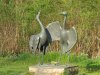
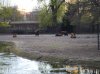
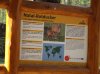
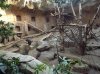
Attached are images of signage at the Pelican Moat, two of the Great Bustard, one of the Sun Bear cages, an example of statue work near the Siberian Crane enclosure and the Wood Bison viewed immediately prior to our departure from Tierpark Berlin)








 After close to 45 minutes with no consensus on where to eat having been reached, Chris having demurred at any suggested location, we elected to get something to eat in what I rather suspect was where Chris had set his heart on all along..... Pizza Hut. We took some small solace - and amusement - in allowing Chris to awkwardly attempt to ask for a menu in faltering German before I chipped in, and pointed out that the staff had already offered us menus in fluent English!