The German Adventures Of A Tea-Loving Dave - April 2014

Part IV: Alfred-Brehm Haus Perimeter

We came to the conclusion that the best way of seeing the Alfred-Brehm Haus would be to view all the surrounding enclosures running around the exterior of the building, before moving inside to look at the Haus itself. As such, we walked to the right of the building where there was a row of exterior enclosures for an assortment of carnivores, of varying quality. I will say this straight away, though; despite the fact these enclosures could be so much better were they to be given a little care and attention (something which I fear may not be happening in the near future considering the current state of upheaval with the accession of Dr Andreas Knieriem) I still feel that they stand up rather well when compared to so many of the enclosures I am familiar with over here in the UK.

This row of enclosures comprised the following, in order:

Amur Leopard (Panthera pardus orientalis)
Indochinese Clouded Leopard (Neofelis nebulosa nebulosa)
Malayan Binturong (Artictis binturong binturong)
Fishing Cat (Prionailurus viverrinus)
Pallas Cat (Otocolobus manul)
Serval (Leptailurus serval)
Missouri Cougar (Puma concolor missoulensis)

Of these enclosures, I think the worst looking one was probably the cougar enclosure - the animals were no-shows so I could not gauge what the enclosure was like with them within, but it seemed in a worse state of repair than the other enclosures. I've heard a lot of people on Zoochat complaining about the Amur Leopard enclosure, and certainly I can imagine just how bad these enclosures would have been prior to their having been extended some time ago, but for what it was - a small enclosure but one providing a decent amount of climbing opportunity for the animals inside, and which seemed to be in a decent state of repair - it was not quite as bad as I had expected it to be.

It was, I have to admit, rather nice to be able to observe Clouded Leopard at length and with only minimal trouble provided by the bars and mesh of the enclosure - I was somewhat surprised at how active and showy the animals were considering the shy nature of the species in my past experience, and discussion of this topic with Sven and Markus revealed a further surprise. From what I was informed, this pair of Clouded Leopards had never had much breeding success but in the last few years, when the ABH has been in a semi-permanent state of construction and renovation with the resulting high level of noise and disruption, the pair have successfully started breeding!

This said, I thought the enclosures worked rather well for the smaller three species held in them - the size considerations were less of an issue, and the climbing opportunities provided in the Fishing Cat and Pallas Cat enclosures in particular were being fully used. I have seen many small cat enclosures in the UK which would very much benefit from being replaced by enclosures such as those I saw in this portion of the ABH exterior.

Opposite the Missouri Cougar enclosure is a small free-standing circular enclosure holding a colony of Black-tailed Prairie Dog (Cynomys ludovicanus), although truth be told we observed more wild sparrows inside the enclosure than we did prairie dogs. It was nothing special, nor anything particularly bad - it is more or less the same enclosure for the species as can be found throughout the UK, with nothing unusual to mark it out from the herd.

Much nicer, as we made our way around the exterior of the Alfred-Brehm Haus, were two penguin pools which provided a decent balance of land and water, built against a rock wall which extended outwards to separate the two enclosures. The first of the enclosures contained Jackass Penguin (Spheniscus demersus) and Northern Gannet (Morus bassanus), whilst the second of the enclosures contained Humboldt penguin (Spheniscus humboldti) and Flightless steamer duck (Tachyeres pteneres) - and I have to admit I was more pleased at the sight of the two non-penguin taxa, neither of which are particularly common in European collections these days - although I see the gannet in the wild relatively often, one cannot take such things for granted. I was also pretty pleased to see the number of wild herons which were coming to the pools - although not a different subspecies to those found in the UK, they did look a bit different and as such I took the opportunity to take plenty of photographs of them.

Opposite the penguin pools is a very large enclosure for Sudan Cheetah (Acinonyx jubatus soemmeringii), a taxon which would excite many people, but with which I am rather familiar due to the presence of the subspecies at Chester Zoo. In point of fact, the two male cheetah held in this enclosure were born at Chester Zoo, the survivors of the ill-fated litter from some years ago which was struck by cowpox infection. The enclosure, although large, did have its faults - foremost being the lack of hillocks and long grass which I believe are held to be good for captive enclosures for the species in question. This said, it was undoubtedly the best large carnivore enclosure I had encountered in the ABH area so far.

The cheetah enclosure was backed by a sheer rock wall, and as we turned the corner we were to come across the enclosure on the other side of this wall, which was evidently primarily in place for the enclosure in question. This was to be the first enclosure I had encountered at Tierpark Berlin which I would be inclined to describe as world-class - a massive set of cliffs for birds of prey, with particular focus on vulture taxa, approximately 8 or 9 metres high and about three or four times that long. Furthermore, the area in front of the cliffs was rather substantial, with multiple trees and other items for the inhabitants to perch in.

As such, I spent rather a long time watching this enclosure - of course, much of my time was spent trying to make sure I had seen all the species found within. It took me a while, but I managed eventually to get the full set, which comprised the following:

Common Buzzard (Buteo buteo)
Cinereous Vulture (Aegypius monachus)
Bateleur (Terathiopius ecaudatus)
White-backed Vulture (Gyps africanus)
Turkey Vulture (Cathartes aura)
Steppe Eagle (Aquila nipalensis)
Griffon Vulture (Gyps fulvus)
White-headed Vulture (Trigonoceps occipitalis)
Egyptian Vulture (Neophron percnopterus)
American Black Vulture (Coragyps atratus)
Bearded Vulture (Gypaetus barbartus)
Himalayan Vulture (Gyps himalayensis)
Rüppell's Vulture (Gyps rueppelli)
Lesser Yellow-headed Vulture (Cathartes burrovianus)
King Vulture (Sarcoramphus papa)

After looking briefly across to the paddock where Chapman's Zebra (Equus quagga chapmani) was held - the beginning of a line of hoofstock paddocks lining the way to the Elephant House, of which more later - we then took a look at the small enclosure for Snow Leopard (Panthera uncia) which sat next to the vulture cliffs. It may have been partially due to the comedown from aforementioned excellent enclosure, but I was left with a distinct sense of dissatisfaction with the enclosure. I cannot put my finger on it, but something about the enclosure struck me as amiss in a way that the previously mentioned enclosures for the leopards, puma and small carnivores did not.

As we continued to walk along the perimeter of the ABH, we passed enclosures which were - I was informed by my German companions - the former home of Maned Wolf, the last of which had recently died, along with the current home for Bush Dog, none of which were anywhere to be seen. As we were skipping past the small plaza for the Asiatic Lion and Siberian Tigers, intending to do this area when visiting the Haus itself, the next occupied enclosures we thus came across were another row of enclosures much like the previously mentioned one, but this time holding solely large cats. As such, the failings of the aforementioned Amur Leopard and Missouri Puma enclosures were shared by these enclosures, although once again there seemed to be a relatively decent amount of climbing opportunity provided for the inhabitants. One or two ideas for improving this area did occur to me, which I will get to in a little bit.

As we walked along, the enclosures held the following:

Sumatran Tiger (Panthera tigris sumatrae)
Melanistic Leopard (Panthera pardus)
Javan Leopard (Panthera pardus melas)
Jaguar (Panthera onca)
Melanistic Jaguar (Panthera onca)
Missouri Cougar (Puma concolor missoulensis) and Javan Leopard (Panthera pardus melas)

The latter of these enclosures is, of course, the famous mixed enclosure which has been commented upon on Zoochat in the past. As Sven mentioned to myself and Hel, the reason for this mix of two sub-adult females is that the animals involved were born at roughly the same time, and after the sibling of the leopard was sent to Prague the remaining leopard was deemed to be suffering from loneliness. As the puma cub had been hand-reared due to the loss of her siblings and a subsequent rejection by the mother, this was seen as an opportunity to help the puma learn how to be a cat, and to provide the leopard with company. Both individuals seemed to be thriving when I observed them, so it seems to have worked - though it is strange to see a small big cat and a big small cat sharing an enclosure!

Something which struck me about these enclosures is that they could easily be improved by merging two sets of the enclosures together - it seems to me that although it is nice to be able to display a non-subspecific and melanistic leopard, if the Tierpark got rid of this animal they could potentially merge this enclosure with either that of the Sumatran Tiger on one side, or the Javan Leopard on the other. Similarly, having two enclosures side-by-side for a melanistic Jaguar and a pair of spotted Jaguar is fine enough if you have larger enclosures, but in this situation is arguably less important than potentially merging the two enclosures and giving the breeding pair more space.

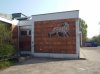
We finally approached the main entrance to the Alfred-Brehm Haus - as remarked upon by Sven, clear of scaffolding and building material for the first time in years - and the small cat enclosures which are found to the left of the entrance, in a small annexe marked by a mosaic on the side of the Haus.

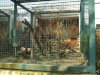
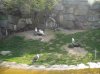
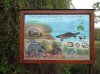
Attached are images of the Clouded Leopard enclosure, the Pallas Cat enclosure, the African Penguin and Northern Gannet enclosure, and the mosaic on the side of the ABH entrance.
 

Attachments

  • DSCF7925.jpg
    DSCF7925.jpg
    2 MB · Views: 64
  • DSCF7936.jpg
    DSCF7936.jpg
    2 MB · Views: 60
  • DSCF7946.jpg
    DSCF7946.jpg
    1.9 MB · Views: 63
  • DSCF8038.jpg
    DSCF8038.jpg
    1.4 MB · Views: 49
A really nice read and this will have to be the most extensive trip report ever on zoochat. Regarding TP Berlin I am more on the "Animal-side", and not a great fan of the ABH, allthough I must admit that this zoo still is a kind of guilty pleasure, because of the gigantic range of really nice species.

A small side-note, you mention the polar bear exhibit as one of the better pb exhibits you have seen, but as this was your first time outside UK, you cannot have much to compare it with :P

Be sure your next trip will be to the Netherlands, I would gladly tour you through Burgers Zoo & Apenheul (on which you are guaranteed to see red howler monkeys :p).
 
Very interesting TLD! Are there no longer small cats in glassed enclosures on the outside?
 
That's because you're a Dudley regular and I guess you go past the flamingos first, it must be some deep-rooted psychological issue! ;) :p[/QUO

Lol, it must be as I'm now programmed to go left on entry to most zoos!.

And no it doesn't matter which way around you go but most zoo maps have recommened routes!
 
A small side-note, you mention the polar bear exhibit as one of the better pb exhibits you have seen, but as this was your first time outside UK, you cannot have much to compare it with :P

I've seen the current one at HWP, and the old ones at Edinburgh Zoo and Flamingoland (the former of those two being unoccupied at the time) so I'm not entirely unfamiliar with the concept of polar bear enclosures ;)

Very interesting TLD! Are there no longer small cats in glassed enclosures on the outside?

Mentioned in my final sentence:

and the small cat enclosures which are found to the left of the entrance

These are discussed in the next portion of my report :)
 
@Dave: You may be pleased to hear that the outside enclosures of the Brehm-building will indeed soon be merged and also extended to the front. This way, each of the new enclosures (except for the seventh one in each row which cannot be merged but just extended to the front) will provide about four times as much space as any of the present enclosures...
 
Part V: Alfred-Brehm Interior

The small row of enclosures to one side of the main entrance to the ABH contained a number of small - but very choice - cat species. Running from the left to the right as one faced the enclosures, the inhabitants were as follows:

Central American Margay (Leopardus wiedii nicaraguae) - a relatively recent import by the collection and the only individuals of this subspecies within Europe.
Geoffroy's Cat (Leopardus geoffroyi)
Gordon's Wildcat (Felis silvestris gordoni)

Frustratingly, the sun was in the ideal position for glare on the windows to make photography troublesome, but it did mean the inhabitants of the enclosures were in plain view sunbathing. All three enclosures contained numerous branches and platforms for the inhabitants to climb and rest on, but I would have to admit that I would have preferred the enclosures to have been slightly more thickly planted in the case of the first two species - all three enclosures were more or less designed along a "desert" theme, which was appropriate for the Gordon's Wildcat but not the other two taxa. As I have something of a soft spot for the Geoffroy''s Cat, I was rather pleased to see this species again - these individuals looked somewhat different to those with which I am familiar in the UK, being rather smaller and rather resembling their close cousin the oncilla, and I found myself wondering whether they originated from wild-caught stock from the zone of occasional hybridisation with this taxon, and furthermore whether this has affected populations of the Geoffroy's Cat in Europe as a whole.

Immediately as one enters the Alfred-Brehm Haus, on the left hand side of the entrance (representing the opposite side of the wall from the aforementioned small cat enclosures) is a sizeable enclosure for the Palawan Leopard Cat (Prionailurus bengalensis heaneyi) held by the collection. This enclosure, although having the undeniable downside of not providing any outside access or natural sunlight for the inhabitants, was somewhat larger than any of the three enclosures on the outside of the building, with the inhabitants able to climb to approximately 5 feet above the heads of the public looking into the enclosure. Moreover, there were a number of hollow logs and other places where the inhabitants could hide somewhat from the public gaze - something which the exterior three enclosures *had* been lacking.

As this was a species which for all intents and purposes had been offshow during the past few months, due to the work taking place on the Alfred-Brehm Haus, I was very pleased to be able to see it - and even more pleased to observe that in the year or so since arriving into the collection, the 1,1 adults have produced two kittens - hopefully between them, Tierpark Berlin and Exmoor Zoo - which has also received this species - will be able to get a decent population of this attractive taxon going in Europe.

Having not entirely expected to be able to visit the ABH, I felt rather pleased to finally be there - although there is still a little building work to be done, and quite a few of the aviaries lining the corridors around the central tropical hall are still standing empty, I could hardly believe that only a fortnight before it had been an active building site. Considering the age of the building, it still looks rather attractive from an aesthetic point of view. It is still an on-going process of course; I am given to understand that in the week since my visit, even more species of bird have been added to both the corridor aviaries and the central hall, and the vegetation in the central hall will certainly benefit from a year or two of growth. But I get ahead of myself.

The indoor viewing along the corridors for most of the larger carnivores in the ABH were empty on my visit - primarily due to the fact the clement weather was inducing the vast majority of the inhabitants to stay outside - but one species which I observed with some pleasure, having only had brief glimpses of the taxon in the past, was the North Chinese Leopard (Panthera pardus japonensis). However my pleasure was tempered, as I knew it would be, by the fact that the indoor enclosures for the carnivores I had seen on my tour of the exterior of the building were indeed insufficent for the purpose. Nowhere near as bad as the indoor enclosures at - for instance - South Lakes Wild Animal Park but nowhere near as good as they could and should have been. Although it will put the inside corridors of the ABH out of commission once again, I do hope that the long-delayed interior work on the cat enclosures goes ahead despite the change in management.

The various small bird aviaries in the corridors, although still in the process of being restocked now that the ABH has been re-opened, provided me with a high number of very nice lifeticks including Cuban Grassquit (Tiaris canorus), D'Arnaud's Barbet (Trachyphonus darnaudii) and Tropical Kingbird (Tyrannus melancholicus). The aviaries themselves struck me as nothing special, but certainly pleasant enough and serving their purpose well. It was unclear to me, however, whether the lack of much vegetation in the aviaries was deliberate or a mark of how recently they had been re-occupied, although judging by what I know of the collection I rather suspect the former is the more likely.

We then reached the indoor enclosure for the Malayan Tiger (Panthera tigris jacksoni), which I rather liked; it was several orders of magnitude bigger than any indoor tiger enclosure I had ever seen in the past, and provided both climbing and swimming opportunities for the inhabitants. I have a sneaking suspicion that were this enclosure to be in any other collection, and not the Alfred-Brehm Haus, it would be much lauded as a world class exhibit - but as it is, it will be stymied by the low quality of most of the other indoor enclosures in the ABH. Of course, another factor which might affect the view people have of this enclosure is the fact that the recently-departed director is said to have been against the 2005 split of the Malayan Tiger from the Indochinese subspecies, and thus never updated the labelling for the taxon to reflect this split.

From here we briefly exited the ABH to pass through the previously mentioned courtyard containing the outdoor enclosures for the tigers and the Asiatic Lion (Panthera leo persica) and into the portion of the house containing the indoor lion enclosure. These enclosures were all rather similar in design and quality to the indoor tiger enclosure, but I must admit that I found myself thinking that if Tierpark went out of the Asiatic Lions they could either use the enclosures for pure African animals, or as housing for their new Sumatran Tigers, which represent a sorely-needed boost to the European genepool for the subspecies.

We then went into the central tropical hall, which as I previously alluded to has only been completed, planted and repopulated in the past fortnight or so. As such, the flora and fauna in the enclosure is nowhere near as impressive as I suspect it will be given another year or so - although even now, there are one or two treasures already housed in the hall, including an unlabelled Arrow-marked Babbler (Turdoides jardineii) which I am given to understand has been held at the Tierpark since before I was born, and which is the sole representative of the species in Europe. As such, this is a portion of the ABH which I expect I will be able to say much, much more about when I hopefully return to Berlin in a couple of years.

We then exited the ABH, and made our way along the route towards the Elephant House which led us past a series of equine paddocks. All of these were a very large size, and contained sizeable herds of the following species:

Chapman's Zebra (Equus quagga chapmani) as mentioned in my previous post.
Hartmann's Mountain Zebra (Equus zebra hartmanni)
Grevy's Zebra (Equus grevyi)
Somali Wild Ass (Equus africanus somalicus)

One thing which particularly impressed me about this collection of equid species, incidentally, is that fact that when taken along with another portion of the collection - more of which later - Tierpark Berlin has a complete set of all extant equine species. As someone with a growing appreciation for hoofstock species, although some might label it a manifestation of a "stamp collector" mentality at the collection, I find myself entirely approving of this fact; it permits visitors who pay attention to get a true grasp of the wild variation found in this particular genus, seeing the small differences that demonstrate that Equus is more than just "horses, donkeys and zebras" as I imagine some would see it.

Naturally, if the enclosures suffer, than such a mentality is not quite as positive - but in this case, where the enclosures are good and give plenty of space for the taxa in question, I would argue that this is a perfect example of how a "stamp collection" showing the range of diversity in nature can not only avoid being a bad thing, but can actively be *good*.

As we approached the end of these paddocks, the Elephant House and the exterior Asian Elephant (Elephas maximus) enclosures came into view.

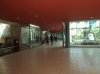
Attached are two interior views of the entrance to the Alfred-Brehm Haus, a photograph of the indoor enclosure for Malayan Tiger, and an image of D'Arnaud's Barbet.
 

Attachments

  • DSCF8069.jpg
    DSCF8069.jpg
    1.2 MB · Views: 64
  • DSCF8070.jpg
    DSCF8070.jpg
    1.1 MB · Views: 63
  • DSCF8093.jpg
    DSCF8093.jpg
    1.2 MB · Views: 63
  • DSCF8118.jpg
    DSCF8118.jpg
    1.3 MB · Views: 49
So from a carnivore enthusiasts point of view I take it you thoroughly enjoyed your time ABH then, even if certain enclosures leave a lot to be desired! :p

Now I'm awaiting Gondwanaland and the Berlin carnivore/nocturnal house reviews! :D

Out of interest what was your species highlight of this trip? I want to say the pangolin (as you keep rubbing it in Chlidonias's face) but given your particular tastes I'm not too sure that they would be it! :D :p
 
Part VI: From Elephant House To Aquarium

Opposite the outside paddocks for the Asian Elephants, there was a large enclosure - next to the aforementioned equine enclosures - which contained South African Ostrich (Struthio camelus australis). It was a nice enough enclosure, all things considered, but I could not help but wish that a more visually striking subspecies like Red-necked or Masai had been displayed. Just personal taste, of course, but there you go. From this position I was also able to look across to the giraffe house, more of which later.

I paid close attention to the exterior enclosure for the Asian Elephants, and the inhabitants therein, as I was aware the herd comprised not only non-subspecific animals, but also Indian Elephant (Elephas maximus indicus) and Sumatran Elephant (Elephas maximus sumatranus), the latter of which is a taxon I had never seen before. However, although I was able to see and photograph the entire herd, I am still entirely uncertain which animals were which! The enclosure was rather good, being relatively spacious, though nowhere near as good as the Asian Elephant enclosure I am most familiar with at Chester. This said (spoilers ahead) it was still the best outside enclosure for elephants I saw at the four collections I visited on the trip.

We approached the entrance to the elephant house itself, but ensured that we paid note to the enclosures on either side of the entrance. On our left was an enclosure for Straw-colored Fruit Bat (Eidolon helvum) whilst on the right was an enclosure for New Guinea Short-beaked Echidna (Tachyglossus aculeatus lawesii). Needless to say, myself and Hel were more interested in the latter than we were the former, although both were lifeticks; conversely our German companions were entirely unimpressed by either. That said, I rather got the impression that they did not much care for many of the species held within the Elephant house - though this may well have been due to the fact that by this point in time, Sven in particular was beginning to be quite vocal about wanting to head towards the cafeteria for a bite to eat! In any case, although the echidna were being quite unshowy - sleeping with their spines just about visible - I was nonetheless pleased to see them. I was also quite pleased by the signage which was placed by the enclosure which gave copious information about monotremes.

Directly inside, once we had passed the gift shop in the house entrance, there were callitrichid enclosures to either side of us - on the left was an enclosure for Emperor Tamarin (Saguinus imperator subgriscens) and on the right was an enclosure for Silvery Marmoset (Callithrix argentata), both of which were high-quality enclosures but nothing particularly amazing nor unusual. Conversely, the criticism which the indoor enclosures for the Asian and African elephants, and the Indian Rhinoceros (Rhinoceros unicornis) have recieved over the years cannot be said to be unjustified, in my opinion - they are extremely small for the taxa in question, and if they appeared in a modern house would rightly be lambasted, but three important points occur to me. Firstly, of the four indoor elephant enclosures I saw during my trip, the interior of the Tierpark elephant house was by far the best. Not to get vastly ahead of myself, but I did not much care for any of the other elephant houses I saw during my trip. Secondly, although it would without a doubt be unpleasant to see these taxa kept inside indefinitely - as I suspect they may be in the depths of winter - thanks to the clement weather the indoor enclosures went entirely unused during the two days I visited the collections. As such, my opinion of the enclosures is unclouded by the negative sentiment that I may well have felt had I seen them in use, as I did for the other three houses. Thirdly, although I would much rather see a collection like Tierpark Berlin have an interior elephant house befitting a world collection, for this to happen it would *have* to be a new build as the current house cannot really be altered in any meaningful fashion.

After looking at the indoor accommodation for the larger mammals, we then turned our attention to one of the main allures of this house in my opinion - the collection of unusual small mammals housed in tanks along one side of the building, which running from left to right were as follows:

Cretan Spiny Mouse (Acomys minous)
Guenther's Vole (Microtus guentheri)
Short-eared Elephant Shrew (Macroscelides proboscideus)
Neumann's Grass Rat (Arvicanthis neumanni)
Barbary Striped Grass Mouse (Lemniscomys barbarus)

Considering how few collections display an interest in obscure small mammals, I was particularly pleased by this facet of Tierpark - especially as it represented the first time I had ever seen a species of elephant shrew. I am given to understand that prior to the renovation work taking place in the Alfred-Brehm Haus, these small mammal tanks had been located in the upstairs area of the tropical hall, along with a number of species currently held off show - I rather hope that this bodes well for a future re-expansion of this side of the onshow collection now that the ABH has been reopened.

A little bit further along in the house was an enclosure containing recent arrivals, a pair of Longtailed Tamandua (Tamandua longicaudata nigra) which were just about visible asleep at the top of the enclosure - this said, the enclosure was a good one and I imagine that it will prove to be a good one for the species. Just opposite from here is another callitrichid enclosure, this one holding Midas Tamarin (Saguinus midas) mixed with Lowland Paca (Cuniculus paca), the latter of which is a species of which I am rather fond. In general, the smaller enclosures in this house are in many ways the model on which I hope future enclosures in the ABH may end up being modelled on - they are a lot more thickly planted and with a high level of enrichment and places for the animals resident within to hide from the public if they so desire.

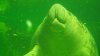
More or less centrally placed in the elephant house is another enclosure which I had been rather looking forward to seeing; that of the West Indian Manatee (Trichechus manatus manatus), representing yet another placental mammalian order which until this point in time I had never seen. Granted I have never seen the species before, and thus have no basis for comparison, but I thought the enclosure they were held in was quite a good one - it seemed a decent enough size for the animals, and provided multiple levels of viewing for the public. I particularly liked watching the actions of the myriad fish in the enclosure whenever one of the sirenians stopped moving for a moment, and all the fish swarmed around the animal - presumably feeding on dead skin and similar detritus from the manatee.

We then proceeded to exit the elephant house through the second exit, once again noting the outdoor enclosures near the exit. We had no luck spotting the inhabitants of the first enclosure, which was labelled as holding Muenster Yellow-toothed Cavy (Galea monasteriensis), but with a little searching we managed to spot the Yellow-spotted Rock Hyrax (Heterohyrax brucei) which were in the second of the enclosures. The enclosure was quite a good one, but the hyrax seemed loathe to use it, being as they were sat on a window ledge some feet above the enclosure itself!

We then made our way to the various carnivore enclosures opposite the elephant house, taking the long route towards the cafeteria. This area holds the full set, at species level, of hyena taxa - however due to the vagaries of the path myself and Hel were being led on by our German companions, we did not pass by all the relevant enclosures at this point in time. The first enclosure we passed was that for Eastern Aardwolf (Proteles cristata septentrionalis) and unusually for this species, we were able to see the animal in question, which was having a doze in the mid-afternoon sun. The enclosure itself was pretty good, as was the neighbouring enclosure for Brown Hyena (Parahyaena brunnea) - although when one considers the lengths that myself and Hel went to in order to see the latter species last summer, I felt a sense of wry amusement at the fact the Brown Hyena at Tierpark Berlin were all asleep in plain view in a public enclosure, requiring no effort whatsoever to see!

We then followed a side path which ran alongside and behind these two enclosures, where on our left there was a sizeable enclosure for Bobcat (Lynx rufus) - my only feline lifetick at species level during the week, and one I had been rather looking forward to. This enclosure was relatively well planted and had cliffwork providing climbing opportunity for the bobcats, one of which was soundly asleep on a ledge when we approached. On the right were a pair of large enclosures, quite similar to that occupied by the bobcats, both of which were occupied by Northern Yellow-throated Marten (Martes flavigula aterrima). This again is a species of which i am rather fond, and having previously only had snatched glimpses of the Twycross animals prior to their coming onshow fully I rather enjoyed being able to watch multiple individuals at my leisure. One of the individuals was rather less showy than the other, something subsequently explained by my discovery that the species has bred at Tierpark within the last month. By the by, all the enclosures in this area, small carnivore and hyena alike, were infinitely better than most of those found within the area of the Alfred-Brehm Haus. I suspect that anyone who - like me - has a particular love for small carnivores will enjoy this area just as much as they would the ABH, if not more.

This carnivore area concluded with a large enclosure for wolves - unfortunately they were, insofar as much as I can tell, non-subspecific Grey Wolf (Canis lupus) and as such a taxon that I find hard to get much enthusiasm for. Seen impartially, the main loss is the fact it is a genuinely good enclosure, being rather sizeable and I feel good for both the inhabitants and the public viewing them - as such, it would be great if Tierpark had pure European Wolf, or even Iberian Wolf, but such an enclosure being occupied by "mongrels" is something of a shame to my eyes. I have similar feelings, incidentally, about the giraffe situation at this collection as will be discussed along the road.

Sven and the other two Germans were getting rather hungry by this point - as were myself and Hel - so we began to pick up the pace on our journey towards the main cafe in the Tierpark. However, as they lay on the route to the cafe and none of our companions had seen the latest arrivals there, we stopped at the two marsupial enclosures en-route.

The first and smaller of the two enclosures contained Swamp Wallaby (Wallabia bicolor) and Mainland Western Grey Kangoroo (Macropus fuliginosus melanops), whilst the larger enclosure contained Yellow-footed Rock Wallaby (Petrogale xanthopus xanthopus), Red-necked Wallaby (Macropus rufogriseus) and Eastern Wallaroo (Macropus robustus robustus) - both enclosures were pretty good, with the latter enclosure being a walkthrough enclosure. However, the Wallaroo, which arrived at the collection relatively recently, were rather shy and stuck to the far side of the enclosure - hopefully this state of affairs will improve over time, as they are a rather nice species. That said, the nicest species of the five was undoubtably the rock wallaby, which I rather hope continues to spread around Europe as it has been in recent years, being as it is both unusual and successfully breeding around the continent unlike some other unusual macropods which are clinging on in Europe.

We finally reached the cafeteria, glad both for the opportunity of a sit-down and the chance to get something to eat.

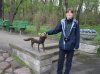
Attached are an image of one of the manatees, a panoramic shot of a mural in the elephant house, the signage discussing monotremes beside the echidna enclosure, and Hel petting a statue of a fox near the Grey Wolf enclosure.
 

Attachments

  • DSCF8231.JPG
    DSCF8231.JPG
    585.7 KB · Views: 48
  • DSCF2660.jpg
    DSCF2660.jpg
    590.6 KB · Views: 69
  • DSCF2748.jpg
    DSCF2748.jpg
    1.9 MB · Views: 55
  • DSCF2944.jpg
    DSCF2944.jpg
    1.7 MB · Views: 102
Nope :p although Zoo Berlin has held Shortbeaked and Longbeaked Echidna a few times over the last century or so, Tierpark Berlin had never held any monotremes at all until the arrival of these animals
 
It is very interesting to read this report, as it has me (mentally) revisit Tierpark from another perspective. I appreciate a lot of what you say (inclusing some of the criticism concerning hybrids and some of the enclosures) and I am rather pleased to hear that overall you generally seem to cherish the park as I do. As everyone else acquainted with the park I am particularly curious how it will develop in the years (or even decades) to come. Unfortunately, funds have been extremely limited so far, virtually ruling out major investments for some years. But I genuinely hope this will change at least to some degree. But as for now we have to deal with the way things are and I feel they could indeed be far worse.

And of course I am very much looking forward to the next steps of your trip - well, content wise I am well aware of what still lies ahead, but I'm still curious about your comments and ideas. But already at this point I want to point out that this has been by far the most detailed and thorough report on the park I ever read (perhaps except for the one found in the pictured guide provided by the former zoo manager)!
 
Lucky bastard, you saw the aardwolf, on our visit we revisited that enclosure several times (which takes a lot of time in Tierpark :p), but they stayed no-show. But well I have seen the other subspecies in the wild :p

It is funny to read about the elephant house, imo one of the worst elephant indoors I have seen, zoos like Ljubljana & Bojnice are lower on that list... I would rate the Leipzig exhibit (and even the Magdeburg indoors) higher than these particular indoor enclosures, which you probably also would have, if you would have seen the animals being chained and separated and handled with elephant hooks...

And btw the manatee enclosure is the worst one in European zoos at the moment (some people would say together with the one in Burgers, as that one lacks underwater viewing), allthough I do not find it that bad and it usually provides good views.
 
One thing which particularly impressed me about this collection of equid species, incidentally, is that fact that when taken along with another portion of the collection - more of which later - Tierpark Berlin has a complete set of all extant equine species.

Many thanks for such a detailed review; there have been a few changes since my last visit.

Like you, I especially appreciate the range of equid species. However, if you follow Colin Groves and consider:-

• the two forms of mountain zebra distinct species:-Equus zebra and Equus hartmanni
• the Indian wild ass Equus khur to be a distinct species from Equus hemionus

then the Tierpark does not have a complete set of all extant equine species
 
It is funny to read about the elephant house, imo one of the worst elephant indoors I have seen, zoos like Ljubljana & Bojnice are lower on that list... I would rate the Leipzig exhibit (and even the Magdeburg indoors) higher than these particular indoor enclosures, which you probably also would have, if you would have seen the animals being chained and separated and handled with elephant hooks...

The elephants aren't chained any longer and often several enclosures are connected so the elephants can have social contacts and walk a bit further in at least one direction. Other than that, however, I fully agree that the inside boxes (for sadly that ispretty much what they are) could and should be far larger and better. But I think Dave rather meant he enjoyed the interiour of the building overall better than that of the others. Personally, I also like it best when I can watch elephants and rhinos outside and then have a walk thorigh the building just for the other animals in there. And fortunately, the animals often get outside for most of the day. Even in winter they usually get some hours outside. I have watched elephants playing with the snow last winter...

And btw the manatee enclosure is the worst one in European zoos at the moment (some people would say together with the one in Burgers, as that one lacks underwater viewing), allthough I do not find it that bad and it usually provides good views.

I don't know any of the other ones, but I don't think the one in the Tierpark is actually THAT bad. Of course, again it could be somewhat larger. But it is structured so they can swim quite well or rest on a "bank". Sometimes they also look outside from on of the Banks or the keepers interact with them or give them branches or stuff like that. And of course their food floats on top so they very often are busy just going for it. Usually the animals seem to be occupied for as much as I am aware of. They don't seem to interact with each other but for what I was told this species (though thought to be rather intelligent) is also not known to show great interaction.
 
@Markmeier, than my most recent visit in 2012 was maybe a bit misleading, when the elephants were being washed inside in the morning and already inside again around 5 pm, allthough it was in the middle of july. And if they are not chained anymore that would be great news, allthough it still doesn't make adequate housing.

Regarding the manatees, as I said, I do not think the enclosure is very bad, but most other European enclosures are just of a higher quality, the one in Burgers as a possible exception, allthough that one is way more spacious, but lacks underwater viewing and is quite shallow overall.
 
I've also heard negative things about Manatee housing at the Tierpark, but appears to be quite adequate! Have they ever bread there?

Off topic, is there an outdoor manatee enclosure anywhere in Europe?
Fantastic review TLD!
 
Lucky bastard, you saw the aardwolf, on our visit we revisited that enclosure several times (which takes a lot of time in Tierpark :p), but they stayed no-show. But well I have seen the other subspecies in the wild :p

A damn nice achievement :) I've seen both subspecies in the one captive collection, it is really quite something to be able to compare the two!

which you probably also would have, if you would have seen the animals being chained and separated and handled with elephant hooks...

I did, of course, note in my review that had I seen the elephants being kept inside I may have felt differently. Naturally, best of the four I saw does not, per se, equal "good" - just that I liked the other indoor elephant houses less.
 
Back
Top