Part IV: Alfred-Brehm Haus Perimeter
We came to the conclusion that the best way of seeing the Alfred-Brehm Haus would be to view all the surrounding enclosures running around the exterior of the building, before moving inside to look at the Haus itself. As such, we walked to the right of the building where there was a row of exterior enclosures for an assortment of carnivores, of varying quality. I will say this straight away, though; despite the fact these enclosures could be so much better were they to be given a little care and attention (something which I fear may not be happening in the near future considering the current state of upheaval with the accession of Dr Andreas Knieriem) I still feel that they stand up rather well when compared to so many of the enclosures I am familiar with over here in the UK.
This row of enclosures comprised the following, in order:
Amur Leopard (Panthera pardus orientalis)
Indochinese Clouded Leopard (Neofelis nebulosa nebulosa)
Malayan Binturong (Artictis binturong binturong)
Fishing Cat (Prionailurus viverrinus)
Pallas Cat (Otocolobus manul)
Serval (Leptailurus serval)
Missouri Cougar (Puma concolor missoulensis)
Of these enclosures, I think the worst looking one was probably the cougar enclosure - the animals were no-shows so I could not gauge what the enclosure was like with them within, but it seemed in a worse state of repair than the other enclosures. I've heard a lot of people on Zoochat complaining about the Amur Leopard enclosure, and certainly I can imagine just how bad these enclosures would have been prior to their having been extended some time ago, but for what it was - a small enclosure but one providing a decent amount of climbing opportunity for the animals inside, and which seemed to be in a decent state of repair - it was not quite as bad as I had expected it to be.
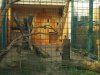
It was, I have to admit, rather nice to be able to observe Clouded Leopard at length and with only minimal trouble provided by the bars and mesh of the enclosure - I was somewhat surprised at how active and showy the animals were considering the shy nature of the species in my past experience, and discussion of this topic with Sven and Markus revealed a further surprise. From what I was informed, this pair of Clouded Leopards had never had much breeding success but in the last few years, when the ABH has been in a semi-permanent state of construction and renovation with the resulting high level of noise and disruption, the pair have successfully started breeding!
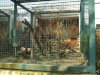
This said, I thought the enclosures worked rather well for the smaller three species held in them - the size considerations were less of an issue, and the climbing opportunities provided in the Fishing Cat and Pallas Cat enclosures in particular were being fully used. I have seen many small cat enclosures in the UK which would very much benefit from being replaced by enclosures such as those I saw in this portion of the ABH exterior.
Opposite the Missouri Cougar enclosure is a small free-standing circular enclosure holding a colony of Black-tailed Prairie Dog (Cynomys ludovicanus), although truth be told we observed more wild sparrows inside the enclosure than we did prairie dogs. It was nothing special, nor anything particularly bad - it is more or less the same enclosure for the species as can be found throughout the UK, with nothing unusual to mark it out from the herd.
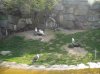
Much nicer, as we made our way around the exterior of the Alfred-Brehm Haus, were two penguin pools which provided a decent balance of land and water, built against a rock wall which extended outwards to separate the two enclosures. The first of the enclosures contained Jackass Penguin (Spheniscus demersus) and Northern Gannet (Morus bassanus), whilst the second of the enclosures contained Humboldt penguin (Spheniscus humboldti) and Flightless steamer duck (Tachyeres pteneres) - and I have to admit I was more pleased at the sight of the two non-penguin taxa, neither of which are particularly common in European collections these days - although I see the gannet in the wild relatively often, one cannot take such things for granted. I was also pretty pleased to see the number of wild herons which were coming to the pools - although not a different subspecies to those found in the UK, they did look a bit different and as such I took the opportunity to take plenty of photographs of them.
Opposite the penguin pools is a very large enclosure for Sudan Cheetah (Acinonyx jubatus soemmeringii), a taxon which would excite many people, but with which I am rather familiar due to the presence of the subspecies at Chester Zoo. In point of fact, the two male cheetah held in this enclosure were born at Chester Zoo, the survivors of the ill-fated litter from some years ago which was struck by cowpox infection. The enclosure, although large, did have its faults - foremost being the lack of hillocks and long grass which I believe are held to be good for captive enclosures for the species in question. This said, it was undoubtedly the best large carnivore enclosure I had encountered in the ABH area so far.
The cheetah enclosure was backed by a sheer rock wall, and as we turned the corner we were to come across the enclosure on the other side of this wall, which was evidently primarily in place for the enclosure in question. This was to be the first enclosure I had encountered at Tierpark Berlin which I would be inclined to describe as world-class - a massive set of cliffs for birds of prey, with particular focus on vulture taxa, approximately 8 or 9 metres high and about three or four times that long. Furthermore, the area in front of the cliffs was rather substantial, with multiple trees and other items for the inhabitants to perch in.
As such, I spent rather a long time watching this enclosure - of course, much of my time was spent trying to make sure I had seen all the species found within. It took me a while, but I managed eventually to get the full set, which comprised the following:
Common Buzzard (Buteo buteo)
Cinereous Vulture (Aegypius monachus)
Bateleur (Terathiopius ecaudatus)
White-backed Vulture (Gyps africanus)
Turkey Vulture (Cathartes aura)
Steppe Eagle (Aquila nipalensis)
Griffon Vulture (Gyps fulvus)
White-headed Vulture (Trigonoceps occipitalis)
Egyptian Vulture (Neophron percnopterus)
American Black Vulture (Coragyps atratus)
Bearded Vulture (Gypaetus barbartus)
Himalayan Vulture (Gyps himalayensis)
Rüppell's Vulture (Gyps rueppelli)
Lesser Yellow-headed Vulture (Cathartes burrovianus)
King Vulture (Sarcoramphus papa)
After looking briefly across to the paddock where Chapman's Zebra (Equus quagga chapmani) was held - the beginning of a line of hoofstock paddocks lining the way to the Elephant House, of which more later - we then took a look at the small enclosure for Snow Leopard (Panthera uncia) which sat next to the vulture cliffs. It may have been partially due to the comedown from aforementioned excellent enclosure, but I was left with a distinct sense of dissatisfaction with the enclosure. I cannot put my finger on it, but something about the enclosure struck me as amiss in a way that the previously mentioned enclosures for the leopards, puma and small carnivores did not.
As we continued to walk along the perimeter of the ABH, we passed enclosures which were - I was informed by my German companions - the former home of Maned Wolf, the last of which had recently died, along with the current home for Bush Dog, none of which were anywhere to be seen. As we were skipping past the small plaza for the Asiatic Lion and Siberian Tigers, intending to do this area when visiting the Haus itself, the next occupied enclosures we thus came across were another row of enclosures much like the previously mentioned one, but this time holding solely large cats. As such, the failings of the aforementioned Amur Leopard and Missouri Puma enclosures were shared by these enclosures, although once again there seemed to be a relatively decent amount of climbing opportunity provided for the inhabitants. One or two ideas for improving this area did occur to me, which I will get to in a little bit.
As we walked along, the enclosures held the following:
Sumatran Tiger (Panthera tigris sumatrae)
Melanistic Leopard (Panthera pardus)
Javan Leopard (Panthera pardus melas)
Jaguar (Panthera onca)
Melanistic Jaguar (Panthera onca)
Missouri Cougar (Puma concolor missoulensis) and Javan Leopard (Panthera pardus melas)
The latter of these enclosures is, of course, the famous mixed enclosure which has been commented upon on Zoochat in the past. As Sven mentioned to myself and Hel, the reason for this mix of two sub-adult females is that the animals involved were born at roughly the same time, and after the sibling of the leopard was sent to Prague the remaining leopard was deemed to be suffering from loneliness. As the puma cub had been hand-reared due to the loss of her siblings and a subsequent rejection by the mother, this was seen as an opportunity to help the puma learn how to be a cat, and to provide the leopard with company. Both individuals seemed to be thriving when I observed them, so it seems to have worked - though it is strange to see a small big cat and a big small cat sharing an enclosure!
Something which struck me about these enclosures is that they could easily be improved by merging two sets of the enclosures together - it seems to me that although it is nice to be able to display a non-subspecific and melanistic leopard, if the Tierpark got rid of this animal they could potentially merge this enclosure with either that of the Sumatran Tiger on one side, or the Javan Leopard on the other. Similarly, having two enclosures side-by-side for a melanistic Jaguar and a pair of spotted Jaguar is fine enough if you have larger enclosures, but in this situation is arguably less important than potentially merging the two enclosures and giving the breeding pair more space.
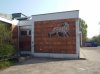
We finally approached the main entrance to the Alfred-Brehm Haus - as remarked upon by Sven, clear of scaffolding and building material for the first time in years - and the small cat enclosures which are found to the left of the entrance, in a small annexe marked by a mosaic on the side of the Haus.
Attached are images of the Clouded Leopard enclosure, the Pallas Cat enclosure, the African Penguin and Northern Gannet enclosure, and the mosaic on the side of the ABH entrance.
We came to the conclusion that the best way of seeing the Alfred-Brehm Haus would be to view all the surrounding enclosures running around the exterior of the building, before moving inside to look at the Haus itself. As such, we walked to the right of the building where there was a row of exterior enclosures for an assortment of carnivores, of varying quality. I will say this straight away, though; despite the fact these enclosures could be so much better were they to be given a little care and attention (something which I fear may not be happening in the near future considering the current state of upheaval with the accession of Dr Andreas Knieriem) I still feel that they stand up rather well when compared to so many of the enclosures I am familiar with over here in the UK.
This row of enclosures comprised the following, in order:
Amur Leopard (Panthera pardus orientalis)
Indochinese Clouded Leopard (Neofelis nebulosa nebulosa)
Malayan Binturong (Artictis binturong binturong)
Fishing Cat (Prionailurus viverrinus)
Pallas Cat (Otocolobus manul)
Serval (Leptailurus serval)
Missouri Cougar (Puma concolor missoulensis)
Of these enclosures, I think the worst looking one was probably the cougar enclosure - the animals were no-shows so I could not gauge what the enclosure was like with them within, but it seemed in a worse state of repair than the other enclosures. I've heard a lot of people on Zoochat complaining about the Amur Leopard enclosure, and certainly I can imagine just how bad these enclosures would have been prior to their having been extended some time ago, but for what it was - a small enclosure but one providing a decent amount of climbing opportunity for the animals inside, and which seemed to be in a decent state of repair - it was not quite as bad as I had expected it to be.
It was, I have to admit, rather nice to be able to observe Clouded Leopard at length and with only minimal trouble provided by the bars and mesh of the enclosure - I was somewhat surprised at how active and showy the animals were considering the shy nature of the species in my past experience, and discussion of this topic with Sven and Markus revealed a further surprise. From what I was informed, this pair of Clouded Leopards had never had much breeding success but in the last few years, when the ABH has been in a semi-permanent state of construction and renovation with the resulting high level of noise and disruption, the pair have successfully started breeding!
This said, I thought the enclosures worked rather well for the smaller three species held in them - the size considerations were less of an issue, and the climbing opportunities provided in the Fishing Cat and Pallas Cat enclosures in particular were being fully used. I have seen many small cat enclosures in the UK which would very much benefit from being replaced by enclosures such as those I saw in this portion of the ABH exterior.
Opposite the Missouri Cougar enclosure is a small free-standing circular enclosure holding a colony of Black-tailed Prairie Dog (Cynomys ludovicanus), although truth be told we observed more wild sparrows inside the enclosure than we did prairie dogs. It was nothing special, nor anything particularly bad - it is more or less the same enclosure for the species as can be found throughout the UK, with nothing unusual to mark it out from the herd.
Much nicer, as we made our way around the exterior of the Alfred-Brehm Haus, were two penguin pools which provided a decent balance of land and water, built against a rock wall which extended outwards to separate the two enclosures. The first of the enclosures contained Jackass Penguin (Spheniscus demersus) and Northern Gannet (Morus bassanus), whilst the second of the enclosures contained Humboldt penguin (Spheniscus humboldti) and Flightless steamer duck (Tachyeres pteneres) - and I have to admit I was more pleased at the sight of the two non-penguin taxa, neither of which are particularly common in European collections these days - although I see the gannet in the wild relatively often, one cannot take such things for granted. I was also pretty pleased to see the number of wild herons which were coming to the pools - although not a different subspecies to those found in the UK, they did look a bit different and as such I took the opportunity to take plenty of photographs of them.
Opposite the penguin pools is a very large enclosure for Sudan Cheetah (Acinonyx jubatus soemmeringii), a taxon which would excite many people, but with which I am rather familiar due to the presence of the subspecies at Chester Zoo. In point of fact, the two male cheetah held in this enclosure were born at Chester Zoo, the survivors of the ill-fated litter from some years ago which was struck by cowpox infection. The enclosure, although large, did have its faults - foremost being the lack of hillocks and long grass which I believe are held to be good for captive enclosures for the species in question. This said, it was undoubtedly the best large carnivore enclosure I had encountered in the ABH area so far.
The cheetah enclosure was backed by a sheer rock wall, and as we turned the corner we were to come across the enclosure on the other side of this wall, which was evidently primarily in place for the enclosure in question. This was to be the first enclosure I had encountered at Tierpark Berlin which I would be inclined to describe as world-class - a massive set of cliffs for birds of prey, with particular focus on vulture taxa, approximately 8 or 9 metres high and about three or four times that long. Furthermore, the area in front of the cliffs was rather substantial, with multiple trees and other items for the inhabitants to perch in.
As such, I spent rather a long time watching this enclosure - of course, much of my time was spent trying to make sure I had seen all the species found within. It took me a while, but I managed eventually to get the full set, which comprised the following:
Common Buzzard (Buteo buteo)
Cinereous Vulture (Aegypius monachus)
Bateleur (Terathiopius ecaudatus)
White-backed Vulture (Gyps africanus)
Turkey Vulture (Cathartes aura)
Steppe Eagle (Aquila nipalensis)
Griffon Vulture (Gyps fulvus)
White-headed Vulture (Trigonoceps occipitalis)
Egyptian Vulture (Neophron percnopterus)
American Black Vulture (Coragyps atratus)
Bearded Vulture (Gypaetus barbartus)
Himalayan Vulture (Gyps himalayensis)
Rüppell's Vulture (Gyps rueppelli)
Lesser Yellow-headed Vulture (Cathartes burrovianus)
King Vulture (Sarcoramphus papa)
After looking briefly across to the paddock where Chapman's Zebra (Equus quagga chapmani) was held - the beginning of a line of hoofstock paddocks lining the way to the Elephant House, of which more later - we then took a look at the small enclosure for Snow Leopard (Panthera uncia) which sat next to the vulture cliffs. It may have been partially due to the comedown from aforementioned excellent enclosure, but I was left with a distinct sense of dissatisfaction with the enclosure. I cannot put my finger on it, but something about the enclosure struck me as amiss in a way that the previously mentioned enclosures for the leopards, puma and small carnivores did not.
As we continued to walk along the perimeter of the ABH, we passed enclosures which were - I was informed by my German companions - the former home of Maned Wolf, the last of which had recently died, along with the current home for Bush Dog, none of which were anywhere to be seen. As we were skipping past the small plaza for the Asiatic Lion and Siberian Tigers, intending to do this area when visiting the Haus itself, the next occupied enclosures we thus came across were another row of enclosures much like the previously mentioned one, but this time holding solely large cats. As such, the failings of the aforementioned Amur Leopard and Missouri Puma enclosures were shared by these enclosures, although once again there seemed to be a relatively decent amount of climbing opportunity provided for the inhabitants. One or two ideas for improving this area did occur to me, which I will get to in a little bit.
As we walked along, the enclosures held the following:
Sumatran Tiger (Panthera tigris sumatrae)
Melanistic Leopard (Panthera pardus)
Javan Leopard (Panthera pardus melas)
Jaguar (Panthera onca)
Melanistic Jaguar (Panthera onca)
Missouri Cougar (Puma concolor missoulensis) and Javan Leopard (Panthera pardus melas)
The latter of these enclosures is, of course, the famous mixed enclosure which has been commented upon on Zoochat in the past. As Sven mentioned to myself and Hel, the reason for this mix of two sub-adult females is that the animals involved were born at roughly the same time, and after the sibling of the leopard was sent to Prague the remaining leopard was deemed to be suffering from loneliness. As the puma cub had been hand-reared due to the loss of her siblings and a subsequent rejection by the mother, this was seen as an opportunity to help the puma learn how to be a cat, and to provide the leopard with company. Both individuals seemed to be thriving when I observed them, so it seems to have worked - though it is strange to see a small big cat and a big small cat sharing an enclosure!
Something which struck me about these enclosures is that they could easily be improved by merging two sets of the enclosures together - it seems to me that although it is nice to be able to display a non-subspecific and melanistic leopard, if the Tierpark got rid of this animal they could potentially merge this enclosure with either that of the Sumatran Tiger on one side, or the Javan Leopard on the other. Similarly, having two enclosures side-by-side for a melanistic Jaguar and a pair of spotted Jaguar is fine enough if you have larger enclosures, but in this situation is arguably less important than potentially merging the two enclosures and giving the breeding pair more space.
We finally approached the main entrance to the Alfred-Brehm Haus - as remarked upon by Sven, clear of scaffolding and building material for the first time in years - and the small cat enclosures which are found to the left of the entrance, in a small annexe marked by a mosaic on the side of the Haus.
Attached are images of the Clouded Leopard enclosure, the Pallas Cat enclosure, the African Penguin and Northern Gannet enclosure, and the mosaic on the side of the ABH entrance.