The German Adventures Of A Tea-Loving Dave - April 2014

No he went as well,because he couldn't bear the thoughts of tld seeing any species that he hadn't seen himself:p

Hey now, play nice :p, we knew TLD had talked about going at some point but we weren't aware he'd booked it when we decided that's where we were going :)

Still a very enjoyable zoo trip though, and admittedly I do wonder if we'd have done Leipzig and Magdeburg had he not been there :p
 
To save making a separate thread, I'm going to just put my opinions of the zoos here (hope you don't mind TLD :))

Fair enough, though to keep things nice and chronological, aim to post in line with my posts ;)

sorry I'm confused by Javan Rhino's post above. Were you there too? Or was this some earlier unrelated visit? What's going on?

Myself and Hel booked our trip for April 2nd until April 10th, and when we mentioned the fact we were going to Berlin to JR he told us he had *just* decided to go there himself. Shortly after we told him when we had booked for, we heard he had booked a trip for April 1st until April 9th ;)
 
Myself and Hel booked our trip for April 2nd until April 10th, and when we mentioned the fact we were going to Berlin to JR he told us he had *just* decided to go there himself. Shortly after we told him when we had booked for, we heard he had booked a trip for April 1st until April 9th ;)

Well we were going to book for later in April admittedly but the flights were much cheaper for the week we went. For the record, it was decided on 4th January this year that we would be going sometime in April/may :p

Anyway, it worked out nice to have a good few catch ups :)
 
It did indeed :)

Typing up the post for day 2 now.....
 
April 3rd 2014 - My first day at Tierpark Berlin

Part I - Arrival

As previously alluded to, I had arranged prior to my trip to meet up at Tierpark Berlin with Animal (henceforth referred to as Sven) along with his partner Katja and his friend and fellow administrator on Zootierliste, Markus - who is a lurker on Zoochat himself under the username Hongabonga.

As such, myself and Hel caught the U2 line from Senefelderplatz to Alexanderplatz, changing there onto the U5 line which took us to the U-bahn stop for the Tierpark. The stop was in front of the Bear Gate, where we had arranged to meet the three German zoonerds prior to the collection opening.

full


In case anyone is unaware, this particular entrance to the Tierpark is so named because there is an enclosure for American Black Bear (Ursus americanus) next to the gate, which members of the public are able to view without entering the collection. In point of fact, the enclosure in question is no longer viewable from within the collection - I am informed that in the past there was elevated viewing into the enclosure from the Tierpark side, but construction work on new eagle aviaries has rendered this a thing of the past.

When we arrived, and having neglected to get breakfast at our hostel, we bought a few Streuselschnecken at a stall in the Tierpark U-bahn and surfaced to our first sight of Tierpark Berlin. There we found that Markus was already waiting at the bear enclosure, but Sven and Katja were yet to arrive. As we waited, I took the opportunity to have a look at the bear enclosure whilst chatting with Markus and joking that the two late-comers were belying the stereotype of German punctuality ;)

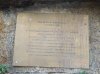
I rather enjoyed getting prolonged views of the American Black Bears, my prior experience of the species having been in the drive-through area at Woburn. The animals in question were highly active and - as they included a number of year-old cubs - rather energetic to say the least! The exterior of the Tierpark was also marked by a plaque talking about the first director of the collection, Dr Heinrich Dathe.

full


Eventually, Sven and Katja arrived just after the collection opened at 9am and we approached the ticket kiosks. Myself and Hel got a 25% discount on entry to the collection as a result of the collection's participation in the WelcomeCard scheme, and we took the opportunity to buy a few of the latest guide to the collection - noting the giftshop by the entrance for future reference, as we had been informed it sometimes sold old guidebooks.

Myself and Hel were told by our German companions that we would be getting the high-speed tour of the collection, with the added bonus that one - Sven - is somewhat cynical about the collection whilst another - Markus - is a big fan of both Berlin collections. As such, we would be getting an all-round view of the collection from the point of view of individuals much more familiar with it than anyone we had consulted from the UK.

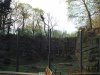
As we entered the collection, the first enclosures we came across were disused, intended as previously noted for future use as eagle enclosures. As such the first enclosures we were to see in-use were a little way into the collection, where we were to find the Spectacled Bear (Tremarctos ornatus) enclosure. Nowhere near as big nor as thickly planted as the enclosure for the species I am familiar with from Chester, I still rather liked the enclosure as it provided a high level of climbing opportunity for the animals within - a number of which were taking advantage of this opportunity - and unlike certain collections I could name, no unsuitable species were mixed within!

full


We next approached the polar bear enclosure, one of the oldest in the collection having been in use since the 1950's and still - I believe - used for the original purpose.

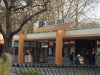
Attached are images of the entrance to the collection, the Dathe plaque and the Spectacled Bear enclosure.
 

Attachments

  • DSCF7716.jpg
    DSCF7716.jpg
    1.9 MB · Views: 36
  • DSCF7723.jpg
    DSCF7723.jpg
    1.7 MB · Views: 36
  • DSCF7729.jpg
    DSCF7729.jpg
    1.9 MB · Views: 48
Last edited:
Part II: Dingos, Domestics and Damp Polar Bears

The Polar Bear (Ursus maritimus) enclosure at Tierpark Berlin has, I believe, been used for the purpose for much of the lifespan of the collection, and in my opinion still stands up as one of the better enclosures for the species which I have seen. It is a pretty decent size, with vast areas for the inhabitants to swim, multiple levels of what I suspect was genuine rock forming the central plateau of the enclosure, as opposed to fake rock à la Colchester, and various enrichment items provided for the inhabitants. Certainly it struck me as better than many of the current enclosures I have seen images of on Zoochat - though nowhere near as impressive as the enclosure for the species at Highland Wildlife Park!

When we were observing the enclosure, three animals were visible - one of which was spending a great deal of time swimming; something for which I vaguely envied them as even at this relatively early hour it was shaping up to be a very hot and bright day.

From here, we headed towards the fairly sizeable domestic area of Tierpark Berlin, by way of enclosures for Caucasian Zebu (Bos primigenius indicus) and Northern Raccoon (Procyon lotor) - the enclosure for the latter, although relatively small, was quite interesting as it provided small pools through which the raccoons were living up to their German name of "Waschbär" by immersing their food in the pools - a behaviour I had obviously been long aware of, but which I had until then never actually seen for myself.

The domestic area turned out to be stocked with a pretty respectable array of rare breeds of livestock, along with aviaries containing various domestic strains of birds such as Canary (Serinus canaria) and Budgerigar (Melopsittacus undulatus) and cages containing common pets such as Guinea Pig (Cavia aperea), Eurasian Rabbit (Oryctolagus cuniculus) and Degu (Octodon degus). The paddocks containing the rare breeds were quite interesting, with few being familiar to me, whilst I was not particularly impressed by the aviaries - these were somewhat overloaded with individuals, with very little enrichment nor space.

However, two things in this immediate area more than compensated for any disappointment I might have felt about the aviaries - firstly, I saw the first of many wild individuals of Hooded Crow (Corvus cornix) which I was to encounter in Berlin. This species is rather unusual in the British Isles, being mostly restricted to the north of Scotland and the Isle of Man, but on the continent it is very much the dominant species as one travels further east than France and western Germany. As such, although I was to see literally hundreds of individuals over the course of the week, I was and still am incredibly pleased to have seen them.

Secondly, I saw my first carnivore lifetick of the trip in the domestic area - a pack of Dingo (Canis lupus dingo) in a side enclosure which, I must admit, I could easily have missed were I not accompanied by my German companions! Having already seen New Guinean Singing Dog, I was interested to see the subtle differences between the two strains - the Dingo were certainly larger and more heavily built, and seemed more solid in their colouration.

After having a look around the domestic area, we moved towards a corner of the collection which held a handful of primate lifeticks for me - but first passed through an area of owl enclosures, which contained lifetick subspecies of both Great Horned Owl (Bubo virginianus subarcticus) and Eagle Owl (Bubo bubo sibiricus) - as something of a fan of owls, I rather appreciated seeing these. Both enclosures were thickly planted, and seemed a decent size for the number of birds found within. This area also contained the first of many animal statues I would encounter in the substantial grounds of Tierpark Berlin - a bear, posed in roughly the same way as that found on the coat of arms for Berlin. Markus wasted no time in mimicking said bear.

The owls having been seen, we made our way to the area where I would encounter my first major no-shows of the trip...

Attached are two images of the polar bear enclosure, an image of the budgerigar enclosure in the domestic area, and a photograph of the bear statue being imitated.
 

Attachments

  • DSCF7738.jpg
    DSCF7738.jpg
    1.7 MB · Views: 61
  • DSCF7752.jpg
    DSCF7752.jpg
    1.9 MB · Views: 64
  • DSCF7777.jpg
    DSCF7777.jpg
    2 MB · Views: 58
  • DSCF7811.jpg
    DSCF7811.jpg
    2 MB · Views: 103
Myself and Hel booked our trip for April 2nd until April 10th, and when we mentioned the fact we were going to Berlin to JR he told us he had *just* decided to go there himself. Shortly after we told him when we had booked for, we heard he had booked a trip for April 1st until April 9th ;)
ah I see. I had feared there was some weird triangle thing going on where Hel was actually Javan Rhino in a dress, and nobody had told Agile Gibbon....
 

Secondly, I saw my first carnivore lifetick of the trip in the domestic area - a pack of Dingo (Canis lupus dingo) in a side enclosure which, I must admit, I could easily have missed were I not accompanied by my German companions! Having already seen New Guinean Singing Dog, I was interested to see the subtle differences between the two strains - the Dingo were certainly larger and more heavily built, and seemed more solid in their colouration.


Canis dingo! Get your facts straight :D I talked so much about this topic that day :)
 
So does this mean you view the New Guinea Singing Dog as Canis dingo hallstromi, or the same as C. dingo?
I would assume Canis hallstromi. There was a paper released this year claiming the dingo to be a distinct species based on very minor morphological differences. It is weak at best. It followed by the researchers that the New Guinea singing dog was also therefore distinct.

Presumably they will next be classifying all the pedigree domestic dogs as distinct species as well. :p
 
Part III: Seabirds and Civets

After the owl enclosures, we approached the small corner of the Tierpark where four very different primate species are found - two of which have only recently come into the collection. As one approaches the area, a block of two smaller enclosures is on the right - one holds Buffy-headed Tufted Capuchin (Sapajus xanthosternos) whilst the second holds Colombian Red Howler (Alouatta seniculus) and White-faced Saki (Pithecia pithecia). On the left is a larger enclosure, which holds Sunda Pig-tailed Macaque (Macaca nemestrina).

I had been looking forward to coming across this portion of the collection, as the macaque and howler were both potential lifeticks for me, but had been warned that the howler in particular was a tricky species to spot, and one potentially requiring multiple visits throughout the day to see. To my disappointment but not my surprise, I failed to see the howler - although this disappointment was eased somewhat by the fact the macaques were incredibly active and readily visible. The macaque enclosure was large, but provided few real climbing opportunities for the species - as such, it could have been so much better.

By the primate enclosures were a pair of much better exhibits, both of which rather impressed me. The first was a large pool with a number of species of waterfowl living on and around it, whilst the second was a rather substantial gull and waterfowl aviary which contained a few common species, a few uncommon species and a handful of real treasures. These, I feel, were some of the best and most interesting enclosures in the collection, and required quite some scrutiny in order to spot and identify all the species found within them. The full species list for each enclosure was as follows:

Waterfowl Aviary

Tundra Swan (Cygnus columbianus)
Red-breasted goose (Branta ruficollis)
European Eider (Somateria molissima)
Pacific brent goose (Branta bernicla nigricans)
Goosander (Mergus merganser)

Gull Aviary

Eurasian Oystercatcher (Haematopus ostralegus)
Smew (Mergellus albellus)
African gray-headed gull (Chroicocephalus cirrocephalus poiocephalus)
Spectacled eider (Somateria fischeri)
Mediterranean gull (Ichthyaetus melanocephalus)
Laughing gull (Leucophaeus atricilla)
Bufflehead (Bucephala albeola)
Black-tailed gull (Larus crassirostris)
Grey gull (Leucophaeus modestus)
Chinese merganser (Mergus squamatus)

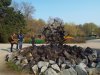
Next to the gull aviary was a rather nice statue/fountain representing a flock of gulls flying around a central rocky area. Overall, I really liked this area of the collection.

Further along the paths were various domestic hoofstock enclosures, of no great allure to me, followed by a large dome-like aviary which was rather nice for the species inside - a combination of African Sacred Ibis (Threskiornis aethiopicus), Abdim's Stork (Ciconia abdimii) and African Openbill (Anastomus lamelligerus), all very nice species and in the latter two cases, ones which are not seen all that often at all elsewhere. But truth be told, I'd have much rather seen the species which I am told was held in this aviary until it moved offshow a year or so ago; Goliath Heron.

After passing the last of the livestock enclosures, we reached the vicinity of the Alfred-Brehm Haus, newly re-opened and representing a decent quantity of lifeticks for both myself and Hel. But before tackling the ABH itself, we wanted to see the four rather special small carnivore taxa held in a row of enclosures to one side of the Haus.

In the first enclosure are held Southern Caracal (Caracal caracal caracal) which are both darker in colouration and more robust than those caracals I have seen in the past. The second enclosure holds Central African Ratel (Mellivora capensis cottoni), the only one of the taxa held in this row which was not new to me, but a damned nice taxon nevertheless. The downside, of course, to this species is that when they are active they are so continuously active it is near impossible to get a decent photograph of them! The third of the enclosures holds a breeding pair of Malay Civet (Viverra tangalunga), which I had been warned might be difficult to spot but which in the event were sunbathing in full visibility.

All these enclosures were pretty functional for the purpose at hand, not flashy or impressive but doing the job well in so far as I could tell, and looked much alike when compared with one another. The fourth enclosure was somewhat different, resembling as it did more or less every meerkat enclosure in Western Europe, but held something much nicer than a meerkat - a large and breeding group of East African Banded Mongoose (Mungos mungo colonus). The enclosure seemed to suit the mongoose fine, which when I reached the enclosure were all sunbathing against one of the walls of the enclosure.

These small treasures having been seen, we headed towards the much-discussed Alfred-Brehm Haus, finally to make our minds up for ourselves.

Attached are photographs of the capuchin and macaque enclosures, and of the gull statue - Sven, Markus and Katja are visible in the latter.
 

Attachments

  • DSCF7814.jpg
    DSCF7814.jpg
    2.1 MB · Views: 63
  • DSCF7822.jpg
    DSCF7822.jpg
    1.9 MB · Views: 67
  • DSCF7863.jpg
    DSCF7863.jpg
    2 MB · Views: 93
Looking forward to your opinions/thoughts on the Brehm building, so many different opinions already float around on ZooChat so I'm keen to see what your impression was! :)
 
Is there a reason why your German guides are taking you a different way around the zoo?
I have always gone to the left as you enter, or maybe I'm going around the wrong way!
 
Looking forward to your opinions/thoughts on the Brehm building, so many different opinions already float around on ZooChat so I'm keen to see what your impression was! :)

Writing that portion up now :) aiming to get day one of Tierpark finished today, and hopefully as much as possible of day one of Zoo as well, as I anticipate my discussion of Magdeburg will be even more in-depth than my discussion of these collections has been - as far as I see it, as nowhere near as many people are familiar with this collection it would be wise to give as much information as I can about the current state of the place.

Is there a reason why your German guides are taking you a different way around the zoo?
I have always gone to the left as you enter, or maybe I'm going around the wrong way!

Personal choice, I would assume!
 
Is there a reason why your German guides are taking you a different way around the zoo?
I have always gone to the left as you enter, or maybe I'm going around the wrong way!
I have to say that I have also only been round it the same way as tld is going round it.
 
Waterfowl Aviary

Tundra Swan (Cygnus columbianus)
Red-breasted goose (Branta ruficollis)
European Eider (Somateria molissima)
Pacific brent goose (Branta bernicla nigricans)
Goosander (Mergus merganser)

The old seal pond ;) No netting or fence above ;)

And for the photo I have to say: I look really good :D
 
I have always gone to the left as you enter, or maybe I'm going around the wrong way!

That's because you're a Dudley regular and I guess you go past the flamingos first, it must be some deep-rooted psychological issue! ;) :p
 
Back
Top