Part III: From Tendaguru To The Present
As noted previously, the dinosaurian taxa displayed in the central hall of the Museum für Naturkunde represented a cross-section of those found in the Tendaguru Formation of Tanzania; specifically those discovered during the paleontological expedition on behalf of the museum led by Werner Janensch in 1909. Due to the high quality of the material discovered in the Tendaguru Formation, the vast majority of taxa on display were represented by complete skeletons from the formation, with the exception of two species which will be noted anon, represented here by related taxa.
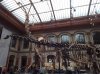
Just behind the massive centrepiece of the exhibit - the Giraffatitan brancai which I have already discussed - there was a significantly smaller skeletal mount; again, this represented a species of sauropod, but one which is rather less well-known to the general public - Dicraeosaurus hansemanni. This species belonged to a branch of the sauropod family closely related to the more famous Diplodocus, but rather smaller and with noticeably deep, short necks. Beside the Dicraeosaurus there was a particularly interesting skeletal mount, and one which again lacks the "name recognition" of more hallowed cousins; Kentrosaurus aethiopicus, the Tanzanian sister-taxon of Stegosaurus. Much like Dicraeosaurus, this species was rather smaller than the equivalent taxon known from the USA, being roughly half the length at a still-respectable 5 metres long, but broadly speaking looked very much akin to its more famous cousin, with a row of plates along the mid-line of the back ending with a set of spines forming the "thagomiser" common to all stegosaurs. However, one way in which Kentrosaurus differed from Stegosaurus was in the retention of long, sharp spines on each shoulder which were lost in more advanced members of the Stegosauridae. In front of the Kentrosaurus mount, there was a large sauropod mount - the first of the aforementioned pair of taxa which are not represented in the Tendaguru formation, but which are displayed as kin of taxa known from much scantier remains. The Tendaguru excavations had uncovered four cervical vertebrae which, at the time, had been assumed to represent Tanzanian remains of the North American taxon Diplodocus. Although more recent research - conducted on casts of the vertebrae, as the original material was lost during the bombing of the museum in World War II - has revealed that these vertebrae likely belonged to a titanosaurid sauropod and assigned them a new taxonomic name (Australodocus bohetii) this material is represented in the central hall by one of the many casts of the famous Diplodocus carnegii skeleton mentioned previously. Although, as noted, taxonomically incorrect for the Tendaguru Formation, the presence of this skeletal mount did serve a very interesting purpose; it provided a size comparison between this well-known taxon and the related Dicraeosaurus displayed in the immediate vicinity, and moreover made clear the sheer scale of how much this massive taxon was dwarfed by Giraffatitan brancai.
Just across from the Diplodocus mount, there were three more skeletal mounts representing taxa from the Tendaguru Formation. The first of these was a little-known carnivorous dinosaur, Elaphrosaurus bambergi, whose exact position among the theropod lineage has long been a matter of some debate. Although known from a near-complete postcranial skeleton, missing only the hands, the only known specimen of this large and slender taxon lacked a skull. This has stymied attempts to classify the taxon for some time, with the gracile build of the species leading many to suggest for much of the 20th Century that it represented an early member of the ornithomimosaur family. However, recent discoveries of closely related taxa, such as the turkey-sized Limusaurus inextricabilis of China, has made it apparent that Elaphrosaurus is a member of the somewhat more basal ceratosaurian theropods - albeit one which seems likely to have possessed the same birdlike frame and toothless skull as the ornithomimosaur group it was so long classified among. The skeletal mount on display is somewhat antiquated, having been reconstructed prior to the discovery of Limusaurus but at a time when the ceratosaur affinities of the taxon were suspected - as such the postcranial skeleton of Elaphrosaurus have been completed with a skull based on more carnivorous members of the ceratosaur lineage.
Alongside the mount of Elaphrosaurus was a small herbivorous dinosaur, and one which is little-known outside of the paleontological community - Dysalotosaurus lettowvorbecki. This taxon has long been assigned to the related taxon found in the Morrison Beds of North America, Dryosaurus, but newer studies reject this synonymy - however, it is clear that the two are close kin, and basal members of the lineage which led to the much-more famous Iguanodon, and the hadrosaur dinosaurs of the Cretaceous. Displayed to the right of the aforementioned taxa, we came across the second taxon unrepresented within the Tendaguru formation, and displayed in the place of a species known from much scantier remains. The Tendaguru expedition unearthed a partial tibia which was described as Allosaurus tendagurensis - a description which now appears to have been in error; although the specimen in question has not been redescribed as yet, it is apparent that it represents a taxon only distantly-related to Allosaurus itself. Nonetheless, the taxon is represented in the central hall by a skeletal mount of the much better-known Allosaurus fragilis of North America.
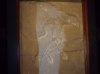
Before leaving the central hall, there was one final highlight which we were extremely keen to view, and which represented the other major reason why I had desired to visit this museum since my childhood; in a small annexe just off the hall itself was one of the most famous and significant discoveries of all time – the “Berlin Specimen” of Archaeopteryx siemensii discovered in 1874 within the Solnhofen deposits. This specimen is still the most complete representative of the genus known, and was the third to be discovered after the “Feather” and “London Specimen” a decade previously. The “Feather” – for many years the original holotype of Archaeopteryx lithographica until the “London Specimen” was designated the neotype on the basis that the “Feather” is no longer diagnostic, and may not even belong to the same genus – is also held within the collection of the Museum für Naturkunde, and was displayed for a short time during 2011, although regrettably it was no longer on-show to the public at the time of our visit. Recent taxonomic study of the various specimens of Archaeopteryx to have been discovered over the past 150 years has also revealed that the genus is not monotypic, and that the distinct taxonomic name of A. siemensii which was assigned to the “Berlin Specimen” for a short period after discovery was indeed valid. I was particularly pleased to note that the specimen on display represented the original fossil material, rather than a cast as is the case for the representation of the “London Specimen” on display at the Natural History Museum back in the UK. Although recent years have seen the discovery of dozens of non-avian dinosaur taxa which display the presence of feathers or even wing material, and our greater understanding of basal avialan dinosaurs and their classification has led to the classical title held by Archaeopteryx as the “first bird” becoming rather more unclear, the significance of this specimen still cannot be understated. Although the “Feather” and the “London Specimen” were discovered first, it was the “Berlin Specimen” which first established the reptilian origins of birds, and provided the first step towards our realisation that we are surrounded by dinosaurs to this day.
We then made our way through an archway into the “System Earth” exhibition – a collection of fossil material, geological displays and taxidermy specimens of extant taxa intended to demonstrate the way in which our planet has changed over the course of eons, and how this has influenced the evolution and diversity of life. This was divided into five sections; one on volcanism and the way in which it has shaped the planet, one on plate tectonics and the effect that landmasses splitting and joining has on evolution, one on orogenesis and how barriers formed by mountain chains can lead to speciation, one on how climatic change can influence vegetation and the development of the taxa dependent on it, and finally one on how extraterrestrial impact events have caused extinction events.
The volcanism exhibit was rather interesting, containing various diagrams, maps and explanatory panels discussing the location of major area of volcanism across the world, along with the various different ways in which this volcanic activity can manifest itself. Perhaps the highlight of this portion of the exhibit was a wide variety of geological specimens representing various igneous rocks such as basalts, pumice and volcanic “bombs”. However, the main purpose of this portion of “System Earth” was to provide context for the plate tectonics exhibit which followed.
This exhibit discussed the influence that plate tectonics has had on the evolution and distribution of plants and animals around the world, both when landmasses are fragmented over time and when they connect having previously been separated. In order to demonstrate the process of speciation caused by larger landmasses fragmenting and splitting what was once a unified population, wet specimens of three lungfish taxa were displayed; the Queensland Lungfish (Neoceratodus forsteri) of Australia, the Marbled Lungfish (Protopterus aethiopicus) of Africa and the South American Lungfish (Lepidosiren paradoxa) representing members of a lineage dating back to the Devonian era, but which have been dispersed across the southern hemisphere by the fragmentation of first Pangaea and then Gondwana. In order to demonstrate the process by which fauna interchange can occur when landmasses join through tectonic movement, a display on the topic of the Great American Interchange presented a variety of informational panels about the lineages which descended into South America - represented by the skull of Smilodon populator, a member of a North American genus which became distinct at species level after crossing the Panama landbridge – along with those which crossed into North America such as glyptodonts, giant sloths and various anteater taxa, represented by the extant Giant Anteater (Myrmecophaga tridactyla), a taxon which only reached Central America itself but works well as a representative of the group as a whole.
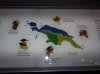
The next exhibit discussed orogenesis, or the formation of mountain ranges through the movements of the earth’s crust, and how the barriers formed can divide members of a species into distinct populations which may eventually undergo speciation. To demonstrate this point, and how a similar process can occur with other barriers to movement such as island formation, the example of the Bird-of-Paradise genus Paradisaea was presented, with diagrams and maps complementing stuffed specimens of each taxon discussed. The species displayed in this exhibit were as follows:
Lesser Bird-of-Paradise (Paradisaea minor)
Greater Bird-of-Paradise (Paradisaea apoda)
Raggiana Bird-of-Paradise (Paradisaea raggiana)
Goldie's Bird-of-Paradise (Paradisaea decora)
Red Bird-of-Paradise (Paradisaea rubra)
I was rather pleased by the fact that this display included a stuffed specimen of both the male and female of each taxon discussed, as this allowed for an accurate comparison of how each species differed from one another in both sexes, with the sexual dimorphism of the genus as a whole taken into account.
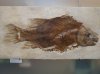
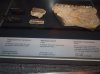
The following exhibit comprised a discussion of how climate change over time can influence the flora found across the world, and the way in which this change in vegetation can influence the evolution of the fauna dependent on it. In order to provide an example of this process, the exhibit displayed a variety of informational maps and panels discussing the evolution of the horse lineage from small generalist herbivores which were resident within the dense rainforests, to the modern representatives of the horse family which are specialist grazers resident to steppes, savannahs and desert-scrub. Along with this informational material, examples of plant material from these different ecosystems was on display, alongside a life-size reconstruction of the early horse taxon Eohippus angustidens, a mounted specimen of the extant Przewalski's Horse (Equus ferus przewalskii) and a variety of fossil material from three extinct taxa; Propalaeotherium hassiacum from mid-Eocene Germany, Mesohippus bairdii from Oligocene South Dakota and the Hagerman Horse (Equus simplicidens) from Pleistocene Idaho - the lattermost of these displayed under the junior synonym Plesippus shoshonensis.
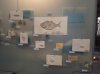
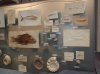
The final portion of the "System Earth" exhibit comprised a display on the effect that extra-terrestrial impact events have had on the course of evolution, causing extinction events and allowing new groups and species to move into niches vacated by taxa which may have been lost. As one would imagine, this exhibit paid particular focus to the Chicxulub event which took place at the Cretaceous–Paleogene boundary 66 million years ago and is generally assumed to have been responsible for the mass extinction which took place at this time, leading to the demise of non-avian dinosaurs alongside myriad other groups such as the pterosaurs, the vast majority of marine reptiles and the ammonites. As such, this display included large quantities of ammonite taxa, alongside various other fossil remains of species which perished during the event and geological specimens from the K/Pg boundary. Perhaps the most interesting specimen displayed in this exhibit was the skull of the unusual pacycephalosaurian dinosaur Stygimoloch spinifer, which is known from the Hell Creek Formation of Montana, a deposit formed more or less immediately before the impact event. I was quite pleased to see this specimen on display, as it represents another taxon which I have known about for as long as I can recall.
The next exhibit we visited was located at the base of a large staircase leading to the upper levels of the museum, the entirety of which is still closed to the public due to a combination of damage inflicted during the war, neglect in the decades following and ongoing renovation of the museum as a whole. The exhibit was a small but choice display on the subject of the "Cosmos and Solar System", comprising a set of models representing the various planets of the solar system alongside informational panels, with a multimedia video on the subject of astronomy played on a screen hanging from the ceiling, viewable from a central island on which the public could sit and recline. The highlight of this particular exhibit were displays of meteorites which have impacted earth, including material which derived from the moon and Mars having been ejected by impact events on said bodies.
Before we made our way to the next major exhibit on the ground floor of the museum - a large hall on the subject of "Evolution in Action" - we took the opportunity to climb the central staircase in this room to look through the glass windows of the doors leading into portions of the closed sections; many of these doors had informational panels attached discussing what was held in the rooms beyond, and the ongoing renovation work which would hopefully bring a small handful of these rooms into public display in the future. Among these were the following; a large room containing a great many shelves of mounted birds stretching through the entire extent of the room, with the specimens found within in varying states of preservation; a room containing the beetle collection owned by the museum, which a sign proclaimed encompassed over 6 million specimens; and a hall devoted to rocks and fossils from central Germany which all originate from the Devonian period, holding a total of 80,000 specimens, but unfortunately one of the worst-damaged by the bombing of Berlin during the war.
We then made our way into the "Evolution in Action" exhibit, devoted to showcasing the diversity of form and adaptation throughout the animal taxa alive today, with the intention of explaining the way in which evolutionary processes had led to this diversity and the functions which these adaptations serve. The centrepiece of this exhibit was the "Biodiversity Wall", the first thing we saw on our arrival into the room - a massive display stretching almost the entire width and height of the room, showing approximately 3,000 species of animal. This display included vast quantities of invertebrate specimens - including hundreds of beetle and butterfly taxa - alongside hundreds of fish and reptile taxa and scores of avian and mammalian species. Even more interestingly, there was no key or guide to the identity of any of the taxa on display, which I felt worked rather well as a means of forcing the public to appreciate the display - and thus the animal kingdom - as a cohesive body, with everything reliant on the whole structure, and with no particular facet selected as being more important or worthy of attention than another. This also allowed Helly and myself to engage in the rather enjoyable pastime of attempting to identify as many taxa as we could!
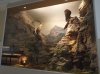
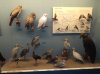
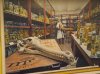
(Attached are images of the Giraffatitan mount alongside the Diplodocus mount, the "Berlin Specimen" of Archaeopteryx, a map discussing the variety of Bird-of-Paradise taxa found on New Guinea, various fossil horse material, a view into one of the closed portions of the museum, and a small section of the Biodiversity Wall)





 got a few posts on the natural history museum in Berlin, then a post concluding the trip and covering events to my return home. After that I plan to post an "index" with links to every walkthrough post, so that people reading the thread in future can easily skip to a certain section. I'll probably edit my opening post to include the index there too.
 the plan being to turn it into an enclosure for Sunda Gharial and Komodo Dragon with viewing from above, if memory serves.





 and be free to move onto writing about my more recent trip to Bavaria - which will hopefully flow a lot faster as I took much more copious notes and I have a lot more access to a desktop computer now.
 so I am now once again reliant on an old laptop.