The Zoochat Photographic Guide To Cetaceans

I won't deny that ungulates and cetaceans are sister groups, but I cannot call them the same order!

You'll have to split Artiodactyla into multiple orders then.

~Thylo

Yeah, Artiodactyla and Cetacea.

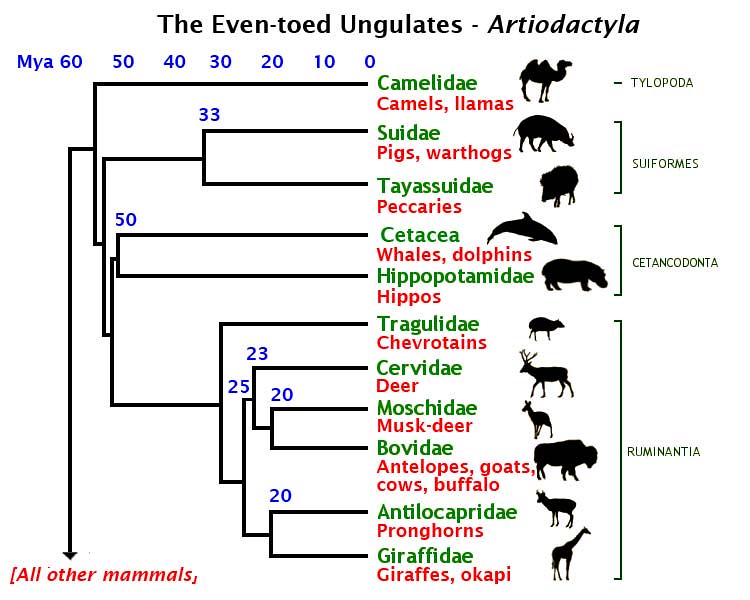
Well, that's the issue which I aimed to highlight - they aren't merely sister groups, as the Cetacea is deeply nested within the Artiodactyla within a clade alongside the Hippopotamidae, but a single monophyletic unit.

So to maintain monophyly but keep the Cetacea outside of any Artiodactyl group, the Artiodactyla would have to be split into four groups - the Hippopotamidae, the Camelidae, the Ruminantia and the Suiformes.

The following tree should hopefully illustrate the issue at hand:
27972561595_2c2e5d89d9_b.jpg
 
Yeah taxonomy is weird. But there in lies the difference between Linnaean taxonomy and phylogenetic bracketing. (Before I continue, please someone correct me if I'm wrong). For Linnaean taxonomy, if you look similar, then you must be related, but if you don't look similar then you must not be related. However, phylogenetic bracketing (which is more accurate to my understanding) takes into account evolutionary history. For example Linnaean taxonomy would argue that since crocodilians, sphenodonts, squmates, and turtles all have scales, lay eggs, and require warmth for activity, then they must be more closely related to each other than they are to any other extant animal. But in walks phylogenetic bracketing and he/she (we can't assume) says "No, no, no, you got it all wrong kid." If we take a look at the fossil record, we'll find that the American alligator is more closely related to the house sparrow than it is to the Komodo dragon. The two belong to Archosauria. (We also find out the house sparrow is technically a dinosaur, which is awesome). Same thing with artiodactyls, based on physically appearance wouldn't one assume the hippo is more closely related to the pig than it is to a dolphin? Well not according to phylogenetic bracketing.
 
(We also find out the house sparrow is technically a dinosaur, which is awesome).

48c.jpg


But in all seriousness, it is noteworthy that the scientific definition of the Dinosauria is now assigned precisely as "‘the least inclusive clade that includes Passer domesticus and Triceratops horridus" and hence the species in question cannot be anything other than a dinosaur :p
 
I'm guessing that the animals that stayed on land became the hippos?

Not quite; as far as we can tell the last common ancestor of both species was semi-amphibious, and similar in general appearance and lifestyle to a water chevrotain - feeding on the land but sheltering from predation in rivers and mangrove swamps.
 
Well that only follows if dinosaurs were reptiles. I've been under the semi-educated impression for some years that they probably weren't, despite being 'reptilian'.
I'm pretty sure scientists now refer to them as "sauropsids." Reptilia is a term used in Linnaean taxonomy and applies to all living and recently extinct crocodilians, sphenodonts, squmates, and turtles. Sauropsida is used in phylogenetic bracketing and can definied as something along the lines of "the least inclusive clade that includes Terrapene carolina and Milleretta rubidgei." Using a Linnaean taxonomy term when talking about prehistoric animals can get confusing because definitions can overlap. For example, under Linnaean taxonomy, a bird is essentially defined as any animals that lays eggs, has feathers, and is warm-blooded. Well then would Velociraptor mongoliensis be considered a bird? But the thing is it obviously isn't, it is a non-avian dinosaur. Linnaean taxonomy works great for extant and recently extinct animals, but I don't think it be used when prehistoric life comes into play. (I hope this makes sense).
 
Last edited:
Well that only follows if dinosaurs were reptiles. I've been under the semi-educated impression for some years that they probably weren't, despite being 'reptilian'.

I could be convinced of that to be honest.

(PS @Chlidonias I'm so sorry if this has to be moved to that taxonomy thread because all of the thread lately seem to be breaking out into taxonomic debate/discussion :p )

~Thylo
 
(PS @Chlidonias I'm so sorry if this has to be moved to that taxonomy thread because all of the thread lately seem to be breaking out into taxonomic debate/discussion :p )
This particular discussion is all on-topic, it being about cetacean evolution and taxonomy in a thread about cetacean taxonomy. The other thread splits were off-topic from the thread subject.
 
Yeah taxonomy is weird. But there in lies the difference between Linnaean taxonomy and phylogenetic bracketing. (Before I continue, please someone correct me if I'm wrong). For Linnaean taxonomy, if you look similar, then you must be related, but if you don't look similar then you must not be related. However, phylogenetic bracketing (which is more accurate to my understanding) takes into account evolutionary history. For example Linnaean taxonomy would argue that since crocodilians, sphenodonts, squmates, and turtles all have scales, lay eggs, and require warmth for activity, then they must be more closely related to each other than they are to any other extant animal. But in walks phylogenetic bracketing and he/she (we can't assume) says "No, no, no, you got it all wrong kid." If we take a look at the fossil record, we'll find that the American alligator is more closely related to the house sparrow than it is to the Komodo dragon. The two belong to Archosauria. (We also find out the house sparrow is technically a dinosaur, which is awesome). Same thing with artiodactyls, based on physically appearance wouldn't one assume the hippo is more closely related to the pig than it is to a dolphin? Well not according to phylogenetic bracketing.

It's infinitely more complicated that this. Linneus was the first exhaustive taxonom, with quite a number of non-exhaustive taxonoms preceeding him and many thousands of taxonoms that followed later until today, and since almost every taxonom have its own cladograms, you cannot divide taxonomic opinions into "Linnean taxonomy and phylogenetic bracketing", because there are hundreds of thousands of different taxonomies, most of which are phylogenetic bracketing, even when many contradict each other (the Artiodactyla cladogram is a good example, as the different branches of it since the inclusion of Cetacea in it have been arranged in many different ways according to different authors).
By other side, yes Linnaeus, according to the knowledge available at his epoch, rely mostly in morphology, tough not completely (Moths also have scales, lay eggs, and require warmth for activity, but are not considered reptiles). For example if he would consider only morphology, he would had included cetaceans into fishes. Posterior authors, much of which are of the Golden Age of the science and taxonomy (more or less 19th and 20th centuries) constructed very valid taxonomic opinions analyzing exhaustively each trait available, including obviously fossils, as well as biochemicals, ethology, biogeography and of course morphology and, when started to be available, also DNA. The problem is that these exhaustive, accurated and true scientific theories have been rejected in recent times by those that think that DNA is the only way to classify things, and for that one don't need to be a knowlegdeable scientific, it's enough with be a good informatic enough for run a program that does the cladograms.
 
Delphinus
Common dolphins
Two species recognized.

Short-beaked common dolphin Delphinus delphis
Two subspecies recognized.

Short-beaked common dolphin Delphinus delphis delphis
Photo by @Giant Eland in the wild at Long Beach, California, USA
full


Black Sea common dolphin Delphinus delphis ponticus
Taxonomic note: The status of this taxon is not completely clear, and it could be a lesser rank taxon than a subspecies, but generally is accepted as a subspecies.
No photos of this subspecies have been uploaded to the Gallery yet.

Long-beaked common dolphin Delphinus capensis
Taxonomic note: Sometimes merged with Delphinus delphis in a single species.
Two subspecies recognized.

Long-beaked common dolphin Delphinus capensis capensis
Photo by @Fireplume in the wild at Monterey Bay, USA.
full


Arabian common dolphin Delphinus capensis tropicalis
Taxonomic note: Sometimes elevated to species level (Delphinus tropicalis) but this is not widely accepted.
No photos of this subspecies have been uploaded to the Gallery yet.

In addition, there is a photo of an hybrid Short-beaked common dolphin x Atlantic bottlenose dolphin (Delphinus delphis x Tursiops truncatus truncatus). Photo by @Giant Eland at SeaWorld San Diego, California, USA.
full
A passing mention on another site lead me to a 2015 paper about Common Dolphin genetics which will be of interest to cetacean fans and listers here. The paper doesn't seem to have gathered much attention on the internet, but it shows that the two species of Common Dolphins (delphis and capensis) are genetically-identical. There is, however, a genetically-distinct population in the northeast Pacific which may be a separate species; it was originally described as D. bairdii but then merged into D. capensis as the latter name had priority.

Molecular and Morphological Differentiation of Common Dolphins (Delphinus sp.) in the Southwestern Atlantic: Testing the Two Species Hypothesis in Sympatry
 
Atlantic white-sided dolphin Lagenorhynchus acutus
Monotypic.
No photos of this species have been uploaded to the Gallery yet.

I set out to change this on my most recent trip and was successful on two different whale watches! Photos now posted in both the US and Canadian Wildlife galleries (along with some other cetacean goodies).
 
Lucky you! Admins can insert the best photo in the relevant place (I can't edit older messages).
 
Back
Top