La Cucaracha
Well-Known Member
This is by no means all the birds kept in open air/hoofstock yards, so please add anything you feel belongs here.
Ostrich
Emu
Greater rhea
Greater flamingo
African sacred ibis
White ibis
African spoonbill
Saddle-billed stork
Marabou stork
Yellow-billed stork
Blue crane
Black-crowned crane
East African crowned crane
Grey crowned crane
Wattled crane
Demoiselle crane
Sandhill crane
Goliath heron
Pink-backed pelican
Dalmatian pelican
Egyptian goose
White faced whistling duck
Northern pintail
Southern pochard
Great cormorant
White-breasted cormorant
Lappet-faced vulture
White-backed vulture
Rüppell's griffon vulture
Cinereous vulture
Hooded vulture
Egyptian vulture
American black vulture
Southern ground hornbill
Abssynian ground hornbill
Cattle egret
Great white egret
Kori bustard
White bellied bustard
Helmet guineafowl
Crested guineafowl
Indian peafowl
Wild turkey
Some facts:
While some of these birds are flightless or aren't necessarily pinioned in order to be housed outdoors, the mix of hoofstock and birds isn't always ideal. Large animals present an obvious danger to stationary birds, but large birds like the ostrich, marabou, or even the ground hornbill can pose a lethal threat to some hoofstock as well.
Though tempting it is to justify it for some avian species such as waterfowl, pinioning is essentially the same procedure as declawing a cat. Netted enclosures are common for big cats and primates, less for marabou stork. The seasoned zoo scholar doesn't need to be told, pinioning harms birds' reproductive success. Some zoos do have netted/indoor hoofstock yards or dedicated aviaries for large birds, especially in Europe.
Of all ungulates, exhibiting flying birds with the common and pygmy hippo seems the most common across Europe and North America.
Suggestions:
Some hoofstock exhibits, like the dik-dik, already have netted enclosures; these would be ideal for coexhibiting some species of birds.
Alternatively, zoos could build enclosures tall and small enough to prevent birds from taking off. Many aviaries are essentially designed this way to prevent harm to large birds. Similar traps have even been used historically to catch birds like Andean condor.
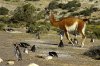
One mix I'd particularly like to see zoos try is guanacos & magellanic penguins.
Ostrich
Emu
Greater rhea
Greater flamingo
African sacred ibis
White ibis
African spoonbill
Saddle-billed stork
Marabou stork
Yellow-billed stork
Blue crane
Black-crowned crane
East African crowned crane
Grey crowned crane
Wattled crane
Demoiselle crane
Sandhill crane
Goliath heron
Pink-backed pelican
Dalmatian pelican
Egyptian goose
White faced whistling duck
Northern pintail
Southern pochard
Great cormorant
White-breasted cormorant
Lappet-faced vulture
White-backed vulture
Rüppell's griffon vulture
Cinereous vulture
Hooded vulture
Egyptian vulture
American black vulture
Southern ground hornbill
Abssynian ground hornbill
Cattle egret
Great white egret
Kori bustard
White bellied bustard
Helmet guineafowl
Crested guineafowl
Indian peafowl
Wild turkey
Some facts:
While some of these birds are flightless or aren't necessarily pinioned in order to be housed outdoors, the mix of hoofstock and birds isn't always ideal. Large animals present an obvious danger to stationary birds, but large birds like the ostrich, marabou, or even the ground hornbill can pose a lethal threat to some hoofstock as well.
Though tempting it is to justify it for some avian species such as waterfowl, pinioning is essentially the same procedure as declawing a cat. Netted enclosures are common for big cats and primates, less for marabou stork. The seasoned zoo scholar doesn't need to be told, pinioning harms birds' reproductive success. Some zoos do have netted/indoor hoofstock yards or dedicated aviaries for large birds, especially in Europe.
Of all ungulates, exhibiting flying birds with the common and pygmy hippo seems the most common across Europe and North America.
Suggestions:
Some hoofstock exhibits, like the dik-dik, already have netted enclosures; these would be ideal for coexhibiting some species of birds.
Alternatively, zoos could build enclosures tall and small enough to prevent birds from taking off. Many aviaries are essentially designed this way to prevent harm to large birds. Similar traps have even been used historically to catch birds like Andean condor.
One mix I'd particularly like to see zoos try is guanacos & magellanic penguins.