La Cucaracha

Well-Known Member
This is by no means all the birds kept in open air/hoofstock yards, so please add anything you feel belongs here.
Ostrich
Emu
Greater rhea
Greater flamingo
African sacred ibis
White ibis
African spoonbill
Saddle-billed stork
Marabou stork
Yellow-billed stork
Blue crane
Black-crowned crane
East African crowned crane
Grey crowned crane
Wattled crane
Demoiselle crane
Sandhill crane
Goliath heron
Pink-backed pelican
Dalmatian pelican
Egyptian goose
White faced whistling duck
Northern pintail
Southern pochard
Great cormorant
White-breasted cormorant
Lappet-faced vulture
White-backed vulture
Rüppell's griffon vulture
Cinereous vulture
Hooded vulture
Egyptian vulture
American black vulture
Southern ground hornbill
Abssynian ground hornbill
Cattle egret
Great white egret
Kori bustard
White bellied bustard
Helmet guineafowl
Crested guineafowl
Indian peafowl
Wild turkey

Some facts:
While some of these birds are flightless or aren't necessarily pinioned in order to be housed outdoors, the mix of hoofstock and birds isn't always ideal. Large animals present an obvious danger to stationary birds, but large birds like the ostrich, marabou, or even the ground hornbill can pose a lethal threat to some hoofstock as well.
Though tempting it is to justify it for some avian species such as waterfowl, pinioning is essentially the same procedure as declawing a cat. Netted enclosures are common for big cats and primates, less for marabou stork. The seasoned zoo scholar doesn't need to be told, pinioning harms birds' reproductive success. Some zoos do have netted/indoor hoofstock yards or dedicated aviaries for large birds, especially in Europe.
Of all ungulates, exhibiting flying birds with the common and pygmy hippo seems the most common across Europe and North America.

Suggestions:
Some hoofstock exhibits, like the dik-dik, already have netted enclosures; these would be ideal for coexhibiting some species of birds.
Alternatively, zoos could build enclosures tall and small enough to prevent birds from taking off. Many aviaries are essentially designed this way to prevent harm to large birds. Similar traps have even been used historically to catch birds like Andean condor.
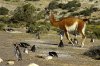
One mix I'd particularly like to see zoos try is guanacos & magellanic penguins.
 

Attachments

  • Penguins_and_Guanaco.jpg
    Penguins_and_Guanaco.jpg
    610.7 KB · Views: 26
This is by no means all the birds kept in open air/hoofstock yards, so please add anything you feel belongs here.
Ostrich
Emu
Greater rhea
Greater flamingo
African sacred ibis
White ibis
African spoonbill
Saddle-billed stork
Marabou stork
Yellow-billed stork
Blue crane
Black-crowned crane
East African crowned crane
Grey crowned crane
Wattled crane
Demoiselle crane
Sandhill crane
Goliath heron
Pink-backed pelican
Dalmatian pelican
Egyptian goose
White faced whistling duck
Northern pintail
Southern pochard
Great cormorant
White-breasted cormorant
Lappet-faced vulture
White-backed vulture
Rüppell's griffon vulture
Cinereous vulture
Hooded vulture
Egyptian vulture
American black vulture
Southern ground hornbill
Abssynian ground hornbill
Cattle egret
Great white egret
Kori bustard
White bellied bustard
Helmet guineafowl
Crested guineafowl
Indian peafowl
Wild turkey

Some facts:
While some of these birds are flightless or aren't necessarily pinioned in order to be housed outdoors, the mix of hoofstock and birds isn't always ideal. Large animals present an obvious danger to stationary birds, but large birds like the ostrich, marabou, or even the ground hornbill can pose a lethal threat to some hoofstock as well.
Though tempting it is to justify it for some avian species such as waterfowl, pinioning is essentially the same procedure as declawing a cat. Netted enclosures are common for big cats and primates, less for marabou stork. The seasoned zoo scholar doesn't need to be told, pinioning harms birds' reproductive success. Some zoos do have netted/indoor hoofstock yards or dedicated aviaries for large birds, especially in Europe.
Of all ungulates, exhibiting flying birds with the common and pygmy hippo seems the most common across Europe and North America.

Suggestions:
Some hoofstock exhibits, like the dik-dik, already have netted enclosures; these would be ideal for coexhibiting some species of birds.
Alternatively, zoos could build enclosures tall and small enough to prevent birds from taking off. Many aviaries are essentially designed this way to prevent harm to large birds. Similar traps have even been used historically to catch birds like Andean condor.
One mix I'd particularly like to see zoos try is guanacos & magellanic penguins.
For many of these species, flight restriction is outdated and compromises welfare. I’m thinking particularly of vultures. Where it doesn’t impact breeding success is with waterfowl. It should no longer be acceptable to run flight restricted birds with hoofstock. The birds are too vulnerable to injury from aggressive, playful or clumsy mammals.
I would take issue with comparing pinioning with declawing. Pinioned birds suffer no long term health effects from the procedure. Declawed felines are more liable to health and mobility issues, especially in later life
 
I would take issue with comparing pinioning with declawing. Pinioned birds suffer no long term health effects from the procedure. Declawed felines are more liable to health and mobility issues, especially in later life

You're right, but not for the reasons you want to be. Pinioning actually removes far more of the metacarpal bones than declawing does.
Claiming it doesn't cause the birds similar pain seems remiss, though. Human amputees certainly report pain from damaged nerves ie "phantom pain". We know pinioned birds struggle with being overweight, too.
 
Pinioned birds are crippled, they are significantly worse injured than a cat because they lose their primary means of movement - to be equivalent, the declawed cat would have to be no longer able to stand. Flightless birds suffer increasingly from heart disease, obesity and behavioral issues relating to a lack of means to escape a threat.
 
It seems my opinions (based largely on half a century with waterfowl) are stirring up a hornet’s nest. Most waterfowl are pinioned in early infancy, and I would question whether there are are any long term effects apart from flightlessness. Adult pinioning may be a very different scenario. It’s worth remembering that almost all waterfowl are naturally flightless during their annual moult, so could be said to be pre-adapted to a non-flying situation. As for obesity, that’s a Red gerri g as far as waterfowl are concerned. Waterfowl are either fat or dead. There’s no middle ground with them. As for longevity, there is no difference between full winged and pinioned waterfowl. Im not advocating here for pinioning of Ground Hornbills, Vultures or much else other than waterfowl, where I’m firmly convinced that it has a place.
As for the comparison with declawing, there is no latter affects all locomotion in the operated animal. Pinioning has now effect on a duck’s ability to walk or swim.
 
I can’t imagine guanacos and penguins existing in a captive setting without any problems, for instance the guanacos being five times their size making it easy for the penguins to get trampled, even deliberately if there’s temperament involved. Maybe if penguins could fly or walk efficiently it wouldn’t be as much of a concern.
 
I can’t imagine guanacos and penguins existing in a captive setting without any problems, for instance the guanacos being five times their size making it easy for the penguins to get trampled, even deliberately if there’s temperament involved. Maybe if penguins could fly or walk efficiently it wouldn’t be as much of a concern.

I'd agree, animals coexisting in the wild doesn't automatically create the right conditions for mixing them together in fixed size enclosures.
 
I remember Bristol Zoo having one or more Alpacas with Rockhopper Penguins, but there may have been an unobtrusive fence between. Maras and Prairie Dogs were also involved
 
I'd agree, animals coexisting in the wild doesn't automatically create the right conditions for mixing them together in fixed size enclosures.
Exactly, confined spaces create very different mental and physical conditions for animals. In the wild Magellanic and Humboldt penguins naturally live near coastal habitats that are different from where guanacos like to live. This makes cohabitant tension either nonexistent or minimal between the species in the wild, but that’s not possible to dictate in a captive setting.
 
Red-crowned Cranes, Southern Screamer, Black, Mute, Coscoroba, Black-necked and Whooper Swans, Cape Barren, Canada, Barnacle, Red-breasted, Upland, Ruddy-headed, Ashy-headed, Orinoco, Snow and Emperor Geese, Ruddy, South African and Common Shelducks, Vulturine Guineafowl, Rosy-billed Pochards and Red-legged Seriemas were kept with hoofstock too (some of them are still kept in such mixes).
 
I remember Bristol Zoo having one or more Alpacas with Rockhopper Penguins, but there may have been an unobtrusive fence between. Maras and Prairie Dogs were also involved

Peak had Mara in with their penguins too but I am not sure they still do, obviously much smaller than a Guanaco and not too confrontational.
 
I can’t imagine guanacos and penguins existing in a captive setting without any problems, for instance the guanacos being five times their size making it easy for the penguins to get trampled, even deliberately if there’s temperament involved. Maybe if penguins could fly or walk efficiently it wouldn’t be as much of a concern.
Peak had Mara in with their penguins too but I am not sure they still do, obviously much smaller than a Guanaco and not too confrontational.

I want to agree, but they're basically acting like pinioned waterfowl at this point, which do have a higher survival rate cohabitating with hoofstock because they can escape into water.
 
I want to agree, but they're basically acting like pinioned waterfowl at this point, which do have a higher survival rate cohabitating with hoofstock because they can escape into water.

That's assuming the bold and inquisitive nature of the penguins won't get them in trouble. A guanaco is going have the upper hand anywhere on land.

Also fwiw, many of the SSP's and TAGs are increasingly pushing for birds to not be held with hoofstock because of too many losses and the impact on breeding. Heard plenty of accounts of ostriches and emus getting themselves injured or killed by being too pushy at that. It's basically gambling when putting Storks, cranes, and vultures with hoofstock.
 
Also fwiw, many of the SSP's and TAGs are increasingly pushing for birds to not be held with hoofstock because of too many losses and the impact on breeding. Heard plenty of accounts of ostriches and emus getting themselves injured or killed by being too pushy at that. It's basically gambling when putting Storks, cranes, and vultures with hoofstock.

I do think ostriches make a poor choice to house with most hoofstock, especially zebras.
Zoo Antwerp keeps vultures with buffalos in a netted aviary. They seem to do fine. I think the gamble is when they take away the birds' ability to escape.
 
I want to agree, but they're basically acting like pinioned waterfowl at this point, which do have a higher survival rate cohabitating with hoofstock because they can escape into water.
Waterfowl are lightly-built making it easier for them to maneuver on land, and they tend to keep their distance from large mammals. Penguins are the opposite of both of those things.
 
A ‘higher’ survival rate doesn’t sound like an ideal way to manage penguins in this scenario and it seems a pointless exercise to seek to mix them for no benefit.

I think you're mistaking this for an actual species compatibility thread.
I'm not the zoo director that thinks it's a good idea to house pinioned vultures with giraffes.
 
Back
Top