Day Three (Part One):
OK, if you are going to read this, you should first go and get a coffee, as its rather long...
After a stunning buffet breakfast at the hotel, with a heavy focus on small pastries, fresh fruits and waffles, we headed out to the taxi rank. Today our destination was the
Lok Kawi Wildlife Park, Sabah’s only 'proper' zoo. Run by the state government’s Wildlife Department, the facility opened in 2007, although any visitor would certainly suspect it was a good twenty years older than that. There are many photos of the zoo in the gallery, and reviews by Chlidonias here:
http://www.zoochat.com/249/lok-kawi-review-12-sept-2009-a-105387/. So I’ll keep this review as brief as possible (knowing full well that it will end up rather long!). The Park is located around 20km/30 minutes from KK city, and the easiest way to get there is by taxi. Unfortunately, this is also the most expensive way and I feel we got quite majorly ripped off by our driver, although he did wait the whole time. The total cost ended up being 150MYR, which is almost AUD$50!
Out the front of the zoo is a roundabout with statues depicting a range of local wildlife: rhino, elephant, orangutan, proboscis monkey, hornbill and eagle, which was pretty cool. Elaborate adornments of roundabouts were actually quite a common sight in Sabah, including massive pineapples, kingfishers, marlin, ginger, baskets and eagles. There is then a short road up to the main entrance building, which looks very modern, with decent signage. Inside it is a little more rundown looking, although does feature a Sumatran Rhino skeleton. A small ticket booth is also in here, with tickets costing 20MYR and a photocopied map included.
Our first impressions of the Wildlife Park were not the best. A set of stairs led up to the Children’s Zoo, which was perched on a small hill. This odd little area included a small set of cages for Rabbits and Guinea Pigs, and a paddock for elephant rides. I have never ridden an elephant, but it is something I always wanted to do growing up. Prior to this visit, I had only had the opportunity once, at Singapore Zoo in 2011, but ultimately decided against it (they have since discontinued the practice). Today I had thought I would have a good look at how this zoo was running their rides, but it turns out they are no longer running. This definitely looks like a good thing, based on the very poor state of this area and my overall impressions of the zoo and its welfare standards.
Descending from the Children’s Zoo, you enter a circular area with exhibits around the outside and a restaurant in the centre. We didn’t enter this tall building, so I don’t know what it’s like, although the views are presumably quite interesting. There were three large enclosures here, the first a large paddock for the local Sambar Deer subspecies, with a couple of Nilgai and a Red Muntjac also present. The second was a paddock for five Bornean Pygmy Elephants, which were exciting to see. The exhibit was small, with pool, mud, grass and shaded area, but rather barren. Other enrichment seemed non-existent. The final exhibit here was a rather dusty sloped paddock, with a number of large trees and heaps of Chital.
Heading further into the zoo, we walked up to another paddock, this holding Javan Rusa, with one further on for Nilgai (empty). Opposite was a large aviary cage for Serval, which was very nice, although not very savannah-like. It would have suited a native cat better, or perhaps birds or monkeys. Further up were small pens for Southern Cassowary and Ostrich and then the Reptile House. This was fairly grim, a row of three open-topped pens for Saltwater Crocodile; Water Monitors; and Malayan Box Turtles and Red-eared Sliders, opposite a building with barren boxes for King Cobra, Mangrove Snake and Reticulated Python. The snake and turtle exhibits were quite large, but the former were essentially just empty boxes, and overall the complex is very poor.
The path continued down to a massive and impressive-looking walk-through aviary, set across a small gully. Unfortunately I can’t say if it was impressive or not, as it was closed. I could see a few large species within it (Great Argus, Green Peafowl and Wreathed Hornbill), but it would be good to have been able to go in. I could see no reason why it was closed, but this appears to be a long-term closure. Attached to the front of this aviary was a large, open and barren aviary, with a couple of sticks for perches. This held Brahminy Kite and White-bellied Sea Eagle, just one of each. More perches (a dead tree or two) would be a useful addition here. Nearby was a rather nice, small aviary containing Nicobar Pigeon and Hill Mynas.
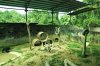
Next was a pair of walled exhibits for Bornean Sun Bears, viewed from above. These were better than expected, with rocks, dirt and grass, a pool, logs and tyres, and a number of large pipes – some stacked to offer elevated shelters. Although it all looked poorly maintained, at least it wasn’t barren. While not large, the three bears all had a bit of space, and it was comparable to many bear exhibits I have seen. Next door was a similar exhibit for Malayan Tigers, although this was rather more vegetated and also had ground-level viewing. This was quite good, with the main concern being the disturbingly low wall surrounding it.
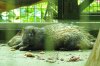
Ahead was a moated enclosure for Bornean Orangutan, with elaborate climbing frames and rope swings, elevated platforms and plenty of grass. This was surprisingly conventional, and comparable to many orangutan exhibits found in many Western zoos. However, the inhabitants must be frustrated by the surrounding rainforest that is just out of reach. A small, dark building with four glass-fronted exhibits was next – these held a solitary (and apparently terrified) Squirrel Monkey; a pair of Prevost’s Squirrels; Masked Palm Civet (unseen); and a Malayan Pangolin. These were very empty exhibits, typically decorated with just a couple of branches. One of the worst parts of the Park. Further on were a pair of large, tall, functional cages for groups of Proboscis Monkeys, which were very good. One also contained a pair of Thick-spined Porcupine, a Bornean endemic and my first new species of the day. A final cage in this row was rather smaller and shadier, but still un-vegetated. This held Binturong and a trio of Malayan Porcupine, and was quite good for these species. Here we were stopped by a group of local girls who wanted a photo with my partner – and wanted me to take the photo! I obliged, in a gritted-teeth way, and remain unsure why I was not the chosen one.
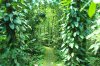
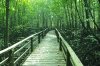
Further along the path was a yard for Miniature Horse, followed by the furthest exhibit from the entrance, a larger paddock for Ankole Cattle. This was a large space, which was previously shared with Zebra, but these appear to have been lost from the collection, as have many of the zoo’s exotic species. Beyond this exhibit was the Lok Kawi Botanical Park, an area of forest with a trail cut through it, and a few planted gardens. Nothing spectacular, and rather rundown, but some nice plants and a few butterflies and lizards about, although very few birds. Under the canopy there was very little air movement, and the heat was stifling. It was a long walk up and down the hillside to get back to the zoo, and it wasn’t really worth it.
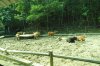
From the Ankole Cattle, a second path led back towards the Orangutans, forming a loop. The first exhibit here was a large, barren, muddy and overcrowded paddock for a herd of Banteng. This was fairly grim, and I think they need to reduce the numbers here, and expand the exhibit. The wild Cattle Egrets seemed to like it though, and I saw my first wild lifer of the day here - a Yellow-bellied Prinia. Opposite were a pair of nicely-vegetated yards for Red Muntjac and Emu, among the nicest exhibits here, and with the added bonus of a Red-whiskered Bulbul, another lifer. Nearby was a large beach umbrella, shading a couple of gentlemen, and well-stocked fridges and freezers, where we picked up soft drinks to help us recover from walking in the heat. The last exhibit on this path was particularly exciting, a moated island featuring two native species – Smooth-coated Otters and Bornean Gibbons. This was nice enough, and the big group of otters was cool to see, although the vegetation for gibbons was fairly low. I think this is also the first time I have seen mixed primates and carnivores.
The last part of the zoo was back past the elephants, and featured rows of cages either side of the path – mammals on the left and birds on the right. The largest exhibit was a large aviary, not particularly tall, for Rhinoceros and Wreathed Hornbill, and this was pretty good. This was followed by a row of aviaries for various parrots, mostly singles but a couple of pairs, mostly cockatoos and lorikeets (including one new species – Black Lory). These were small, barren and dark. The final aviary here was stand-alone, with a bit of vegetation, and a relatively good size for the unexpected inhabitants - Lesser Bird-of-Paradise.
The mammal row consisted of three cages, all fairly horrible, with furnishings limited to logs and branches. Two adjacent cages were for civets – Masked Palm, Common Palm and Malay Civets (I think). These were very average cages, but not much worse than many other zoos, and a much better view than the silhouettes at Singapore Night Safari. The final cage here was larger, but overall much less suitable. It did however, hold the single most awesome animal at Lok Kawi, a Bornean Clouded Leopard. This animal was sprawled along the back wall of the cage, and was much larger than I had expected, certainly it seemed bigger than the Clouded Leopards I have previously seen. It was also much greyer, and looked much more like a Snow Leopard than anything else. Regardless, it was a stunning creature, and certainly deserves a much better home than the crappy cage it had.
We left after about three hours, having seen everything once in the very hot weather. The gift shop was small, but had some nice, reasonably-priced stuff, and I picked up a copy of Phillipps’ Field Guide to the Birds of Borneo and a mug. Overall, Lok Kawi Wildlife Park was fairly bad. Some of the exhibits were great and some acceptable, but a large proportion were neither. It’s hard to believe it has been open less than ten years, and comparing my experience with others’ visits shows that very little is being improved. The collection is great, it just needs to be better housed. Just nine new taxa, including a few Bornean subspecies.
Photos below show: the adorable Thick-spined Porcupines, the path through the very green Botanical Garden, the impressive Bornean Banteng herd, the shabby Bornean Sun Bear exhibit, and the awesome Bornean Clouded Leopard.