zooboy28
Well-Known Member
Day Seven:
We were up before dawn, and raced down to the breakfast buffet for our last meal at the Hyatt Regency Kota Kinabalu. It was as spectacular as ever, with waffles and coffee, eggs and sausages, pastries, curry puffs and smoothies. Then we headed to the airport, and after navigating the rather complex security, went back out to check in and then went through security again. We were flying east across the north of Borneo, to the second-largest city in Sabah – Sandakan. Our flight was brief, but included spectacular views of the top of Mount Kinabalu, the only time we saw the peak of South-East Asia’s tallest mountain.
Upon arrival at Sandakan, we were greeted by Rahman, a guide from Borneo Eco Tours, who would be with us for the next few days. I’d organised a private tour as a) we didn’t want to drive ourselves; and b) there weren’t any existing tours that covered everything I wanted to see. Our first stop was Sepilok, which is a little way inland from Sandakan. We arrived a little before 9am, and had a look around the entry area of the Sepilok Orangutan Rehabilitation Centre, before entering a small theatre and watching a video on the Centre’s work. Which is pretty impressive, with over 200 Bornean Orangutans rehabilitated in 50 years of operation. The Centre includes 43 square kilometres of rainforest, adjacent to a larger forest reserve, and there are 60-80 orangs in the area. Most were orphaned through deforestation or other conflict with humans. We set off along the boardwalks through the jungle to catch the morning feeding, where supplemental fruits are offered to the more-or-less wild orangs. After waiting a while in the drizzle, one sub-adult male appeared, swinging down from the gloom of the surrounding trees. This was awesome to see, and we watched him until he was full, and faded back into the green.
We continued further into the forest, reaching the nursery area, where young orangs (2-6 years old) transition from full time care to independent jungle life. There was an extensive playground for them here, with ropes out to the surrounding forest, and we watched them from a large viewing building. After half an hour here, we returned to the entrance, seeing another adult en route, which was building a nest to shelter from the rain. While orangs were the only animals we saw here, we did hear an elephant – a young male that had become separated from its herd locally and was reared at the Centre, although not on display.
Next door is the much newer Bornean Sun Bear Conservation Centre, which opened to the public in 2014 on land that was used for a Sumatran Rhino breeding programme. This currently houses 38 Bornean Sun Bears, which had usually been found as orphans, pets or in the restaurant trade. A boardwalk takes visitors up from a small visitor’s centre, past a series of excellent educational signs, to a viewing platforms that looks directly over two enclosures, with others visible further back. These are essentially fenced off sections of rainforest, and are superior to the vast majority of sun bear enclosures I have seen in zoos. The bears are kept in compatible groups or singly, and in the front exhibit we could see a young female, who was searching for bugs, climbing stumps and being rather playful. In the enclosure behind, we could see a dark shape about 20 metres up a tree – an adult bear snoozing. They are currently building a boardwalk extension, to allow visitors to see more enclosures. Overall, a superb facility and well worth a visit.
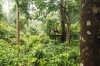
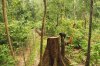
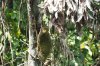
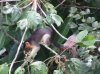
We had lunch at a nearby restaurant, before heading to our final stop in Sepilok, the Rainforest Discovery Centre. Fortunately, the rain had cleared and the air was getting very warm. The RDC includes trails through primary rainforest, with elevated walkways and viewing towers. I hoped to spot some birds here, but the heat of early afternoon and our minimal time meant we saw no notable birds. But we did spot a skink, as well as Prevost’s Squirrel, before things started to get exciting – starting with a Bornean Colugo (a different subspecies to that seen in Singapore). Remarkably, we were able to view this (very green) animal extremely closely, as it was clinging to a trunk at eye level from the elevated boardwalk. A little further on, we spotted an adult female orangutan, much further from the boardwalk, but at a similar height. She rapidly climbed up into the canopy, and her toddler (~3 years old) followed briskly. She was likely a rehabilitated animal from the nearby Centre that had moved out into the wider surrounding reserve. The final mammal we saw here, and probably my favourite, was also almost at eye level – a Bornean Giant Squirrel. This animal was foraging out on an exposed branch, and was huge!
We then drove another half hour or so, leaving the rainforest and entering the monotonous oil palm plantations. These were mostly flat, straight dirt roads, so we went quite fast apart from the occasional heavy breaking for water monitors. Our destination was one particular oil palm plantation, located on the coast, which doubled as a small tourist attraction – the Labuk Bay Proboscis Monkey Sanctuary. Unlike the orang and bear rehabilitation centres, this was a privately-owned attraction, and the monkeys were wild. The story goes that when the forest was cleared for the plantation, some workers left pancakes on the windowsill of their hut, and the monkeys stole them. The workers then began making more pancakes than necessary, so they could feed the monkeys too, but this attracted more monkeys and eventually became untenable, so they turned it into a tourist attraction.
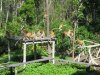
On arrival, we followed a boardwalk through the plantation, passed a pet cat, then entered the mangrove forest and eventually reached the feeding area. Here was a building and a large viewing deck, with fake tree stumps and platforms surrounded by mangroves. And a heap of proboscis monkeys. On one side was a large male and a harem of females, with a couple of babies, probably 30 individuals all up. On the other was a bachelor group, with around 20 males. The staff first fed the harem, with ‘pancakes’. The pancakes are not what I would call pancakes, but rather are doughy cakes. The first to feed was the dominant male, who was given a few pieces of cake that he ate on the railing of the viewing deck. He was huge, but we were encouraged to get very close (< a foot away) for photos with this impressive animal. The harem and bachelor groups were then fed with pancakes scattered on the platforms. We spent around half an hour watching these animals, which were generally calm and food-focused, but there were occasional interruptions caused by some of the bolder bachelors coming too close to the harem. When this happened, the dominant male would run across the deck, slapping the boards loudly to scare off the intruders, then return to the harem and make some low calls to reassure the females.
After an hour or so, we returned to the van and drove back to Sandakan, where we checked in to Four Points by Sheraton Sandakan. This was a large modern tower located right on the coast, giving views of the Sulu Sea and over the city behind. After coffee, we headed to the infinity pool, where we swam as the sun edged lower. I hadn’t been in an infinity pool before, and this one was on the 13th floor so was rather high. Once I was sure I wasn’t going to fall out I enjoyed the pool and views, including of a White-bellied Sea Eagle soaring above. We had dinner at the hotel bar, which was on the second level, and had views of both the streets and shore below. Unexpectedly, I managed to see two more mammal species from here, a Norway rat on the pavement and an otter (I think smooth-coated) in the water. This was one of the longest days of the trip, so it wasn’t long before we were off to bed, excited about the next day’s adventure into the jungle proper.
Borneo Wildlife Species Lists:
Birds:
24 White-bellied Sea Eagle Haliaeetus leucogaster
Mammals:
2 Bornean Colugo Galeopterus variegatus borneanus
3 Bornean Orangutan Pongo pygmaeus morio
4 Bornean Giant Squirrel Ratufa affinis baramensis
5 Proboscis Monkey Nasalis larvatus
6 Plantain Squirrel Callosciurus notatus dilutus
7 Norway Rat Rattus norvegicus
8 Smooth-coated Otter Lutrogale perspicillata
Photos below show: a male Bornean orangutan at the Sepilok Orangutan Rehabilitation Centre feeding platform; a young Bornean sun bear at the Bornean Sun Bear Conservation Centre; Bornean colugo clinging to a tree trunk at the Rainforest Discovery Centre; Bornean giant squirrel foraging at the Rainforest Discovery Centre; and an action shot of the proboscis monkey harem at the Labuk Bay Proboscis Monkey Sanctuary.
We were up before dawn, and raced down to the breakfast buffet for our last meal at the Hyatt Regency Kota Kinabalu. It was as spectacular as ever, with waffles and coffee, eggs and sausages, pastries, curry puffs and smoothies. Then we headed to the airport, and after navigating the rather complex security, went back out to check in and then went through security again. We were flying east across the north of Borneo, to the second-largest city in Sabah – Sandakan. Our flight was brief, but included spectacular views of the top of Mount Kinabalu, the only time we saw the peak of South-East Asia’s tallest mountain.
Upon arrival at Sandakan, we were greeted by Rahman, a guide from Borneo Eco Tours, who would be with us for the next few days. I’d organised a private tour as a) we didn’t want to drive ourselves; and b) there weren’t any existing tours that covered everything I wanted to see. Our first stop was Sepilok, which is a little way inland from Sandakan. We arrived a little before 9am, and had a look around the entry area of the Sepilok Orangutan Rehabilitation Centre, before entering a small theatre and watching a video on the Centre’s work. Which is pretty impressive, with over 200 Bornean Orangutans rehabilitated in 50 years of operation. The Centre includes 43 square kilometres of rainforest, adjacent to a larger forest reserve, and there are 60-80 orangs in the area. Most were orphaned through deforestation or other conflict with humans. We set off along the boardwalks through the jungle to catch the morning feeding, where supplemental fruits are offered to the more-or-less wild orangs. After waiting a while in the drizzle, one sub-adult male appeared, swinging down from the gloom of the surrounding trees. This was awesome to see, and we watched him until he was full, and faded back into the green.
We continued further into the forest, reaching the nursery area, where young orangs (2-6 years old) transition from full time care to independent jungle life. There was an extensive playground for them here, with ropes out to the surrounding forest, and we watched them from a large viewing building. After half an hour here, we returned to the entrance, seeing another adult en route, which was building a nest to shelter from the rain. While orangs were the only animals we saw here, we did hear an elephant – a young male that had become separated from its herd locally and was reared at the Centre, although not on display.
Next door is the much newer Bornean Sun Bear Conservation Centre, which opened to the public in 2014 on land that was used for a Sumatran Rhino breeding programme. This currently houses 38 Bornean Sun Bears, which had usually been found as orphans, pets or in the restaurant trade. A boardwalk takes visitors up from a small visitor’s centre, past a series of excellent educational signs, to a viewing platforms that looks directly over two enclosures, with others visible further back. These are essentially fenced off sections of rainforest, and are superior to the vast majority of sun bear enclosures I have seen in zoos. The bears are kept in compatible groups or singly, and in the front exhibit we could see a young female, who was searching for bugs, climbing stumps and being rather playful. In the enclosure behind, we could see a dark shape about 20 metres up a tree – an adult bear snoozing. They are currently building a boardwalk extension, to allow visitors to see more enclosures. Overall, a superb facility and well worth a visit.
We had lunch at a nearby restaurant, before heading to our final stop in Sepilok, the Rainforest Discovery Centre. Fortunately, the rain had cleared and the air was getting very warm. The RDC includes trails through primary rainforest, with elevated walkways and viewing towers. I hoped to spot some birds here, but the heat of early afternoon and our minimal time meant we saw no notable birds. But we did spot a skink, as well as Prevost’s Squirrel, before things started to get exciting – starting with a Bornean Colugo (a different subspecies to that seen in Singapore). Remarkably, we were able to view this (very green) animal extremely closely, as it was clinging to a trunk at eye level from the elevated boardwalk. A little further on, we spotted an adult female orangutan, much further from the boardwalk, but at a similar height. She rapidly climbed up into the canopy, and her toddler (~3 years old) followed briskly. She was likely a rehabilitated animal from the nearby Centre that had moved out into the wider surrounding reserve. The final mammal we saw here, and probably my favourite, was also almost at eye level – a Bornean Giant Squirrel. This animal was foraging out on an exposed branch, and was huge!
We then drove another half hour or so, leaving the rainforest and entering the monotonous oil palm plantations. These were mostly flat, straight dirt roads, so we went quite fast apart from the occasional heavy breaking for water monitors. Our destination was one particular oil palm plantation, located on the coast, which doubled as a small tourist attraction – the Labuk Bay Proboscis Monkey Sanctuary. Unlike the orang and bear rehabilitation centres, this was a privately-owned attraction, and the monkeys were wild. The story goes that when the forest was cleared for the plantation, some workers left pancakes on the windowsill of their hut, and the monkeys stole them. The workers then began making more pancakes than necessary, so they could feed the monkeys too, but this attracted more monkeys and eventually became untenable, so they turned it into a tourist attraction.
On arrival, we followed a boardwalk through the plantation, passed a pet cat, then entered the mangrove forest and eventually reached the feeding area. Here was a building and a large viewing deck, with fake tree stumps and platforms surrounded by mangroves. And a heap of proboscis monkeys. On one side was a large male and a harem of females, with a couple of babies, probably 30 individuals all up. On the other was a bachelor group, with around 20 males. The staff first fed the harem, with ‘pancakes’. The pancakes are not what I would call pancakes, but rather are doughy cakes. The first to feed was the dominant male, who was given a few pieces of cake that he ate on the railing of the viewing deck. He was huge, but we were encouraged to get very close (< a foot away) for photos with this impressive animal. The harem and bachelor groups were then fed with pancakes scattered on the platforms. We spent around half an hour watching these animals, which were generally calm and food-focused, but there were occasional interruptions caused by some of the bolder bachelors coming too close to the harem. When this happened, the dominant male would run across the deck, slapping the boards loudly to scare off the intruders, then return to the harem and make some low calls to reassure the females.
After an hour or so, we returned to the van and drove back to Sandakan, where we checked in to Four Points by Sheraton Sandakan. This was a large modern tower located right on the coast, giving views of the Sulu Sea and over the city behind. After coffee, we headed to the infinity pool, where we swam as the sun edged lower. I hadn’t been in an infinity pool before, and this one was on the 13th floor so was rather high. Once I was sure I wasn’t going to fall out I enjoyed the pool and views, including of a White-bellied Sea Eagle soaring above. We had dinner at the hotel bar, which was on the second level, and had views of both the streets and shore below. Unexpectedly, I managed to see two more mammal species from here, a Norway rat on the pavement and an otter (I think smooth-coated) in the water. This was one of the longest days of the trip, so it wasn’t long before we were off to bed, excited about the next day’s adventure into the jungle proper.
Borneo Wildlife Species Lists:
Birds:
24 White-bellied Sea Eagle Haliaeetus leucogaster
Mammals:
2 Bornean Colugo Galeopterus variegatus borneanus
3 Bornean Orangutan Pongo pygmaeus morio
4 Bornean Giant Squirrel Ratufa affinis baramensis
5 Proboscis Monkey Nasalis larvatus
6 Plantain Squirrel Callosciurus notatus dilutus
7 Norway Rat Rattus norvegicus
8 Smooth-coated Otter Lutrogale perspicillata
Photos below show: a male Bornean orangutan at the Sepilok Orangutan Rehabilitation Centre feeding platform; a young Bornean sun bear at the Bornean Sun Bear Conservation Centre; Bornean colugo clinging to a tree trunk at the Rainforest Discovery Centre; Bornean giant squirrel foraging at the Rainforest Discovery Centre; and an action shot of the proboscis monkey harem at the Labuk Bay Proboscis Monkey Sanctuary.

 )
)