ZooChat Cup Group C2: Beauval vs Bronx

Beauval vs Bronx: North America and Europe


  • Total voters
    27
  • Poll closed .
I don't think any of these species count.

Bar headed goose I accept, was a mistake, Cape Barren goose I accept, was a mistake, Hawaiian goose - well its a US state so I dunno if that counts, the next two depend on if Mexico is counted but I thaimk spectacled owl should be counted anyway because it lives in Mexican deserts (Palearctic as opposed to Neotropical), the next two are found in Southern Florida, White headed duck is found in Spain and the other two are clearly in Europe and North America respectively, so is that just a mistake?
 
Bar headed goose I accept, was a mistake, Cape Barren goose I accept, was a mistake, Hawaiian goose - well its a US state so I dunno if that counts, the next two depend on if Mexico is counted but I thaimk spectacled owl should be counted anyway because it lives in Mexican deserts (Palearctic as opposed to Neotropical), the next two are found in Southern Florida, White headed duck is found in Spain and the other two are clearly in Europe and North America respectively, so is that just a mistake?
The duck was a mistake. The pintail and the spindalis are occasional vagrants to Florida, but not don't really live there.
 
Hawaiian goose - well its a US state so I dunno if that counts,

Slippery slope - if you count it for that reason, then you'd have to count Guam Kingfisher and other such species as North American, and Striated Caracara and certain penguin taxa as European :p
 
Slippery slope - if you count it for that reason, then you'd have to count Guam Kingfisher and other such species as North American, and Striated Caracara and certain penguin taxa as European :p

Well. Hawaii is actually a state as opposed to a territory in the other two cases so one could argue it is different.

However, it serves no purpose to debate these topics - we just need @CGSwans to confirm/settle the debate on territories.
 
Cape Barren Goose jumped out at me too... :p

I didn't even see that before! :p

From the rebooted thread:

- Central America fits better with South, not North America based on the types of species that live there, so the third category is ‘South and Central America’. Caribbean islands also belong here.

- North America and Europe, as Amur Leopard notes, aren’t categories that often cross the pond. A European zoo drawing ‘Europe’ against an American zoo will win by default, and vice-versa. Luckily, the species line-ups are broadly similar so North America and Europe will form a combined category, allowing zoos from both continents to be meaningfully compared.


The categories are zoogeographic so Mexico should fall in Central America which falls in South America. North America/Europe is basically a Palaearctic category.

But Mexico isn't part of Central America. I left Mexican species out of my original post just in case but ecologically Mexico is mostly more in line with the Southwest United States than with Central America.

They were not introduced - no-one knows how they got there but there was a native population.
Arctic wolves are found in North America btw.

If no one knows how they got there then they can't be known as a definite native population :p Regardless, I'm fine with counting them in a similar vane to counting Dingos for Australia or elephants for Borneo.

I meant the entire European captive population of Arctic Wolves are wolf-dog hybrids, therefore I don't know if they should count, especially as most are more dog than wolf at this point.

The pintail has part of its range in Florida, it isn't just a vagrant, but the spindalis is pretty rare, true.

Anas bahamensis is not native to Florida according to HBW.

Well. Hawaii is actually a state as opposed to a territory in the other two cases so one could argue it is different.

Hawaii has always been firmly treated as Oceania in these types of games on the forum as well as in inventory threads (ie. birds-of-paradise in captivity, etc.)

~Thylo
 
Well. Hawaii is actually a state as opposed to a territory in the other two cases so one could argue it is different.

My point is that the categories are biogeographical, not political - so it's not different at all.

But even if you were right, a better conparison would be to note that you wouldn't say the Aruba Rattlesnake is European, even though Aruba is explicitly one of the countries within the Kingdom of the Netherlands and not "merely" a territory.
 
But Mexico isn't part of Central America. I left Mexican species out of my original post just in case but ecologically Mexico is mostly more in line with the Southwest United States than with Central America.

Only northern Mexico - biogeographically central and southern Mexico are Neotropical.
 
If no one knows how they got there then they can't be known as a definite native population :p Regardless, I'm fine with counting them in a similar vane to counting Dingos for Australia or elephants for Borneo.

I meant the entire European captive population of Arctic Wolves are wolf-dog hybrids, therefore I don't know if they should count, especially as most are more dog than wolf at this point.

When I said no-one knows how they got there I meant they have been in Gibraltar almost since they existed, but no-one knows how they physically got there (long before humans of course).

Beauval also keeps California sea lions.

Sorry I forgot them.

My point is that the categories are biogeographical, not political - so it's not different at all.

But even if you were right, a better conparison would be to note that you wouldn't say the Aruba Rattlesnake is European, even though Aruba is explicitly one of the countries within the Kingdom of the Netherlands and not "merely" a territory.

Slightly different because Hawaii is geographically close to North America (if it can be called close).

But yes fundamentally I agree
 
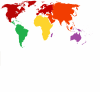
So far, anyway, I made this map. The only think we are unsure about is Mexico. Although @CGSwans said Central America and the Caribbean was with South America and the rest of the Americas was North American, which would include Mexico theoretically.

Anyway, here it is:

zoochat cup map.png
 

Attachments

  • zoochat cup map.png
    zoochat cup map.png
    211.7 KB · Views: 35
Source? The ABA, AOS, HBW, and IUCN all seem to disagree. Not too many eBird reports or iNaturalist observations, either.

The uber-reliable Wikipedia :)

EDIT: Just checked IUCN and they actually agree with me.
It says they are 'Extant and vagrant' in Florida
 
The uber-reliable Wikipedia :)

Wikipedia literally says it's only a vagrant.

When I said no-one knows how they got there I meant they have been in Gibraltar almost since they existed, but no-one knows how they physically got there (long before humans of course).

The leading theory is that they were introduced and this is supported by mtDNA testing from what I quickly looked up. I suspect what you're referring to is the fact that Wikipedia states they were present before British occupation of the island.

Slightly different because Hawaii is geographically close to North America (if it can be called close).

It's almost 4000--and increasing-- miles away...

~Thylo
 
Back
Top