ZooChat Exhibit Design Competition #1

Design 0-20 6
Animal Needs 0-20 8
Visitor Needs 0-20 12
Write-up 0-20 18
Landscaping 0-10 2
Interpretation 0-10 5
51

1. Excellent write up. It could benefit from standardized formatting.

2. It is impossible to gauge how bog or small exhibits are. You mention measurements in the write-up but these no not transfer over to the design.

3. You design itself isn't really a design. It's a vague layout that one might see on a zoo map. It's impossible to tell what's what on the map. There are numbers floating in the air with nothing attached to them.

4. Many of the exhibits are far too small. The raptor aviaries for instance. The biggest aviary is 9 meters long, which I would hope holds the largest bird there the Golden Eagle. The eagle has a 2.5 meter wingspan. The bird will barely be able to move. Same with your wildcat enclosures. A 2 meter square enclose for a cat is almost cruel. That's the size of a large transport crate.

5. Roe dear can easily jump the fence in the area where I have to assume the exhibit is.

6. You have a lot of common native species. For interpretation and ecological reasons, might it be better to have an area where wild animals can come in to the zoo? Bird feeders, naturally planted areas, etc. and have those areas with signs/guides pointing out what might be seen. The rarer chance of seeing a wild animal in a zoo is far more rewarding that seeing one behind a barrier. This would include many of your birds, rabbits, rodents, etc.

7. " This has several chambers (which serve different
purposes) and tunnels connecting these up; due to the design, some are on show and some aren’t. Keepers can’t access some..."
This is a huge red flag! A keeper not being able to reach an animal is really poorly designed. Within a week of that exhibit opening, I can guarantee that the keepers will have dug up that area and redesigned it in case they need to get to a sick or injured (or dead) animal.

8. The immediate thing I have to ask about this exhibit (which, heavens know is why I'm saving it for #8...) is, why should this exhibit be built? What is the justification for a zoo to spend a good deal of money on these backyard animals? This is a personal taste (and one where no points were lost). There's no "wow" element to the exhibit. There's no megafauna, there's no incredible experience, there's no overriding conservation message/effort, in essence, there's nothing that would keep an average zoo visitor coming back to this zoo. I think, if themed properly, this area could work as a children's zoo with appropriate play areas, demonstrations, animal experiences etc.

51/100
 
I can't help noting that the clear consistently weakest point in all entries (except desertrhino's!) is landscaping. Oh for shame, Zoochatters!
 
Wild Asia

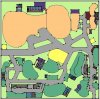
Here is my entry for my 10 acre exhibit complex: Wild Asia.

I designed it using Sketch Up, but it is 2D. I can provide additional zoomed-in versions of any of the areas if anyone is curious.

I didn't provide a key for what color means what on the maps. Darker green and orange are exhibit areas, light green are landscape areas, yellow are guest facilities (restaurant, bathroom, etc), animal holding areas are blue, shift corridors are red, off-show holding yards are purple, keeper spaces are brown, and visitor pathways are grey.

I look forward to the next design challenge!
 

Attachments

Here is my entry for my 10 acre exhibit complex: Wild Asia.

I designed it using Sketch Up, but it is 2D. I can provide additional zoomed-in versions of any of the areas if anyone is curious.

I didn't provide a key for what color means what on the maps. Darker green and orange are exhibit areas, light green are landscape areas, yellow are guest facilities (restaurant, bathroom, etc), animal holding areas are blue, shift corridors are red, off-show holding yards are purple, keeper spaces are brown, and visitor pathways are grey.

I look forward to the next design challenge!

Wow! Best one on this whole thread. Had to google a lot of the birds, but well done. Loved all the herp and 'phib choices. Very impressive. Well done.
 
Turns out I had some time the last couple of nights so here is my submission.

Journey to Kimbala:
You first encounter a small African homestead that has been partially destroyed. All that is left is the large outhouse (usable public restrooms) and a few structures holding up a shade cloth. Signs explain that the damage was due to elephants. From under the shade on one side of the homestead, views open out into forest with an elephant trail visible below. Looking through the forest you notice a herd of nyala and the occasional greater kudu. As you follow the elephant trail to the other side the landscape opens into a savanna habitat with giraffe, impala, greater kudu, and a lone elephant trumpeting as she walks away.
After crossing the suspension bridge beyond the homestead you come upon a makeshift scientific research camp. The villagers have been complaining about the destructive elephants and want to figure out a way to stop them. Interpretives about the importance of animal movement through different habitats and creating corridors for them to effectively live their lives adorns the side of the tent. A sign lets you know progress is being made and a plan is being formed at the Kimbala Research Station. So your journey to find Kimbala begins as you head into the forest.
A rustic path leads you into the dense thicket. Along the path you see an aardvark family foraging in the undergrowth. They had better be careful because stalking them is a serval just meters away! You enter into a research tent along the trail to observe the stalking behavior of the serval. You are intently watching but out of the corner of your eye from an opening in the other side of the tent a blur brushes past and all you can make out as it leaps up into the trees is it’s black spotted tail. Interpretives within the tent explain some of the reasons animals move between habitats which including foraging, mating, hunting, and retreat. As you leave the tent the forest around you comes alive with the sounds of amethyst starling, sociable weavers, and tinkerbirds. A high viewpoint down the trail allows you to observe and enjoy their antics. Up ahead, you see a leopard walking along a fallen tree. He quickly disappears out of sight but leads you to a dried up creek. One direction is blocked by a fallen snag so you follow it upstream. Suddenly, you come upon a lion resting in the shade of the forest canopy. Just beyond in the undergrowth you see a pair of nyala frozen with apprehension as they cautiously wait for the lion to doze off.
Your trail continues up the other side of the creek and the forest slowly opens up as you encounter a large kopje rock formation. Playing amongst the rocks is a family of hyrax and a klipspringer moving with agility through the large boulders. As you clamber into the maze of rocks to get a better look at the hyrax you notice a curious caracal looking for an afternoon snack. You slowly back away and continue down the trail to get a better look. A large group of kopje’s form a sort of shelter that beckons you to sit and relax out of the sun. As you sit and watch the caracal patrol the view in front of you open up to a vast grassland beyond and herds of thompson’s gazelle, impala, and giraffe. But that’s not all! Just to your right sitting atop a large kopje overlooking the grasslands is a large male cheetah! He yawns as his little ones play on the boulders below.
As you exit this shady retreat and make your way down the single track path, the singing birds lead you down a slope, across the dry creek and up the other side. The landscape is slowly being more and more dominated by grass and the sun is out in full force. A tent on a ridge ahead offers a shady retreat from the sun and a place to sit and relax. Inside the tent, interpretives explain the importance of ecotones and wildlife corridors to the everyday lives of animals and how without them conflict can occur. Research about the impact of humans building settlements or roads that transect and disturb these natural transition zones is posted and it further explains that cutting off populations from each other is causing a decline in biodiversity, which in the end hurts us all. A patch of land just outside the tent serves a place to pause, rest, and observe a healthy savanna with a host of fauna flourishing as you take in the importance of biodiversity.
Continuing down the trail, a leopard travels along his fallen tree superhighway above and leaps down into the dry creek bed ahead. You cautiously make your way down the path and pause as you reach the creek bed and realize the leopard is staring back at you from under a tree just beyond. After catching your breath, you slowly back up and leave the leopard to his own devices and head forward toward a large research pavilion ahead. This structure is much larger than the previous tents and its sign welcomes you as you reach the Kimbala Research Station! Once inside, the large tent makes way to views in seemingly all directions! The panoramic views to the landscape and watering hole beyond are stunning and leave you mesmerized as you watch elephants, giraffes, thompson’s gazelles, impalas, kori bustards, and vultures move about the vast grassy plain as a cheetah family keeps a close watch. Within the tent, tables with maps and plans to construct several wildlife crossings over roads to create adequate corridors for wildlife movement answer the question you have had since your journey began. Construction progress signs announce the first crossing is complete and viewable just up the road! But before you head out a quick stop by the restroom is needed. As you walk in and are about to lighten the load a small curious window at eye level beckons you over. Gazing out the window you load almost lightens itself as you are face to face with a leopard! After using the restroom you immediately exit to find a Landrover being loaded up for an expedition to scout more wildlife crossing sites in the area. That persistent leopard must be as fascinated with you and you are with him as he prowls around the Landrover before quickly making his way up a tree and back into the savanna. You follow the road out and in the distance you observe the first Kimbala Wildlife Crossing. It is being put to good use as a small family group of elephants passes overhead. Success! As you exit the tunnel you are struck how a little knowledge about wildlife behavior can completely change your outlook on things. If only the homesteader knew that by working with scientists and land planners he could have avoided all that destruction and come to know just how truly majestic and important all wildlife and their habitats are.

I don't have exact dimensions of the plan but the whole thing is using the 10 acres given so the combination of grassland, savanna, and woodland areas that are all interconnected are probably 6.5-7 acres or so. The aviary is probably about 1.5 acres. I can measure over lunch tomorrow but obviously it's getting too late now! I was also hoping to add more amphibians and reptiles at some of the research tents just can out of time. oh well! I didn't have the time to do any sections or sketches so hopefully it all makes sense. I have a color rendered siteplan, but I have no idea how to post it up here. Do I have to have it hosted somewhere?

EDIT: Nevermind, figured it out. Below is a link to the siteplan.

https://www.dropbox.com/s/veekxxmrg3gk9qm/Zoochat%20Design%20-%20Africa.pdf?dl=0
 
Last edited:
Very nice write-up, puts mine to shame! ...and makes me wish i had more time to invest in describing my exhibit. Mine is in the form of a story which i now realize limits my ability to describe the workings of the design.

Here is my entry for my 10 acre exhibit complex: Wild Asia.

I designed it using Sketch Up, but it is 2D. I can provide additional zoomed-in versions of any of the areas if anyone is curious.

I didn't provide a key for what color means what on the maps. Darker green and orange are exhibit areas, light green are landscape areas, yellow are guest facilities (restaurant, bathroom, etc), animal holding areas are blue, shift corridors are red, off-show holding yards are purple, keeper spaces are brown, and visitor pathways are grey.

I look forward to the next design challenge!
 
Trying not to argue :p


5. Roe dear can easily jump the fence in the area where I have to assume the exhibit is.
For Roe Deer the maximum height of fencing needed is 1.5 metres.
6. You have a lot of common native species. For interpretation and ecological reasons, might it be better to have an area where wild animals can come in to the zoo? Bird feeders, naturally planted areas, etc. and have those areas with signs/guides pointing out what might be seen. The rarer chance of seeing a wild animal in a zoo is far more rewarding that seeing one behind a barrier. This would include many of your birds, rabbits, rodents, etc.
There are Bird Feeders towards the end. There are a lot of naturally planted areas. I think I forgot to mention the signs at the feeders. Did you ignore the insect garden? None of the birds are extremely common (including the starlings and the sparrows) and some of the mammals are rarely seen by the general public (the wood mice and brown rats the most often)
8. The immediate thing I have to ask about this exhibit (which, heavens know is why I'm saving it for #8...) is, why should this exhibit be built? What is the justification for a zoo to spend a good deal of money on these backyard animals? This is a personal taste (and one where no points were lost). There's no "wow" element to the exhibit. There's no megafauna, there's no incredible experience, there's no overriding conservation message/effort, in essence, there's nothing that would keep an average zoo visitor coming back to this zoo. I think, if themed properly, this area could work as a children's zoo with appropriate play areas, demonstrations, animal experiences etc.
The idea is to inspire visitors to get outside and experience nature. There are a number of species the zoo could conserve, White-clawed Crayfish (endangered), European Eel (Critically Endangered), which just to note will be actively released on a regular basis, as they're only rearing the fry, then locally endangered there are; Scottish Wildcat, Hazel Dormouse, Golden Eagle, Pine Marten. Lynx would be a draw, as they generally seem popular.
51/100

Thanks for the criticisms :). The indoors for the cats is designed to be used with the outdoor exhibits and not on their own.

P.S. as said I'm awful at picturing sizes, so I knew that would be a drawback.
 
Last edited:
Trying not to argue :p

Actually, for Roe Deer the minimum height required by the Forestry Commission is 1.5 metres, not maximum - and this figure comes from 2009 guidelines which are in the process of being changed because the height was too low.

As it happens, Helly has fencing of that height around her garden- doesn't stop Roe Deer coming and going freely.

Also, starlings are the most common bird in the UK. The public won't see sparrows in their enclosure however, because the grass snakes will eat them :p
 
fkalltheway's exhibit

Design 0-20 20
Animal Needs 0-20 20
Visitor Needs 0-20 20
Write-up 0-20 20
Landscaping 0-10 8
Interpretation 0-10 8
96

1. Now that is an exhibit!

2. I love everything about it. I think it's a great feature of a well-designed and thought out exhibit that as I kept reading I was thinking to myself: hmmmm, what else could you add to this.

3. The only points I took away were for landscaping and interpretation. As for landscaping, we can't all be Zooplantman. A fact Zooplantman himself probably appreciates. As for interpretation, a lot of the interpretation is built into the design. Something that cannot be said of most exhibits. Something like the Asian bird market is brilliant. If anything, I would love to see more animal and keeper interactions built into the exhibit.

96/100
 
Drew's exhibit

Design 0-20 20
Animal Needs 0-20 19
Visitor Needs 0-20 20
Write-up 0-20 17
Landscaping 0-10 9
Interpretation 0-10 10
95

1. You really had to make things difficult, didn't you Drew!:p

2. The combination of a trails system for the predators and an immersion exhibit might be a true stroke of brilliance. If that's what the burgeoning trails system can lead to, them I can buy into that concept.

3. Interpretation is built into the exhibit beautifully.

4. The only design concern I would potentially have is that the hoofstock barn is probably too small for the 5 listed species you have (Nyala, Greater Kudu, Giraffe, Impala, and Thomson's Gazelle).

5. The center aviary is a great way to mix landscaping and animal housing. It gives both a reprieve from the constant in your face-ness of all animals all the time while at the same time makes you focus on the small. Only concern is, there's no bypass around it for people who are deathly afraid of birds (I know several... sadly).

95/100
 
Final Results

#9 Longleat Diego - 33
#8 11jadaway - 44
#7 Macaw16 - 51
#6 Nisha - 53
#5 FunkyGibbon - 64
#4 Laughingdove - 85
#3 Desertrhino150 - 87
#2 Drew - 95
#1 fkalltheway - 96

Congrats to fkalltheway.

Second challenge will be on the way.
 
Excellent exhibits Drew & fkalltheway.

Drew..what program did you use for your map btw?..looks good.
 
Somehow I had a feeling fkalltheway was going to get me on this one, that write-up was impressive! Completely understand the aviary bypass comment. The concept has been questioned in my head many times but the success I have seen from my time walking around Sedgwick County Zoo's Australian & South American walk-through aviary exhibits with viewing to megafauna at the perimeter pushed me to go that direction. I tried to not put a ton of species in there (and the species I did keep were fairly small) to combat just that occurrence. Overall completely fair assessment and congratulations to fkalltheway.

p.s. - As a landscape architect I think zooplantman will be upset with me I got a 9/10 on landscaping...:p

Design 0-20 20
Animal Needs 0-20 19
Visitor Needs 0-20 20
Write-up 0-20 17
Landscaping 0-10 9
Interpretation 0-10 10
95

1. You really had to make things difficult, didn't you Drew!:p

2. The combination of a trails system for the predators and an immersion exhibit might be a true stroke of brilliance. If that's what the burgeoning trails system can lead to, them I can buy into that concept.

3. Interpretation is built into the exhibit beautifully.

4. The only design concern I would potentially have is that the hoofstock barn is probably too small for the 5 listed species you have (Nyala, Greater Kudu, Giraffe, Impala, and Thomson's Gazelle).

5. The center aviary is a great way to mix landscaping and animal housing. It gives both a reprieve from the constant in your face-ness of all animals all the time while at the same time makes you focus on the small. Only concern is, there's no bypass around it for people who are deathly afraid of birds (I know several... sadly).

95/100
 
Last edited:
Pen, Paper, and marker with a tiny bit of work in photoshop for the trees.

Excellent exhibits Drew & fkalltheway.

Drew..what program did you use for your map btw?..looks good.
 
Oh what a shame that i completely missed this thread, looking forward to next challenge :)
 
Turns out I had some time the last couple of nights so here is my submission.

Journey to Kimbala:
You first encounter a small African homestead that has been partially destroyed. All that is left is the large outhouse (usable public restrooms) and a few structures holding up a shade cloth. Signs explain that the damage was due to elephants. From under the shade on one side of the homestead, views open out into forest with an elephant trail visible below. Looking through the forest you notice a herd of nyala and the occasional greater kudu. As you follow the elephant trail to the other side the landscape opens into a savanna habitat with giraffe, impala, greater kudu, and a lone elephant trumpeting as she walks away.
After crossing the suspension bridge beyond the homestead you come upon a makeshift scientific research camp. The villagers have been complaining about the destructive elephants and want to figure out a way to stop them. Interpretives about the importance of animal movement through different habitats and creating corridors for them to effectively live their lives adorns the side of the tent. A sign lets you know progress is being made and a plan is being formed at the Kimbala Research Station. So your journey to find Kimbala begins as you head into the forest.
A rustic path leads you into the dense thicket. Along the path you see an aardvark family foraging in the undergrowth. They had better be careful because stalking them is a serval just meters away! You enter into a research tent along the trail to observe the stalking behavior of the serval. You are intently watching but out of the corner of your eye from an opening in the other side of the tent a blur brushes past and all you can make out as it leaps up into the trees is it’s black spotted tail. Interpretives within the tent explain some of the reasons animals move between habitats which including foraging, mating, hunting, and retreat. As you leave the tent the forest around you comes alive with the sounds of amethyst starling, sociable weavers, and tinkerbirds. A high viewpoint down the trail allows you to observe and enjoy their antics. Up ahead, you see a leopard walking along a fallen tree. He quickly disappears out of sight but leads you to a dried up creek. One direction is blocked by a fallen snag so you follow it upstream. Suddenly, you come upon a lion resting in the shade of the forest canopy. Just beyond in the undergrowth you see a pair of nyala frozen with apprehension as they cautiously wait for the lion to doze off.
Your trail continues up the other side of the creek and the forest slowly opens up as you encounter a large kopje rock formation. Playing amongst the rocks is a family of hyrax and a klipspringer moving with agility through the large boulders. As you clamber into the maze of rocks to get a better look at the hyrax you notice a curious caracal looking for an afternoon snack. You slowly back away and continue down the trail to get a better look. A large group of kopje’s form a sort of shelter that beckons you to sit and relax out of the sun. As you sit and watch the caracal patrol the view in front of you open up to a vast grassland beyond and herds of thompson’s gazelle, impala, and giraffe. But that’s not all! Just to your right sitting atop a large kopje overlooking the grasslands is a large male cheetah! He yawns as his little ones play on the boulders below.
As you exit this shady retreat and make your way down the single track path, the singing birds lead you down a slope, across the dry creek and up the other side. The landscape is slowly being more and more dominated by grass and the sun is out in full force. A tent on a ridge ahead offers a shady retreat from the sun and a place to sit and relax. Inside the tent, interpretives explain the importance of ecotones and wildlife corridors to the everyday lives of animals and how without them conflict can occur. Research about the impact of humans building settlements or roads that transect and disturb these natural transition zones is posted and it further explains that cutting off populations from each other is causing a decline in biodiversity, which in the end hurts us all. A patch of land just outside the tent serves a place to pause, rest, and observe a healthy savanna with a host of fauna flourishing as you take in the importance of biodiversity.
Continuing down the trail, a leopard travels along his fallen tree superhighway above and leaps down into the dry creek bed ahead. You cautiously make your way down the path and pause as you reach the creek bed and realize the leopard is staring back at you from under a tree just beyond. After catching your breath, you slowly back up and leave the leopard to his own devices and head forward toward a large research pavilion ahead. This structure is much larger than the previous tents and its sign welcomes you as you reach the Kimbala Research Station! Once inside, the large tent makes way to views in seemingly all directions! The panoramic views to the landscape and watering hole beyond are stunning and leave you mesmerized as you watch elephants, giraffes, thompson’s gazelles, impalas, kori bustards, and vultures move about the vast grassy plain as a cheetah family keeps a close watch. Within the tent, tables with maps and plans to construct several wildlife crossings over roads to create adequate corridors for wildlife movement answer the question you have had since your journey began. Construction progress signs announce the first crossing is complete and viewable just up the road! But before you head out a quick stop by the restroom is needed. As you walk in and are about to lighten the load a small curious window at eye level beckons you over. Gazing out the window you load almost lightens itself as you are face to face with a leopard! After using the restroom you immediately exit to find a Landrover being loaded up for an expedition to scout more wildlife crossing sites in the area. That persistent leopard must be as fascinated with you and you are with him as he prowls around the Landrover before quickly making his way up a tree and back into the savanna. You follow the road out and in the distance you observe the first Kimbala Wildlife Crossing. It is being put to good use as a small family group of elephants passes overhead. Success! As you exit the tunnel you are struck how a little knowledge about wildlife behavior can completely change your outlook on things. If only the homesteader knew that by working with scientists and land planners he could have avoided all that destruction and come to know just how truly majestic and important all wildlife and their habitats are.

I don't have exact dimensions of the plan but the whole thing is using the 10 acres given so the combination of grassland, savanna, and woodland areas that are all interconnected are probably 6.5-7 acres or so. The aviary is probably about 1.5 acres. I can measure over lunch tomorrow but obviously it's getting too late now! I was also hoping to add more amphibians and reptiles at some of the research tents just can out of time. oh well! I didn't have the time to do any sections or sketches so hopefully it all makes sense. I have a color rendered siteplan, but I have no idea how to post it up here. Do I have to have it hosted somewhere?

EDIT: Nevermind, figured it out. Below is a link to the siteplan.

https://www.dropbox.com/s/veekxxmrg3gk9qm/Zoochat%20Design%20-%20Africa.pdf?dl=0

Great job! Not your typical, bland Savanna firms and zoos are kicking out these days. I thoroughly enjoy the fact that animal space is greater than visitor space. No massive lodges and other cookie cutter junk found in what is being put forth these days. Really drawn in by the leopard. While reading, I imagined being stalked. No Meerkats! Congrats. Can the elephants roam 360°? The drawing didn't show a chute on one side of the building. Just access from the off-show holding. Overall, I thoroughly enjoyed the write-up and loved the rendering. Maybe some day you can work this into your firms work with a Zoo willing to stand alone and not follow the cheese that has become the norm'.
 
Can the elephants roam 360°? QUOTE]

Yes, that was the thought. Of course the way it is designed they would potentially be out of view if they hung out at the holding building. Maybe the trick would be to make it just narrow enough to allow movement through but be tight enough to not be comfortable for spending long periods of time there.

EDIT: I see now I forgot to extend the yellow exhibit space from the woodland elephant trail, through the holding space, and connect it up with the grassland exhibit. I had intended to but obviously missed it.

All: Thanks for the kind comments, it was fun!
 
Back
Top