Zoos on Paper: An Investigation of Zoo Maps

Here are a couple maps that I hate:

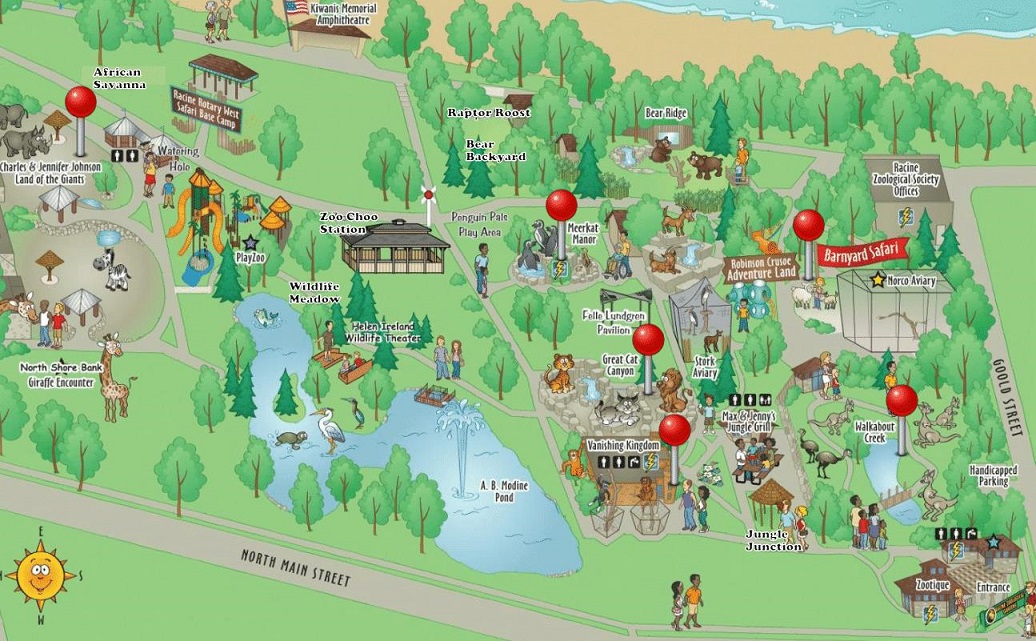
map-thumb-2015.jpg


RacineZooMap.png


These maps do not at all help when navigating these zoos.
 
Quite a lot of discussion in little time... more than I was expecting! I'll try to catch up some.

First, I was without decent Internet access during the time when you posted a similar thread @Echobeast, so I did miss that convo. Thanks for linking it, I've read some of it and will do more tomorrow when I have time. Hopefully you don't mind a second exchange on the topic here!

I would agree that SDZ and Bronx's maps are polar opposites of each other. I think Bronx's is easier to digest and read, but @Echobeast's point about ambiguous silhouettes is valid and something I had considered while preparing this thread. I'm still not of one mind on what the best way to identify animals on a map is, but these are certainly two methods of doing so.

@CGSwans' point about the scaling issues with Bronx is valid as well; I've found this to be common of large, spread-out zoos in general. Maybe it has to do with being able to fit everything on the map and maximize space?

I'm not a fan of Atlanta or Jacksonville's maps, but my feelings are not quite as strong about them. They are aesthetically unpleasing, but in terms of functionality they're decent.

Something that I like and which is not present in any of these maps are exhibit boundaries. Part of me just likes being able to compare exhibit sizes easily, but I also find it useful to know exactly where each enclosure is located, as then you know how many things there actually is to see there and where all of the viewing areas are located. I think it also looks more professional. The Saint Louis Zoo does a pretty good job of that:

Spring_2018_Map.jpg


Source: https://www.stlzoo.org/files/3215/2001/7960/Spring_2018_Map.jpg

I really like this map personally. The color coding is helpful, the silhouettes are easy to distinguish, individual enclosures are shown really well, paths and amenities are very easy to identify, and from experience I know that it is accurately scaled. It's utilitarian like the Bronx map, but much more colorful and detail-oriented.

And as a fun comparison, this is the Saint Louis Zoo map in 1968, exactly 50 years ago!
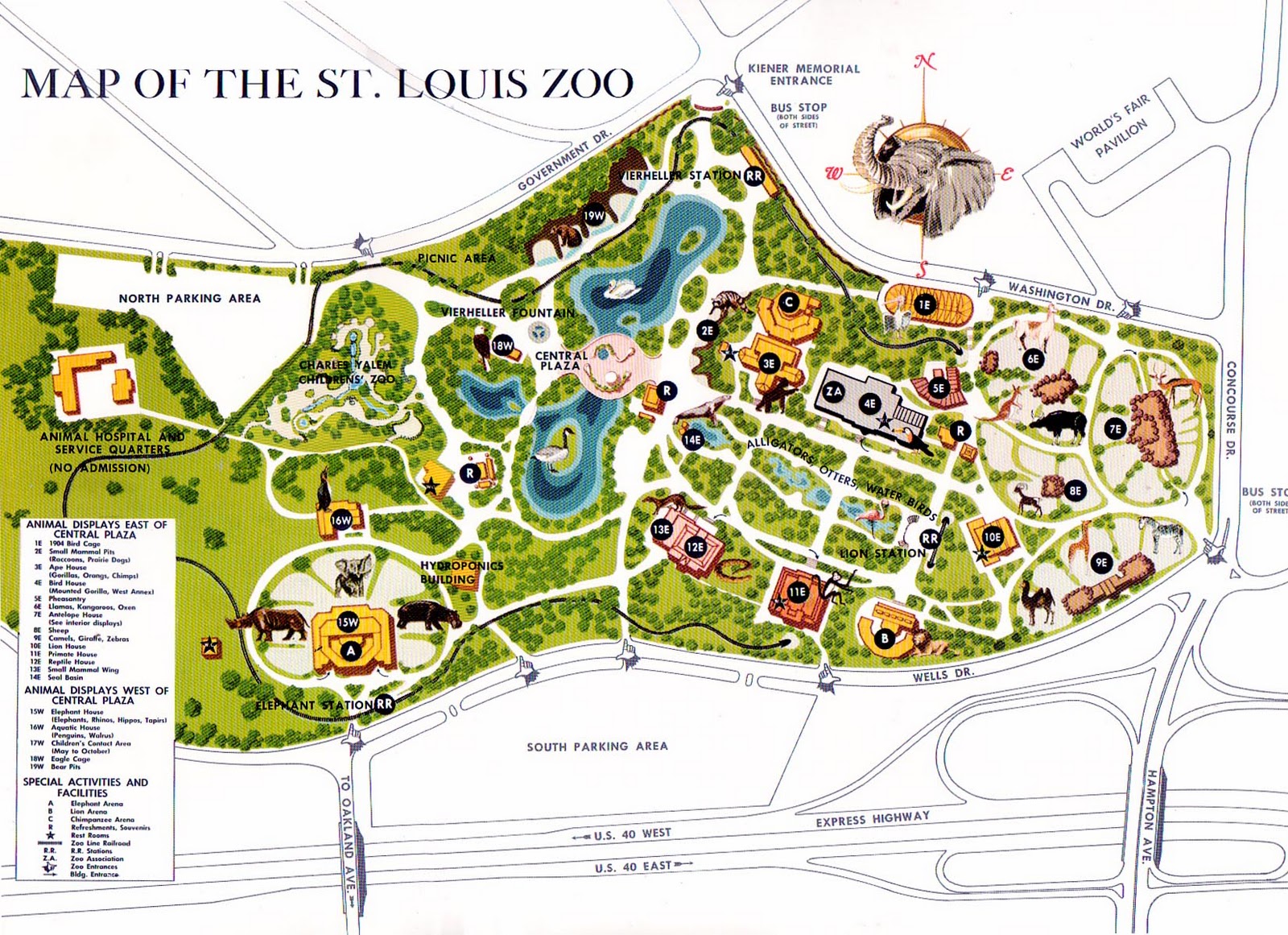
STL+ZOOmap.jpg


Source: http://3.bp.blogspot.com/_ja0u9vcxkW0/TNYHnu5kS3I/AAAAAAAAVKE/LwJegWTDZVg/s1600/STL+ZOOmap.jpg

The graininess makes it hard to look at for a long time, but otherwise I think this was a pretty good map too.
I was actually just thinking how much I hate the St. Louis Zoo map.

The problem I have with it is that, looking at the silhouettes, it can be difficult to tell what animals are where. Here are a few I prefer:

ZooMapSummer2018.jpg


BZ-Map-2017.jpg
 
Here are a couple maps that I hate:

What is the second collection?

I think that for the purposes of clarity it is essential that - at the very least - the name of the collection is provided for each map :P
 
  • Like
Reactions: TNT
What is the second collection?

I think that for the purposes of clarity it is essential that - at the very least - the name of the collection is provided for each map :p

It is the Brookfield Zoo, and agreed (although in this particular case the name of the collection is on the map).
 
I was actually just thinking how much I hate the St. Louis Zoo map.

The problem I have with it is that, looking at the silhouettes, it can be difficult to tell what animals are where.

How? The silhouettes are placed directly over the enclosures that those animals are in. Is it that the silhouettes are hard to distinguish, or that not every species and enclosure has one?

I'm not really a fan of Brookfield's map, as to me it is lacking in exact detail. The scaling is also off (not surprising, as Brookfield is 200+ acres as well) and I don't think it's aesthetically pleasing either.

The Milwaukee map is hard to view on my phone, so I'll have to wait till my laptop is booted up to comment.
 
11faaede635c0e0730565b0cd2f8109a.jpg


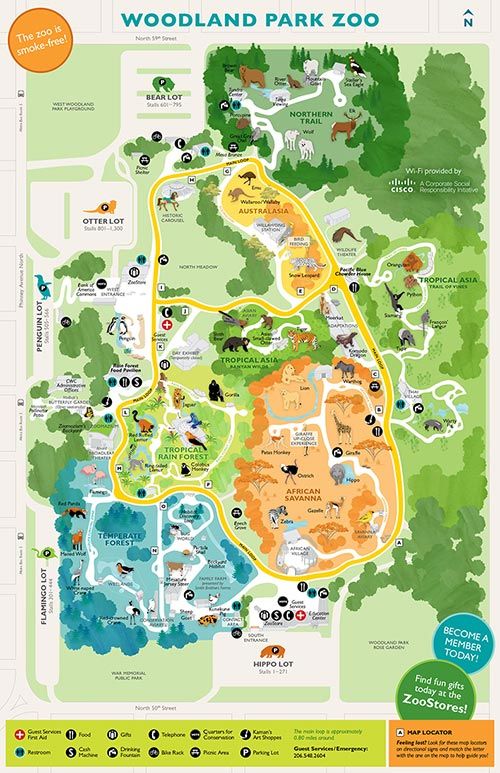
Woodland Park actually has ny favorite map of any zoo. Pictures and animals labelled, nicely defined zones and clearly defined visitor services all are great. It also shows the size of each of the parking lots, which is great as from experience at the Bronx zoo most people congregate at one lot.
 
I like the Woodland Park Zoo map. It's the first time I've seen it, but it looks very clear, paths marked out well, animals are easy to identify and locate.

For me, a map is useful both on the day (for finding animals, routes, food etc), but also for later on after a visit, to be able to look at the map again and remember the visit. A good map makes reminising and remembering so much better and more fruitful. I'm usually quite sad when a zoo doesn't provide a paper map on entry, so long as they have good maps on boards around the site.

I also like to look at previous maps, to see how a zoo has changed over the years. Many times I have poured over the book 'By Underground to the Zoo', which has a few historic London Zoo maps alongside historic London Underground posters for the Zoo.
 
upload_2018-7-12_15-37-11.png

Zoo Map - Colchester Zoo

This is the map for Colchester Zoo, a zoo notorious for it's winding paths, dead-ends and turn-backs. It does have (most) paths marked, but not all the animals are marked, especially in the top-right area, where the enclosures are smaller. On my visit we used this map extensively to try and find our way round, but we still ended up on dead-ends and missed a couple of sections. It might help is the map was broken down into areas, at present it is a very large area of green with nothing to distinguish areas of the zoo. Colchester is quite large too, so breaking it down into manageable 'chunks' on the map might help with finding things.
 
Any tips on a route when visiting Colchester? When I visit for the first time in the summer, I don't want to end up walking around and around and exhausting myself.
 
Any tips on a route when visiting Colchester? When I visit for the first time in the summer, I don't want to end up walking around and around and exhausting myself.

Without derailing the thread too much, as someone who got lost many times on my as-yet only visit, I'm afraid not! All I can say is, keep the map handy and whenever you come to a junction, check the map to see which way is the dead-end, and then follow it before going back to the junction and continuing whatever route you pick. I'm sure it takes many visits before Colchester starts to make any kind of spacial sense :p
 
How? The silhouettes are placed directly over the enclosures that those animals are in. Is it that the silhouettes are hard to distinguish, or that not every species and enclosure has one?

I'm not really a fan of Brookfield's map, as to me it is lacking in exact detail. The scaling is also off (not surprising, as Brookfield is 200+ acres as well) and I don't think it's aesthetically pleasing either.

The Milwaukee map is hard to view on my phone, so I'll have to wait till my laptop is booted up to comment.
Not enough silhouettes. Especially in Red Rocks. You can see a lot of enclosures with no silhouettes to mark them.
 
Not enough silhouettes. Especially in Red Rocks. You can see a lot of enclosures with no silhouettes to mark them.

More silhouettes would be nicer; as it stands now, it at least gets the point across that Red Rocks is primarily the zoo's ungulate area.

Here is an example of a zoo (the Seneca Park Zoo in Rochester, New York) that uses neither illustrations nor silhouettes, but instead just has numbers with a key to which animal is at which number. I have mixed feelings about this as well. On the one hand, it is easier to convey more information about specific animals and exhibits this way, and there's no ambiguity as to what something is. On the other hand, perhaps it is more difficult having to match the number to the species, rather than just looking at a picture and knowing what animal is there immediately. Just another method, I suppose. I posted the link but I can't embed it because this version is only available as a PDF file (any way ZooChat v.4 can have a workaround for this?).

https://senecaparkzoo.org/wp-content/uploads/2018/06/ZooMap_May2018.pdf?x82903
 
Here is yet another different design, from another New York zoo: the Rosamond Gifford Zoo in Syracuse. It's too cartoony for my taste, and I don't know how well-scaled it is. It's also harder to judge how well it simplifies the routes, since the zoo is just a one-path loop (or at least that's what the map conveys).

2012-Zoo-Map-FINAL-1.gif
 
Here's a dropbox for every AZA map: Dropbox - Zoo Maps - Simplify your life

Maps aren't made for people who care which of the couple of species of tapir it is, or what type of hog it is. We are in the vast minority, and people like us tend to know which of those it is before arriving. I didn't say Atlanta's images were great, but you can tell what they are.
 
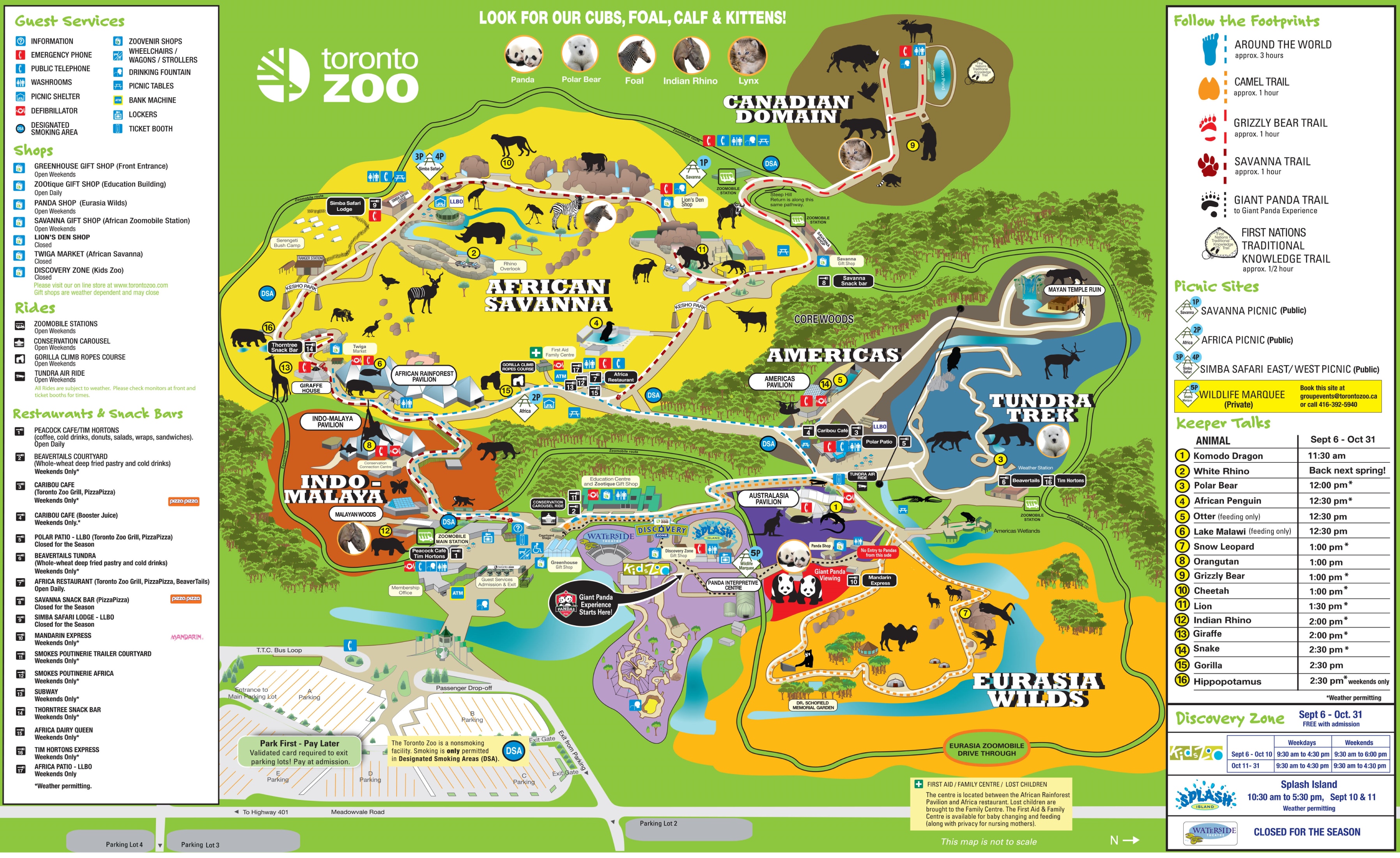
I'm not a fan of the Toronto Zoo's current map compared to its mid-2000's one. Let's take a look at the former, shall we?
toronto-zoo-map.jpg

Sure, it does show the job of showing where is where, and the colours are nice, but individual exhibits aren't highlighted.

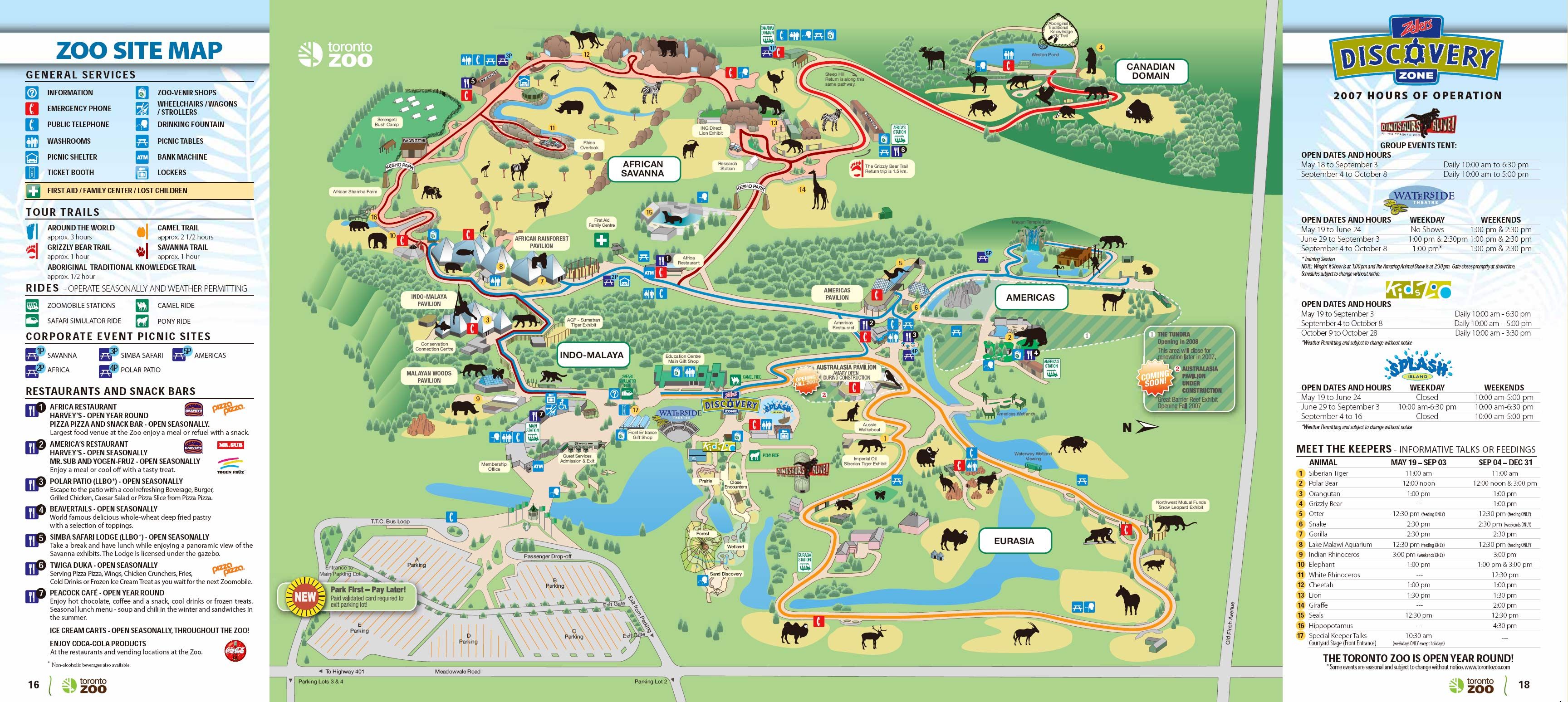
Now, look at the latter map: not only do you get a clear idea of where each individual is thanks to the shaded areas (sometimes - look at the then-elephant and hippo exhibit), not to mention you get an idea of the topography of the zoo's site

f166dda717cb32ad533ab67009d3835c.jpg


(On a side note, I still don't know why they had a generic bear graphic for the red pandas)
 
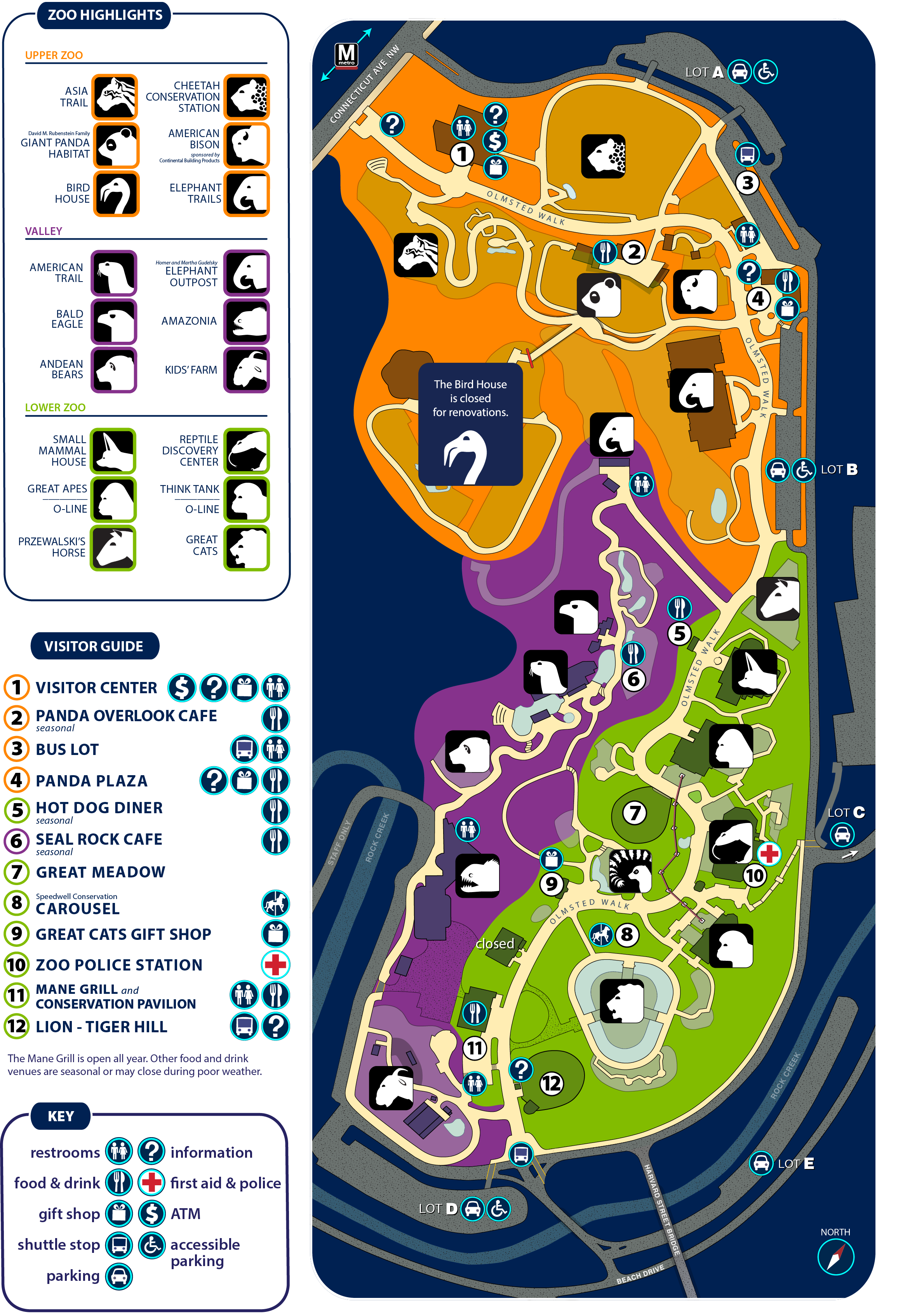
This is the National zoos current map.
2018_updated_print_version_0320.png

I think the map is awesome, mostly because it uses two of my favorite colors, green and purple (orange ain't bad either).
 
Back
Top