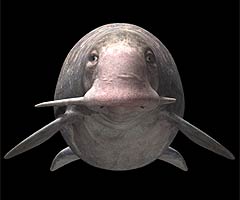
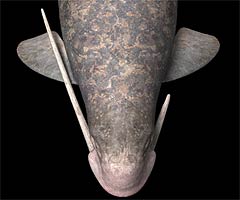
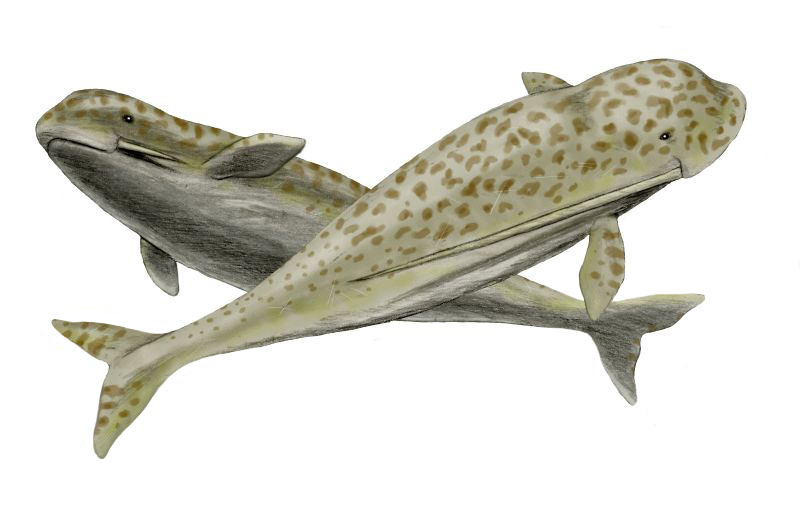
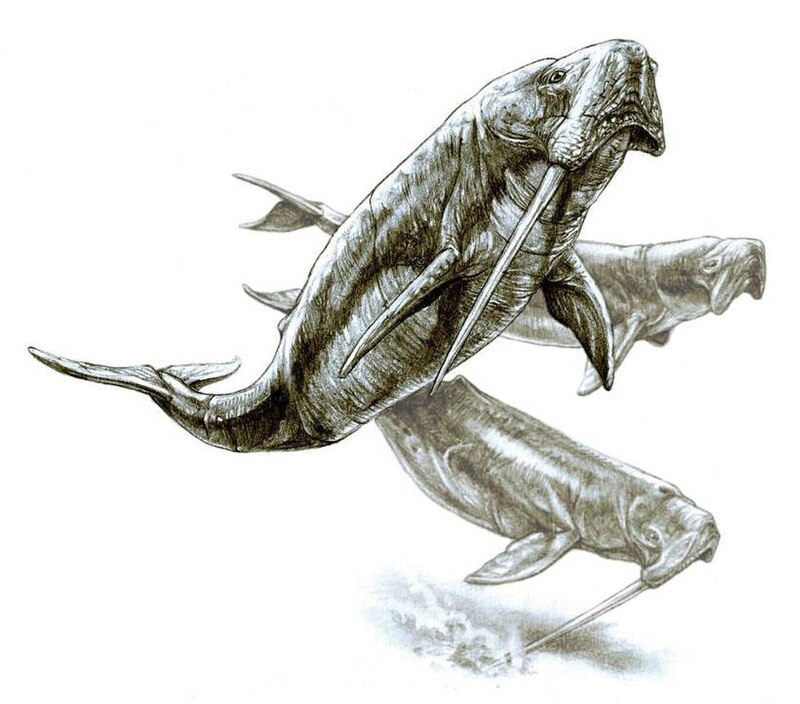
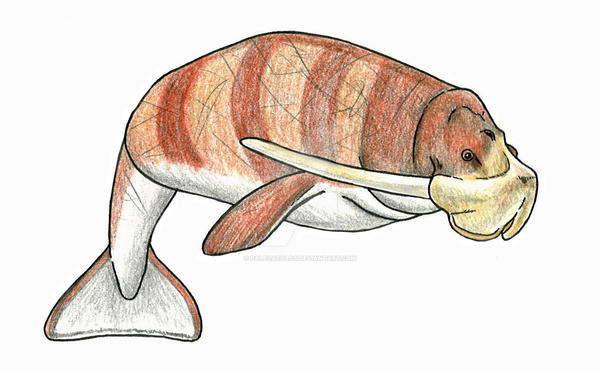
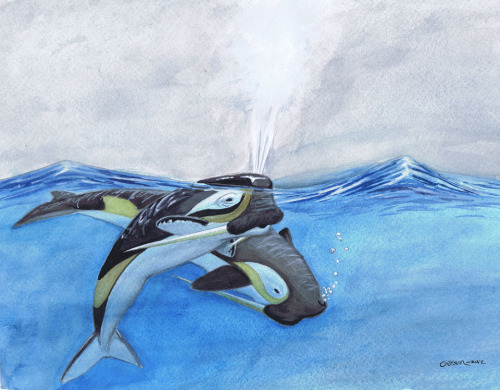
NUMBER TWELVE: It looks like a dolphin without a dorsal fin and also a walrus head, but said walrus head has some funky tusks





Picture and Information Sources:
- Animal: Odobenocetops
- Species: Two; O. peruvianus (type species) and O. leptodon
- Pronunciation: oh-doh-ben-oh-set-ops
- Name Meaning: "Cetacean that seems to walk on its teeth;" from Greek odon ("tooth") and baino ("walk"), and Latin cetus ("whale" or "cetacean") and ops ("like")
- Species Authority: Muizon, 1993
- Classification: Life, Eukaryota, Animalia, hordata, Vertebrata, Gnathostomata, Osteichthyes, Sarcopterygii, Tetrapodomorpha, Tetrapoda, Reptiliomorpha, Amniota, Synapsida, Therapsida, Mammalia, Placentilia, Boreoeutheria, Ungulata, Artiodactyla, Whippomorpha, Cetacea, Delphinoidea, Odobenocetopsidae
- When: 7,200,000 B.C.E. to 3,600,000 B.C.E. (the Tortonian stage of the Miocene epoch to the Zanclean stage of the Pliocene epoch)
- Where: South America (Chile and Peru)
- Size: 6.9 feet (2.10 meters) long
- Diet: Carnivore
Picture and Information Sources:
- My brain (no link, I'm looking at you @birdsandbats)
- Odobenocetops - Wikipedia
- BBC - Science & Nature - Sea Monsters - Fact File: Odobenocetops
- Odobenocetops Leptodon. A 2.1m (6.9ft) long toothed whale which lived during the Neogene epoch (20.45 MYA). The right tusk was 1.2 m, while the left was just 25cm long. (3.9ft-9.8in) : Naturewasmetal
- Odobenocetops Field Day
- https://www.researchgate.net/publication/324976310_Odobenocetops
Last edited: