Kakapo's Photographic Collection of Endangered Species

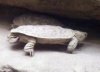
NUBIAN FLAPSHELL TURTLE - Cyclanorbis elegans
Cyclanorbis elegans.jpg

Photo taken at: Antwerp zoo, Belgium

Short taxonomy: Sauropsida > Chelonia > Trionychidae

Native range: western and central tropical Africa

Ex-situ frequence: Extremely rare

Danger factors: Mining, dams and pool construction, river course channeling, contamination, and heavy harvest of adults and egg for human food.

Other comments: Formerly it has a very wide distribution area, nowadays it's extremely fragmented. It's the most endangered of all the African turtles, and probably only survives now in the far wetlands of White Nile in south Sudan. None wild individual has been found in last 25 years, and very rarely in the last 50 years. The species is not legally protected worldwide, it doesn't occur in any protected area, it lives in area of high politic instability and is almost absent from captivity in ex-situ facilities, so the future of the species is really dark. The individual on the photo already disappeared and no members of this species are left in European zoos, I wonder if any are left in zoos from other continents (any additional info is welcome).
 

Attachments

  • Cyclanorbis elegans.jpg
    Cyclanorbis elegans.jpg
    311 KB · Views: 34
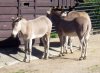
AFRICAN WILD ASS - Equus africanus
Equus africanus somalicus (12-8-13 Zoo Liberec).jpg
Equus africanus somalicus 3 (31-7-21 Oasys Mini Hollywood).JPG

Photos taken at: Liberec zoo, Czech republic and Oasys Mini Hollywood, Spain

Short taxonomy: Synapsida > Perissodactyla > Equidae

Native range: Horn of Africa

Ex-situ frequence: Common

Danger factors: Main threat is direct hunt, both for meat as for supposed medicinal purposes of their bones. Also, there is strong competence with livestock that means limited access to food and water sources, causing starvation of the most vulnerable individuals such as pregnant mares and young foals.

Other comments: Of the three subspecies of this species, one already went extinct during Roman Empire for excessive hunt. The two remaining subspecies are in inminent danger. Probably is already extinct in Somalia and Sudan and the remaining populations thrive only in a single area shared by Ethiopia and Erithrea. That would mean that the Somali subspecies, that is the one represented widely in zoos worldwide, would be extinct in the wild. In Ethiopia a reserve was especifically created for protect the asses but it's heavily used by shepherds and their livestock.
The species could be considered as Leat Concern if we include it as part of the domestic donkey species, but I considere them two separated species.

RED KAUAI ROSEMALLOW - Hibiscus clayi
Hibiscus clayi.jpg

Photo taken at: Berlin botanical garden, Germany

Short taxonomy: Magnoliopsida > Malvales > Malvaceae

Native range: Kauai, Hawaii islands

Ex-situ frequence: Rare

Danger factors: Formerly the livestock grazing was the main threat that leaded to the species to current status, but this threat has been neutered. Nowadays, main threat is competence with invasive plants (Brazilian peppertree, strawberry guava, soapbush, palm fern and scaly tree fern), followed by grazing from alien species such as pigs and rats. The species is also extremely sensitive to climate change.

Other comments: One of various similar Hibiscus species endemic to Kauai, that were discovered in 1928 by Albert W. Duvel who brought them into cultivation. This one is restricted to the Nounou mountains and only four wild individuals remain. But various plants obtained from cultivation have been planted in native area for increase the population. The plant was named honouring Horace F. Clay, a gardener and botany teacher at the Leeward Community College, in O'ahu island. So nowadays the Leeward Community College campus have a small garden with Hibiscus clayi planted and a small sign in honor of the plant.
 

Attachments

  • Equus africanus somalicus (12-8-13 Zoo Liberec).jpg
    Equus africanus somalicus (12-8-13 Zoo Liberec).jpg
    86.1 KB · Views: 35
  • Equus africanus somalicus 3 (31-7-21 Oasys Mini Hollywood).JPG
    Equus africanus somalicus 3 (31-7-21 Oasys Mini Hollywood).JPG
    140 KB · Views: 33
  • Hibiscus clayi.jpg
    Hibiscus clayi.jpg
    54.2 KB · Views: 34
NUBIAN FLAPSHELL TURTLE - Cyclanorbis elegans
I have never seen this specis in trade (or in zoos or at private collections). I have seen only Cyclanorbis senegalensis for sale, and I think one local breeder produced some, so knowledge to breed the first species in captivity should be in theory available, if they ever turn out in Europe again.
 
Other comments: Of the three subspecies of this species, one already went extinct during Roman Empire for excessive hunt. The two remaining subspecies are in inminent danger. Probably is already extinct in Somalia and Sudan and the remaining populations thrive only in a single area shared by Ethiopia and Erithrea. That would mean that the Somali subspecies, that is the one represented widely in zoos worldwide, would be extinct in the wild. In Ethiopia a reserve was especifically created for protect the asses but it's heavily used by shepherds and their livestock.

The Ethiopian and Eritrean animals are of the Somali subspecies, the Nubian subspecies is possibly extinct though, not having been seen for decades....
 
Thanks, I misinterpreted the distribution range of each subspecies. It's tragic the loss of Nubian subspecies and I hope that some population still remains :-(

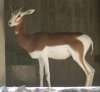
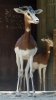
DAMA GAZELLE - Gazella dama
Gazella dama 2.jpg
Gazella dama 3.jpg

Photos taken at: Madrid zoo-aquarium, Spain

Short taxonomy: Synapsida > Artiodactyla > Bovidae

Native range: south of Saharan desert

Ex-situ frequence: Common

Danger factors: Mainly direct hunt from vehicles. The species is also sensitive to drought, diseases transmited from livestock, and civil unrest.

Other comments: First big conservation effort directed to this species was the creation of the Saharian Fauna Rescue Park in 1971 in Almeria, Spain. This facility only hold 4 species and all of them are Saharian ungulates (three gazelles plus barbary sheep), but is still one of the most important captive populations of Dama gazelles worldwide. Following the success of this reserve, a second one was founded in Chad but it was abandoned due to civil war. Currently, several zoos and facilities participate in breeding programs, and it's curious that European holders have almost only mhorr subspecies while North American ones holds almost only ruficollis subspecies. The most succesful holder is White Oak Conservation, Florida, that bred the gazelles since 1983 obtaining about 300 calves.

In 2015, a reintroduction program was taken in Safia Natural Reserve in Morocco, but the captive-bred animals were not educated for survive in the wild and do not recognize predators: of the 24 gazelles released in semi-wild conditions, three were poached and other seven were killed by dogs.
 

Attachments

  • Gazella dama 2.jpg
    Gazella dama 2.jpg
    48.2 KB · Views: 29
  • Gazella dama 3.jpg
    Gazella dama 3.jpg
    52.3 KB · Views: 29
NUBIAN FLAPSHELL TURTLE - Cyclanorbis elegans
View attachment 531912

Photo taken at: Antwerp zoo, Belgium

Short taxonomy: Sauropsida > Chelonia > Trionychidae

Native range: western and central tropical Africa

Ex-situ frequence: Extremely rare

Danger factors: Mining, dams and pool construction, river course channeling, contamination, and heavy harvest of adults and egg for human food.

Other comments: Formerly it has a very wide distribution area, nowadays it's extremely fragmented. It's the most endangered of all the African turtles, and probably only survives now in the far wetlands of White Nile in south Sudan. None wild individual has been found in last 25 years, and very rarely in the last 50 years. The species is not legally protected worldwide, it doesn't occur in any protected area, it lives in area of high politic instability and is almost absent from captivity in ex-situ facilities, so the future of the species is really dark. The individual on the photo already disappeared and no members of this species are left in European zoos, I wonder if any are left in zoos from other continents (any additional info is welcome).

Some recent information about the species in the wild :

Nubian flapshell turtle found in northern Uganda | Oryx | Cambridge Core
 
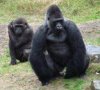
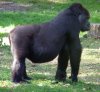
WESTERN GORILLA - Gorilla gorilla
Gorilla gorilla 4.jpg
Gorilla gorilla 2.jpg

Photos taken at: Apenheul Apeldoorn, Netherlanda and Burgers zoo, Netherlands

Short taxonomy: Synapsida > Primates > Pongidae

Native range: western tropical Africa

Ex-situ frequence: Very common

Danger factors: Main threat is poaching, both for meat as for illegal trade of alive individuals or parts of it, and even just for hate, supertitions and legends associated to the species. Other threats include disease transmision (especially Ebola virus), habitat destruction (mainly for implant oil palm plantations), and climatic change (that lead to droughts, risk of forest fires, and disorders in the seasons of maturation of shoots, buds and fruits that constitute the diet of the species).

Other comments: Despite having a very wide distribution area which includes several protected spaces in it, population of this species diminished drastically in last decades. It's an strictly protected animal and very huge conservation efforts are inverted with it (so, it's an umbrella species), but also it's a much more tempting, attractive and searched prize for illegal hunters than the not so heavily protected animals that share its habitat. Even the protected reserves suffer an unsustainable pression of illegal capture and killing of gorillas currently.

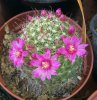
SNOWBALL PINCUSHION CACTUS - Mammillaria carmenae
Mammillaria carmenae (23-5-20 Chema).jpg

Photo taken at: a private collection in Saragossa, Spain

Short taxonomy: Magnoliopsida > Caryophyllales > Cactaceae

Native range: Tamaulipas, Mexico

Ex-situ frequence: Common

Danger factors: Harvest for illegal trade

Other comments: It has a very small native range, reduced to two contiguous localities that can be treated as a single location, in the Altas Cumbres Biosphere Reserve. The species was discovered in 1953 and brought to cultivation but individuals died and it was assumed extinct until 1977 when it was rediscovered alive by Alfred Lau. The threats and situation of this species are not exhaustively studied and the last assesment is from 2013 so it needs an update.
 

Attachments

  • Gorilla gorilla 4.jpg
    Gorilla gorilla 4.jpg
    231 KB · Views: 31
  • Gorilla gorilla 2.jpg
    Gorilla gorilla 2.jpg
    250.3 KB · Views: 28
  • Mammillaria carmenae (23-5-20 Chema).jpg
    Mammillaria carmenae (23-5-20 Chema).jpg
    337.8 KB · Views: 32
LESSER ANTILLEAN IGUANA - Iguana delicatissima
Iguana delicatissima (16-9-21 Tiergarten Schönbrunn).jpg
Iguana delicatissima 2 (16-9-21 Tiergarten Schönbrunn).jpg

Photos taken at: Tiergarten Schönbrunn, Austria

Short taxonomy: Sauropsida > Squamata > Iguanidae

Native range: Lesser Antillas, from Anguilla to Martinique

Ex-situ frequence: Rare

Danger factors: Main threat is hybridation and competence with the green iguana, that have been introduced in these islands. Other threats include habitat loss due to agricultural expansion, predation by feral dogs/cats/mongooses.

Other comments: The green iguana depletes the populations of its close relative by hybridation and competence but is not always introduced by mankind. Iguanas are famous for being travelers on rafts after storms and colonizate remote islands, and in fact this is the way the Lesser Antillean iguana had evolved. In 1995, a group of green iguanas arrived to Saint Martin island after the hurricane Luis, and by 2015 the native Lesser Antillean iguana have disappeared completely from this island due to green iguanas. One can wonder if humans should intervene in what is just natural selection and evolution. But of course, the increase of climatic disasters is due to human activity, so I guess the answer is yes.

The species is difficult to keep and breed in captivity, more than the green iguanas. Eggs are very often infertile. Jersey zoo (Durrell Wildlife Conservation Trust) was the first to obtain success in breeding this species, as late as 1997, and following this they had greater success in obtaining hatchlings, to the point that in 2016, 11 iguanas hatched in Durrell's was sent to other European zoos for strenght the captive breeding program.
 

Attachments

  • Iguana delicatissima (16-9-21 Tiergarten Schönbrunn).jpg
    Iguana delicatissima (16-9-21 Tiergarten Schönbrunn).jpg
    604.8 KB · Views: 33
  • Iguana delicatissima 2 (16-9-21 Tiergarten Schönbrunn).jpg
    Iguana delicatissima 2 (16-9-21 Tiergarten Schönbrunn).jpg
    447.6 KB · Views: 26
LESSER ANTILLEAN IGUANA - Iguana delicatissima
View attachment 532276
View attachment 532277

Photos taken at: Tiergarten Schönbrunn, Austria

Short taxonomy: Sauropsida > Squamata > Iguanidae

Native range: Lesser Antillas, from Anguilla to Martinique

Ex-situ frequence: Rare

Danger factors: Main threat is hybridation and competence with the green iguana, that have been introduced in these islands. Other threats include habitat loss due to agricultural expansion, predation by feral dogs/cats/mongooses.

Other comments: The green iguana depletes the populations of its close relative by hybridation and competence but is not always introduced by mankind. Iguanas are famous for being travelers on rafts after storms and colonizate remote islands, and in fact this is the way the Lesser Antillean iguana had evolved. In 1995, a group of green iguanas arrived to Saint Martin island after the hurricane Luis, and by 2015 the native Lesser Antillean iguana have disappeared completely from this island due to green iguanas. One can wonder if humans should intervene in what is just natural selection and evolution. But of course, the increase of climatic disasters is due to human activity, so I guess the answer is yes.

The species is difficult to keep and breed in captivity, more than the green iguanas. Eggs are very often infertile. Jersey zoo (Durrell Wildlife Conservation Trust) was the first to obtain success in breeding this species, as late as 1997, and following this they had greater success in obtaining hatchlings, to the point that in 2016, 11 iguanas hatched in Durrell's was sent to other European zoos for strenght the captive breeding program.
I think any island where Green Iguanas get to themselves they should be kept as a native species. Isn’t that how the Lesser Antillean Iguana got to these islands in the first place? IMO, it’s just as native as the Green Iguana.
 
  • Like
Reactions: MRJ
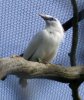
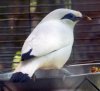
BALI MYNAH - Leucopsar rothschildii
Leucopsar rothschildii LondonZoo.jpg
Leucopsar rothschildii 2 (2-7-16 Zoo de San Diego).jpg

Photos taken at: London zoo, UK and San Diego zoo, USA

Short taxonomy: Aves > Passeriformes > Sturnidae

Native range: Bali island, Java

Ex-situ frequence: Very common

Danger factors: Main threat is poaching for the illegal cage bird market.

Other comments: This distinctive bird is the only vertebrate endemic of Bali island. It has been close to disappearing from the wild since at least 1994. Currently there are about a hundred of wild individuals, more or less the double than 15 years ago. However, the captive population worldwide is at least 10 times larger, and even private bird keepers often hold this species. The number of illegally kept individuals obtained from the black market is around the double than the legally kept ones. Reintroduction of captive bred individuals in the native island is constant and abundant, but poaching still is strong, so in a certain exent it's a vain effort. However, poaching diminished a lot thanks to exhaustive campaings of concienciation amongst local villagers, and many of the protection that this bird receive nowadays come from native communities.

ROSE PINCUSHION CACTUS - Mammillaria zeilmanniana
Mammillaria zeilmanniana (21-4-07 Zaragoza, comprada el 1-5-04 en Sopesens).jpg

Photo taken at: my garden, Saragossa, Spain

Short taxonomy: Magnoliopsida > Caryophyllales > Cactaceae

Native range: Guanajuato, Mexico

Ex-situ frequence: Very common

Danger factors: Illegal collection for the plant trade

Other comments: Very easy to care and reproduce and with abundant and showy blooming, this is one of the most classical cacti for collectors, a "beginner's species". Despite its abundance in cultivation, the species have a very small native range restricted to a single location (San Miguel de Allende), and from the discovery of the species in the 1920's to 1988, the species seemed extinct in the wild as none individual has been found. In 1988, after an exhaustive search, the collector and exporter of exotic plants Erich Georgi of Saltillo rediscovered it alive in the wild. There are less than 250 mature plants growing here, in a narrow isolated passage of volcanic rock.

In case of considering Mammillaria zeilmanniana as just a form of Mammillaria crinita as some recent researcher purposes, then the whole species would be Least Concern.
 

Attachments

  • Leucopsar rothschildii LondonZoo.jpg
    Leucopsar rothschildii LondonZoo.jpg
    56.8 KB · Views: 32
  • Leucopsar rothschildii 2 (2-7-16 Zoo de San Diego).jpg
    Leucopsar rothschildii 2 (2-7-16 Zoo de San Diego).jpg
    146.2 KB · Views: 30
  • Mammillaria zeilmanniana (21-4-07 Zaragoza, comprada el 1-5-04 en Sopesens).jpg
    Mammillaria zeilmanniana (21-4-07 Zaragoza, comprada el 1-5-04 en Sopesens).jpg
    93 KB · Views: 34
PANKACE TORTOISE - Malacochersus tornieri
Malacochersus tornieri (11-8-13 Zoo de Plzen).jpg

Photo taken at: Plzen zoo, Czech republic

Short taxonomy: Sauropsida > Chelonia > Testudinidae

Native range: Kenya and Tanzania

Ex-situ frequence: Common

Danger factors: Main threat is overharvest for the pet trade. In a lesser exent, rock extraction (for building, etc) and intentional fires oriented to destroy vegetation.

Other comments: The capture of this species affects its populations more easily than other tortoises because the species have little mobility (small home range and high site fidelity, what makes harder to recolonizate areas) and very low reproductive rate (due to the shape of the carapace, females only lay one egg each reproductive season). As the species is specialist that are found only in certain microhabitats, whole population in each microhabitat can be easily depleted by a single collecting event. Fortunately, the creation of turtle farms in Tanzania and Kenya allowed them to export captive-bred individuals, thus alliviating the impacts on wild population. Despite it's low reproductive rare, the species is quite common now in European and North American zoos.
 

Attachments

  • Malacochersus tornieri (11-8-13 Zoo de Plzen).jpg
    Malacochersus tornieri (11-8-13 Zoo de Plzen).jpg
    42.8 KB · Views: 26
I think any island where Green Iguanas get to themselves they should be kept as a native species. Isn’t that how the Lesser Antillean Iguana got to these islands in the first place? IMO, it’s just as native as the Green Iguana.

I could not agree less. Given the source populations of these animals are the introduced populations elsewhere in the Lesser Antilles, this is exactly the same as any other invasive species expansion.

The highly destructive Common Starling was introduced to the United States and flew from there to Bermuda. Should it be considered native to Bermuda?
 
I could not agree less. Given the source populations of these animals are the introduced populations elsewhere in the Lesser Antilles, this is exactly the same as any other invasive species expansion.

The highly destructive Common Starling was introduced to the United States and flew from there to Bermuda. Should it be considered native to Bermuda?
I retract the comment then, I was under the impression the source populations were native. They are without a doubt invasive then.
 
  • Like
Reactions: MRJ
EUROPEAN MINK - Mustela lutreola
Mustela lutreola 2 (23-7-17 Zoo Madrid).jpg

Photo taken at: Madrid zoo-aquarium, Spain

Short taxonomy: Synapsida > Carnivora > Mustelidae

Native range: Europe

Ex-situ frequence: Common

Danger factors: Mainly competence with the introduced American vison that escaped from pelt factories, as well as diseases transmited by the latter species (mainly the viral Aleutian Mink Disease, but also others).

Other comments: The shrinking of the distribution map is heartbreaking (see map, it's extinct in all the red area). In some areas, the decline is previous to the introduction of American mink, what means that other factors also are threatening the species, such as river ecosystem destruction by drainage and agricultural development. However the American mink, larger and more competitive, is the main threat. It does not only compete directly and transmit diseases to the European species (and sometimes even predates it), but it also mates with it, and when a male American mink copulates with a female European mink, the embryos of the latter are reasbsorbed and thus the female is unable to reproduce latter with males of its own species.

First program of captive breeding and recovering was leaded by Tallinn zoo and Foundation Lutreola, both in Estonia, it started in 1992 and their about 250 minks produced several offspring since then. Following this, several countries released conservation,protection and captive-breeding programs, including Spain, France, Germany and Romania. A collaboration and coordination of all these single-country programs into a bigger whole iniciative is needed for a real effectivity of the efforts combined.

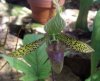
SUKHAKUL'S SLIPPER ORCHID - Paphiopedilum sukhakulii
Paphiopedilum sukhakulii (Munich).jpg

Photo taken at: Munich botanical garden, Germany

Short taxonomy: Liliopsida > Asparagales > Orchidaceae

Native range: Northeastern Thailand

Ex-situ frequence: Rare

Danger factors: Habitat destruction and degradation via logging, deforestation, trampling, recreation and disturbances. Also but in a lesser degree, collecting for the horticultural trade.

Other comments: It's one of the most heavily traded ornamental plants of Thailand, and wild individuals are collected both for local and international horticulture trade. Found only in the Mount Phy Luang Mountains, this species have a quite small native range restricted to a single subpopulation that only contains about 50 individuals. In just a decade, the 95% of its population have been extirpated.
 

Attachments

  • Mustela lutreola 2 (23-7-17 Zoo Madrid).jpg
    Mustela lutreola 2 (23-7-17 Zoo Madrid).jpg
    65.8 KB · Views: 29
  • Paphiopedilum sukhakulii (Munich).jpg
    Paphiopedilum sukhakulii (Munich).jpg
    65.8 KB · Views: 31
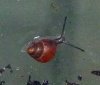
(one of the) POLYNESIAN TREE SNAIL - Partula affinis
Partula affinis (24-9-18 Artis).jpg

Photo taken at: Artis royal zoo, Netherlands

Short taxonomy: Gastropoda > Stylommatophora > Partulidae

Native range: Tahiti island, Polynesia

Ex-situ frequence: Very rare

Danger factors: Introduction in their native range of the South American carnivorous snail Euglandina rosea, that predates only in other snails

Other comments: This genus had 72 species all of which were endemic to Polynesia. 47 of them has been already completely exterminated due to the introducition of the carnivorous snails. The remaining species are almost all extinct in the wild, critically endangered or at least endangered. This species, formerly widespread over the whole Tahiti island, has been now extirpated from all except Faaroa Valley on the Peninsula of Tahiti Iti, it's last reduct. The carnivorous snail already reached that valley, but it seems failing to spread in it for unknown reasons, allowing the native P. affinis to remain extant. In this valley has been instaurated a reserve for the species, but said reserve was quickly destroyed by a rockfall.
 

Attachments

  • Partula affinis (24-9-18 Artis).jpg
    Partula affinis (24-9-18 Artis).jpg
    223.8 KB · Views: 34
(one of the) POLYNESIAN TREE SNAIL - Partula affinis
View attachment 532574

Photo taken at: Artis royal zoo, Netherlands

Short taxonomy: Gastropoda > Stylommatophora > Partulidae

Native range: Tahiti island, Polynesia

Ex-situ frequence: Very rare

Danger factors: Introduction in their native range of the South American carnivorous snail Euglandina rosea, that predates only in other snails

Other comments: This genus had 72 species all of which were endemic to Polynesia. 47 of them has been already completely exterminated due to the introducition of the carnivorous snails. The remaining species are almost all extinct in the wild, critically endangered or at least endangered. This species, formerly widespread over the whole Tahiti island, has been now extirpated from all except Faaroa Valley on the Peninsula of Tahiti Iti, it's last reduct. The carnivorous snail already reached that valley, but it seems failing to spread in it for unknown reasons, allowing the native P. affinis to remain extant. In this valley has been instaurated a reserve for the species, but said reserve was quickly destroyed by a rockfall.
That species actually does have a specific common name - the Similar Partula.
 
Thanks, it easily can win the price to the less imaginative common name in the world, if we can call it a common name :P so maybe is better to keep it as above :)

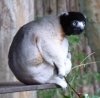
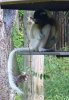
CROWNED SIFAKA - Propithecus coronatus
Propithecus coronatus (23-9-18 Apenheul).jpg
Propithecus coronatus 2 (23-9-18 Apenheul).jpg

Photos taken at: Apenheul, Apeldoorn, Netherlands

Short taxonomy: Synapsida > Primates > Lemuridae

Native range: Madagascar

Ex-situ frequence: Rare

Danger factors: Mainly habitat destruction, overall by the infamous slash-and-burn agriculture so typical of Madagascar. The forest are also destroyed for obtain wood and charcoal.

Other comments: The 2009 political crisis in Madagascar lead to more habitat destruction within protected spaces and more illegal bushmeat hunting. In some places, traditional taboos protect this species from hunting but in the vast majority of sites where it occurs, it's hunted, and in every place where the species occurs, there is habitat destruction in various degrees. Only a bunch of European holders have this species ex-situ, summarizing about 16 individuals in total (in North America the holders focus in Coquerel's sifaka instead crowned one). Despite the low numbers in captive breeding programs, the breeding is usually successful, and it could lead to strong captive population in the future with the combined efforts of various institutions.
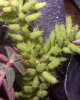
CLUMPY MISTLETOE CACTUS - Rhipsalis mesembryanthemoides
Rhipsalis mesembryanthemoides (6-6-08 Luis Doblado).jpg

Photo taken at: a private collection in Malaga, Spain

Short taxonomy: Magnoliopsida > Caryophyllales > Cactaceae

Native range: Rio de Janeiro, Brazil

Ex-situ frequence: Very common

Danger factors: Urbanization

Other comments: Probably the whole native habitat within species range have been urbanized, the species survives in the wild now by growing in public park trees! The conservation of the species is now entirely dependent of the management of these urban parks. Parque Laje is apparently the park holding a strongest population. The species is very common in horticultural trade as it's attractive and extremely easy to reproduce asexually - about a couple a weeks ago I even saw one for sale in a Chinese bazaar, mixed with other little common succulents.
 

Attachments

  • Propithecus coronatus (23-9-18 Apenheul).jpg
    Propithecus coronatus (23-9-18 Apenheul).jpg
    173.2 KB · Views: 25
  • Propithecus coronatus 2 (23-9-18 Apenheul).jpg
    Propithecus coronatus 2 (23-9-18 Apenheul).jpg
    316.4 KB · Views: 31
  • Rhipsalis mesembryanthemoides (6-6-08 Luis Doblado).jpg
    Rhipsalis mesembryanthemoides (6-6-08 Luis Doblado).jpg
    49.5 KB · Views: 32
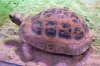
MADAGASCAR SPIDER TORTOISE - Pyxis arachnoides
Pyxis arachnoides (26-9-18 Pairi Daiza).jpg

Photo taken at: Pairi Daiza, Belgium

Short taxonomy: Sauropsida > Chelonia > Testudinidae

Native range: south Madagascar

Ex-situ frequence: Common

Danger factors: Slash-and-burn agriculture, once more. Also, invasive plant species leading to strong changes in their native habitat, that is the unique Madagascar Spiny Forest. The species is also harvested for food, especially once the larger Radiated Tortoise have been exterminated from an area changing the target by this smaller species. Recently, it has been instaurated a demand of the livers of this species from Asia.

Other comments: A tortoise and turtle refugee and breeding centre in Madagascar, called Village de Tortues de Mangily, was and probably still is a keystone in the production of a global captive population for this species. Breeding in captivity is not especially difficult and the species thrive even in private hands, tough currently it's a barely accesible species for the private keeper. For the captive breeding is essential to mimic the humidity regime of their natural habitat. Reproductive rate is very low, with only one egg laid by breeding event per female. The species is considered one of the 25 most endangered testudines in the world. The populations of each of the 3 subspecies are heavily fragmented, what limits the genetic flow.
 

Attachments

  • Pyxis arachnoides (26-9-18 Pairi Daiza).jpg
    Pyxis arachnoides (26-9-18 Pairi Daiza).jpg
    358.9 KB · Views: 29
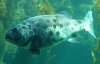
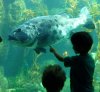
GIANT SEABASS - Stereolepis gigas
Stereolepis gigas (12-7-16 Birch Aquarium).jpg
Stereolepis gigas size (12-7-16 Birch Aquarium).jpg

Photos taken at: Birch Aquarium, California, USA

Short taxonomy: Osteichthyes > Perciformes > Serranidae

Native range: Pacific coast of southern North America, also reported from Japan

Ex-situ frequence: Rare

Danger factors: Overfishing

Other comments: Once common, it already went extinct locally in part of its range since the 1980's. The impressive size it can reach (the photo with the kids doesn't make it justice, in real I was atonished by this colossus!) made it a very popular game fish. This species is especially sensitive to overfishing due to its slow regeneration, the habit of spawning aggregation, and the limited native range. The species was banned from fishing in California since 1982, tough accidental captures are allowed. As result of this protection, the population slightly recovered a bit. In Mexico, the species is still fished legally. The Aquarium of the Pacific was the first to succeed in captive breeding the species, in 2016. I guess the species is not displayed in any facilities far from native range, and the ones within native range are scarce and usually displays solitary individuals, which don't allow breeding.

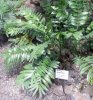
RED DWARF CYCAD - Zamia pygmaea
Zamia pygmaea (12-8-13 Botánico de Liberec).jpg

Photo taken at: Liberec botanical garden, Czech republic

Short taxonomy: Cycadopsida > Cycadales > Zamiaceae

Native range: western Cuba, including Pinos island

Ex-situ frequence: Rare

Danger factors: Agricultural expansion for implement farming and ranching areas, plus deforestation. In a lesser exent also harvesting of individuals for the horticultural trade.

Other comments: The smallest of all cycads, and the most xerophytic within the large genus Zamia, this species have a small native range and is estimated that no more than 250 mature individuals remain. Three protected areas falls within native range of the species. The species is not traited in detail in the IUCN pages and the threats, protection and conservation sections needs updating.
 

Attachments

  • Stereolepis gigas (12-7-16 Birch Aquarium).jpg
    Stereolepis gigas (12-7-16 Birch Aquarium).jpg
    95.5 KB · Views: 24
  • Stereolepis gigas size (12-7-16 Birch Aquarium).jpg
    Stereolepis gigas size (12-7-16 Birch Aquarium).jpg
    71.5 KB · Views: 28
  • Zamia pygmaea (12-8-13 Botánico de Liberec).jpg
    Zamia pygmaea (12-8-13 Botánico de Liberec).jpg
    111 KB · Views: 27
Last edited:
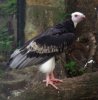
WHITE-HEADED VULTURE - Trigonoceps occipitalis
Trigonoceps occipitalis 2 (20-8-11 Tierpark Berlin).jpg
Trigonoceps occipitalis (26-9-18 Pairi Daiza).jpg

Photos taken at: Berlin zoo-aquarium, Germany and Pairi Daiza, Belgium

Short taxonomy: Aves > Accipitriformes > Accipitridae

Native range: Africa

Ex-situ frequence: Common

Danger factors: Habitat destruction for agricultural expansion, and decreasing of large mammal populations whose carcasses are needed for this species. In a lesser exent, poisoning with baits, mainly oriented to kill mammals, but also directly oriented against vultures for prevent drawing attention to poaching activities.

Other comments: The species is quite sensitive to habitat alteration, much more than other vultures and hence habitat destruction is a more serious threat than poisoning, or poaching for other reasons. Despite an enormous area of distribution on most of subsaharian Africa, it went extinct from several large areas in it. The species is highly concentrated in protected spaces as a result of that. Still relatively common in European zoos, but it almost disappeared from North American zoos. It also thrives in a few Asian zoos such as Eco Green Park. Some of these facilities obtained breeding success, such as Attica, Rotterdam, Oliemeulen or Beekse Bergen, so the species have still a relatively strong captive population.
 

Attachments

  • Trigonoceps occipitalis 2 (20-8-11 Tierpark Berlin).jpg
    Trigonoceps occipitalis 2 (20-8-11 Tierpark Berlin).jpg
    61.6 KB · Views: 27
  • Trigonoceps occipitalis (26-9-18 Pairi Daiza).jpg
    Trigonoceps occipitalis (26-9-18 Pairi Daiza).jpg
    285.5 KB · Views: 28
Last edited:
Back
Top