Day 6. The Hanseactic city of Krakόw
‘Hanze’ means troop or band in old German. The Hanseatic League was a medieval cooperative organization between merchants from towns more or less located around the North and Baltic Seas. Krakόw was the southernmost and inland member. It was also the very first royal city in Poland and the entire historic old town is now a World Heritage Site and particulary worth visiting. You can easily spend here 2 to 3 days and visit other interesting places nearby like the Wieliczka Salt Mine, Auschwitz concentration camp, the Schindler factory and the socialist-realist architecture of the Nowa Huta suburb.
#11 Ogrόd Zoologiczny w Krakόwie – Krakόw Zoo
The zoo was established in 1929 but the city has a much longer tradition of menageries, just because of its history as the seat of the first kings. For instance, the first lions came to the city as early as 1406 and a royal menagerie with camels, lions, leopards, monkeys, etc. was set up on the Wawel Hill, the centre of royal power, in the Middle Ages. That menagerie fell into disrepair with the move of the royal seat to Warsaw but in the 18th and 19th centuries the city saw a number of private zoos.
The zoo is nowadays located in the 420ha Wolski forest, a sloping forest intersected by streams and deep ravines. In the forest, besides the zoo, other attractions include a monastery, a castle and the artificial Pilsudski hill.
I arrived before the opening hour and again someone came running up to me shouting loudly that parking here was paying. He was particularly annoyed when I asked if he could speak English and he said he did .
You can briefly describe the zoo layout as a long straight avenue with parallel paths on either side, and a more wooded area with a circular walkway at the end.That avenue with some formal landscaping runs perpendicularly through the zoo and fits in perfectly with its surroundings. Outdated someone wrote. Beautiful I thought. Although there are certainly things to be said about it.
 Elephants
, it seems, are again and again a tragedy in Poland. Often there are only 2 of them, in terrible outdated barracks and small concrete outside enclosures. In Kraków, unfortunately, it is no different. I don't see an immediate future for these animals in this zoo.
The
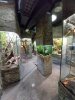
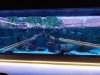
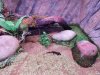
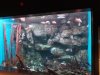
Reptile House is no better off. I have seen many really good reptile and fish exhibits during this trip, but Kraków was not among them. It is a small ramshackle building where you walk around in a square, past small and often unkempt terraria (and a few aquaria). There are few really interesting species to be found, and apart from a few nice turtles (McCord's snake-necked turtle, New Guinea snapping turtle) it was mainly my daily dose of red-footed turtle and leopard gecko. The visitors' area was also narrow and uncomfortable. For a full species list, see my next post.
The
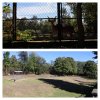
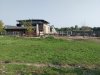
Monkey Building is nearby, and it has obviously been renovated, which I'm sure is a big improvement over before. But it has particularly small outdoor enclosures for the large species they keep here: Javan lutung, Mandrill, Black Crested Mangabey, Mantled Colobus and Lar Gibbon. Too bad, as everything looks quite new. In terms of architecture, I think it is really ok: the austere construction with its fresh white colour does fit into this setting. Opposite the monkey house is a large construction site for what I think will be a new chimpanzee house. Construction already seemed well advanced and people were busy working on the outside enclosure. The building looks impressive, but I fear the outdoor enclosures will again be on the small side. However, it would be nice if at least the mandrils would also find a home here.
 Black crested mangabey (Lophocebus aterrimus) enclosure
Not a good start, but things get quickely better by a new
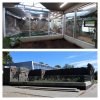
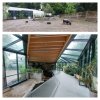
Pygmy Hippo House (2015) with a large outside enclosure. The accessible building lies on an off-shoot and is neat, with two compartments (again - on the small side). Outside are more enclosures for Lechwe, Barbary sheep and Prezwalski horses.
 Western Pygmy Hippo (Choeropsis liberiensis liberiensis) House
Then a hidden gem appear. The
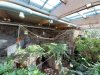
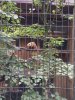
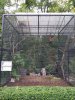
Small Mammal House is one of the most interesting buildings in the zoo. I have seen quite a few of these buildings during this trip, and this was definitely one of the better. At the front are four tall cages, all well planted and equipped with climbing structures for binturong, coatis and tree porcupines, while at the back is the entrance to a
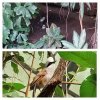
Nocturnal House. This was unexepected, and more importantly, it was a genuine highlight , with a very nice species list: Northern Luzon giant cloud rat, Kinkajou, Senegal bushbaby, Brushtail possum, Egyptian fruit bat, Common rock hyrax, Large hairy armadillo and Pygmy slow loris. Sugar glider also were signed but I didn’t see them. The hyrax also have an outdoor cage. The building consist of just 1 corridor with 6 enclosures, all of decent size and pretty well designed. Outside, there’s a final enclosure for golden lion tamarin, white-fronted marmoset and two-toed sloth.
 Senegal Bushbaby (Galago senegalensis)
Past small owl aviaries and a large one for Manchurian cranes, it's on to the felines. Cats are Krakόw's speciality, with as many as 14 species (of which I saw 13). The enclosures for the 5 species from the genus
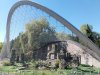
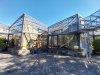
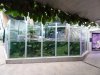
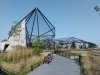
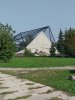
Panthera are new and consist of large curved steel pylons to which nets are stretched. On show are jaguar, snowleopard, Siberian tiger, Asiatic lion and North Chinese leopard. These enclosures looked good and they were well designed with plants, trees and trunks, grass, water features, rocks and scratching trees. But I think those for tigers and lions looked on the small side, while there’s no second enclosure for any of the solitairy species. It is something I’ve seen before: it appeared to me that many of the new structures in Polish zoos don’t excel in size. This is certainly the case in Krakόw for all new enclosures. Stylistically, this carnivore complex looks very nice and it fits perfectly into the same style found at the pygmy hippo building and the new aviary complex. It doesn't have to be like in every zoo, but I think the new projects in krakόw show a clear coherence.
 Asiatic lion enclosure
 North China leopard (Panthera pardus japonensis)
The back part of the zoo consist of forest and has almost no formal park layout. You can tour a large aviary for
great curassow (a species that is ubiquitous in Polish zoos), a children’s zoo with some aviaries, and large enclosures for Milu, nilgau, barasingha and forest reindeer, among others. In the middle of this forest is a small cafeteria, which is also the only dinning place in the zoo.
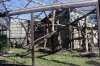
After an old cage for Pallas cat it’s a large old-fashioned aviary that draws attention. It has a slightly odd chape: at the back, with an artificial rock focus point, it is at its lowest and then rises to a very respectable height and its length allows the birds to flit around a bit. It houses a pair of
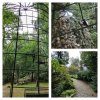
Andes condor. The zoo has another breeding pair in an off-show aviary. Anyway, this is exactly the kind of historical architecture I was hoping to see on this trip.
 On-show and off-show Andes condor (Vultur gryphus) aviaries
The
Giraffe House is a letdown on the outside: yet another barren lawn surrounded by a small wall. It is bizarre how many times I’ve seen a boring giraffe enclosure in Poland. But inside the building is warm and cosy with lots of wood, a nicely decorated visitor area with plants, exceptionally good info panels and a viewing platform. I noticed more than once during this trip that you can find remarkably good information signs in Poland, even in the smallest zoos. It was no different in Kraków, where there were large info panels scattered all over the garden about camels, giraffes, etc.
A lane that runs along the edge of the zoo passes the stables for South American lowland tapir and Chapman zebra, both which have beautifull enclosures. The zoo has a very large collection of
small carnivores, but most are kept in enclosures that are too small and/or severely outdated. However, I understood that improvement is on the way, and the zoo was already working on new enclosures for maned wolves. Still, it is nice to see all these species: Polar fox, Jaguarundi, ocelot, Geoffroy's cat, Arabian sand cat, Common genet, Fennek, Serval, European wild cat, Pallas' cat, Tayra, Bat-eared fox and European otter. The Meerkats and Yellow mongooses had already given a new enclosure some distance away. A short ascending path connects two parallel lanes and here the cages, although nicely decorated, are really terribly tiny, not only for the Fennec foxes and Geoffroy's cats but also for the Steppe eagles. A real shame, as they seemed to me to be more recent and very well cared for.
 Ocelot enclosure
A somewhat outdated enclosure for Eurasian otter is the prelude to the zoo’s
bird department, which starts with a spacious aviary for Scarlet ibis, African spoonbill, Comb duck and others. A series of island encosures/aviaries contain species like Hawaiian goose, ducks, Great white pelican, Grey crowned cranes and Ring-tailed lemur. Oppose those is the zoo’s Pheasantry which should be by now, with the opening of the new bird complex, at least partially empty.

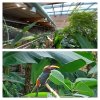
Krakόw's bird department consists mainly of species often found in zoos, with a few exceptions such as the Australian Hardhead, Sumbawa Forsten's lorikeet and Southern festive amazon, all three obtained from Prague in 2024, as well as Red-breasted parakeet and Red-breasted toucan. Many of these species were not on show during the time of my visit, but they should be now.
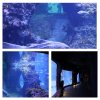
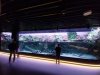
The central avenue is most reminiscent of a classic zoo with its well-maintained landscaping. It starts at the entrance and first passes by the birds, elephants and reptiles. Then there’s a series of beautiful ungulate enclosures (Mishmi takin, Chapman zebra, Ellipse waterbuck, western sitatunga, etc.). Halfway there is a really stunning new
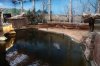
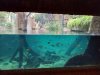
penguin enclosure with a great vantage point on Common waterbucks and other nearby enclosures.

There is also an outdated monkeyhouse to be found, and enclosures for Vicunha, Common eland, Ostrich, our Bennett friends and one of my favourites, Roan antelope.
I unexpectedly had a very nice time in Kraków. Of course, the place is far from perfect, and I can see why some consider it an old-fashioned zoo, but I actually experienced it as a very charming place. The recent developments are clearly an improvement in terms of animal welfare, and what pleases me is that all new structures have great architectural consistency (althoug they are all too small). The weaknesses seem to be eliminated one by one and I would definitely want to return here in 10 years.
And if you like carnivores, well, this place has 27 species and that list does not include a single pinniped after the departure of the South American sea lions.

 there's three in the zoo itself!