Philippine eagle spotted above Poland and Eastern Germany

Did you know Wroclaw is famous for its gnomes in the cityscape? I certainly didn’t before this trip. The first one only came in 2001 as a tribute to a playful resistance organization (Orange Alternative - Wikipedia) and in 2024 there are more than 800 to be found in the city. I didn’t see any, they probably do not like mad hotel managers.

I don't know how you missed them to be honest :D there's three in the zoo itself!

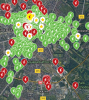
I have an app to track my gnome sightings when visiting the city, this is my current sighting map where the city centre is concerned:

Screenshot_20241227-131626.png

Seen over 500 so far, with a total of about 600 more to see in the city outskirts and in other parts of Poland and Europe as a whole!
 

Attachments

  • Screenshot_20241227-131626.png
    Screenshot_20241227-131626.png
    594.1 KB · Views: 227
Day 4. #6 Wroclaw Zoo – The Afrykarium (part 2)

So, what about the Afrykarium (2014)?

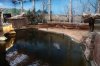
This massive 160x60m black box is plopped down like an outsized shopping mall in the middle of the zoo. It is a cheeky and modern construction, certainly not ugly in itself but because no effort has been made to integrate it in the garden, it’s very ubiquitous. There are already at least a few points that bother me on the outside. When rain is pouring down and you’re at the wrong side, don’t think about quickly fleeing into the building. In fact, the designer liked the idea of creating an elongated modern pond in front of the building with no bridge, forcing visitors to the side, only to return tot the entrance located in the middle. Sounds a bit theatrical of course, but when you've already visited the entire garden, have tired feet and are in danger of getting soaking wet, you curse a bit . At the back, two sublime large pools for Cape fur seals and African penguin can be found, separated by a ship-shaped protrusion that houses restaurants, cold-water aquariums and underwater views.

upload_2024-12-28_14-5-24.jpeg
At the back of the Afrykarium - Cape Fur seal pool

Inside, it’s the same feeling: it's more like stepping into a theatre or concert hall, a kind of lounge-like space with some plant compartments that eventually contain animals (turtles, but e.g. just ducks too). Lots of concrete, glass and a wooden roof construction. The tour starts (and ends) here, then goes down for a while and reappears at the back of the lounge, where you walk from one part to the other through a bizarrely narrow passageway. I don't quite understand why this was built this way and how 1.7 million visitors are supposed to pass through here.

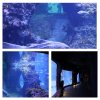
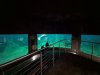
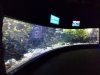
Anyway, just like the sublime Burgers' Ocean, visitors start at the "beach", which is a turtle enclosure here, and then dive into the sea past a large aquarium dedicated to the Red Sea. Unfortunately, the many viewpoints are placed in such a way that cross-viewing is inevitable, this is certainly not well thought out here. Why spend so much money and make such a crucial mistake is beyond me.

upload_2024-12-28_13-43-46.jpeg
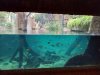
Red Sea tank

Then you go to the hippo underwater view where everyone stands endlessly waiting for a hippo to swim by. If you are really lucky, it gives the purification plant some extra work.

upload_2024-12-28_13-44-26.jpeg

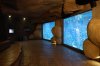
After that it getting much better, although the first reservation on seeing the aardvarks' underground lair is that it is quite small. Rounding the corner two impressive meters high Tanganiyka and Malawi tanks are very good, although they clearly need to develop furtheron.

upload_2024-12-28_13-47-5.jpeg

Lake Malawi (left) and Lake Tanganiyka (right)

Staircase or lift brings everyone into the large hippo enclosure. You can argue endlessly about whether these animals need an outdoor enclosure or not (it could still get there), but this enclosure is already very large, with plenty of both swimming and land area. But I liked much more the other stuff here: Kirk dikdik's, for example, in a rather too open enclosure, Cape ground squirrel and a large open hole, which is the entrance to the previous seen aardvark den. And you can have a very enjoyable search for birds in this spacious hall. There are a lot of them: European golden oriole, yellow-necked francolin, African openbill, cattle egret, hammerhead, Hadada ibis, white-faced whistling duck, marbled duck, Cape teal, African pochard, African spoonbill, laughing dove, red-billed quella, yellow-crowned bishop, white-headed buffleback weaver and black faced go-away-bird. I can't figure out why people stand for 10 minutes staring at a lazy sack of bacon splashing some turds in the water every other hour, while all around this place was bustling with bird life.

upload_2024-12-28_13-47-36.jpeg

upload_2024-12-28_14-0-47.jpeg
Red-billed quelea

After the hippos it’s back to the sea. The Mozambique Channel shark tank is the largest inside the Afrykarium and is focusing on sharks, sea turtle, guitarfish and other . They did a better job here as cross-sights are less present.

Then all of a sudden visitors are back in the Atrium and walk around the back of stairs and lift shafts to the other side. Under those stairs is a kind of papyrus swamp representing the Okavango marshlands, with fish and Hottentot ducks. Upstairs is a nice coffee bar, restaurans and observation decks. There is a sort of shipwreck extension at the back of the building. This separates the Cape fur seals and the African penguins. Both have absolutely state-of-the-art basins, imo these are the best parts of the Afrykarium. Downstairs there’re excellent views of swimming penguins and fur seals and a couple of saltwater tanks.

The other side of the Afrykarium is dedicated to the rainforest. The tour starts on the forest floor along two large pools for Nile crocodiles and then dive into a hall with large connected pools for (Antillean) manatees. This is very nicely done with large underwater viewings and it’s quite spectacular seeing a herd of these majestic animals swimming on or above eye-level.

upload_2024-12-28_13-51-19.jpeg

upload_2024-12-28_13-48-56.jpeg

A staircase or a mini elevator brings everyone to the top floor of the Congo rainforest. Here too everything is well executed, especially when the walls will be completely covered with plants. The hall has some nice surprises: a large enclosure for black-and-rufous sengi, and a separate bottom-top aviary for Congo peacock, Bruce green pigeon and Schalow turaco. Freeroamers are difficult to find but I did see a pair of green woodhoopoe, and blue-bellied roller, spotted mousebird, African grey hornbill, Amethyst starling, common little bittern and golden oriole. Only the golden breasted starling I couldn’t find.

upload_2024-12-28_13-50-25.jpeg

upload_2024-12-28_13-58-8.jpeg
Narrow passage to the Congo exhibit. Little Bittern. Green wood hoopoe. Black and rufous sengi

It is not entirely clear to me to what extent disabled visitors in a large wheelchair can visit the Afrykarium. Some passages are extremely narrow, there are many stairs and tiny lifts.

There is no doubt that the Afrykarium has given Wroclaw a definite boost and this is clearly reflected in visitor numbers. It is an attraction you can spend several hours in and has taken the zoo to the next level. Moreover, the new lion enclosure also shows that Wroclaw has big plans for the future.

Wroclaw is obviously an extremely interesting zoo, but like elsewhere, it has its downsides and flawns. I was certainly not particularly fond of the way the big Asian cats and bears are kept.

If you really want to see every species, 1 day may not be enough. I saw everything in 9.5 hours, and did the Afrykarium, the European faune and the Birdhouse twice. But I certainly could have spent an hour longer in the Reptile house and I barely stopped in the Aquarium, walked at a brisk pace through the Odrarium and the Pheasantry and didn’t pay any attention to the flamingos, children’s zoo, the Ranch and the South American faune.
 

Attachments

  • upload_2024-12-28_13-43-46.jpeg
    upload_2024-12-28_13-43-46.jpeg
    115.7 KB · Views: 239
  • upload_2024-12-28_13-44-26.jpeg
    upload_2024-12-28_13-44-26.jpeg
    78.4 KB · Views: 236
  • upload_2024-12-28_13-47-5.jpeg
    upload_2024-12-28_13-47-5.jpeg
    112.5 KB · Views: 205
  • upload_2024-12-28_13-47-36.jpeg
    upload_2024-12-28_13-47-36.jpeg
    167.4 KB · Views: 238
  • upload_2024-12-28_13-48-56.jpeg
    upload_2024-12-28_13-48-56.jpeg
    68 KB · Views: 196
  • upload_2024-12-28_13-50-25.jpeg
    upload_2024-12-28_13-50-25.jpeg
    236.4 KB · Views: 199
  • upload_2024-12-28_13-51-19.jpeg
    upload_2024-12-28_13-51-19.jpeg
    161.1 KB · Views: 244
  • upload_2024-12-28_13-58-8.jpeg
    upload_2024-12-28_13-58-8.jpeg
    162.5 KB · Views: 195
  • upload_2024-12-28_14-0-47.jpeg
    upload_2024-12-28_14-0-47.jpeg
    111.4 KB · Views: 189
  • upload_2024-12-28_14-5-24.jpeg
    upload_2024-12-28_14-5-24.jpeg
    136.4 KB · Views: 208
Day 4. Boris

#7 Opole Zoo

The day started rather funny, with a group of elderly people who robbed the hotel breakfast buffet, meanwhile bickering with each other. It was as good and interesting as the interaction between some animals.

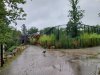
The weather has been bad all week but today hit everything. The cyclone Boris had arrived in the Carpian area between Poland, Tsjechia and other countries, strong winds and incessant rainfall resulted.

It had as consequence that I was kicked out of the excellent Opole Zoo around 3 pm. Luckily I already had visit large parts of the zoo and I have to admit that the last 2 hours weren’t that pleasant: buildings like the Giraffe House were closed (and barricaded by sandbags) or were only reachable through wet feet (Insect House). The whole African and Australian sections of the zoo were becoming more inaccessible by the minute: paths were flooded, animals were sheltering.

That said, Opole is a good zoo.

It's located on the island of Bolko in the middle of the Oder River and is part of a larger park with forests, clearings and a few restaurants. It dates from 1912 when it became a place for the city dwellers, although exotic animals only arrived in the 30s. After the devastation in WWII, the zoo reopened in 1953. In 1997, the garden was almost completely destroyed by dramatic floods, and this largely explains the fact that Opole is one of the most modern Polish zoos in 2024.

The zoo of Opole has 2 parking lots, the nearest of which is paying. I took the furthest and that immediately turned out to be a big blunder when I got out of the car. It's a kilometer and a half of walking while strong tailwinds and gusts of rain whipped me, as punishment for my stinginess.

Bizarrely enough, the entrance building is hidden in a forest and looks a bit childish. The park is extensive, and has the shape of a boomerang (with the main entrance at the left end) and with the left half being the most intensively developed.

My visit starts with the Callithrichidae House which has on the outside 5 open-range aviaries with a water mout, not often shown that way.

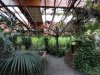
The 2019 ‘Kraina Bioroznorodnosci’ exhibit is a tropical glasshouse with a stunning outside aviary for local waterbirds. Inside is a small but very dense - it is literally a green wall - tropical rainforest with violet turaco, Victoria crowned pigeon, purple glossy-starling, European tick-knee and snowy-crowned robin-chats. It has a small water feature with a waterfall and African ciclids, and a small aviary for European roller. A fast running tiny stream runs from one pool to another. My main concern is that this building is lacking adequate visitor comfort: The path is far too narrow to properly accommodate large numbers of visitors. ‘Small’ ‘tiny’ ‘narrow’ are the key words here, and that’s bit pity. It is hard to look for the birds among the dense vegetation, which here consists mainly of palm trees and secondary fast-growing plants. I have seen many tropical greenhouses, large and small, and this one in Opole was a bit disappointing.

upload_2024-12-30_12-40-1.jpeg
Kraina Bioroznorodnosci - Snowy-crowned robin-chat (Cossypha niveicapilla) and Purple glossy-starling (Lamprotornis purpureus)

upload_2024-12-30_12-40-32.jpeg
Kraina Bioroznorodnosci

Outside is an enclosure for maned wolf and an ibis aviary with scarlet ibis and pied avocet. Another aviary was holding 2 female Malaysian Great Argus and I was very surprised that both birds had to sit outside for much of the day in this very cold weather.

Other enclosures here are for Californian sea lions and great curassow, the latter a very common species in Poland.

The left side of the zoo is probably the oldest and it’s, like in many Polish zoos, a mikmak of enclosures and visitors paths, not grouped by theme, geographical area nor by animal class.

It starts with 2 lush islands for siamang and lar, followed by a vicunha enclosure and a spacious outside enclosure for western lowland gorilla, a decent cage for ocelot and the first of 2 jaguar enclosures.

There’s a lovely oldschool Primate House, surrounded by small but high cages, and a large enclosure for gorilla. Inside it’s small, dark and smelly, but there’s nothing wrong with that. Visitors walk through some tropical vegetation where grey-handed night monkey can be found, while passing along tall indoors enclosures.

upload_2024-12-30_12-45-29.jpeg

upload_2024-12-30_12-45-45.jpeg
Monkey House - Grey-handed Night monkey (Aotus griseimembra)

All of these had natural soil, some lovely brick walls and a good portion of climbing structures. Clearly this building is old and the enclosures are too small, but I secretely enjoy this type of buildings. Near a transverse corridor are two enclosures for gorillas. It is unclear to me if both animals can join each other or not. Also pygmy slow loris have an exhibit here.
upload_2024-12-30_12-43-53.jpeg
Monkey house - Common Squirrel Monkey (Saimiri sciureus)

An old Andes Condor aviary is followed by a new and wonderfull double aviary for Silvery-cheeked hornbill and Toco toucan.

Opposite the second jaguar enclosure is a small but attractive Herps House. Like most other Polish reptile houses it’s stocked with terraria and species. Luckily there weren’t many other visitors otherwise it would be quite uncomfortable. It’s stronghold are frogs and newts. The building is quite fairy-like with a South American temple theme and subtile lighting.

upload_2024-12-30_12-51-25.jpeg
Inside the Reptile building

Outside, it was still pouring water, but that could not stop my appreciation for the excellent pampa, in fact, the rain made it more Patagonia than a summer sun would ever do. This could well be the most popular theme in European zoos. Look on a zoo map, and you’ll know where to find your rhea and capybara. It has al the usual suspects like vicunha, lowland tapir, Patagonian mara, capybara and greater rhea. And there’s a second one for tapir and vicunha. Another ocelot exhibit and enclosures for giant anteater complete this section.

upload_2024-12-30_12-53-13.jpeg

South-America enclosure

Because it kept raining steadily, I quickly ran into the newest building, the Aquarium. It starts with an attached conservatory that shows a mangrove exhibit with four-eyed fish. The building is again one without frills: industrial construction, large darkened hall without furnishing. There are also only 6 aquariums, but of very good quality. There is a large aquarium with spectacular tiger fish, a very beautiful Southeast Asia branch tank and some barren coral reef tanks. There is a ray basin and some smaller aquariums with, among other things, Banggai cardinalfish and laced moray. I later realised that this was the last time I met any other visitor.

upload_2024-12-30_12-47-14.jpeg
Southeast-Asia tank

The Insect house was barely reachable due to the deep puddles but I was glad to have made the effort. Inside, it is a bit cramped but certainly the upstairs has a very nice collection and it is beautifully decorated.

Outside the Eurasian section starts with Eurasian wolves and red panda, and continues with snowleopard and Eurasian moose. A large and appealing aviary for Manchurian cranes rise up between large trees.

Africa starts with breeding herds for addax and western sitatunga, followed by a very large enclosure for pygmy hippo. The little ones were ofcourse at the time of my visit inside (but visible) cosely lounging in the warm straw, but I am sure they greatly appreciate the vast land area of their outdoor enclosure. It’s certainly one of the best I’ve ever seen for this species. Adjacent are wooded enclosures for mountain bongo and okapi and then followed by a huge savannah. Unfortunately the building was closed and there were no animals to be seen. Cheetah live closeby and as I was prepared to swim, one of the cats was on show in its night quarter.

upload_2024-12-30_12-48-13.jpeg
Western Pygmy Hippo enclosure

The Australian section has emus, Bennett’s and red kangaroos and is then followed by meerkat, ringtailed lemur and red vari. I was near soaking wet and although everything looked good here, it was time to move further. I heard sirens in the background and I realised that it was times ago I met another visitor. There were more aviaries for owls, egrets, ducks, cranes and pelicans and when I was approaching the new Carnivore House a zookeeper ran to me telling me the zoo was closed due to the weather. I still quickly slipped into the new building, which looked good, inside and outside, having Siberian tiger and Southwest African lion.

upload_2024-12-30_12-49-15.jpeg
Carnivore building - Southwest African lion enclosure

I regretted even more now than this morning that I was parked so far. I quickely changed clothes in the car and thaught what to do next. I had two more visits planned but wasn’t sure if they were open with this weather. Because it seemed very unlikely to me that the Wilkowice zoo would still be open with this weather, I decided to limit the day to my next stop.
 

Attachments

  • upload_2024-12-30_12-40-1.jpeg
    upload_2024-12-30_12-40-1.jpeg
    178.5 KB · Views: 213
  • upload_2024-12-30_12-40-32.jpeg
    upload_2024-12-30_12-40-32.jpeg
    180.6 KB · Views: 221
  • upload_2024-12-30_12-43-53.jpeg
    upload_2024-12-30_12-43-53.jpeg
    142.2 KB · Views: 227
  • upload_2024-12-30_12-45-29.jpeg
    upload_2024-12-30_12-45-29.jpeg
    166.9 KB · Views: 211
  • upload_2024-12-30_12-45-45.jpeg
    upload_2024-12-30_12-45-45.jpeg
    103.4 KB · Views: 200
  • upload_2024-12-30_12-47-14.jpeg
    upload_2024-12-30_12-47-14.jpeg
    97.5 KB · Views: 222
  • upload_2024-12-30_12-48-13.jpeg
    upload_2024-12-30_12-48-13.jpeg
    201.6 KB · Views: 227
  • upload_2024-12-30_12-49-15.jpeg
    upload_2024-12-30_12-49-15.jpeg
    220.3 KB · Views: 218
  • upload_2024-12-30_12-51-25.jpeg
    upload_2024-12-30_12-51-25.jpeg
    105.2 KB · Views: 216
  • upload_2024-12-30_12-53-13.jpeg
    upload_2024-12-30_12-53-13.jpeg
    126 KB · Views: 213
Just found this thread now so have had a lot of catching up to do - another brilliant series of reviews.

It is nice to have another extensive review of Dresden to compare with, as I visited this zoo for the first time in summer and loved it. I entered with rather low expectations, which did the place a great favour as it far exceeded them - lions aside, I couldn't find a single poor enclosure in the zoo, with several truly elite ones, a lovely park-like atmosphere, and a high attention to detail with landscaping throughout. For the most part, I agree with what you said, although I will dispute that 1,300 sqm is big enough for lions. I loved the Orangutan-Haus (uninspiring reptile collection being the only minor disappointment), and thought the indoor areas for the apes were amongst the finest that I had seen. Interesting to hear you say that 2 outdoor areas isn't enough for five orangs (twice as many as what some zoos offer for even larger groups), but I suspect you are correct. I believe the choice to have the indoor enclosures in the centre of the house was either so that the green inner walls of the house evoke an enclosed rainforest feel, or to seem innovative and 'modern' purely for the sake of it. The rain was torrential on my visit as well, amongst the worst I have ever experienced at a zoo. But for some areas (European bird aviaries in particular), I felt it added to the character - it certainly enhanced my appreciation for the warmth of the indoor areas!

Chemnitz has long been on my bucket list as an amphibian lover; nice to hear in depth about their non-Vivarium offerings. Łaçna is one of those zoos that I would likely never had heard of without a thread like this - that tiger enclosure looks awful, nice to hear they are getting a new one, but some of those hoofstock pastures look truly beautiful. I never mind the farm-like fields as long as they are spacious and grassy, especially with scenery like that.

I have heard Wrocław praised frequently, but other than the Afrykarium I had heard little explanation for the high regard the place is held in. From your review, the zoo looks beautiful and I love the sheer number of specialist buildings, but some areas appear seriously outdated.

Great reviews, can't wait to see what's next.
 
Day 4. #8 Palmiarnia Miejska Gliwice (Palm House Gliwice)

It took a while to find a free parking space around the Chopin park, it seemed that everyone was looking for the warmth of the palm house. The storm kept raging and I hurried past torn branches and large puddles to the moodily lit building that looked incredibly inviting in this weather.

The Gliwice Palm House has a rich history: the first greenhouses in the Frederic Chopin Park date back to 1880. The current buildings were built in 1924, but anyone who sees them nowadays will immediately know that this is only half the truth. In 1985, the dilapidated greenhouses were closed and construction of the current building began. They simply built over the old greenhouses, which were then demolished. This not only made it possible to continue to care for the rich plant collection on site, often palm trees that are decades old, but also to preserve parts of the cast-iron balconies. In 2024, any reference to the past has disappeared on the outside: it has become an ultra-modern construction consisting of 5 connected greenhouses (just take a look at the website: Palmiarnia Miejska - Miejski Zarząd Usług Komunalnych w Gliwicach). Traditionally, animals are also on display, mainly reptiles and fish, back in history also parrots and monkeys.

2 lion sculptures guard the entrance and inside the ticket office it was pleasantly busy at the ticket booth. The people of Gliwice clearly love their palm house and were not deterred by the bad weather. The first 4 greenhouses can be visited both at ground level and via a cast-iron walkway, the fifth pavilion is only on the ground floor. When I was there it was already very dark so the lights were on. That immediately gave a particularly magical atmosphere.

upload_2025-1-1_11-21-44.jpeg

Pavilion for useful plants

The first subtropical greenhouse has an emphasis on plants that are useful to humans. There are also a few bird cages for cockatiels, zebra and Gouldian finches, a practice that I have unfortunately also seen elsewhere in Poland. A member of the Polish Zoo Association should do better.

Pavilion for tropical plants

In the second greenhouse many types of bamboo and fan palms are growing. Begonias, peppers and arum lilies are peppering the forest bottom . A circular walk goes around a small pond with four-eyed fish. In the corners displays with bromeliads and orchids, and terrariums for panther chameleons and others. A small Amazon black water aquarium is over-crowded with Uaru, black-banded leporinus and Metynnis hypsauchen, a close family member of the more common piranha and silver dollar fish.

upload_2025-1-1_11-18-59.jpeg
upload_2025-1-1_11-19-47.jpeg
Black-banded leporinus (Leporinus fasciatus) and Uara cichlid (Uara amphiacanthoides)

Historic conservatory

The largest and highest conservatory is for some reason called the historic conservatory. Perhaps it is called this because it houses the oldest plants in the collection: 25m high and 150 year old Canary Island date palms. It is a very impressive construction with also 15m high Norfolk pines, parasol fan palms and Illawara flame trees. Between the palms are small ponds with crucian and koi carp. The perfectly placed lighting made this a particularly cosy and moody place. Chinese softshell turtles, Indochinese water dragons, Madagascar day geckos and walking leaves live in terrariums.

upload_2025-1-1_11-19-19.jpeg


Succulent greenhouse

The pavilion dedicated to cacti is, unlike the previous ones, much brighter. It is said to contain 2000 different species, ranging from columnar cacti that are over 8m high to tiny ‘living stones’ from the genus Lithops. There is a terrarium for Sinola milk snakes and a large 2-store enclosure for the only mammal in Gliwice, Red-flanked variegated squirrel. Even after a long wait I could only catch a glimpse of 1 animal. Their enclosure is next to a busy staircase and I suspect that the animals wisely wait until closing time.

upload_2025-1-1_11-22-3.jpeg
Exhibit for Red-flanked variegated squirrel

Aquarium

The aquarium building was added later. It consists of only 4 but stunning freshwater tanks, varying in size between 11,000 and 60,000 liters.

The first shows a Southeast Asia fish community. It mainly concerns well-known species such as botia (clown botia, Almorha loach, Burmese border loach), puntius (Sumatra, Denison barb), Gray flying fox, Redtail sharkminnow and Siamese algae eater, but also lesser-known or endangered species such as the Small spiny eel, firetail labeo, iridescent pangaius, archerfish and the Bala carp. It is a beautiful and long Dutch-style aquarium with strong lighting and impressive planting , including both densely overgrown and large open swimming areas. The latter is certainly necessary since many of these species are real busy swimmers.

upload_2025-1-1_11-20-5.jpeg

Opposite this tank is a similar aquarium dedicated to the Polish rivers. It is much more sparsely overgrown but beautifully decorated with large stones and pieces of wood. Again these are all well-known species: tench, crucian carp, barbel, ide, nape and grayling.

upload_2025-1-1_11-20-20.jpeg

Lake Tanganyika is the longest and second deepest lake in the world. It is known for its many endemic (cichlid) species and as such one of the most frequently presented biotopes in zoos. There are more than 20 species to see in Gliwice, from the genera Tropheus (Duboisi cichlid and a lot of color morphs of the Bunthead cichlid: Kasanga, Ikola, Moori), Neolamprologus (Princess of Burundi, Lemon and Sexfaciatus cichlid), Synodontis, Julidochromis (Convict julie, Marlier’s julie, Masked Julie), Chalinochromis, Petrochromis, Cyprichromis, Altolamprologus (compressed cichlid and Congo Blackfin) and Lepidiolamprologus.
I am not an expert but I learned, among other things, that the cuckoo catfish from the genus Synodontis has its eggs incubated by mouthbrooders from the genus Tropheus, so that its young can enjoy the unique protection that the white-spotted and blunt-headed cichlids offer them. Nature never ceases to amaze me.

upload_2025-1-1_11-20-37.jpeg

The largest aquarium in Gliwice is located in a separate room and it is a particularly impressive Amazon tank. It has a large artificial tree, some roots are hanging, while the sandy bottom is sparsely strewn with stones and driftwood. The vegetation is limited to the large leaves of a water lily that is planted in a hanging pot. Light falls diffusely to the bottom. This tank has some giants such as an arapaima, black pacu, blue peacock bass and ripsaw catfish. Somewhat smaller fish are represented by uaru cichlids and Piraputanga. White-spotted freshwater ray and large-toothed freshwater ray complete the species list.

upload_2025-1-1_11-20-55.jpeg
upload_2025-1-1_11-21-9.jpeg
Amazon tank - Blue Peacock bass (Cichla monoculus)

I had a very pleasant time in Gliwice. This modern building scores with its impressive collections and fish lovers will certainly get their money's worth here. The cast-iron balconies, together with the carefully placed lighting, give the palm house an almost fairytale atmosphere, especially when darkness has fallen outside.
 

Attachments

  • upload_2025-1-1_11-18-59.jpeg
    upload_2025-1-1_11-18-59.jpeg
    181.9 KB · Views: 181
  • upload_2025-1-1_11-19-19.jpeg
    upload_2025-1-1_11-19-19.jpeg
    135.7 KB · Views: 226
  • upload_2025-1-1_11-19-47.jpeg
    upload_2025-1-1_11-19-47.jpeg
    105.6 KB · Views: 211
  • upload_2025-1-1_11-20-5.jpeg
    upload_2025-1-1_11-20-5.jpeg
    72.9 KB · Views: 195
  • upload_2025-1-1_11-20-20.jpeg
    upload_2025-1-1_11-20-20.jpeg
    71.2 KB · Views: 181
  • upload_2025-1-1_11-20-37.jpeg
    upload_2025-1-1_11-20-37.jpeg
    70.7 KB · Views: 212
  • upload_2025-1-1_11-20-55.jpeg
    upload_2025-1-1_11-20-55.jpeg
    81.4 KB · Views: 220
  • upload_2025-1-1_11-21-9.jpeg
    upload_2025-1-1_11-21-9.jpeg
    112.4 KB · Views: 215
  • upload_2025-1-1_11-21-44.jpeg
    upload_2025-1-1_11-21-44.jpeg
    119.3 KB · Views: 191
  • upload_2025-1-1_11-22-3.jpeg
    upload_2025-1-1_11-22-3.jpeg
    93.7 KB · Views: 215
Day 5. #9 Katowice Slaski Ogrod Zoologicany – Silesian Zoological Park

The next morning, and against all weather forecasts, the sun pierced through the window of my hotel room. A big relieve as my next location is located in a large park.

The 48 ha Silesian Zoological Garden was founded in 1954 and is the main zoo of the Metropolis GZM, a metropolitan association with a population of + 2 million. It lies within the Silesian Park, a 620 ha recreation area in the city of Chorzow and on the border with Katowice, the largest city of the GZM.

It’s a rather large and somewhat outdated zoo with open landscaped enclosures for ungulates and some accessible builings.

It’s main entrance is by the Brama Glowna historical landmark but visitors by car enter the zoo by the side gate, close to the zoo’s parking lot (which has terrible visitor reviews but I was lucky as the young gate keeper was very friendly).

First impressions are good, with 2 large ponds and a lot of greenery. The Gibbonhouse is what you can expect, looked inside spacious and enriched, while the pilaeted gibbon also have access to a large wooded island.

upload_2025-1-3_12-25-54.jpeg
Pileated gibbon (Hylobates pileatus)

The main building is de Monkey annex Parrothouse, which clearly dates from another era. It has a long corridor with monkey night quarters on the left and some nicely designed terraria on the right. Species-wise this place has an interesting collection with mandrill, Hanuman langur, mantled colobus and patas monkey. Outside cages are not big (and sometimes really tiny) but all four species have alternating access to one of the 2 large cages located on the other side of the visitor path. Aesthetically all this is not appealing but the extra space certainly looks good.

upload_2025-1-3_12-16-32.jpeg
upload_2025-1-3_12-21-6.jpeg
Inside and outside the monkey house - Blue spiny lizard (Sceloporus cyanogenys) - Mandrill (Mandrillus sphinx)


Another wing of the building has more reptiles, golden lion and golden-headed lion tamarin and some parrots, all in descent enclosures and having access to a small aviary outdoors.

The South America House is a modern building with a tropical rainforest, a herps section and enclosures for monkeys and anteaters. The rainforest has yellow-spotted river turtle, and free ranging two-toed sloth and green aracari. There’s a section with about a dozen terraria, all of these are very well designed. Black howler monkeys live in a large but entirely indoors netted enclosure, and so does bearded emperor tamarin, who share their enclosure with giant anteater. Last enclosure is empty and is meant to be for giant river otter. This looked ok but I have serious doubt about their outside enclosure as that is no more than a standing swimming pool. However, there is ample space to construct outside enclosures for the otters and howler monkeys. Giant anteaters and vicunha already have these at the eastern side of the building.

upload_2025-1-3_12-22-50.jpeg
South America House - Reptile section

upload_2025-1-3_12-21-48.jpeg
(provided) Giant river otter enclosure

The Antelope House is surrounded on three sides by large paddocks for nyala, Defassa waterbuck and eastern bongo. Inside are small and currently almost empty enclosures for callithrichidae.

upload_2025-1-3_12-29-41.jpeg
Antelope building and nyala enclosure

The whole eastern part of the zoo consist of woodland enclosures for ungulates, dilapidated cages for small predators with very little space to move, a nice and densely planted bear pit inhabited by brown bears (and Asiatic black bear?), an empty lion enclosure and new ones for snow leopards. The latter are certainly ok, but as is often the case in Poland, little effort has been made to blend them nicely into the park landscape. It should be no problem at all to quickly relocate the now poorly housed servals to the former lion enclosure.

The central part of the zoo is dedicated to large mammals. The Rhino House is the most modern and elegant facility. It is surrounded by 2 spacious enclosure for white rhino while the interior can be viewed through large window panes.

The Giraffehouse has one of those barren enclosures surrounded by high fences which are frequently seen in Poland. Fortunately, it has on the other side a large beautiful enclosure for the herd and for gemsbok (I saw only 3 while 3.4 came from Magdeburg in 2022).

The round-shaped Elephant House (1965) doesn't look very appealing from a distance. It’s clearly run-down and the modern era is far away, but I thought this building still has some interesting architecture. Inside are two paddocks, while a third one housed hippo till 2016. A visitor half-circel walkway runs through the building with on the wall side large terraria for monitor species, pythons and and other large reptiles.

upload_2025-1-3_12-18-9.jpeg

The far Northwest corner of the zoo consist again of woodland enclosures for Nilgai, Milu, Sikadeer and Addax while some densely planted aviaries housing capercaillie.

A large aviary is one of the more interesting constructions in the zoo. It houses a pair of Demoiselle crane and further also scarlet ibis, furruginous duck, black-crowned night heron and little egret. Not the most inspired species line-up but the architecture certainly makes up for it.

upload_2025-1-3_12-17-10.jpeg

Nearby are good sized enclosures for ungulates like western sitatunga, greater kudu, Kafue lehwe and a very nice breeding group of 9 red river hog. Too often I see these animals in pairs instead of larger family groups.

upload_2025-1-3_12-19-2.jpeg

African lion and Siberian tiger got new enclosures with the Lion House having window panes and surrounded by 3 enclosures. Little effort has been made to really enrich the enclosures (in that respect, the old enclosures on the other side of the zoo looked a lot better – with more dense vegetation). The zoo keeps its large birds in the area between de felids and the main entrance: Common and Red-necked crane, Greater flamingo, Great Cormorant, Great White and a bit further Pink-Backed pelicans.

As is often the case in Polish zoos, this zoo has unclear visitor routes. There are paths and dead ends everywhere and you have to be careful not to miss anything. That’s certainly the case in the southern part of the zoo. There is a dead end to some new constructions for Eurasian wolverine and lynx and there are many aviaries for birds of prey and wading birds (Unfortunately, these tend to be very common species).

A rather unremarkable building is the Egzotarium. It starts with dwarf crocodiles, which also have an outdoor area, and is followed by a small walk-through rainforest. White-crested laughingthrush are the key species here (only seen in 10 European zoos), along with red-billed leiothrix, common emerald dove, common hill myna and crested partridge. A third section of the building leads past a series of terrariums (Cuban iguana, Chekered garter snake, Vietnamese crocodile newt) and bird aviaries for Australian species (Diamond dove, laughing kookaburra and Australian ringneck parrakeets).

upload_2025-1-3_12-20-5.jpeg

Outside the Egzotarium, there is a modern but somewhat theatrical enclosure for Humbold penguin. The Aquarium on the other hand is small and outdated, but there are so many fish species in zoos that there is always a rarity among them, and it is no different here. These are not bad aquariums, but the building is not immediately appealing. The Lemur House (black and white vari and ring-tailed lemur) gives access to an island (there’s another one near the lion house) and next to it is a large enclosure for South African cheetah.

Chorsow Zoo is a large zoo in an even larger park built on one of the many derelict industrial sites in this highly industrialised region. It is a large zoo with +300 animal species, several accessible buildings, but it needs a bit of TLC for the current exhibits. I was a little disappointed because I had hoped to see some communist-era buildings here. There were, but they did not leave a memorable impression.
 

Attachments

  • upload_2025-1-3_12-16-32.jpeg
    upload_2025-1-3_12-16-32.jpeg
    139.8 KB · Views: 202
  • upload_2025-1-3_12-17-10.jpeg
    upload_2025-1-3_12-17-10.jpeg
    268.8 KB · Views: 234
  • upload_2025-1-3_12-18-9.jpeg
    upload_2025-1-3_12-18-9.jpeg
    92.3 KB · Views: 218
  • upload_2025-1-3_12-19-2.jpeg
    upload_2025-1-3_12-19-2.jpeg
    190.4 KB · Views: 198
  • upload_2025-1-3_12-20-5.jpeg
    upload_2025-1-3_12-20-5.jpeg
    148.3 KB · Views: 226
  • upload_2025-1-3_12-21-6.jpeg
    upload_2025-1-3_12-21-6.jpeg
    194.1 KB · Views: 203
  • upload_2025-1-3_12-21-48.jpeg
    upload_2025-1-3_12-21-48.jpeg
    130.4 KB · Views: 202
  • upload_2025-1-3_12-22-50.jpeg
    upload_2025-1-3_12-22-50.jpeg
    219 KB · Views: 199
  • upload_2025-1-3_12-25-54.jpeg
    upload_2025-1-3_12-25-54.jpeg
    146.4 KB · Views: 197
  • upload_2025-1-3_12-29-41.jpeg
    upload_2025-1-3_12-29-41.jpeg
    115.5 KB · Views: 204
Bonus post species list #9Silezian Zoological Garden


Monkey & Parrot House (starting from ‘monkey entrance’)

upload_2025-1-3_12-42-58.jpeg

Grey or Hanuman langur (Semnopitecus entellus)

Monkeys
1. Hanuman langur (Semnpithecus entellus)

2. Patas monkey (Erythrocebus patas)

3. Capuchin

4. Mandrill (Mandrillus sphinx)

5. Mantled colobus (Colobus guereza)

6. Goeldi’s monkey (Callimico goeldii)

7. Patas monkey (Erythrocebus patas)

8. Golden lion tamarin (Leontopithecus rosalia)

9. Golden-headed lion tamarin (Leontopithecus chrysomelas)

Reptiles

upload_2025-1-3_12-36-46.jpeg
Koch's giant day gecko (Phelsuma madagascariensis kochi)

1. Golden gecko (Gekko badenii)

2. Holguin anole (Anolis noblei)

3. Standing Day gecko (Phelsuma standing

4. Yellow-headed day gecko (Klemmer’s day gecko) (Phelsuma klemmeri) + Robert Mertens’ day gecko (Phelsuma robertmertensi)

5. Turner’s thick-toed gecko (Chondrodactylus tuerneri)

6. Blue Spiny lizard (Sceloporus cyanogenys)

7. Madagascar Giant Day gecko (Phelsuma grandis)

8. Rhinoceros snake (Gonyosoma boulengeri)

9. Rankin’s dragon or Black-soil Bearded dragon (Pogona henrylawsoni)

10. Koch’s Giant Day gecko (Phelsuma madagascariensis kochi)

11. Carpet Python (Morelia spilota)

12. Western Bearded anole (Anolis barbatus) + Indian star tortoise (Geochelone elegans)

13. Hispaniolan boa (Chilabothrus striatus)

14. Asian Water dragon (Physignathus cocincinus)

15. Empty

16. Ball python (Python regius)

17. Cuban tree boa (Chilabothrus angulifer)

18. Frill-necked lizard (Chlamydosaurus kingii)

19. Dumerill’s Ground boa (Acranthophis dumerili) + Madagascar Tree boa (Sanzinia madagascariensis)


Parrots & Cockatoos

upload_2025-1-3_12-38-21.jpeg


Red-fronted macaw aviary

1. Araruna (Ara araruna)

2. Araruna (Ara araruna) + crested partridge (Rollulus rouloul)

3. Military macaw (Ara militaris)

4. Yellow-crested cockatoo + crested partridge (Rollulus rouloul)

5. Red-fronted macaw (Ara rubrogenys)

6. Salmon-crested cockatoo (Cactua moluccensis) + Grey parrot (Psittacus erithacus)

7. Galah (Eolophus roseicapilla)

South America Building:

upload_2025-1-3_12-34-34.jpeg

Green aracari (Pteroglossus viridis)

Free roamers:

1. Yellow-spotted river turtle (Podocnemis unifillis)

2. Linnaeus two-toed sloth (Choloepus didactylus)

3. Green aracari (Pteroglossus viridis)

Outer circle

1. Plumed basilisk (Basilliscus plumifrons) + Yellow-footed tortoise (Chelonoidis denticulatus)

2. Argentine black and white teju (Salvator merianae)

3. Argentine black and white teju (Salvator merianae)

4. Giant ameiva (Ameiva ameiva)

5. Green anaconda (Eunectes murinus murinus)

6. Boa constrictor (Boa constrictor imperator)

7. Plumed basilisk (Basilliscus plumifrons) + Red-footed tortoise (Chelonoidis carbonarius)

Inner circle:

upload_2025-1-3_12-39-33.jpeg
Brazilian salmon pink bird-eating tarantula (Lasiodora parahybana)

1. Amazon tree boa (Corallus hortulana) + Brown rainbow boa (Epicrates maurus)

2. Argentine horned frog (Ceratophrys ornata)

3. Brazilian salmon pink bird-eating tarantula (Lasiodora parahybana)

4. Green and blakc poison dart frog (Dendrobates auratus)

5. Deing poison dart frog (Dendrobates tinctorius)

6. Blue poison dart frog (Dendrobates tinctorius ‘azureus’)

7. Curlyhair tarantula (Tliltocatl albopilosus)

8. Yellow-banded poison dart frog (Dendrobates leucomelas)

9. Anthony’s poison arrow frog (Epipedobates anthonyi)

10. Golfodulcean poison arrow frog (Phyllobates vittatus)

11. Greenbottle blue tarantula (Chromatopelma cyaneopubescens)

Separate enclosures

1. Black howler monkey (Alouatta caraya) + Big Hairy armadillo (Chaetophractus villosus)

2. Bearded emperor tamarin (Saguinus imperator subgrisescens) + Giant anteater (Mymecophaga tridactyla)

Elephant House

1. Empty

2. Mertens monitor (Varanus mertensi)

3. Black rough-necked monitor (Varanus rudicollis)

4. Gould’s monitor (Varanus gouldii)

5. Cuban iguana (Cyclura nubila nubila)

6. Philippine sailfin lizard (Hydrosaurus pustulatus)

7. Yellow-headed temple turtle (Heosemys annandalii)

8. Macklot’s python (Liasis mackloti mackloti)

9. Malagasy ground boa (Acrantophis madagascariensis) + Cuban tree boa (Chilabothrus angulifer)

10. Alligator snapping turtle (Macrochelys temminckii)
 

Attachments

  • upload_2025-1-3_12-34-34.jpeg
    upload_2025-1-3_12-34-34.jpeg
    160.1 KB · Views: 207
  • upload_2025-1-3_12-36-46.jpeg
    upload_2025-1-3_12-36-46.jpeg
    122.4 KB · Views: 220
  • upload_2025-1-3_12-38-21.jpeg
    upload_2025-1-3_12-38-21.jpeg
    143.8 KB · Views: 220
  • upload_2025-1-3_12-39-33.jpeg
    upload_2025-1-3_12-39-33.jpeg
    134.1 KB · Views: 185
  • upload_2025-1-3_12-42-58.jpeg
    upload_2025-1-3_12-42-58.jpeg
    261.8 KB · Views: 222
Day 5. #10 Ecological Education Center Exotarium Sosnowiec

It is no more than 30 minuten further to my next destination, the ultra modern Egzotarium and Botanical Garden in neighbouring Sosnowiec. Sushine is back after a week of rain and the Silesian people clearly want to get out. Parking lots are full and it’s searching for a free spot.

When I walk into the building, it is immediately clear that a lot of attention has been paid to visitor comfort. There is a spacious visitors' lobby, with cloakroom and a cash desk. The only downside is that all signs are only in Polish. Fortunately, someone once decided to use Latin for species labelling. And the zoo has a good website in English. There are no maps of the zoo, you can download an app, but I actually find that one of those annoying sides of modern times, especially if you also use the mobile phone to take photos.

The visit is a one-way tour that takes visitors first down to the aquarium and from there to the tropical-mediterranean-desert greenhouses, bathed in sunlight.

It starts with an attractive terrarium for the Beauty rat snake and this first one sets the tone for all the other exhibits: they are all undeniably exceptionally well designed and decorated. The only downside is that the interior designer who designed the public space did earn some demerits, as the installed LED lighting reflects the light so much that it hinders viewing and picture-taking.

That said, the route continues with a rocky tank for native fish after which a stunning Amazon tank appears. This one has a spectacular species line-up: Tucanare Peacock Bass, an armored catfish Pterygoplichthys gibbiceps, Alligator gar, Arapaima, Silver arowana, Ocellate river stingray. It was beautiful and the seats provided were welcome to quietly enjoy this stunning aquarium.

upload_2025-1-5_11-41-39.jpeg
Amazon aquarium

Around the corner it continues with 2 other high-quality Polish-themed aquariums. The first has as its main resident northern pike, which lives with a host of other species (river trout, european graylling, ide, common barbel and common chub) while the other shows a similar river community (lavaret, European eel, common carp, common bream, asp, zander and tench).

upload_2025-1-5_11-42-21.jpeg
Northern Pike aquarium

Three superb South American aquariums appear on the right. The largest contains only 3 species: red-tailed catfish, Pirapitinga or red-bellied pacu and an African Tigerfish-like fish, probably a member of the Brycon genus, which do occur in South America, but it was not indicated. It is wonderful to see these big fish swimming around in a really large tank.

upload_2025-1-5_11-42-2.jpeg
Redtailed Catfish (Phratocephalus hemioliopterus) and Pirapitinga (Piaractus brachypomus)

It is followed by two large community aquariums for mainly South American characin species. The first one is a flooded forest community (blue-red Colombian tetra, bloodspot tetra, spotted armored catfish, spotted Raphael's thorn catfish, red discus, Orinoco moonfish, black fluke eel, pearl cichlid, ruby crown cichlid, zebra pleco, streamline armored catfish, Sterbai armored catfish and diamond tetra).
The second aquarium has a very low water level, I thought it also contained some reptiles, but there was no indication. It has a nice collection of catfish and tetras (Antenna catfish, brush nose antenna catfish, cardinal tetra, green neon, corydoras haraldschultzi, emperor tetra, emerald armored catfish, blue neon and panda armored catfish, coral platy).

upload_2025-1-5_11-49-35.jpeg
South America aquarium with Orinoco moonfish, discus, tetras and catfish

These 3 South American aquariums are wonderful examples of how to keep fish: lots of litres with sufficient depth and swimming length, beautiful decoration and no overcrowding. The sheer quality of this place is just amazing.

upload_2025-1-5_11-49-16.jpeg

The middle section of the hall consists of small terrariums for small reptiles, insects, spiders and poison dart frogs: eyelash gecko, Australian flapper branch, coral tree frog, white-striped gecko, the rarely shown Amami sword-tailed newt, etc.

upload_2025-1-5_11-53-57.jpeg
Amami sword-tailed newt (Cynops ensicauda ensicauda)

After that comes another fish section, starting with South American cichlid tank with hardly any plant life (uaru, emerald cichlid, triangle cichlid, severum cichlid, scalare, moga cichlid, and armored catfish).

The last large tank is a themed Southeast asian branch aquarium, with no vegetation but beautifully decorated with bamboo and branches (giant gourami, Chitala knifefish, Asian arowana, elongated mudskipper and the aluminum carp).

upload_2025-1-5_11-55-41.jpeg
Southeast Asian aquarium

After a small Tanganyika tank and a few terraria for poison dart frogs, it’s upstairs to the botanical greenhouses. That is actually just 1 building divided into three areas: desert, Mediterranean and tropics. Animals are scarcer here, with most species in the desert section: Cuban iguanas, king pythons, spiny-tailed monitor lizards, turtles and nine-banded armadillos can be seen in large and beautifully designed terraria. Finally, there are Mexican beaded lizards and bearded dragons.

upload_2025-1-5_11-58-33.jpeg

Desert greenhouse - Terrariums for Cuban iguana, Royal python and Spiny-tailed monitor

The Mediterranean greenhouse has three tall aviaries for military macaw, great curassow and African grey parrot. The aviaries are quite bare and small in area, I actually did not find them suitable and they are in stark contrast to the quality and attention paid to the terrariums and aquariums. In addition green spiny lizards and snapping turtles are shown here and, unfortunately, lovebirds in bird cages.

upload_2025-1-5_12-0-55.jpeg
The Mediterannean - Bird cages for Military macaw, Great curassow and Grey parrot

The tropical section is actually entirely occupied by animals, mainly reptiles. It is also partly under a slope. There are large paludariums for four-eyed fish and Pig-nosed turle, and another with Nile tilapia, midas cichlid and spectacled caiman. Furthermore are large terrariums for larger species: green iguana, red-footed tortoise, reticulated and carpet python, Brazilian garden boa, mud turtles, Indochinese water dragon and anacondas. A fairly classic list.

upload_2025-1-5_12-2-46.jpeg
The tropics - Spectacled caiman, Midas Cichlid and Nile tilapia

At the end of the visit, upstairs in the cafeteria, Eurasian harvest mice can be found in a small terrarium near the toilets.

The Egzotarium in Sosnowiec is a very modern zoo with good collections of reptiles and fish in large and absolutely stunning exhibits. The collection may lack some interesting, rarer species, but personally I did not mind: it is just a delight to see how everything is arranged and displayed here. I could especially appreciate the metre-high aquariums, as many species really come into their own this way. I actually think visitors with a botanical interest will be the most disappointed, as the plant collection may be a bit weaker.
 

Attachments

  • upload_2025-1-5_11-41-39.jpeg
    upload_2025-1-5_11-41-39.jpeg
    126.1 KB · Views: 203
  • upload_2025-1-5_11-42-2.jpeg
    upload_2025-1-5_11-42-2.jpeg
    136.6 KB · Views: 216
  • upload_2025-1-5_11-42-21.jpeg
    upload_2025-1-5_11-42-21.jpeg
    137 KB · Views: 185
  • upload_2025-1-5_11-49-16.jpeg
    upload_2025-1-5_11-49-16.jpeg
    104.9 KB · Views: 175
  • upload_2025-1-5_11-49-35.jpeg
    upload_2025-1-5_11-49-35.jpeg
    165.2 KB · Views: 221
  • upload_2025-1-5_11-53-57.jpeg
    upload_2025-1-5_11-53-57.jpeg
    294.5 KB · Views: 196
  • upload_2025-1-5_11-55-41.jpeg
    upload_2025-1-5_11-55-41.jpeg
    159.2 KB · Views: 211
  • upload_2025-1-5_11-58-33.jpeg
    upload_2025-1-5_11-58-33.jpeg
    141.7 KB · Views: 208
  • upload_2025-1-5_12-0-55.jpeg
    upload_2025-1-5_12-0-55.jpeg
    237.5 KB · Views: 161
  • upload_2025-1-5_12-2-46.jpeg
    upload_2025-1-5_12-2-46.jpeg
    144.2 KB · Views: 226
Day 6. The Hanseactic city of Krakόw

‘Hanze’ means troop or band in old German. The Hanseatic League was a medieval cooperative organization between merchants from towns more or less located around the North and Baltic Seas. Krakόw was the southernmost and inland member. It was also the very first royal city in Poland and the entire historic old town is now a World Heritage Site and particulary worth visiting. You can easily spend here 2 to 3 days and visit other interesting places nearby like the Wieliczka Salt Mine, Auschwitz concentration camp, the Schindler factory and the socialist-realist architecture of the Nowa Huta suburb.

#11 Ogrόd Zoologiczny w Krakόwie – Krakόw Zoo

The zoo was established in 1929 but the city has a much longer tradition of menageries, just because of its history as the seat of the first kings. For instance, the first lions came to the city as early as 1406 and a royal menagerie with camels, lions, leopards, monkeys, etc. was set up on the Wawel Hill, the centre of royal power, in the Middle Ages. That menagerie fell into disrepair with the move of the royal seat to Warsaw but in the 18th and 19th centuries the city saw a number of private zoos.

The zoo is nowadays located in the 420ha Wolski forest, a sloping forest intersected by streams and deep ravines. In the forest, besides the zoo, other attractions include a monastery, a castle and the artificial Pilsudski hill.

I arrived before the opening hour and again someone came running up to me shouting loudly that parking here was paying. He was particularly annoyed when I asked if he could speak English and he said he did .

You can briefly describe the zoo layout as a long straight avenue with parallel paths on either side, and a more wooded area with a circular walkway at the end.That avenue with some formal landscaping runs perpendicularly through the zoo and fits in perfectly with its surroundings. Outdated someone wrote. Beautiful I thought. Although there are certainly things to be said about it.

upload_2025-1-7_18-13-12.jpeg

Elephants, it seems, are again and again a tragedy in Poland. Often there are only 2 of them, in terrible outdated barracks and small concrete outside enclosures. In Kraków, unfortunately, it is no different. I don't see an immediate future for these animals in this zoo.

The Reptile House is no better off. I have seen many really good reptile and fish exhibits during this trip, but Kraków was not among them. It is a small ramshackle building where you walk around in a square, past small and often unkempt terraria (and a few aquaria). There are few really interesting species to be found, and apart from a few nice turtles (McCord's snake-necked turtle, New Guinea snapping turtle) it was mainly my daily dose of red-footed turtle and leopard gecko. The visitors' area was also narrow and uncomfortable. For a full species list, see my next post.

The Monkey Building is nearby, and it has obviously been renovated, which I'm sure is a big improvement over before. But it has particularly small outdoor enclosures for the large species they keep here: Javan lutung, Mandrill, Black Crested Mangabey, Mantled Colobus and Lar Gibbon. Too bad, as everything looks quite new. In terms of architecture, I think it is really ok: the austere construction with its fresh white colour does fit into this setting. Opposite the monkey house is a large construction site for what I think will be a new chimpanzee house. Construction already seemed well advanced and people were busy working on the outside enclosure. The building looks impressive, but I fear the outdoor enclosures will again be on the small side. However, it would be nice if at least the mandrils would also find a home here.

upload_2025-1-7_18-16-31.jpeg
Black crested mangabey (Lophocebus aterrimus) enclosure

Not a good start, but things get quickely better by a new Pygmy Hippo House (2015) with a large outside enclosure. The accessible building lies on an off-shoot and is neat, with two compartments (again - on the small side). Outside are more enclosures for Lechwe, Barbary sheep and Prezwalski horses.

upload_2025-1-7_18-14-5.jpeg
Western Pygmy Hippo (Choeropsis liberiensis liberiensis) House

Then a hidden gem appear. The Small Mammal House is one of the most interesting buildings in the zoo. I have seen quite a few of these buildings during this trip, and this was definitely one of the better. At the front are four tall cages, all well planted and equipped with climbing structures for binturong, coatis and tree porcupines, while at the back is the entrance to a Nocturnal House. This was unexepected, and more importantly, it was a genuine highlight , with a very nice species list: Northern Luzon giant cloud rat, Kinkajou, Senegal bushbaby, Brushtail possum, Egyptian fruit bat, Common rock hyrax, Large hairy armadillo and Pygmy slow loris. Sugar glider also were signed but I didn’t see them. The hyrax also have an outdoor cage. The building consist of just 1 corridor with 6 enclosures, all of decent size and pretty well designed. Outside, there’s a final enclosure for golden lion tamarin, white-fronted marmoset and two-toed sloth.

upload_2025-1-7_18-13-49.jpeg
Senegal Bushbaby (Galago senegalensis)

Past small owl aviaries and a large one for Manchurian cranes, it's on to the felines. Cats are Krakόw's speciality, with as many as 14 species (of which I saw 13). The enclosures for the 5 species from the genus Panthera are new and consist of large curved steel pylons to which nets are stretched. On show are jaguar, snowleopard, Siberian tiger, Asiatic lion and North Chinese leopard. These enclosures looked good and they were well designed with plants, trees and trunks, grass, water features, rocks and scratching trees. But I think those for tigers and lions looked on the small side, while there’s no second enclosure for any of the solitairy species. It is something I’ve seen before: it appeared to me that many of the new structures in Polish zoos don’t excel in size. This is certainly the case in Krakόw for all new enclosures. Stylistically, this carnivore complex looks very nice and it fits perfectly into the same style found at the pygmy hippo building and the new aviary complex. It doesn't have to be like in every zoo, but I think the new projects in krakόw show a clear coherence.

upload_2025-1-7_18-22-8.jpeg
Asiatic lion enclosure

upload_2025-1-7_18-27-37.jpeg
North China leopard (Panthera pardus japonensis)

The back part of the zoo consist of forest and has almost no formal park layout. You can tour a large aviary for great curassow (a species that is ubiquitous in Polish zoos), a children’s zoo with some aviaries, and large enclosures for Milu, nilgau, barasingha and forest reindeer, among others. In the middle of this forest is a small cafeteria, which is also the only dinning place in the zoo.

After an old cage for Pallas cat it’s a large old-fashioned aviary that draws attention. It has a slightly odd chape: at the back, with an artificial rock focus point, it is at its lowest and then rises to a very respectable height and its length allows the birds to flit around a bit. It houses a pair of Andes condor. The zoo has another breeding pair in an off-show aviary. Anyway, this is exactly the kind of historical architecture I was hoping to see on this trip.

upload_2025-1-7_18-14-58.jpeg
On-show and off-show Andes condor (Vultur gryphus) aviaries

The Giraffe House is a letdown on the outside: yet another barren lawn surrounded by a small wall. It is bizarre how many times I’ve seen a boring giraffe enclosure in Poland. But inside the building is warm and cosy with lots of wood, a nicely decorated visitor area with plants, exceptionally good info panels and a viewing platform. I noticed more than once during this trip that you can find remarkably good information signs in Poland, even in the smallest zoos. It was no different in Kraków, where there were large info panels scattered all over the garden about camels, giraffes, etc.

A lane that runs along the edge of the zoo passes the stables for South American lowland tapir and Chapman zebra, both which have beautifull enclosures. The zoo has a very large collection of small carnivores, but most are kept in enclosures that are too small and/or severely outdated. However, I understood that improvement is on the way, and the zoo was already working on new enclosures for maned wolves. Still, it is nice to see all these species: Polar fox, Jaguarundi, ocelot, Geoffroy's cat, Arabian sand cat, Common genet, Fennek, Serval, European wild cat, Pallas' cat, Tayra, Bat-eared fox and European otter. The Meerkats and Yellow mongooses had already given a new enclosure some distance away. A short ascending path connects two parallel lanes and here the cages, although nicely decorated, are really terribly tiny, not only for the Fennec foxes and Geoffroy's cats but also for the Steppe eagles. A real shame, as they seemed to me to be more recent and very well cared for.

upload_2025-1-7_18-24-48.jpeg
Ocelot enclosure

A somewhat outdated enclosure for Eurasian otter is the prelude to the zoo’s bird department, which starts with a spacious aviary for Scarlet ibis, African spoonbill, Comb duck and others. A series of island encosures/aviaries contain species like Hawaiian goose, ducks, Great white pelican, Grey crowned cranes and Ring-tailed lemur. Oppose those is the zoo’s Pheasantry which should be by now, with the opening of the new bird complex, at least partially empty.


upload_2025-1-7_18-21-19.jpeg


Krakόw's bird department consists mainly of species often found in zoos, with a few exceptions such as the Australian Hardhead, Sumbawa Forsten's lorikeet and Southern festive amazon, all three obtained from Prague in 2024, as well as Red-breasted parakeet and Red-breasted toucan. Many of these species were not on show during the time of my visit, but they should be now.

The central avenue is most reminiscent of a classic zoo with its well-maintained landscaping. It starts at the entrance and first passes by the birds, elephants and reptiles. Then there’s a series of beautiful ungulate enclosures (Mishmi takin, Chapman zebra, Ellipse waterbuck, western sitatunga, etc.). Halfway there is a really stunning new penguin enclosure with a great vantage point on Common waterbucks and other nearby enclosures.

upload_2025-1-7_18-15-21.jpeg

There is also an outdated monkeyhouse to be found, and enclosures for Vicunha, Common eland, Ostrich, our Bennett friends and one of my favourites, Roan antelope.

I unexpectedly had a very nice time in Kraków. Of course, the place is far from perfect, and I can see why some consider it an old-fashioned zoo, but I actually experienced it as a very charming place. The recent developments are clearly an improvement in terms of animal welfare, and what pleases me is that all new structures have great architectural consistency (althoug they are all too small). The weaknesses seem to be eliminated one by one and I would definitely want to return here in 10 years.

And if you like carnivores, well, this place has 27 species and that list does not include a single pinniped after the departure of the South American sea lions.
 

Attachments

  • upload_2025-1-7_18-13-12.jpeg
    upload_2025-1-7_18-13-12.jpeg
    169.2 KB · Views: 186
  • upload_2025-1-7_18-13-49.jpeg
    upload_2025-1-7_18-13-49.jpeg
    141.3 KB · Views: 176
  • upload_2025-1-7_18-14-5.jpeg
    upload_2025-1-7_18-14-5.jpeg
    150.4 KB · Views: 164
  • upload_2025-1-7_18-14-58.jpeg
    upload_2025-1-7_18-14-58.jpeg
    238.9 KB · Views: 196
  • upload_2025-1-7_18-15-21.jpeg
    upload_2025-1-7_18-15-21.jpeg
    176.8 KB · Views: 205
  • upload_2025-1-7_18-16-31.jpeg
    upload_2025-1-7_18-16-31.jpeg
    149.5 KB · Views: 175
  • upload_2025-1-7_18-22-8.jpeg
    upload_2025-1-7_18-22-8.jpeg
    178.7 KB · Views: 199
  • upload_2025-1-7_18-21-19.jpeg
    upload_2025-1-7_18-21-19.jpeg
    280.8 KB · Views: 204
  • upload_2025-1-7_18-24-48.jpeg
    upload_2025-1-7_18-24-48.jpeg
    348.1 KB · Views: 201
  • upload_2025-1-7_18-27-37.jpeg
    upload_2025-1-7_18-27-37.jpeg
    228 KB · Views: 199
I am really enjoying all your reviews from this up- and coming zoo country. It seems all the interest and money is there, but they seem to take a decidedly old school approach to building there!

The enclosures for the 5 species from the genus Panthera are new and consist of large curved steel pylons to which nets are stretched. On show are jaguar, snowleopard, Siberian tiger, Asiatic lion and North Chinese leopard. These enclosures looked good and they were well designed with plants, trees and trunks, grass, water features, rocks and scratching trees. But I think those for tigers and lions looked on the small side, while there’s no second enclosure for any of the solitairy species. It is something I’ve seen before: it appeared to me that many of the new structures in Polish zoos don’t excel in size. This is certainly the case in Krakόw for all new enclosures. Stylistically, this carnivore complex looks very nice and it fits perfectly into the same style found at the pygmy hippo building and the new aviary complex. It doesn't have to be like in every zoo, but I think the new projects in krakόw show a clear coherence.

These enclosures aren't exactly new, they were already there when I visited the zoo 12 years ago. They already looked quite small back then and woefully lackin in climbing structures

after the departure of the South American sea lions.

Which is good, as it was a truly atrocious pinniped enclosure ;)
 
Thank you @lintworm, much appreciated!
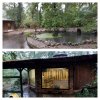
Without discussion the Panthera enclosures in Krakow are far too small, although each on its own would be very suitable to keep 1 specimen (not a pair) of the jaguar and leopards. For the lions and tigers, it cannot be done, I would remove the tigers (and snowleopards) from there, and in time build a larger lion enclosure. There are a lot of European grants available but it remains remarkable how small zoos keep building here. The Monkey House, the recently opened bird complex and the upcoming chimpanzee building clearly suffer from the same shortcoming.

Even so I did find these enclosures very stylish and the planting must have evolved a bit since your visit. Although I am surprised that they are aldready so old (I couldn't find any information about these - or most other - structures on the zoo's (own or wiki) web page).

I saw that empty pinniped enclosure, truly horrible.
 
Bonus post #11 Krakόw zoo - Species list as of 16th september 2024:

Reptile House

1. Dwarf caiman (Paleosuchus palpebrosus) + New Guinea Snapping Turtle (Elseya novaeguineae)

2. Rhinoceros Snake (Gonyosoma boulengeri)

3. Pacific Boa (Candoia carinata)

4. Green Crested Basilisk (Basiliscus plumifrons)

5. Giant Blue-tongued Skink (Tiliqua gigas)

6. South America red-footed Turtle (Chelonoidis carbonarius)

7. Philipine Sailfin Lizard (Hydrosaurus pustulatus)

8. Mountain Chicken (Leptodactylus fallax)

9. Blue Tree Monitor (Varanus macraei) + Roti Island Snake-necked Turtle (Chelodina mccordi)

10. African Spur-thighed tortoise (Testudo graeca graeca)

11.A. Green and Black Poison Dart Frog (Dendrobates auratus) / Yellow-banded Poison Dart Frog (Dendrobates leucomelas) / Golfodulcean Poison Dart Frog (Phyllobates vittatus)

11.B. Emperor newt (tylototriton shanjing)

11.C Green and Back Poison Dart Frog (Dendrobates auratus) / Deying Dart Frog (Dendrobates tinctorius)

11.D Sambava Tomato Frog (Dyscophus guineti)

11.E Anthonys Poison-arrow Frog (Epipedobates anthonyi) / Blue Spiny Lizard (Sceloporus cyanogenys)/ empty

11.F Oriental Fire-bellied toad (Bombina orientalis)

12. Aquarium: Spotted gar (Lepisosteus oculatus) + Spotted Sailfin Suckermouth Catfish (Pterygoplichtys gibbiceps)

13. Mexican Beaded Lizard (Helodorma horridum)

14. Leopard Gecko (Eublepharis macularius)

15. Boa Constrictor (Boa constrictor)

16. Sinolan Milksnake (Lampropeltis triangulum sinaloae)

17. Yellow Anaconda (Eunectes notaeus)

18. Lake Malawi aquarium

19. Dwarf Caiman (Paleosuchus palpebrosus)

20. Common Chuckwalla (Sauromalus ater)

21. Emerald Tree Boa (Corallus caninus)

22. Aquarium: Clown (Amphiprion ocellaris) + Palette Surgeonfish (Paracanthurus hepatus) + Goldtail Demoiselle (Chrysiptera parasema)

23. Fiji Banded Iguana (Brachylophus fasciatus)

24. Aquarium: Doubleband Surgeonfish (Acanthurus tennenti) + Black Sea Cucumber (Holothuria atra) + Royal Dottyback (Pseudochromis or Pictichromis paccagneliae) + Whitetail Damselfish (Dascyllus aruanus) + Clown Anemonefish (Amphiprion ocellaris)

25. Axolotl (Ambystoma mexicanum)

26. Madagascar Giant Day Gecko (Phelsuma grandis)

27. Aquarium: Red-bellied Piranha (Pygocentrus nattereri)

28. Red-spotted Newt (Notophthalmus viridescens viriddescens)

Species list Small Mammal Nocturnal House :

upload_2025-1-8_17-25-41.jpeg

Luzon Northern Giant Cloud Rat (Phloeomys pallidus)

1. Common rock hyrax (Procavia capensis)

2. Common brush-tailed possum (Trichosurus vulpecula) + sugar glider (Petaurus breviceps) (not seen)

3. Luzon northern giant cloud rat (Phloemus pallidus)

4. Egyptian fruit bat (Rousettus aegyptiacus)

5. Senegal bushbaby (Galago senegalensis)

6. Pygmy slow loris (Xanthonycticebus pygmaeus)

7. Kinkajou (Potos flavus) + Southern 3-banded armadillo (Tolypeutes matacus)

Outside

upload_2025-1-8_17-27-12.jpeg
South American Coati (Nasua nasua)

1. Common rock hyrax (Procavia capensis)

2. Golden lion tamarin (Leonthopithecus rosalia) + Geoffry’s tufted-ear marmoset (Callithrix geoffroyi) + Linnaeus’ two-toed sloth (Choloepus didactylus)

3. Binturong (Arctictis binturong)

4. Northern raccoon (Procyon lotor)

5. South American coati (Nasua nasua)

6. North American porcupine (Erethizon dorsatum)


Species list Pheasantry :

upload_2025-1-8_17-30-20.jpeg

Purple glossy-starling (Lamprotornis purpureus)

1. Scarlet macaw (Ara macao)

2. Temminck tragopan (Tragopan temmincki)

3. Military macaw (Ara militaris)

4. Blue-and-yellow macaw (Ara ararauna)

5. Elliot’s pheasant (Syrmaticus ellioti) and Bali myna (Leucospar rothschildi)

6. Lady Amherst pheasant (Chrysolophus amherstiae) and Purple glossy-starling (Lamprotornis purpureus)

7. Edward’s pheasant, Monk parakeet (Myiopsitta monachus) and Nanday parakeet (Aratinga nenday)

8. Himalayan monal (Lophophorus impejanus) and Grey parrot (Psittacus erithacus)

9. Red-billed Blue magpie (Urocissa erythroryncha)

10. Burrowing parrot (Cyaboliseus patagonus), red-breasted parakeet (Psittacula alexandri) and Indian peafowl (Pavo cristatus)

11. Coconut lorikeet (Trichoglossus haematodus), Himalayan monal (Lophophorus impejanus) and Common Hill myna (Gracula religiosa)

12. Palawan Peacock-pheasant (Polyplectron napolensis) and Von der Decken's hornbill (Tockus deckeni deckeni)
 

Attachments

  • upload_2025-1-8_17-25-41.jpeg
    upload_2025-1-8_17-25-41.jpeg
    95 KB · Views: 160
  • upload_2025-1-8_17-27-12.jpeg
    upload_2025-1-8_17-27-12.jpeg
    149.4 KB · Views: 197
  • upload_2025-1-8_17-30-20.jpeg
    upload_2025-1-8_17-30-20.jpeg
    211.7 KB · Views: 199
Day 7. To the East!

#12 Lesne-Zacisze Zoo (Lisόw)

I left Krakow under a bright sun and for the first time this trip it was really hot. I’m off the beaten trails of the south and made my way through the Polish countryside. Over the next week, I will explore the ‘Polish Plain’, a topographic region that covers large parts of the country, roughly following the Vistula river bassin, Poland’s longest river with great historical relevance. My first and today’s only destination is a small and unknown zoo hidden in the countryside near the town of Kielce.

The tiny village of Lisόw has a population of about 500 and that’s probably less than the inhabitants in the local zoo.

It takes some driving on a narrow road to reach this destination. The zoo is situated in a forest area and is surrounded by open woodland and meadows. There’s no significant architecture here, as this place has evolved from a private rescueing station into a zoo. It consists mainly of fenced enclosures and some scratchy small buildings. It is all about functionality and not for my or your pretty eyes. Some Zoochatters would definitely decribe this place as a roadside zoo but more recent developments do indicate some seriousness.

Nevertheless, it has an interesting collection with Javan banteng, L’Hoest guenon, White-tailed wildebeest, Red forest buffalo, Collared mangabey, Lybian arui and Sri Lankan Junglefowl.

Most enclosures are spacious and look well maintained, but there are no mouth-watering enclosures to be found. The only other visitors were a group of school children and a group of elderly people having a nice party with barbecue and (apparentely) good wine.

Through a gate and the ticket booth, you enter a farm yard with a small cafeteria. The tour starts and ends here. It looks clean and cosy, and it immediately gave me a good feeling about this place.

upload_2025-1-9_17-33-19.jpeg

The visit starts with a construction site for a new aviary, followed by Manchurian cranes, Temminck tragopan and some other birds.

Monkeys like Green grivet, L’hoest guenon and Collared mangabey live in not too bad cages, and so do Sumatran prevost squirrel and Meerkat.

upload_2025-1-9_17-33-37.jpeg
L'Hoest guenon (Allochrocebus lhoesti)

Large ungulates are concentrated at the back of the zoo, kept in spacious fenced enclosures: Water buffalo, SA lowland tapir (and capybara), European mouflon, Bactrian camel, White-tailed wildebeest, Scimitar-horned oyrx, Barbary sheep and Kafue lechwe.

upload_2025-1-9_17-35-5.jpeg
White-tailed wildebeest (Connochaetes gnou)

A new aviary for Australian parrots (Australian king parrot, Red-crowned parakeet, Crimson and Eastern rosella) and an old one for Sri Lankan junglefowl, the latter is a rare species in Europe, lead to very good enclosures for Northern raccoon, South-American coati, Serval (2 enclosures), Red-rumped agouti, and finally to a spacious and well structured enclosure for Maned wolf.

upload_2025-1-9_17-36-41.jpeg
Sri Lankan junglefowl (Gallus lafayettii)

upload_2025-1-9_17-39-0.jpeg
South American coati enclosure

upload_2025-1-9_17-47-37.jpeg
Maned wolf (Chrysocyon brachyurus)

There is an equally spacious enclosure for Japanse white-necked cranes, Great white pelican and Blackbuck, followed by a scenic yard for White-tailed wildebeest, while other African species like Grant’s zebra and single specimen of Common eland and Blesbok are next. These enclosures have a lot of scrub, so animals aren’t easy to find. Alle stables consist of small similar buildings painted in a warm ochre colour, all looking small and neat.

upload_2025-1-9_17-48-34.jpeg
Grant's zebra (Equus quagga boehmi)

It is very pleasant walking here past a nice variety of species and enclosures.

upload_2025-1-9_17-42-36.jpeg

With a single Red forest buffalo and a brand-new Brown capuchin enclosure the tour enters a large forest area with Mishmi takin, Milu, Nilgai and Vietnamese sika deer. Stars here are 2 Javan Banteng bulls (kept with a herd of Blackbuck) and Dybowski deer. The latter is a species that used to be more common in large zoos. This section also has 2 beautifull aviaries for Golden and Lady Amherst pheasant.

upload_2025-1-9_17-37-42.jpeg
Brown capuchin enclosure - Javan banteng (Bos javanicus javanicus)

After some farm animals appears a really bad Pheasantry with small and dark cages for pheasants (Cheer Pheasant, Blue-eared Pheasant, Himalayan Monal), a rather average cage for Japanese macaques and a nicely done woodland aviary (Trumpeter hornbill, Blacksmith Lapwing, Military macaw, Red-billed Blue Magpie, Black-winged stilt, Patagonian conure, White-cheeked turaco and Grey-capped Emerald Dove).

The lion enclosure is empty for a couple of years now and that’s a bit of a shame because a mid-sized feline would fit in perfectly. It is followed by a good aviary for Great Curassow and a few others for ducks and Grey-crowned cranes before the path heads down towards the exit.

upload_2025-1-9_17-46-45.jpeg
former lion enclosure (now empty)

This zoo is not worth a diversion but if you are in the area anyway, I would not hesitate to stop there. A visit takes about 2 hours and it is a pleasant stroll along the aviaries and open woodland enclosures. It has just enough relief in the terrain to make the scenery attractive, but without making you tired. It is a quiet place and the collection is quite nice. It has a few weak points (owls and the Pheasantry) but what zoo doesn’t have any?

After this visit, I drove 240 km further on the ‘express’ road S74 which, once completed, will be truly express. It took me more than 4 hours through roadblocks, construction sites and cyclists suddenly appearing in the dark.
 

Attachments

  • upload_2025-1-9_17-33-19.jpeg
    upload_2025-1-9_17-33-19.jpeg
    303.2 KB · Views: 154
  • upload_2025-1-9_17-33-37.jpeg
    upload_2025-1-9_17-33-37.jpeg
    360.4 KB · Views: 159
  • upload_2025-1-9_17-35-5.jpeg
    upload_2025-1-9_17-35-5.jpeg
    251.3 KB · Views: 170
  • upload_2025-1-9_17-36-41.jpeg
    upload_2025-1-9_17-36-41.jpeg
    180.2 KB · Views: 169
  • upload_2025-1-9_17-37-42.jpeg
    upload_2025-1-9_17-37-42.jpeg
    186.4 KB · Views: 165
  • upload_2025-1-9_17-39-0.jpeg
    upload_2025-1-9_17-39-0.jpeg
    228.7 KB · Views: 168
  • upload_2025-1-9_17-42-36.jpeg
    upload_2025-1-9_17-42-36.jpeg
    204.9 KB · Views: 159
  • upload_2025-1-9_17-46-45.jpeg
    upload_2025-1-9_17-46-45.jpeg
    303.5 KB · Views: 183
  • upload_2025-1-9_17-47-37.jpeg
    upload_2025-1-9_17-47-37.jpeg
    406 KB · Views: 166
  • upload_2025-1-9_17-48-34.jpeg
    upload_2025-1-9_17-48-34.jpeg
    266 KB · Views: 160
Day 8. A rennaissance surprise, Star Wars at the zoo and a remote hobby zoo

Close to the Ukrainian border lies a trully magnificent city. Zamocs is Europe’s northernmost Renaissance city and while I first thaught that this was a bit of a tourist trap, it appeared not to be.

My initial intention to visit the city by eve was crashed by endless roadworks on the S74 from Kielce to Zamocs. But to leave my hotel 1 hour earlier in the morning than scheduled to visit the old town was certainly a very good decision: the 16th c town is compact and completely surrounded by fortifications which are nowadays transformed into parks and greenery.

upload_2025-1-11_18-30-6.jpeg

Around the regular Rynek or Great Market Square is a grid of straight streets packed with churches, palaces and other beautifull buildings. The Rynek itself is dominated by the splendid Town Hall and is surrounded by arcaded houses all brightly coloured in green, yellow, red and various tints of white.

upload_2025-1-11_18-29-27.jpeg
Zamocs Town Hall

The square measures exactly 100 x 100 m and is crossed by the two main axes of the old town, connecting smaller squares, fortifications and the Zamoyski Palace, named after the founder of the city, who commissioned Venetian architects to design the city, which is now sometimes called ‘the Padua of the north’. Anyhow, any Zoochatter who intends to visit the local zoo, should also scheduled a visit to the old town.

upload_2025-1-11_18-31-34.jpeg
 

Attachments

  • upload_2025-1-11_18-29-27.jpeg
    upload_2025-1-11_18-29-27.jpeg
    164.6 KB · Views: 163
  • upload_2025-1-11_18-30-6.jpeg
    upload_2025-1-11_18-30-6.jpeg
    133.2 KB · Views: 170
  • upload_2025-1-11_18-31-34.jpeg
    upload_2025-1-11_18-31-34.jpeg
    102.5 KB · Views: 124
Close to the Ukrainian border lies a trully magnificent city. Zamocs is Europe’s northernmost Renaissance city and while I first thaught that this was a bit of a tourist trap, it appeared not to be.

Also notable as the hometown of the Spartacist revolutionary Rosa Luxemburg, whose body was dumped into the Landwehrkanal where it passes Zoo Berlin (a memorial is present underneath the Liechtensteinbrueke which links the main body of the zoo to the extension area to the north) after her summary execution in 1919.
 
Day 8. #13 Zamocs Zoo

What about the zoo? Frankly, I was surprised to find such a modern zoo that far east. It is not inferior to many similarly sized zoos in Western Europe.

At the back of the entrance building are a number of aviaries for white tufted-ear marmoset, Peruvian squirrel monkey and Bearded emperor tamarin. Their winter enclosures can already be seen from the car park.

Beyond the brown bear enclosures is a small row of aviaries with Cheer pheasant, Tawny owl, Harris’ hawk, Red-billed blue magpie + Satyr tragopan, Pied crow and European eagle-owl. None of these aviaries are large, but all provide shelter and everything else the birds need. Then there are enclosures for White-lipped deer, a rather rare species in Europe, and Mhor gazelles, and an aviary for Cattle egret and Sacred ibis.

The Monkey House is an old-fashined building surrounded by cages, aviaries and islands. It has breeding groups of Colombian black spider monkey, Lion-tailed macaque, Lar gibbon, Ringtailed lemur, Brown capuchin and Mantled colobus. There’s also a single l’Hoest guenon. Katta and lar have access to large islands while all other species live in cages. At the frontside of the building are 5 parrot aviaries : Vinaceous amazon, Ararauna, Green-winged macaw, Mexican military macaw and Yellow-billed amazon. These can also be seen inside the building in very small aviaries. Right in the middle of the building is a small tropical rainforest that visitors used to be able to walk through. This is no longer the case but it can be viewed through large window panes. Black crake and Sumatran laughingthrushes are its inhabitants, unfortunately I only saw the latter. Clearly this is an older structure and presumably where a number of more interesting but now missing species listed on ZTL were kept: bearded barbet, black-naped fruit-dove, speckled mousebird and superb fruit-dove. None of these are present today.

upload_2025-1-12_17-39-41.jpeg
Inside the Monkey house

Back outside, you cannot look next to some modern structures looming in the distance. These aviaries are the starting point of a completely revamped area of the zoo. It often happens to me that I want to see aviaries bigger, and that is certainly the case here, but they are stylish and beautifully decorated and have an interesting species line-up.

The first one is the tallest and contains Steller’s sea eagle and Western Eurasian griffon vulture. Vissually it is a hit, but it is also clear that the odd shape does not always add value: no bird of prey can make use of the space in the pointed top of the aviary. At the back of the aviary, an enclosure has been built with a rock structure in the style of a ‘Star Wars spaceship’ for bharal or blue sheep. This enclosure, well I don't really like the rock structures, but it's certainly different.

upload_2025-1-12_17-41-14.jpeg

upload_2025-1-12_17-37-59.jpeg

Bharal / Stellers Sea eagle

The Birdhouse begins and ends on the outside with an accessible aviary, but both were closed. This is no surprise as both house cranes. Demoiselle cranes, with Maguari stork in the first, and Machurian cranes, with white-winged woodduck in the latter.

In between are 7 smaller aviaries, all good designed for the species kept:

1. Madagascar teal, Masked lapwing, Mindanao bleeding-heart

2. Helmeted curassow and Turtle dove

3. Temminck’s tragopan and Grey parrot

4. Pink-headed imperial-pigeon

5. Great curassow

6. Silvery-cheeked hornbill

7. Little owl

Inside the building the visitors’s path is bordered on one side with a small tropical rainforest, and on the other side by the winter aviaries for the already mentioned species. The rainforest has a few free-roamers: White-crowned robin-chat, Crested partridge, Ringed teal, Common green pigeon and the inevatible Nicobar pigeon. I couldn’t find two others that were signed, red-whiskered and white-spectacled bulbul. I doubt these are still there, the hall isn’t that big and bulbuls are quite active birds. On the other hand, I have often discovered birds on a second round that did not seem to be there on a first pass, and that in much smaller aviaries. The building has two more aviaries for species without access to the outside: gouldian finch and Java sparrow, and Sulphur-crested cockatoo with Galah.

upload_2025-1-12_17-41-57.jpeg

A third complex consist of a single large aviary for waterbirds: Greater flamingo, Inca tern, Comb duck, Black-necked swan, Black stork (doubtfull and not seen), Red-crested pochard and Laysan duck. The winter quarter can be viewed through a window and again I tought it’s too small. Along a long wall is a bizarre rocky enclosure for a herd of arui. It is a bit of an odd design, and from a distance it looks somehow like modern fortifications.

upload_2025-1-12_17-38-46.jpeg

Across the bird/arui section is a large paddock for ungulates (Blackbuck, Defassa waterbuck and Kafue lechwe) and the new South America enclosures. The latter, like the bird sectionn consists of a long strech of rather narrow enclosures in front of a building. I saw Giant anteater, Vicunha, Patagonian mara, Greater rhea, Capybara, Black-tailed prairie dog and Kirk dikdik. At the back of the building, some of the winter quarters are accessible for visitors.

This whole area is a good and much needed upgrade of the zoo. As before in Krakόw I found the new enclosures stylish, w designed for the species kept there, but rather too small. But I liked the architectural consistency here too, I can always appreciate when a zoo tries to develop its own style.

Walking further towards the weekend gate, first past 2 enclosures for Warty hogs and Red river hogs, then past spacious yards for Somali wild ass and Saharan dorcas gazelles, another building looms up: the Feline House.

It is surrounded by 2 enclosures for lions and Siberian tigers. Inside, two of the dens can be viewed. There is an aquarium on the first floor and reptiles can also be found but that seemed closed (or I missed the other entrance). Outside the building are 2 elegant but far too small cages for the Sri Landa leopard, one of the largest subspecies. I don't mind seeing cats in old-fashioned cages, as long as they are big enough. It is good to know that there is enough free space around this building to expand some of these enclosures, so who knows for the future.

upload_2025-1-12_17-40-17.jpeg

Next is a very large enclosure for emus and Bennett’s, but it’s a row of aviaries and enclosures against the side of the Labunka river, which is more interesting. The Pheasantry consists of overgrown aviaries for a pleiade of common and less common species: Blue crane, Red junglefowl, the non-threatened but in zoos quite uncommon Chaco chacalaca, Brown eared-pheasant and Eastern spotted dove and further Pink pigeon, Great argus, Red-billed blue magpie, Azure-winged magpie, Palawan peacock-pheasant, Bali myna, Edward’s pheasant, Southern ground hornbill and Great curassow.

upload_2025-1-12_17-39-58.jpeg

There are free-standing aviaries with a number of Amazon parrots (orange-winged, yellow-headed and yellow-crowned) and another houses splendid Tibetan white eared-pheasants. But it’s the grey crowned crane walk-through aviary that stood out. Visitors walk on a raised wooden platform that keeps the cheeky birds at bay. There is a lot of planting, but the birds seem ok with that. This aviary seems perfect for keeping other birds in it, e.g. a turaco or a barbet.

upload_2025-1-12_17-51-58.jpeg
Grey crowned crane walk-through

Another row of enclosures, of the same size and design, forms the zoo's small carnivore building. On show is a mix of very common species like the South American coati, Northern lynx and Banded mongoose and more interesting species like Geoffroy's cat and Bat-eared fox, which are the prelude to two very rarely shown species: Marsh mongoose and White-bearded masked palm civet seen in only 2 and 9 European zoos respectively. I was lucky enough to see both, which were completely new to me. There are a few non-carnivorous species here: both Southern tree and Cape rock hyrax, and Azara agouti. It goes up and down a bit here, all the enclosures were acceptable except that of the lynx, the only species I did not see.

upload_2025-1-12_17-39-8.jpeg
Marsh mongoose (Atilax paludinosus)

It was time for a coffee break so I took the path between two ponds and past a very large aviary for African spoonbill to a cafeteria. Turned out that I caused some panic by the very friendly lady who was operating the catering stand, only by speaking English, so she had to call someone to whom I could explain that I only wanted a black coffee . We both smiled slightly uncomfortably at each other, both looked aside for a moment, at a group of noisy schoolchildren, doing what they always do, and we both thought the same thing. It was a good coffee.

Returning to the Stellers Sea eagle aviary to take the route to the Giraffe Building which opened in 2014 at a cost of almost 1 million euro. It houses Meerkat, ofcourse, and although the building is not accessible the interior can be watched through large windows. The Meerkat enclosure is also supposed to have Cape Ground Squirrel as the zoo’s website states, but I’m pretty sure these are absent (and a combination with the zoo’s tree or rock hyrax would be a better solution). There’s a large herd of Grant’s Zebra (9), what looked like a pair of Rothschildt’s giraffes and another group of Mhor Gazelles (4), all in sufficiently large but barren enclosures (which could easily be combined, too bad they didn’t).

upload_2025-1-12_17-48-3.jpeg
Giraffe building - Grant's zebra (Equus quagga boehmi) and Rothschildt's giraffe (Giraffa camelopardalis rothschildi)

Facing the giraffe building live a single pygmy hippo and a pair of South American tapir, both in large enclosures, provided with shade and large pools.

A dead end leads to the zoo’s collection of waterfowl, centered around 3 new winter housing and in large enclosures with ponds and dense vegetation. I saw amongst others Northern Spur-winged Goose, a species not that common in Europe (ZTL list 14 zoos) and Cape Barren Goose.

Zamocs Zoo is a surprisingly modern zoo just outside the old city centre. Being on a new site with almost no mature trees, it looks a bit bare in some places. The many new buildings of the past decade are mostly simple but necessary modernisations, but sometimes they stand out for their distinct architecture. There is nothing to see here that you can't also find elsewhere, but together with a visit to the old town, it makes for an almost perfect day out.
 

Attachments

  • upload_2025-1-12_17-37-59.jpeg
    upload_2025-1-12_17-37-59.jpeg
    174.4 KB · Views: 138
  • upload_2025-1-12_17-38-46.jpeg
    upload_2025-1-12_17-38-46.jpeg
    129.1 KB · Views: 143
  • upload_2025-1-12_17-39-8.jpeg
    upload_2025-1-12_17-39-8.jpeg
    189.4 KB · Views: 143
  • upload_2025-1-12_17-39-41.jpeg
    upload_2025-1-12_17-39-41.jpeg
    182 KB · Views: 134
  • upload_2025-1-12_17-39-58.jpeg
    upload_2025-1-12_17-39-58.jpeg
    132 KB · Views: 155
  • upload_2025-1-12_17-40-17.jpeg
    upload_2025-1-12_17-40-17.jpeg
    223.8 KB · Views: 158
  • upload_2025-1-12_17-41-14.jpeg
    upload_2025-1-12_17-41-14.jpeg
    155.6 KB · Views: 145
  • upload_2025-1-12_17-41-57.jpeg
    upload_2025-1-12_17-41-57.jpeg
    199.9 KB · Views: 144
  • upload_2025-1-12_17-48-3.jpeg
    upload_2025-1-12_17-48-3.jpeg
    218.8 KB · Views: 142
  • upload_2025-1-12_17-51-58.jpeg
    upload_2025-1-12_17-51-58.jpeg
    292.4 KB · Views: 144

I may have heard them constantly but did not pay too much attention to them at first. It was only when I was near the cheetahs that I realised there might be more to it. They also didn't sound right up close (and certainly not inside the zoo).
 
Back
Top