DAY 19: Tuesday, August 20th
This review will be the last really big one of the trip, with multiple parts to it, as the remaining 10 zoos and aquariums are all on the smaller side.
Zoo/Aquarium #49: Ragunan Zoo (Ragunan, Indonesia) - Part 1
Zoo #600 all-time
This day was a big moment for me, to visit my
600th different zoo all-time. Back home, my wife ordered special t-shirts for our 4 kids congratulating me and since I love stats and numbers, it was a really cool day overall. My 100th zoo was the world-class North Carolina Zoo in 2010, although I didn't know it at the time. My 200th zoo was the obscure Hemker Park & Zoo (Minnesota) in 2014, and my 300th zoo was another obscure place in Texas called Abilene Zoo in 2015. Yes, I really did add on 100 zoos between 2014 and 2015!

At the time, I had no idea when I hit my 100th, 200th and 300th zoos as I hadn't ever sat down and calculated them all in a lengthy word document, but I was well aware of my 400th when I toured the roadside Critchlow Alligator Sanctuary (Michigan) in 2018. I deliberately made adjustments to my itinerary and chopped and changed things around to ensure that Tierpark Hagenbeck was my 500th zoo in 2019, a fitting attraction for such a personal honour. This time around, I spent months planning the schedule for the trip and the "National Zoo of Indonesia" seemed a great fit to be my 600th zoo, a full 6 years after my day at Hagenbeck.
For the first time on the trip I was genuinely nervous and it was a weird morning. Konstantin was very patient with me and the nerves dissipated after we began strolling around the huge Ragunan Zoo, but before that things were chaotic. It was odd that for the
only time on the entire trip, I left my Calgary Zoo hat behind at the hotel and so while Konstantin was at McDonald's having breakfast, I had to walk all the way back just to get my hat. Then on the return leg to him, I wasn't paying attention and walked right past the restaurant and was temporarily lost. After figuring out the situation, we set off for the zoo and took some photos of me holding a "#600" sign outside. Except the pen markings weren't dark enough to show up in the photo and so we had to go to a store and ask to borrow a black felt-tip pen to go over the numbers on the sign with someone who spoke zero English. To top it all off, the zoo's entrance desk would only accept cash even though there was a credit card machine sitting right there on the counter! Nope, it had to be cash or we weren't allowed into the zoo and it was so laughable that we just shrugged and went back down the street again in search of a bank machine. Once there, my Canadian card wouldn't work at any of the machines and Konstantin ended up taking out the cash. We hiked our way back to the zoo and paid in cash, which they probably immediately pocketed, and proceeded into the zoo. Oh yeah, crossing the street back and forth from Ragunan Zoo to the small convenience store and the bank was by far the scariest couple of moments of the entire 23-day trip. We literally took our life in our hands with cars speeding in all directions and no one giving a damn about a couple of backpack carrying zoo nerds. Our whole holiday was so spectacularly fantastic and ran smoothly for weeks, but on this one morning there was an hour and a half of a long list of minor calamities and looking back it's all rather amusing to me.
So, what to make of
Ragunan Zoo? It's a place that is proud of its history, having been founded in 1864 and therefore it is one of the oldest zoos on the planet. It's been at its current location since 1966, on an enormous amount of land that covers 350 acres/140 hectares and it takes at least 8 hours of non-stop walking to see everything and for many people would be a two-day zoo. It has signs up proclaiming its status as the 'National Zoo of Indonesia' and there's a proud heritage here. The city of Jakarta is so gargantuan that it's divided up into North, East, South and West, with Ragunan Zoo in South Jakarta and the metropolitan population of all 4 mini-cities is circa 30 million people. On one day in 2015, Ragunan Zoo had 186,000 visitors in the zoo, but this place is huge and so even when we were there we never felt any congestion as visitors spread out everywhere across the vast grounds. It really is the Berlin Tierpark of Southeast Asia, with occasional long treks between exhibit complexes and tons of empty space in all directions.
Loads of pelicans, and even a couple of partially obscured elephant statues, greet visitors near the main entrance.
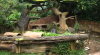
My first impression of Ragunan Zoo was not a good one, with an empty old grotto, some chain-link yards and here is one of the zoo's
THREE Binturong exhibits. This must obviously be an original 1966 grotto that once held a larger species.
Signs for an
Aquarium seemed promising, but in fact the building is very old, with visitors going around the outside looking at grimy, dark tanks that often held only one or two fish. I don't think for a second that the species list is 100% accurate, but I did take photos of all the signs.
Aquarium species list (11 species): San Francisco Piranha, Black Ghost Knifefish, Green Arowana, Super Red Arowana, Banjar Arowana, Silver Asian Arowana, Red-tailed Catfish, Tiger Catfish, Pangasius, Tinfoil Barb and Red Snakehead.
Similar to the urban zoo in Surabaya, amongst other places, Ragunan Zoo has rows and rows of food sellers in a couple of areas. There will be 12 little convenience store type establishments all in a row and later in the day we bought some drinks and potato chips while vendors were calling out to us to buy food. These all appear to perhaps be small family-run businesses.
Ragunan Zoo has
TWO open-air Reptile Houses, both open to the elements at each end and looking quite similar in terms of having terrariums down each side.
Here's an example of some of the species held in Reptile House #1, but keep in mind that this zoo loves having multiple exhibits for the same species. For example, I think they had at least 3 Reticulated Python enclosures.
Reptile House #1 (7 species): Saltwater Crocodile, New Guinea Crocodile, False Gharial, Reticulated Python, Indian Python, King Cobra and Gold-ringed Cat Snake.
In truth, reptiles do well here and the terrariums are large in size. You can see a King Cobra in my photo below and the enclosure goes back a long way. I also like the rockwork along the walls and reptiles are a strength of Ragunan Zoo.
What was shocking to see was the primate collection in naff cages that must be 1966 originals. There can be found at least
THREE blocks of these prison-like structures, with scandalously small areas for the primates to move. Tiled floors, cement walls, bars on the front...ugh.
I saw so many great Proboscis Monkey exhibits on the trip, but here in Ragunan the cages are pitiful. The 'holding areas' are at the bottom at the very back, only maybe 5 feet across and like mini dog cages that you'd see in a public kennel.
The two Muller's Gibbons hanging around at the back of their cage have a single rope and two sticks and that's it.
These hellholes have some ultra-rare, spectacular species, but I struggled to linger as the accommodation is truly awful.
Primate species list for blocks of cages (14 species): Siamang, Silvery Gibbon, Agile Gibbon, Muller’s Gibbon, Proboscis Monkey, East Javan Langur, West Javan Langur, Silvery Lutung, Javan Surili, White-thighed Surili, Heck’s Macaque, Tonkean Macaque, Gorontalo Macaque and Southern Pig-tailed Macaque. Some of these species have multiple small cages and there's primates by the dozen in this part of the zoo.
While it was exciting to see a new species (Gorontalo Macaque), the conditions are horrendous for these primates and I'd rather have not seen the rarities at all. The irony with the situation is that Ragunan Zoo also has the
Schmutzer Primate Center and that zoo-within-a-zoo opened in 2002 and is arguably world-class. Primates are kept in a series of modern, at times fantastic exhibits, and yet the blocks of cages elsewhere are horrendous and as bad as probably anything I've ever seen for primates. It's quite the stunning contrast.
Gorontalo Macaque:
@twilighter
I added at least 6 new macaque species on my Southeast Asian trek. What's the definitive number of macaque species these days? Has anyone reading this seen every type of macaque?
My all-time list of macaques now consists of 18 species:
26 zoos with Japanese
26 zoos with Lion-tailed
22 zoos with Sulawesi Crested
16 zoos with Barbary
16 zoos with Southern Pig-tailed
14 zoos with Crab-eating
12 zoos with Rhesus
8 zoos with Stump-tailed
5 zoos with Bonnet
3 zoos with Moor
3 zoos with Tonkean
2 zoos with Assam
2 zoos with Heck’s
2 zoos with Toque
1 zoo with Booted
1 zoo with Gorontalo
1 zoo with Northern Pig-tailed
1 zoo with Siberut
Siamangs with nowhere to go:
Moving on from the horrible primate conditions, there's a gigantic
Snake Pit that houses a few Reticulated Pythons. It's probably at least double the size of what is shown in my photo and fully open-topped. I doubt that the signage is correct as 4 species are listed and we only saw the pythons.
Snake Pit (4 species): Reticulated Python, Gold-ringed Cat Snake, Keeled Rat Snake and Radiated Rat Snake.
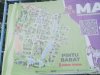
I'm not joking when I say that Ragunan Zoo is massive and it's a real shame that there aren't any paper maps. Konstantin thought ahead and he did print off some online maps for a few zoos on the trip, but at Ragunan animals get moved around and so even the online map isn't great. For instance, there's a small primate icon that turns out to be 14 species, or there's a bird icon and it turns out that the zoo has an enormous, shed-like structure with rows upon rows of aviaries.
I'll call this
Bird House #1 (there's an almost identical building elsewhere in the zoo!) and I didn't make an exhaustive list of species. Indian Peafowl, Silver Pheasant, New Guinea Bronzewing, African Grey Parrot and Maleo are all present here, but signage is a serious issue at Ragunan Zoo and some aviaries have multiple species and literally no signs anywhere. At times, the zoo is a bit overwhelming due to its huge size and repetitive species.
As is the case at seemingly every single Southeast Asian zoo, there are tons and tons of hippos everywhere. The zoo has
several exhibits for Common Hippos that have a lot of water and a lot of land to roam. How did Southeast Asian zoos end up with so many dang hippos? Breeding gone out of control?
It's tough to tell with all the pools and lakes everywhere, but my best guess is that the zoo has a minimum of
THREE Common Hippo exhibits and they are all huge.
There's also a minimum of
THREE Pygmy Hippo exhibits, not quite as many as the
SIX at Taman Safari I Bogor the day before, but still a heck of a lot. Hippos by the dozen!
At this point, and after seeing a couple of enormous, wild Asian Water Monitors roaming the grounds and waterways, we found an upper level of the zoo that was blocked off with big barriers. We dallied for a while until a keeper came along and he gave us permission to quickly run around in that area that is now technically an off-show part of Ragunan Zoo.
Off-show mammal species list (8 species): Plains Zebra, Javan Rusa Deer, Bawean Deer, Malayan Sambar Deer, Lowland Anoa, Mountain Anoa, Babirusa and Capybara.
There's at least 3 Lowland Anoa paddocks, another for Mountain Anoa, and multiple enclosures for most of the species in what seems like an off-show ungulate breeding area. However, this whole zone has always been on the zoo's map so perhaps it's open now and is once again a regular part of a zoo visit. Does anyone know? I could see a lot of visitors skipping the area, as it's in a slightly elevated section and has species that might not be of much interest to Muggles. Does a non-zoo nerd even care about looking at a Mountain Anoa?

Bawean Deer exhibit:
A gorgeous Javan Rusa Deer exhibit:
I saw a single Mountain Anoa at Krefeld Zoo (Germany) in 2019 and here we saw one (and possibly two) Mountain Anoas.
@twilighter
Up next: Part two of my Ragunan Zoo review.

 ). Crab-eating macaques and plantain squirrels are the most common, though you might see Javan mongoose and Javan langurs as well. At night, it was reported that Javan leopards might wander around some parts of the Park.