Alishan, day one
The schedule for the Alishan Forest Train from Fenqihu to Alishan wasn't helpful for me. The only train was at 1.20pm and I wanted to get to Alishan as early as possible to make the most of birding time, so I caught a bus instead. The bus times aren't that much better. There are lots of buses throughout the day between Chiayi and Alishan, but only two of them go via Fenqihu and the first one wasn't until 11.30am. I was told at the reception desk of the Fenchihu Hotel that the best option was to get the 9am bus heading down towards Chiayi but to get off at the junction town of Shizhuo, ten minutes down the mountain, and from there catch one of the frequent Chiayi-to-Alishan buses.
Shizhuo is also spelled Shizhao (always an annoying thing, because you're not sure if you are at the right place or if there genuinely are two different places with almost the same name). I got there at 9.15am. I think I might have just missed a bus to Alishan - the next one didn't arrive until 9.55am. Really I only saved about an hour, or maybe an hour and a half, than if I'd just caught the 11.30am bus from Fenqihu, but there was a real possibility that the 11.30am bus may not have even had any seats so going via Shizhuo was a safer bet.
I didn't like Alishan on arrival but by the end of the day it had grown on me, once I'd figured out where everything was and how to get there, and by the time I left it was my second favourite place in Taiwan after Xitou. I saw 35 species of birds while there, which doesn't sound like many but looking at the eBird checklists I think it probably is. Nine of the birds were lifers. I saw six species of mammals of which three were lifers.
Taiwan Yuhina - one of the most common endemics so I have lots of photos of them!
Arrival was, as is often the case for me when I arrive anywhere, confusing. The Gau Shan Ching Hotel was supposed to be about a minute's walk from the bus station. The only thing where the bus stopped was the entrance gate to the Alishan National Forest Recreation Area which, as far as I had gathered from looking at maps, was
beyond the hotel and village area. I asked a guard at the stop where the hotel was and he said I had to go through the gates where you pay to enter. I thought there was a translation error but he insisted I had to pay to get to the hotel. I went up to the gate where they said the same thing. It turned out the whole village area is inside the Forest Recreation Area and you have to pay. I mean, I would have been paying to go into the park anyway, but it seemed weird having to pay to just get to the hotel. Although obviously it does mean you're not paying an entry fee every day, because you're already inside.
As for the hotel being a minute's walk, it might be a minute's walk from the bus stop in a straight line, but in real life it was more like fifteen or twenty minutes because I had to walk up the entrance road and all the way through the tourist village - asking people along the way for directions - and then down a steep set of narrow stone steps before getting there.
The hotel was the cheapest one on Trip, and it was still costing me NZ$147 per night (after transaction fees etc added on to the booking). The staff at reception were lacking in any sort of charm or enthusiasm, the room was tiny and (at best) adequate, the hotel itself was old and noisy. Not good first impressions of Alishan at all!
I left my pack at the reception and went for a wander to try and suss out the layout of the area. The whole place struck me as just a tourist village, with expensive restaurants and manicured gardens. I mean, it
is a tourist village, that's literally what they call it, but it did not seem at all like the great birding destination that trip reports made it out to be. I went to the tourist office for information and found that, unlike what I had thought, there wasn't really any way to make day-trips from here to other parts of the mountains because no buses had usable schedules. To get to Tataka, for example (where Yellow-throated Martens were said to be reliable at the viewpoint car-park) there was only one bus a day, which left Alishan in the afternoon and came back from Tataka at 8am in the morning, so completely useless.
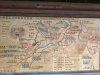
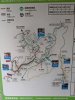
I tried to work out what the map of Alishan was showing me and it didn't look promising. There were shuttles which did runs to a couple of viewing points higher up but they either left really early (for people to watch the sunrise) or too late into the morning, and it was difficult to get a sense of scale for distances. I decided to just go walking and see where I found myself.
Most of the "trails" on the map are actually boardwalks running alongside the roads, on the downhill side so the slope drops away below the boardwalk, but they are in effect sidewalks rather than trails. The slopes are covered in forest, which is mostly cypress, so you can bird from them, but most of the birds I was seeing were the same common species I'd seen at Xitou and Fenqihu, the White-eared Sibias and Steere's Liocichlas and so forth. I wasn't "feeling it", as they say, and was grumbling away internally about how rubbish the place was.
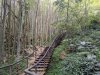
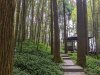
After walking for a distance along the initial boardwalk from the village I took an over-bridge which led on to Zhaoping Park, and when I got there I saw there was a stone-paved trail cutting up the hill, an actual trail through forest and not a boardwalk following a road. This was the Sunrise Trail (or Zhushan Footpath, depending on which map or sign you're looking at) which basically cuts out half the walk up the road if on the way up to Zhushan lookout. I didn't ever see anything on this trail as it happens - the trees were immensely tall and it just seemed remarkably birdless any time I was on it - and at the top I just kept walking up the road.
Just a little way further on the road doubled back on itself in an abrupt U-bend and right there, on the uphill side of the bend by a 4km marker sign, I suddenly found a whole lot of birds, including three endemics which were lifers - the Flamecrest, the White-whiskered Laughing Thrush and the Collared Bush-Robin - along with Taiwan Yuhinas, Morrison's Fulvettas, Taiwan Barwings, Green-backed Tits, Black-throated Tits, and even a Coal Tit (which in Asia have a pointy crest unlike the crestless European ones). I went up this road every day I was at Alishan and there were loads of birds at this spot every time except on the very last morning.
White-whiskered Laughing Thrush
Taiwan Barwing
The Flamecrest is a relative of the Goldcrest and is only found in the mountain forests of Taiwan. It is a really cute little bird with a bright yellow belly and a cartoony white face with black stripes.
The flame in its crest isn't obvious - most of the time it just looks black and white - but when it is displaying or threatening another Flamecrest it somehow reveals a blazing orange mohawk from nowhere. It's extraordinary. I saw two birds fly into the same tree and suddenly their heads looked like they had caught fire.
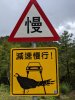
I carried on walking, and around the next bend in the road was a road-sign with a Mikado Pheasant on it. There are two endemic pheasants in Taiwan, the Swinhoe's Pheasant of lower altitudes and the Mikado Pheasant of the mountains. I think the Swinhoe's is the easier one to see, but this is probably just because it is more widespread. That's the bird I most associate with Taiwan, but (spoiler alert) I never saw one the whole time I was in Taiwan.
Mikado Pheasants are regularly reported from Alishan so I had my hopes up, but at the same time pheasants are tricky beasts (except when they're not!). Pheasants are odd birds - they are sneaky most of the time but then randomly they will just walk out in front of you as if they are a domestic chicken. But no, I did not see a Mikado Pheasant today.
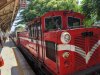
At the top of the road is the Zhushan Viewing Point, which has a train station for the Alishan Forest Train in the morning, and a path from here leads further on to the Mt. Ogasawara Viewing Point. Part way along this path is the small Alpine Botanical Garden. Just past here is a raised boardwalk to the viewing platform. There were some birds in the bushes along the walkway but they were ones I'd already seen today.
Taiwan Yuhina
More interesting was a Taiwan Striped Squirrel, deep inside one of the small trees. This ended up being the only one I saw in Taiwan, which was disappointing, but at least I saw it well even if I couldn't photograph it.
This area also seemed to be a good spot to see the Taiwan Yellow-bellied Bush Warbler. Normally bush warblers are secretive, creeping around in thickets and trying not to be visible, but up here I saw them frequently.
On the way back to the tourist village I came across a huge troop of Taiwan Macaques feeding on grass in Zhaoping Park.
While in Taipei I hadn't had any luck finding the "easy and reliable" Taiwan Red Giant Flying Squirrels at Fuyang Eco Park. In the mountain forests there is another endemic species which is also supposed to be "common" and "easy to see" at Alishan (and at Dasyueshan), which goes by the long-winded name of Taiwan Red & White Giant Flying Squirrel. Both these species are splits from more widespread species of the Chinese mainland (the first from the Philippine Giant Flying Squirrel and the second from the Red & White Giant Flying Squirrel). Apparently they are easy to see at Alishan because of the boardwalks which mean you can be looking across into the trees rather than up at them from the ground. However that was also supposed to be the case at Fuyang Eco Park and it didn't help me at all!
To my surprise, it turned out to be true! I went out in the evening and in no time at all I was looking at a Taiwan Red & White Giant Flying Squirrel!
I have some doubts that they are really as common as they are said to be. On the boardwalk I only saw them at one spot (every night), and I saw one elsewhere and heard a couple, but it felt like there were just some individuals which happened to live by the boardwalk at that spot and were used to people and lights, so the impression is that they are common because those particular animals are very visible. Nevertheless, even if that's the case, it still means they are "easy to see" at Alishan.