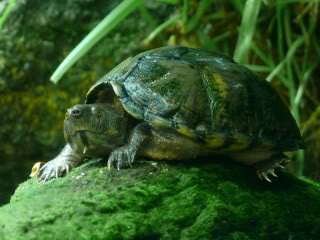
Myrtle Beach Zoological Park - A 'New' Project

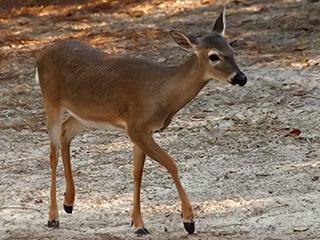
We return to the North America Trail, with a pathway winding from the coastal regions of the Pacific Northwest and Canadian Atlantic to... The Everglades. Trading rocks and sand for marshes and cypress trees, visitors are once again immersed totally into the new biome. With that in mind, numerous road signs marked with 'Gator X-ing' can be found along the path leading to the Everglades Alligator House. While warning of the gators, visitors are also prompted to look around into the many habitats on this side of the outdoor stretch. The first habitat is an example of the more calm demeanor that shares a home with the iconic crocodilians visitors are being bombarded with warnings about. A 3/4-acre forested habitat lies along the left side of the path, providing a home to a herd of Florida Key White-tailed Deer Odocoileus virginianus clavium (1.9), a subspecies of one of eastern North America's more common mammalian species.

images

Example Road Sign
full

Possible Look of Deer Habitat
Image Credit -> @SusScrofa
Key-Weisswedelhirsch.jpg

Florida Key White-tailed Deer
Image Source -> ZooTierListe

Walking past the deer, visitors come across a building facade, similar in appearance to the entrance to Zoo Miami's Florida: Mission Everglades, which acts as an airlock system into the first of two walkthrough aviaries in a row. Spanning 5.5m up above visitors' heads, and having a floor area of 2,750 sq. meters, the aviary is roughly half land area and half shallow water. The walkway through the aviary is an elevated boardwalk, another commonality in Everglades walking trails, allowing visitors to have birds on either side as well as below. The most common sighting on the water and underfoot would be our flock of American Wood Duck Aix sponsa (2.5), while along the shorelines, visitors will likely spot our pair of American Great White Egret Ardea alba egretta (1.1), and our flocks of American Wood Stork Mycteria americana (5.5) and Green Heron Butorides virescens (4.4). Meanwhile, amid the dense reeds on the shoreline, visitors may be able to spot either of our American Bittern Botaurus lentiginosus (1.1), a species more likely to be heard than seen by visitors.
Another facade separates the two aviaries, and upon passing through, two of the inhabitants are immediately noticed. This is due to the sheer size of the groups of American White Ibis Eudocimus albus (13.13) and Roseate Spoonbill Platalea ajaja (10.10), as well as their vibrant coloration and seemingly incessant presence in the shrimp-stocked shallows of this 2,450 sq. meter and 4.5-meter high aviary. As the boardwalk winds around the perimeter, this allows deeper water without forcing it to be beneath the visitors' footpath. As such, the zoo's bachelor pair of Anhinga Anhinga anhinga (2.0) can be seen darting throughout the water much more clearly than if the depths were under the planks of the boardwalk.

upload_2025-8-2_19-14-58.jpeg
Mission Everglades Entrance
Image Source -> Exhibits | Zoo Miami
full

Possible Look of Walkthrough Aviaries
Image Credit -> @honeybadger
full

full

Top: American Wood Duck
Bottom: (American?) Great White Egret
Image Credit -> @KevinB
full

American Wood Stork
Image Credit -> @Ituri
full

Green Heron
Image Credit -> @red river hog
full

American Bittern
Image Credit -> @Mr. Bobcat
full

American White Ibis
Image Credit -> @Gab_1
full

Roseate Spoonbill
Image Credit -> @GiornoPizza
full

Anhinga
Image Credit -> @red river hog

Phew... with the sheer quantity of feathers in there, you couldn't possibly expect MORE birds, right? Well, briefly, we turn back to the furry side of things, with a 450 sq. meter habitat that is not meshed in, but contained by tall, inward-angled barriers which are not climbable. As is the case in many canine habitats, your eyes may immediately drift to the lower reaches of the space. For our brotherly trio of Florida Gray Fox Urocyon cinereoargenteus floridianus (3.0), the ground-dwelling nature of most canines misleads you. With the presence of trees with low-hanging limbs, visitors can just as often spot these canines somewhere most others will never attempt to venture: in the trees, or on elevated platforms strategically placed to give visitors the 'dog in a sunbeam' image with the foxes.

full

Possible View of Fox Habitat
Image Credit -> @geomorph
full

Florida Gray Fox
Image Credit -> @Andrew_NZP

Just when I said there had been an excess of birds (yes, the creator of this facility complaining about his excessive use of birds, but oh well), three aviaries round out the lead-up to the Everglades Alligator House (name is a work-in-progress, if not mentioned earlier). The first looks eerily familiar if we recall our trip to the Pantanal. This is because it was designed on the exact same blueprint (450 sq. meters, 4m high) as the aviary in the Pantanal for the same species, being the Snail Kite Rostrhamus sociabilis (0.2), with this space hosting the female counterparts to the males seen previously. This isn't the largest aviary in the row, however. Next door to them is a species many a visitor (myself included) has likely witnessed circling high above, scanning the ground for any potential food. I speak, of course, in reference to the Eastern Turkey Vulture Cathartes aura septentrionalis (4.4), with this flock of birds on a wide spectrum of physical conditions occupying a 650 sq. meter and 5m high aviary, stocked with numerous carrion tables to reduce risk of hostile confrontation, sandwiched by the kite aviary and the 250 sq. meter, 3m high aviary for a pair of Fish Crow Corvus ossifragus (1.1). The crows are given a large central tree and a marshier environment stocked with small fish and crustaceans as dietary enrichment.

full

Possible Look of Kite Aviary
Image Credit -> @Zoofan15
full

Snail Kite
Image Credit -> @savethelephant
full

Possible Look of Vulture Aviary
Image Credit -> @gulogulogulo
full

Eastern Turkey Vulture
Image Credit -> @Ituri
full

Possible Look of Crow Aviary
Image Credit -> @Pleistocene891
full

Fish Crow (poster was unsure of I.D.)
Image Credit -> @Elephantlover

And with that, we arrive at the doors to the complex named for its largest inhabitants (I'm going to stop using the temporary name until I come up with a better one), whose exterior is inspired primarily by both Zoo Knoxville's ARC Campus and Toronto's Australasia Pavilion. As one might expect, alligator warning signs are present on both sides of the buildings entrance, and will continue to be present throughout the building, varying from serious road signs to more comical signs (such as the ones found here and here). On that note, stay tuned and enjoy!
 

Attachments

  • upload_2025-8-2_19-14-58.jpeg
    upload_2025-8-2_19-14-58.jpeg
    10.8 KB · Views: 154
Entering the pavilion we left off with, visitors first find themselves slightly raised above a 125 sq. meter area, much of which is water, directly underfoot of a wood-framed Plexiglass footbridge. The pool is surprisingly deep, though the bottom is not visible due to the presence of lily pads and floating logs. Both of these additions provide a dry crossing for the female members of our American Purple Gallinule Pophyrio martinicus (0.4) flock, whose male counterparts (2.0) are kept off-display. Any females who have any success in breeding (taking place off-display) will remain off-exhibit until any eggs hatch, so as to reduce the risk of any hostility toward their exhibit-mates, being groups of Chicken Turtle Deirochelys reticulara (4.4) and Florida Red-bellied Cooter Pseudemys nelsoni (5.7) which are, more often than not, seen basking on the logs floating in the water, or simply poking their heads out amid the lilies.

full

Possible Look of Turtle/Gallinule Habitat
Image Credit -> @BeardsleyZooFan
full

Purple Gallinule
Image Credit -> @Therabu
full

full

Top: Chicken Turtle
Bottom: Florida Redbellied Cooter
Image Credit -> @RatioTile

While crossing the bridge over the turtles and gallinules, visitors may have noticed the presence of steel mesh in the background, arching away along the path in a big circle. This comes with a good reason. Visitors walk across the bridge and onto an elevated platform (you're only about 3m above the ground level of the habitat below) which allows a look down through steel mesh onto a 3,450 sq. meter slice of the Evergladian (is that a word?) swamp. Bald cypress, willow, and mangrove trees line the land areas leading up to muddy shorelines into three sizeable pools (each ~450 sq. meters surface, reaching roughly 3m deep at the deepest points), while reeds, cypress knees, and lilies shroud the surface in the shallows. Meanwhile, a nearly clear view to the muddy bottom is available in the deeper portions, which would allow visitors to catch a glimpse of the shimmering scales of approximately 600 Bluegill Lepomis macrochirus. Don't worry, these little guys aren't the stars of the exhibit. In fact, a quick look at the wall behind you will show you 50 more of those little guys in a 1,600-gallon tank that doesn't provide potential as dietary enrichment. Meanwhile, the sunfish down below are, in all likelihood, ultimately destined to become a piece of dietary enrichment for their roommates, the ever-iconic American Alligator Alligator mississippiensis (4.18). Seems like a large group, right? Well, as well as this near-3/4 acre indoor space, the gators are provided another 2,000 sq. meters of outdoor space, which will be seen later, that they can move freely to and from throughout the day.

full

Possible Look of Gator and Dietary Enrichment Bluegill Habitat (sans egrets, of course)
Image Credit -> @NNM.
full

Possible Look of Non-Enrichment Bluegill Tank
Image Credit -> @BeardsleyZooFan
full

Bluegill
Image Credit -> @Zooish
full

American Alligator
Image Credit -> @SivatheriumGuy

As the elevated pathway slopes downward, visitors pass a series of 15 tanks displaying a wide variety of Floridian reptiles, amphibians, fish, and invertebrates. The full list, including tank sizes as well, is found below in the spoiler.

Tank #1 - 20 sq. meter habitat home to breeding pair of Florida Cottonmouth Agkistrodon conanti (1.1)
Tank #2 - 15 sq. meter home to breeding pair of Eastern Indigo Snake Drymarchon couperi (1.1)
Tank #3 and #4 - 12 sq. meter homes to respective pairs (1.1) of Harlequin Coral Snake Micrurus fulvius and Southern Pine Snake Pituophis melanoleucus mugitus
Tank #5 and #6 - 250-gallon vertical rectangular tanks home respectively to lone Greater Siren Siren lacertina (1.0) and Three-toed Amphiuma Amphiuma means (0.1), each with breeding partners off-display
Tank #7 - 2,000-gallon cube tank home to lone Florida Gar Lepisosteus platyrhincus (0.0.1)
Tank #8 and #9 - 1 sq. meter tanks, 'stacked' atop one another, respectively home to rotating pair of Eastern Tiger Salamander Ambystoma tigrinum (1.1) and group of Northern Red Salamander Pseudotriton ruber ruber (3.3)
Tank #10 - 1 sq. meter and 2m-high tank home to Green Tree Frog Hyla cinerea (3.9), with 250 offspring off-display
Tank #11 - 65-gallon tank home to Giant Water Bug Abedus herberti (0.0.6)
Tank #12 - 1 sq. meter tank housing Eastern Lubber Grasshopper Romalea microptera (0.0.6)
Tank #13 - 2 sq. meter tank home to Southern Leopard Frog Lithobates sphenocephalus (1.3)
Tank #14 and #15 - respective 8 sq. meter paludarium displays housing a pair of Florida Softshell Turtle Apalone ferox (1.1) and a group of Razorback Musk Turtle Sternotherus carinatus (3.3)
(images for the spoiler will be uploaded in a two-part media roundup at some point tomorrow {probably about 24 hours after this post will be uploaded})

Having rushed through the fifteen tanks along the right-hand wall of the walkway, the sloping path has led us to the ground, allowing a floor-to-ceiling glass view into the indoor alligator habitat. The transition from steel mesh to glass occurred rather gradually, as soon as it became a potential risk for visitor fingers and/or food to end up in the alligators' space.
Now, there are two more habitats inside the building before a short and sweet outdoor wrap-up concludes the Everglades area and, with it, the North America Trail. But first, indoor habitats. Directly beside the alligator viewing window, the habitat ends abruptly and is replaced with another alligator (in a sense). The 40 sq. meter land area, and thus the level of the 80 sq. meter aquatic space, is roughly 5.5ft above the floor you walk on. That in mind, the underwater view will be most fruitful on the average day, seeing as our rotating male and female Alligator Snapping Turtle Macrochelys temminckii (1.1) {see? alligator!} don't often venture onto land. In fact, the actual rotation of the individuals is made in time with the habitat cleaning schedule, as the rotation process requires the draining of the pool for easier access to the turtle which has likely found a comfy spot at the very bottom.
Opposite the snapping turtle tank, a space that looks to be one really is two. For context, visitors are given a 150 sq. meter touch pool, spanning roughly 8m or so from end to end, which houses a decent group of Atlantic Horseshoe Crab Limulus polyphemus (0.0.15). This is backdropped by another habitat, 90 sq. meters of mangrove coastline, which looks as though it extends to include this touch pool. This illusion is furthered by the identical depths of water between the two spaces, as well as the artificial currents which seem synchronized. However, the backdrop houses its own species, being the Atlantic Blue Crab Callinectes sapidus (0.0.20), often seen burying themselves in the sand either underwater or among the mangrove roots.

full

Possible Look of Snapping Turtle Tank
Image Credit -> @Dhole dude
(Yes, I used this image before here. It just so happens to work for both my snapping turtle tank designs. Sue me.)
full

Alligator Snapping Turtle
Image Credit -> @USZOOfan42
full

Potential Look of Horseshoe Crab Touch Pool
Image Credit -> @ZooNerd1234
full

Atlantic Horseshoe Crab
Image Credit -> @GiornoPizza
full

Possible Look of Blue Crab Habitat
Image Credit -> @Philipine eagle
full

Atlantic Blue Crab
Image Credit -> @RatioTile

And with that *sigh* we are just three total habitats (and two media roundup posts) from putting a bow on the Everglades and the North America Trail! While the final post likely will not go up tomorrow alongside the media roundup posts, you can expect the finale of the North America Trail by no later than Sunday (Earlier? Potentially...) afternoon. For now, I will leave those of you who follow the tour to your speculations about the finale of the area (already set though, so you won't be influencing anything major) and any questions that might be had about zones that have already been presented, the current zone, or any future zones.
Anyway... with that I leave you with my same message as always. Stay tuned, and enjoy!
 
Before we begin the media roundups, I'd like to address a small error on my part:
Tank #5 and #6 - 250-gallon vertical rectangular tanks home respectively to lone Greater Siren Siren lacertina (1.0) and Three-toed Amphiuma Amphiuma means (0.1), each with breeding partners off-display
The amphiuma in question is, in fact, NOT the Three-toed Amphiuma, but the Two-toed. The scientific name was correct, I apparently read the common name too fast when I wrote this initially and just wrote the first number beginning with "T" that popped into my head... and it was the wrong one.
Apologies! Anyways, here's the first media roundup post (complete with the correct amphiuma species :p)

Media Roundup - Part One

full

Possible Look of Cottonmouth Exhibit
Image Credit -> @snowleopard
full

Florida Cottonmouth
Image Credit -> @Maguari
full

full

Top: Possible Look of Indigo Snake Exhibit
Bottom: Eastern Indigo Snake
Image Credit -> @Moebelle
full

Possible Look of Coral and Pine Snake Exhibits
Image Credit -> @Gibbonsagainstgravity
full

Southern Pine Snake
Image Credit -> @RatioTile
full

Harlequin Coral Snake
Image Credit -> @Maguari
full

Possible Look of Amphibian Tanks
Image Credit -> @German Zoo World
full

Greater Siren
Image Credit -> @biggiesmalls
full

Two-toed Amphiuma
Image Credit -> @Ding Lingwei
full

Possible Look of Gar Tank
Image Credit -> @SwampDonkey
Lepisosteus%20platyrhincus%20Frankfurt%202.JPG

Florida Gar
Image Source -> ZooTierListe
full

Possible Look of Salamander Tanks (reused this one, from two areas ago; post #66 on this thread)
Image Credit -> @Moebelle
full

Eastern Tiger Salamander
Image Credit -> @Dhole dude
full

Red Salamander
Image Credit -> @Ituri

Part Two coming very soon...
 
Media Roundup Part Two (no silly mistakes to correct this time :p)

full

Possible Look of Tree Frog Exhibit
Image Credit -> @MagpieGoose
full

Green Tree Frog
Image Credit -> @vogelcommando
full

Possible Look of Water Bug Exhibit
Image Credit -> @TinoPup
full

full

Top: Giant Water Bug
Bottom: Possible Look of Grasshopper Exhibit
Image Credit -> @Moebelle
full

Eastern Lubber Grasshopper
Image Credit -> @biggiesmalls
full

Possible Look of Leopard Frog Exhibit
Image Credit -> @SivatheriumGuy
full

Southern Leopard Frog
Image Credit -> @Astrotom3000
full

Possible Look of Turtle Exhibits
Image Credit -> @CarnotaurusSastrei
full

Florida Softshell Turtle (is it weird that these guys creep me out a bit but the bigger softshells don't?)
Image Credit -> @twilighter
GekielteMoschusschildkrte.jpg

Razorback Musk Turtle
Image Source -> ZooTierListe

Side tangent to round off this post... what would the viewers of this thread (and those who have been mentioned time and time again as I use your images) think if I did some kind of commemorative post (at the end of the grand tour, of course) in which I give one final shoutout to not only the biggest supporters, but also any members of the community who have supplied images to this thread? I'm considering it, but wanted some other opinions before I began a true tracklist of those whose photos have been utilized, as well as those who have liked each post I make to this thread.
... and one last image, acting as a teaser/spoiler for what is to come in wrapping up the trail Saturday evening, because I couldn't help myself. Anyways, stay tuned and enjoy!
full

Image Credit -> @red river hog
 
Short and sweet is the game today, with just a trio of habitats to cover, having just exited the pavilion. It begins with one final alligator warning sign directing attention to the left, where the previously-mentioned 2,000 sq. meter outdoor home for our sizeable group of American Alligator Alligator mississippiensis (4.18) sits, bearing a resemblance to the Native Swamp and Rookery exhibit at St. Augustine Alligator Farm. This space often finds itself housing numerous native birds in the upper branches of the cypress and willow trees dotting the landscape, with the most notable being the cattle egret.

full

full

Possible Looks of Alligator Outdoor Space
Image Credit -> @Moebelle
full

American Alligator
Image Credit -> yours truly, @Van Beal

From here, the pathway curls off to the right on a gentle downward slope, nearing a large false-rock archway labelling this final display as "Manatee Springs" (name temporary). Despite this mention of the much-loved sirenian, the first viewing window does not look onto the manatee, but rather a reptile, in the shape of the Ornate Diamondback Terrapin Malaclemys terrapin macrospilota (4.8). These testudines paddle through 10 sq. meters of 1-meter-deep eelgrass-rich brackish waters beneath a tangle of mangrove roots which extends 1m above the water's surface. The glass back to the tank is thicker than that of the front of the tank, seeing as it allows a brief glimpse into the larger tank behind it.
Speaking of that larger tank, continuing forward past the terrapins, visitors come to a 6m-long viewing window into a 185,000-gallon tank. With a sandy bottom allowing for eelgrass to grow, visitors can observe the grazing behavior of our rehabilitating Florida Manatee Trichechus manatus latirostris (2.3), the five counterparts to the three seen earlier on in our Central America/Caribbean complex. Much like the previously seen individuals, these five are not housed alone, instead sharing the tank with a small school of Atlantic Tarpon Megalops atlanticus (0.0.6).

full

Possible Look of Terrapin Habitat
Image Credit -> @Philipine eagle
full

Ornate Diamondback Terrapin
Image Credit -> @SusScrofa
full

Possible Look of Manatee Habitat
Image Credit -> @snowleopard
full

Florida Manatee
Image Credit -> @USZOOfan42
full

Atlantic Tarpon
Image Credit -> @CarnotaurusSastrei

And with that, visitors emerge from the darkened viewing area and find themselves... right back at the beginning of the loop. However, rather than head to the right, and ultimately back toward the entrance, we continue to the left, venturing off our continent and onto one which is very well-known for a few big-name zoo species...
Oh... right. ZooChatters aside, that could be any of the continents not already covered.
I speak of the zoo's third trail, the African Continental Trail, one which sits smack in the middle in terms of species population, behind the one we just traversed and one to come later. And, while not considered a portion of the main trail, this trail does also allow us to make a quick stop on the island Dreamworks made famous to many... Madagascar!
But that all will have to wait for now. I will post again tonight, however just to give a Species Roundup for the North American Trail and to update the total number of species we have had the pleasure of seeing so far. So for now I leave, but stay tuned and enjoy!
 
And so, with another trail wrapped up, that means more math to be done (yay!).
The figures for the areas previously viewed are quoted below, and will be followed by the North America Trail's numbers, and finally, an updated count on how many species we have seen so far!
Galapagos Ecotarium: 13 total species; 4 birds, 5 fish, 4 reptiles
Nocturnia - A World Without Light: 28 total species; 1 amphibian, 2 birds, 3 fish, 2 invertebrates, 17 mammals, 3 reptiles
Central America: 40 total species; 4 amphibians, 6 birds, 8 fish, 7 invertebrates, 1 mammal, 14 reptiles
And now the larger South American Trail, divided into its parts:
The Southern Tip: 32 total species; 3 amphibians, 14 birds, 2 invertebrates, 10 mammals, 3 reptiles
Andes Mountain Trail: 15 total species; 2 amphibians, 7 birds, 6 mammals
Pantanal Preservation Project: 21 total species; 1 amphibian, 10 birds, 6 mammals, 4 reptiles
Amazon and Atlantic: 72(!) total species; 8 amphibians, 14 birds, 13 fish, 16 invertebrates, 10 mammals, 11 reptiles
SOUTH AMERICAN TRAIL: 140 total species; 14 amphibians, 45 birds, 13 fish, 18 invertebrates, 32 mammals, 18 reptiles
North American Deserts: 32 total species; 1 amphibian, 8 birds, 1 fish, 8 invertebrates, 5 mammals, 9 reptiles
Great Plains and Mountain Ranges: 25 total species; 4 amphibians, 7 birds, 8 mammals, 6 reptiles
Temperate and Taiga Woodlands: 58 total species; 12 amphibians, 17 birds, 2 fish, 6 invertebrates, 10 mammals, 11 reptiles
Atlantic and Pacific Coasts: 26 total species; 12 birds, 8 fish, 2 invertebrates, 4 mammals
Florida's Everglades: 36 total species; 6 amphibians, 10 birds, 3 fish, 4 invertebrates, 2 mammals, 11 reptiles
NORTH AMERICAN TRAIL: 177 total species; 23 amphibians, 54 birds, 14 fish, 20 invertebrates, 29 mammals, 37 reptiles
EXTRA - Dual-Feature Species: Over the course of the first two major continental trails, four species have been seen multiple times. As such, with these four being the only species in the facility to overlap areas, I've decided that with both trails wrapped up, I should add them into our total as the 3 birds* and 1 mammal** that they are. Also, for those who might have noticed that mathematical discrepancy in the first post with these numbers, I appreciate that you trusted me to have an answer for it. And if nobody noticed, well then nobody noticed :)
* Anhinga, Snail Kite, Burrowing Owl
** Florida Manatee
And now... with the updated figures to the total species list so far:
402 total species
42 amphibians
114 birds
43 fish
47 invertebrates
80 mammals
76 reptiles

And now I leave you for tonight, so stay tuned and enjoy!
full

One last teaser... of course a Varanus now that we've left the New World
Image Credit -> @fofo
 
As far as the African Continental Trail is concerned; I have to ask if the next post will start with the continent proper, or will it cover Madagascar first?

Either way, I can’t wait for the beginning of this next section!
 
As far as the African Continental Trail is concerned; I have to ask if the next post will start with the continent proper, or will it cover Madagascar first?

Either way, I can’t wait for the beginning of this next section!
The way I have it laid out, the trail will start in Africa, covering the first three portions of the trail, then bringing visitors to the Madagascar complex, and finally concluding the area with the last of four subsections.
 
Brief statement before I officially dive into the African Continental Trail with my personal favourite subsection in the entire zoo: the posts on this are going to be slowing down, to probably about twice a week. Yes, this does mean there is one more post coming this week (likely tomorrow) but there will be a bit more of a schedule. Ideally, the posts will be coming on Tuesdays and Thursdays until this project is totally posted on this thread. Those other five days, while some might be used for additional posts here, will more often be utilized as a means for me to work on a couple of other spec zoo projects I have been developing over the past month or so (one substantially more than the other, but that's besides the point). At some point near the conclusion of this thread, I will ask which of the two projects would be more desired by those of you who follow this thread closely, and based on the results of that, the more popular project will take priority in regards of my presence in the spec zoo forum (no, I am not disappearing, simply managing my time in a method which better allows me both flexibility between the projects and some off-days when needed). This scheduling process will ideally aid the elimination of the lengthy spans of time in which I do not post on this thread. Any further questions regarding this matter can be asked via private message or in the thread below, whichever of the two better suits your fancy. Anyway, onto the zoo...

The African Continental Trail begins with Sahara and Kalahari, a journey through the arid landscapes of Africa's northern and southern regions. Unlike some of our previous tours, I will not be halting at the doors to the Woestyndierehuis (Afrikaans for Desert Animal House), but rather beginning the venture into what is yet another indoor area for the zoo.
However, we begin outdoors beneath a simple shaded viewing area, detailed with fake rock and wood accents allowing it to blend almost seamlessly into the surrounding false-rock walls which contain the 1-1/2 acre habitat which is viewable through this glass panel. This is the first of two viewing areas onto a plot which has been transformed into quite the dry landscape, with a floor of dry soil and sand exposing clusters of rock, while small bushes and the occasional stunted tree cling to what little life this desolate landscape provides. While the animals may be visible from this perspective, the second view, coming from a slightly elevated viewing deck across from the entrance to the Woestyndierehuis, puts visitors directly above the primary feeder for our herds of Addax Addax nasomaculatus (1.4) and Nubian Red-fronted Gazelle Nanger dama ruficollis (2.7), as well as a group of Red-necked Ostrich Struthio camelus camelus (3.5) made up of 1.3 adult birds and 2.2 juveniles. The zoo also holds an additional pair of male addax off-display, however the three males, given all are socially accepted by the females of the herd, are rotated on a weekly basis to ensure each animal is given the enrichment of the social interaction beyond their indoor holding area.

full

Possible Look of Arid Grassland Habitat
Image Credit -> @WhistlingKite24
full

Addax
Image Credit -> @KevinB
full

Nubian Red-necked Gazelle
Image Credit -> @RatioTile
full

Red-necked Ostrich
Image Credit -> @Benosaurus

Visitors now turn to the Woestyndierehuis, with the sign above the door providing an image of a fennec fox's head, with the Afrikaans name of the building spanning between the ears, while the English name is written beneath the fox's head. With this (albeit unnecessary) detail out of the way, visitors head through the double doors and are immediately hit with a wave of dry heat, with the temperature in the building sitting around roughly 30 degrees Celcius, with designated areas having fans and misters to ensure visitors remain comfortable in the heat. We are not actually in the Sahara, after all :p.
Just a short walk into what is an immersive set-up, a trio of 2 sq. meter terrariums can be seen built into the false-rock wall ahead. While the wall guides the path off to the right, visitors can stop and take a peek at a trio of serpentine desert dwellers, with the left-most tank hosting Desert Horned Viper Cerastes cerastes (0.3*), the central tank the Snouted or Banded Egyptian Cobra Naja annulifera (0.2*), and the right-most our Kenyan Sand Boa Eryx colubrinus loveridgei (0.3*). Each species is supplied with a three-dimensional false rock backdrop complete with small caves for hiding, as well as a number of branches and other rocks to bask on or hide beneath.

*each of the species has 1.0 individuals kept off-display, with plans to introduce additional males to balance out the sex ratio within the zoo's populations

full

Possible Look of Snake Terrariums
Image Credit -> @SivatheriumGuy
full

Desert Horned Viper
Image Credit -> @jayjds2
full

Snouted Cobra
Image Credit -> @Batto
full

Kenyan Sand Boa
Image Credit -> @red river hog

And with that, as the path turns off to the right beyond our snake-filled rock wall, this portion of the tour will come to a close. Tomorrow, we will conclude the Woestyndierehuis (and possibly the entirety of Sahara and Kalahari), a venture which will inevitably require a media roundup to follow it, so expect multiple posts (one of true content, and one or two of media) around this time tomorrow!
Stay tuned, enjoy, and feel free to address anything mentioned at the beginning of this post, whether it be in this thread or in a private message to me!
 
As a man of my word (despite the autism in me almost stopping me), I return to conclude Sahara and Kalahari. With this requiring the completion of the Woestyndierehuis walkthrough as well as the viewing of a few outdoor habitats, I have decided that the indoor species/exhibits will be the contents of the media roundup, while the images for the outdoor portion will be contained in this post.

The trip through the Woestyndierehuis continues from our wall of serpents along a pathway which curves off to the right. As the curve begins to straighten out, visitors find themselves walking along the chest-height barrier of a 100 sq. meter kopje habitat. Smaller palms shroud the habitat's perimeter, while scraggly bushes and dead branches make up the remainder of the foliage found in the space. The rocks of the kopje reach roughly 3m high, and the gaps in the rock are filled with PVC pipes to create a complex tunnel system up within the rocks, into the many caves beneath, and into some smaller reinforced burrows in the habitat's sandy floor. Darting among these tunnels are a group of Common Dwarf Mongoose Helogale parvula (3.7). Neighbouring this habitat is one which is identical in size and features the continuance of the sheer false-stone wall backdropping the spaces, but features a much lower rock structure than the mongoose space. Additionally, the PVC piping which acts as the tunnel system for our burrowing mammals continues beneath the ground and connects to another habitat in the building. This habitat, much like the previous, hosts a mongoose species, this one being the poster-child of the area that is the Meerkat Suricata suricatta (6.6).

Across the pathway from the meerkat space are four 145 sq. meter habitats, each viewable through glass rather than the open viewing given in the previous two. The first of these is drastically different from the others in terms of inhabiting species, but otherwise the four spaces are near-identical. As each habitat is open-topped, the dividing walls between the spaces are smooth and completely vertical at the top, just beyond the jumping range of the most agile inhabitant, while having a rugged three-dimensional backdrop range down to the floor. Planting in the spaces is sparse, with small bushes and dead tree limbs dotted around central rock formations, and the occasional succulent or green plant located near to the water dish for the animals. The first space provides a home to the Desert Monitor Varanus griseus (1.0, additional 1.1 off-display), while the second and third provide homes to respective canine species, being the Bat-eared Otocyon megalotis and Fennec Fox Vulpes zerda (1.1 each), and the last space houses Saharan Sand Cat Felis margarita margarita (1.1), a subspecies which is not all that common on the continent, with the majority of holdings being the Arabian subspecies F. m. harrisoni.

Visitors next wrap around the false stone wall which provided the backdrop to the mongoose and meerkat habitats, and find another habitat on the right-hand side of the pathway. This habitat is the space which the meerkats have access to by way of underground PVC tunnels. At 175 sq. meters, the inhabitants of the space, being both the visiting meerkats and the always-present North African Crested Porcupine Hystrix cristata (1.1, additional 1.2 off-display), are given more sandy soil to dig around in, as well as reinforced burrows more suited to the larger porcupines, though still frequented by the visiting meerkats.

The Woestyndierehuis concludes as visitors enter a darker area with a trio of habitats, two on the left, and one on the right after a short walk past the porcupines. First, a look to the left. Here, visitors can find a pair of 8 sq. meter terrarium displays, mixing desert reptiles in spaces lit by red light. Both spaces lack much in terms of verticality, with all four species seen being much more ground-dwelling. The three-dimensional false rock backdrop features a number of smaller shaded areas, as well as several elevated basking areas. These elevated basking sites are more suited to the squamate half of each mix, respectively being the Armadillo Girdled Lizard Ouroborus cataphractus (1.1*) and Ornate Uromastyx Uromastyx ornata ornata (1.1*), while the testudine half, respectively the Egyptian Testudo kleinmanni (2.3) and Pancake Tortoise Malacochersus tornieri (1.1*) are often seen basking on some of the flat rocks which sit slightly above the level of the sand.
Finally, visitors turn to the right. While not guaranteed to be a fruitful look, it is here that visitors are provided a glimpse into the 400 sq. meter indoor habitat for a true rarity in American facilities. The floor of the space is predominantly sand, with rocks and dead trees dotting the landscape and providing visual barriers for our brother pair of Southern Aardwolf Proteles cristata cristata (2.0). As it is currently, this window is periodically closed to allow this indoor habitat to function as a backstage care space for the hyaenids. Plans are in motion, however, to construct a more permanent off-show area for these elusive nocturnal animals.

full

Possible Look of Aardwolf Indoor Space
Image Credit -> @geomorph

From the darkness, we emerge before the 600 sq. meter outdoor yard for the aforementioned aardwolf brothers, a space which provides a grassier landscape of rolling hills as well as many rocky structures acting as both visual barriers and as shade from the heat of the sun.

full

Possible Look of Outdoor Aardwolf Habitat
Image Credit -> @gulogulogulo
full

Southern Aardwolf
Image Credit -> @pendraig_milnerae

The next portion of our journey comes around on the left-hand side, starting with twin habitats of 250 sq. meters contained by false rock walls intended to replicate the orange-red coloration of the rocks around the Arabian Peninsula and northern Africa, both regions making up the home territory of the inhabiting Honey Badger Mellivora capensis (1.1). The pair is split between the two habitats, male on one side and female on the other, until a decision is made on whether or not breeding will be attempted. With the space given, the eyesight of the visitors will be tested as these tenacious mustelids navigate a space dense with low-lying scrub, while dead trees allow a potential elevated perspective for the animals in the habitat. As well-known as their attitude is, the zoo is taking no chances on potential predators entering the space, having meshed these habitats in to ensure keepers don't find an unpleasant surprise on any given day.
Next along the left-hand side are a pair of aviaries, each covering 500 sq. meters and spanning 5m vertically. The first 2m of the aviary height in both cases is from a base resembling the false-rock barrier walls of the honey badger habitat, while the remaining 3m are the typical mesh used in raptor aviaries. Along the floor of the aviary, visitors are presented with 3m-long viewing windows, which are just under 2m in height, of steel mesh enclosed in glass. This barrier style allows visitors to get as close as they'd like without the risk of injury, while also ensuring the glass is visible to the raptors and reducing their risk of injury as well. The rocky aviary floor provides limited foothold for natural trees, so the zoo has opted for a nature-mimicking false tree which dual-functions as a perching and nesting area for our raptors, as well as the general support system for the aviary roof. In the first aviary, visitors can find a breeding pair of Verreaux's Eagle Owl Bubo lacteus (1.1), while the second plays host to an all-female flock of Short-toed Snake Eagle Circaetus gallicus (0.4) whose male counterparts (2.0) are kept off-display.

full

Possible Look of Honey Badger Habitat and Raptor Aviaries
Image Credit -> @Moebelle
full

Honey Badger
Image Credit -> @MagpieGoose
full

Verreaux's Eagle Owl
Image Credit -> @TheGerenuk
full

Short-toed Snake Eagle
Image Credit -> @Gavial

From here, visitors come to the last two habitats of the Sahara and Kalahari region of the zoo. The first is yet another aviary, the third in the row. Unlike the previous avian displays, this space is half the size (250 sq. meters) and only 3m high. The space also has a much more elongated footprint in comparison to the raptor aviaries' circular/elliptical footprint, but keeps the rocky floor space and subs out the false tree supports for real trees, as well as a number of shallow pools. Regardless, this aviary provides a home to a slightly more common bird alongside a member of the zoo's North American Reintroduction program. While the program name might be confusing, it simply intends to breed species not kept (currently or ever) in captivity on the North American continent and instate a solid breeding population for said species. In this aviary's case, the species which is involved in this program is the Four-banded Sandgrouse Pterocles quadricinctus (2.3), which takes the terrestrial lifestyle while the Magpie Shrike Urolestes melanoleucus (2.2) flit through the trees, their black-and-white plumage a stark contrast from the sandstone backdrop.

full

Potential Look of Mixed Aviary
Image Credit -> @Moebelle
full

Four-banded Sandgrouse
Image Credit -> @Ituri
full

Magpie Shrike
Image Credit -> @KevinB

And with that, a short turn to the right brings us to a set of cut-stone stairs leading up to a viewing deck placed atop another false sandstone formation, providing a view out over the Sahara and Kalahari's final habitat, an acre of arid grassland dotted with low-lying shrubs and trees. Visitors are once again positioned directly above one of the feeding areas for the inhabiting ungulates. Much like the ungulate habitat at the entrance to the area, visitors are warned to keep all fingers and edible items away from the feeders, so as to ensure the health of our Common Beisa Oryx Oryx beisa beisa (2.5) herd as well as visitor safety. Unlike the addax in the first grassland ungulate space, these oryx do not have any other species to share the space with.

full

Possible Look of Oryx Yard
Image Credit -> @gulogulogulo
full

Beisa Oryx
Image Credit -> @Max Blundell

And with that, we conclude the first of four (or if you count the Madagascar detour after the third area, five) areas along the African Continental Trail. Despite my (albeit not 100% guaranteed) promise to include the media roundup(s) today as well, with how late this post is getting up (much later than intended), I will be unable to make the media roundup post(s) until tomorrow.
So for now, stay tuned and enjoy!

full

Teaser of what is to follow the media roundup...
Image Credit -> @Philipine eagle
 
From here, visitors come to the last two habitats of the Sahara and Kalahari region of the zoo. The first is yet another aviary, the third in the row. Unlike the previous avian displays, this space is half the size (250 sq. meters) and only 3m high. The space also has a much more elongated footprint in comparison to the raptor aviaries' circular/elliptical footprint, but keeps the rocky floor space and subs out the false tree supports for real trees, as well as a number of shallow pools. Regardless, this aviary provides a home to a slightly more common bird alongside a member of the zoo's North American Reintroduction program. While the program name might be confusing, it simply intends to breed species not kept (currently or ever) in captivity on the North American continent and instate a solid breeding population for said species. In this aviary's case, the species which is involved in this program is the Four-banded Sandgrouse Pterocles quadricinctus (2.3), which takes the terrestrial lifestyle while the Magpie Shrike Urolestes melanoleucus (2.2) flit through the trees, their black-and-white plumage a stark contrast from the sandstone backdrop
Nice to see you give smaller birds much space to live, but maybe I would add a few species more to this beautiful aviary, like Dusky Turtle Dove, Spotted Thick-knee, Common Hoopoe, Green Woodhoopoe or White-headed Buffalo Weaver, as both species could get a little lost in such a big area.
 
Nice to see you give smaller birds much space to live, but maybe I would add a few species more to this beautiful aviary, like Dusky Turtle Dove, Spotted Thick-knee, Common Hoopoe, Green Woodhoopoe or White-headed Buffalo Weaver, as both species could get a little lost in such a big area.
Noted. While none of the above listed species will be added in the present, the possibility of one or two species listed coming in the future is not a huge stretch.
Now, to the primary reason I am making this post:

Media Roundup
full

Possible Look of Mongoose and Meerkat Habitats
Image Credit -> @snowleopard
full

Common Dwarf Mongoose
Image Credit -> @ro6ca66
full

Meerkat
Image Credit -> @Haliaeetus
full

Possible Look of Monitor and Small Carnivore Habitats
Image Credit -> @lintworm
full

Desert Monitor
Image Credit -> @fofo
full

Bat-eared Fox
Image Credit -> @merlin
full

Fennec Fox
Image Credit -> @Rizz Carlton
full

Saharan Sand Cat
Image Credit -> @Jakub
full

Possible Look of Porcupine Habitat
Image Credit -> @Wild wolverine
full

North African Crested Porcupine
Image Credit -> @Daniel Sörensen (was credited to external sources in image description)
full

Possible Look of Lizard/Tortoise Mixed Tanks
Image Credit -> @Cichlid
full

Armadillo Girdled Lizard
Image Credit -> @Zoological Point
full

Ornate Uromastyx
Image Credit -> @Summer Tanager
full

Egyptian Tortoise
Image Credit -> @hmb_zoo
full

Pancake Tortoise
Image Credit -> @Rizz Carlton
 
Our journey to the second of our four African subsections, the Highlands of North Africa, takes a brief pitstop in a transitionary region dedicated to African coastal life. In the current state, this area (which is not officially in the zoo's subsection yet) boasts a single habitat and two species. As visitors arrive at the ground-level viewing for this habitat, it can be seen that construction has begun on a second habitat. This habitat will, in the future, be home to a soon-to-be-imported family group of Cape Fur Seal, but seeing as they won't join the collection for some time yet, we will move on.
Turning back to the habitat which makes up the entirety of the African Coasts, visitors can see half an acre of meshed-in sandy beaches, intended to replicate the ecosystem found on Dyer Island, off the coast of South Africa's Gansbaai. The ground-level viewing, provided through a window marked with bird-repelling decals of simple ocean waves, is nestled in a shaded area among the large shelf of rock which acts as a backdrop to the whole aviary when viewed from the main path. Atop this rock shelf, visitors can walk along a covered path inside the aviary while getting a view of the habitat's footprint. Lastly, visitors can head down below the level of the water (taking up roughly half the habitat space, and gradually reaching roughly 3m in depth) and view our flock of African Penguin Spheniscus demersus (15.15) performing their underwater acrobatics through a 10m-long viewing window, which in itself is roughly 2m shorter than the pool's total length. Occasionally, this underwater view also rewards visitors with a feeding White-breasted Cormorant Phalacrocorax carbo lucidus (2.2), who are more often found sunning themselves in the branches of the few trees dotted along the shoreline.

full

full

Possible Look(s) of Penguin Habitat
Image Credit -> @conservationistdude (top) and @Astrotom3000 (bottom)
full

African Penguin
Image Credit -> @evilmonkey239
full

White-breasted Cormorant
Image Credit -> @Dormitator

From the coasts of southern Africa, visitors are whisked away to the plateaus which make up the Ethiopian Highlands, the namesake for this region of the zoo. While not boasting the rarities which many know inhabit this incredible mass of elevation (yes, that means I haven't stretched international law and squeezed in Simien Jackals or [Mountain] Nyala, no matter how much I wanted to), visitors will experience the true diversity of species which make a home in this environment alongside those too rare to acquire.
As such, we begin with arguably the heaviest-hitting habitat in the area. At roughly an acre and a quarter of highland rock with a mesh ceiling nearly 8m overhead, the visitor path cuts directly through the space, a pathway fully contained by chain-link fences and occasionally passing beneath a series of false-rock arches that allow for the inhabitants to cross over between the two halves. The fence itself is further secured with Plexiglass panels along the outside, ensuring no appendages may poke out of the fence, and no animals get their own limbs into the contained area. As expected, cliffs rise to nearly 6m up, leaving enough clearance that even the largest of our Nubian Ibex Capra nubiana (1.5) can stand atop the summit, looking down on their domain. Most often seen wandering the floor or resting on the lower reaches of the cliffs are the many members of our Gelada Theropithecus gelada (3.9) troop, while several relatively shallow pools provide a flock of Blue-winged Goose Cyanochen cyanoptera (2.6) with a space to swim, should these primarily terrestrial anseriformes decide to do so. With these much larger species typically visible at all times on one side or the other, visitors might miss the smallest of the four inhabitants of the space, nestled away most often on the rock shelves on the right of the pathway. These cliffs are quite a bit closer to the visitors, and are the location of almost all the food, water, and enrichment required by our colony of Common Rock Hyrax Procavia capensis (4.20). As such, while you might spot a hyrax or two wandering the larger half of the habitat, most often they remain on the right side, typically among the cliffs closest to visitor view toward the end of the path.

full

Possible Look of Ethiopian Mixed Habitat
Image Credit -> @Philipine eagle
full

Nubian Ibex
Image Credit -> @RatioTile
full

Gelada
Image Credit -> @Panthera9
full

full

Top: Blue-winged Goose
Bottom: Common Rock Hyrax
Image Credit -> @SivatheriumGuy

Exiting what is one of two pseudo-walkthrough habitats in the area, visitors come to what is a section used to bridge the gap between the two, providing three terraria, two ungulate yards and... something I can really only describe as a series of pipes and plastic containment vessels connected to one another to form a makeshift underground network. Now if that isn't a dead giveaway to at least one of the species, I'm unsure of what more could be needed.
Regardless, we will be covering the terrariums and the mess of pipes and containers next. We begin with the trio of terrarium displays embedded in the continuation of the highland rock faces, each 2 sq. meters and roughly 1m high, allowing for (yet more) highland rock to provide a backdrop to a rather drab set of landscapes. The substrate of the three tanks is primarily dirt and leaf litter, with the occasional shrub providing a more dull green. Only the central tank features much in the way of a pop of color, in the form of tree limbs draped with vines of a more vibrant green than that seen in the shrubs surrounding it. The first tank visitors will encounter plays host to 0.1 Ethiopian Mountain Adder Bitis parviocula, whose male counterpart is kept off-display unless breeding is attempted. Standing in the greenest of the three tanks is another with a counterpart off-display, this time a male Jackson's Chameleon Trioceros jacksonii (1.0) is on-display with a female off-display. And lastly, no, it isn't another one-on, one-off situation. Here visitors can find a breeding group of Shield-tailed Agama Xenagama taylori (1.4).
Now to the tangle of pipes and containers. Laid out straight, these pipes, which look as if they were placed in the wall as the rock was forming so as to provide semi-obstructed views into the tunnels, would span roughly half the length of a football field. Paired with a series of larger and totally unobstructed "common areas" which make up roughly 2 sq. meters, visitors are given a look into an approximation the world of the Damaraland Mole Rat Fukomys damarensis (20.20). While not natives to the Ethiopian Highlands, these hairy counterparts to the always-popular naked mole-rat act as a stand-in for a species (Tachyoryctes macrocephalus) which is native, but also unacquireable (go figure, if the Simien Jackal isn't acquireable, neither is their main food source :rolleyes:).

full

full

Possible Look of Reptile Displays
Top Image: @British explorer
Bottom Image: @TinoPup
full

Ethiopian Mountain Adder
Image Credit -> @Coelacanth18
full

Jackson's Chameleon
Image Credit -> @RatioTile
full

Shield-tailed Agama
Image Credit -> @Daniel Sörensen
full

Possible Look of Mole Rat Display
Image Credit -> @Chlidonias
full

Damaraland Mole Rat
Image Credit -> @RatioTile

And with that, the first half (roughly) of the Highlands of North Africa have been toured, with just a pair of ungulate paddocks to the right and one final pseudo-walkthrough* aviary rounding out the area. Beyond that, we venture to the third area of the African Continental Trail, and one that can seem kinda boring to some ZooChatters (yay, another Masai Giraffe) but will be made more interesting (that I can promise... hopefully). Regardless, I leave you for now, and with it I will take my jokey grudge with Ethiopia for not letting the Simien Jackal be a more common zoo species (it is totally understandable, given less than 500 estimated to still be around). So for now, stay tuned and enjoy!

pseudo-walkthrough might be a term I use for walkthroughs with covered paths from here on out, regardless of the fact that it probably sounds better in my head than it does in reality :p
 
a pair of ungulate paddocks to the right and one final pseudo-walkthrough* aviary
This is not the case, as it turns out. It is the two ungulate paddocks followed by a trio of aviaries, and then the pseudo-walkthrough aviary. Anyways, onward we head...
Or rather, we just turn to the right. From the trio of terrariums and the mole-rat display on the left, turning the opposite direction provides a first, albeit more obstructed, view into the smaller of the two ungulate paddocks. At 1,800 sq. meters of floor space, the habitat features two distinct levels, differentiated by a 1m-high cliff, which is passable for the inhabiting pair of Common Warthog Phacochoerus africanus (1.1) by way of a gently sloping area of land hidden behind some larger bushes. The zoo houses a non-subspecific pair because the subspecies found in Ethiopia, being the Eritrean Warthog P. a. aeliani, as well as the other species in the genus, Ethiopian native Desert Warthog Phacochoerus aethiopicus, are not found in captivity save for a single holding of P. a. aeliani in the United Arab Emirates.
A short walk ahead leads visitors to the intended primary viewing area for the warthogs, with a small shade shelter constructed in a rock-hewn style reminiscent of Ethiopia's "medieval" time period, from the tenth century up until the twelfth. From this shade shelter, visitors can look through the branches of the trees and catch a glimpse of the neighbouring paddock. Once arriving at an elevated and shaded viewing deck similar in style to the shade shelter, visitors can look out onto this 3,450 sq. meter expanse of drier grassland, which plays home to an all-female herd of Northern Bushbuck Tragelaphus scriptus (0.6, 2.0 individuals off-display) as well as a harem herd of Nyala Tragelaphus angasii (1.5). The former is kept in an all-female group to prevent any potential hostility between the males of the two species, as well as to ensure that hybridization is not a concern.

full

Possible Look of Warthog Enclosure
Image Credit -> @Miss Gulch
full

Common Warthog
Image Credit -> @Max Blundell
full

Possible Look of Mixed Spiral-Horned Antelope Habitat
Image Credit -> @Zoofan15
full

Northern Bushbuck
Image Credit -> @ThylacineAlive
full

Nyala
Image Credit -> @NathanTheAsian

Visitors pass the second ungulate yard and, along the left side, a line of slowly shrinking aviaries can be seen, each sharing a wall with the next, though these walls are blocked by an opaque film across the mesh to ensure the neighbouring species don't display any hostility toward one another. The first is the largest, at 150 sq. meters and 2.5m high. The space uses a thick-trunked tree, branches hung with mirrors and lengths of spray millet, as the centerpiece, with a pair of hollows at differing heights ensuring a lack of competition for nesting sites when our two pairs of Black-winged Lovebird Agapornis taranta (2.2) enter their breeding season. Besides the leaves on this tree, plant life is limited to low-lying plants which provide some kind of dietary enrichment to these birds, as they would otherwise simply be destroyed.
Moving down in size, visitors next come to an aviary of 100 sq. meters, which keeps the height consistent with the lovebird aviary. The majority of the trees in this space are either totally bare or have very few leaves, allowing visitors to spot a number of false waxbill nests. As signage explains, the inhabiting Pin-tailed Whydah Vidua macroura (1.4) is a parasitic nester, often targetting the nests of waxbills to lay their eggs in. Seeing as the zoo does not want to sacrifice true waxbill eggs, they instead utilize false eggs and dummy waxbills to encourage the whydahs to lay eggs in the nests. With the parents playing no role in chick-rearing, staff members will remove the eggs and help raise the young to an age when they can fend for themselves.
Lastly, a 75 sq. meter aviary, yet again identical in height. Once again, the trees in the space are either bare or have very few leaves. The sandy ground beneath these trees allows only the growth of a few more desert-adapted plants, while our pair of Snowy-crowned Robin-chat Cossypha niveicapilla (1.1) dart among the branches, two small flashes of orange plumage against a backdrop of brown and tan.

full

Possible Look of Lovebird Aviary
Image Credit -> @Causticjay
full

Black-winged Lovebird
Image Credit -> @Daniel Sörensen
full

Possible Look of Whydah and Robin-Chat Aviaries
Image Credit -> @Moebelle
full

Pin-tailed Whydah
Image Credit -> @Austin the Sengi
full

Snowy-crowned Robin-chat
Image Credit -> @Fallax

And now, the second coming of the Ethiopian Highlands walkthrough!
In all seriousness, visitors pass the robin-chat aviary and are promptly guided beneath a rock arch into yet another pseudo-walkthrough aviary. At 4,500 sq. meters, this one is slightly outsized by the aviary which acted as the introduction to the northern highlands (after the penguins of South Africa, of course!) Regardless, four species wander the space, with the terrestrial species, our zoo's herd of Barbary Sheep Ammotragus lervia (1.5) restricted to one half. That half, of course, is actually a majority of the space, all 3,750 sq. meters which extend out to the right of the path. As with the ibex in the first aviary, visitors can often see these nimble caprids dancing their way up the near-5m tall cliffs that backdrop the right-hand side and come just short of reaching the 6m ceiling of the aviary. Along the left is the remaining 750 sq. meters, equally imposing with the cliff face backdrop. Here, however, visitors are not always guaranteed an animal sighting. The remaining three species in this aviary are, as one might expect, birds. Two of these species prefer to spend their time on the ground, being a pair of Abyssinian Ground Hornbill Bucorvus abyssinicus (1.1) and a flock of Wattled Crane Bugeranus carunculatus (1.4), while the last is the one you will most likely spot on the left-hand cliffs almost as often as on the right-hand side of the space. This is the Southern Bald Ibis Geronticus calvus (12.12), a species which might lack the fun nickname of its northern cousin the Waldrapp, but is nearing a similarity in their IUCN status.

full

Oh look, a reused image :p
Image Credit -> @Philipine eagle
full

full

Top: Barbary Sheep
Bottom: Abyssinian Ground Hornbill
Image Credit -> @RatioTile
full

Wattled Crane
Image Credit -> @Prochilodus246
full

Southern Bald Ibis
Image Credit -> @KevinB

And with that, the first half of the African Continental Trail has been completed, leaving us with two more sections (and a brief island pit-stop) before we wrap up the third of our five continental trails!
From here, we head on safari (not literally... no Jeep ride through the savanna for us) and dive into a surprisingly complex biome with the Many Sides of Savanna subsection. Then after the aforementioned island pit-stop (I think some people have figured out which island), we delve into the heart of the African rainforest.
Before I get ahead of myself, I shall leave, so stay tuned and enjoy!

full

Why start small when you can start with the biggest?
Image Credit -> @SivatheriumGuy
 
With half the African Continental Trail in the rearview mirror, visitors are now entering Africa's most iconic ecosystem: the savanna.
We begin this journey through the wooded savanna, the first of three savanna varieties which this area will explore. Opening this area, visitors come first to a 200 sq. meter and 3m-high aviary, with large educational signs (and an external display, inspired by the Toronto Zoo) which ultimately play spoiler to the inhabitants of this aviary. This, of course, is because the signage displays information regarding the different nest shapes made by weavers. In this aviary, visitors are challenged to spot three weaver species and their nests, being the more spherical nests of the Taveta Golden Ploceus castaneiceps (5.7), the retort-shaped nests of the Chestnut Ploceus rubiginosus (4.6), and the longer, multi-chambered oval nests of the White-headed Buffalo Dinemellia dinemelli (3.5). These smaller avians are not alone, as the flashes of purple darting among the branches may hint. Also in this aviary, visitors can find a smaller flock of Amethyst or Purple-backed Starling Cinnyricinclus leucogaster (2.2) among the variety of weaver nests.

full

Possible Look of Weaver and Starling Aviary
Image Credit -> @Philipine eagle
full

Taveta Golden Weaver
Image Credit -> @African Grey
full

Chestnut Weaver
Image Credit -> @DesertTortoise
full

White-headed Buffalo Weaver
Image Credit -> @KevinB
full

Amethyst Starling
Image Credit -> @SivatheriumGuy

While the next species may have been visible through the aviary mesh, let's just pretend it wasn't. Anyways, visitors walk around to a rounded and slightly elevated viewing deck which sits along the edge of a deep moat (it gradually reaches the maximum depth of approximately 3m, and is filled with water), which provides visitors with a very unique viewing experience for the African Elephant Loxodonta africana (0.7) housed in a 2.5-acre space (not including the moat), which includes roughly half an acre of acacia forest which is periodically inaccessible to the elephants to allow the trees to regenerate from the elephants' behavior which could be described as "destructive" despite it just being the nature of these animals. This wooded region makes up the back area of the habitat, providing a backdrop to the incredible landscape given to these animals. What few trees are dotted across their 2-acre main space are protected by both man-made tree guards and strategically placed rocks. Puzzle feeders are given to the animals periodically throughout the day, and their main feeding area is located directly in the habitat's center alongside a series of artificial shade trees, slightly obscured by the rolling hills and higher-growing grass in the space.

full

Possible Look of Elephant Habitat
Image Credit -> @Green_mamba
full

African Elephant
Image Credit -> @Austin the Sengi

The wooded savanna concludes with a complex nearing the land area of the elephants, instead dedicated to the incredibly intelligent (to a near-concerning notion, in the case of captive containment) Western Common Chimpanzee Pan troglodytes verus. Troops of seven individuals (2.5) are housed in 3,000 sq. meter spaces contained almost entirely by 3.5m-high walls constructed from sheer materials, with the visitor perspective having a more natural fake-rock look concealing the majority while glass viewing windows allow a peek in. In addition to the 3,000 sq. meters each troop has access to, an additional 1,000 sq. meter space is opened to each troop on alternating days. All three spaces are furnished with large naturalistic climbing structures, kept away from habitat boundaries to ensure the safe containment of the apes. The visitor path does walk around this entire complex, allowing views of both main yards if walking to the left, and the smaller yard as well as one main yard if going around to the right. The large cliff structure in the center of the complex conceals both the staff headquarters for the entire first half of the savanna and the indoor quarters for the chimps, with entry given by way of a corridor built into the wall dividing the two main chimp yards.

full

Possible Look of Main Chimp Yards
Image Credit -> @Philipine eagle
full

Possible Look of Rotational Yard
Image Credit -> @Nix
full

Western Common Chimpanzee
Image Credit -> @KevinB

And with that, we conclude the first (and smallest) third of the Many Sides of Savanna complex, with the domed top of an aviary visible among the trees just a short walk away, down a gently sloping hill. From the wooded savanna, visitors will stop in two other savanna varieties, each with more species than the last.
And for a final note before I leave you, visitors (that's you viewers who like all these posts) can expect TWO more posts this week, potentially rounding out the Many Sides of Savanna and leaving us at a fun little crossroads which dives off the African Continental Trail briefly...
For now, stay tuned, and until Thursday, enjoy!

full

It lurks beneath the surface... yet it cannot swim...
Image Credit -> @Kim Minwoo
 
I love how the elephant photo I took at ZooTampa managed to find its way into this thread! I always appreciate it when my images become a piece of the post!!
 
From the wooded savannas, visitors venture into the marshy savanna, with the first habitat being a two-part walkthrough aviary. The first portion is smaller than the second, at 1,600 sq. meters and 4,000 sq. meters respectively, but supplies the true barrier-free walkthrough experience while the larger space is more cordoned off.
The winding pathway through the smaller section weaves between stands of papyrus and variably-sized bodies of water, allowing our flock of African Jacana Actophilornis africanus (2.2) to evade the eyes of the visitors. As the papyrus gives way to unobstructed views to the back of the aviary, trees spanning over the water provide roosting areas for the White-faced Whistling Duck Dendrocygna viduata (5.15), while the grassy areas beneath supply more sturdy ground for the roaming of our all-female flock of Blacksmith Lapwing Vanellus armatus (0.8).
Passing through the set of double doors which brings visitors to the second half of the aviary, it is immediately noticed that visitors are no longer barrier-free. In this half, the visitor pathway is roofed, and follows the curvature of the aviary wall as it runs opposite the shoreline of the shallow pool which covers ~50% of the total area. Mud flats are provided along the back of the aviary, which is blocked off unlike in the previous section, providing a private nesting area for the stars of the aviary that are the Lesser Flamingo Phoeniconaias minor (25.25). While these flamboyant birds may steal the show, they are not alone in this space. The shrouds of papyrus return along the shoreline near the aviary's exit, concealing our bachelorette flock of Saddle-billed Stork Ephippiorhynchus senegalensis (0.4), with plans to introduce at least one male in motion. Lastly, and likely already noticed, are the members of our Pink-backed Pelican Pelecanus rufescens (1.5) flock, most often seen gliding across the surface of the water, quite often nearer the guests' pathway.

full

Possible Look of Smaller Walkthrough Portion (sans cormorants)
Image Credit -> @Philipine eagle
full

African Jacana
Image Credit -> @JaxElephant
full

White-faced Whistling Duck
Image Credit -> @Gab_1
full

Blacksmith Lapwing
Image Credit -> @vogelcommando
full

Possible Look of Larger Walkthrough Portion
Image Credit -> @KevinB
full

Lesser Flamingo
Image Credit -> @DaLilFishie
full

Saddle-billed Stork
Image Credit -> @merlin
full

Pink-backed Pelican
Image Credit -> @MonkeyBat

From the bright colors and feathers of the walkthrough aviaries, visitors are brought quickly alongside two titans of this savanna subregion. To the left and to the right visitors are surrounded by waters reaching nearly 3.5m deep so as to allow for the total submersion of the inhabitants in the pools. In the current standing, underwater viewing is not supplied for either habitat, however future plans involve bringing underwater viewing to this space in coordination with a potential Savanna Vivarium. For now, visitors will have to settle for the above-water views of our Southern Nile Crocodile Crocodylus niloticus cowiei (1.5) in the 1,000 sq. meter space to the left, and our harem herd of Hippopotamus Hippopotamus amphibius (1.9) navigating 1-and-3/4 acres, with both spatial values encompassing land and water area.

full

Possible Look of Croc Habitat
Image Credit -> @Moebelle
full

Southern Nile Crocodile
Image Credit -> @Bwassa
full

Possible Look of Hippopotamus Habitat
Image Credit -> @geomorph
full

Nile Hippo
Image Credit -> @pachyderm pro

As the titans of Africa's marshy savanna come to pass, visitors come next to 3,450 sq. meter marshy paddock designed for yet more ungulates. With the females of each species always present amid the papyrus stands in the paddock, visitors are tasked with determining which of the males are on display, with the near-black coat of our Nile Lechwe Kobus megaceros (1.4) male drastically contrasting the gray-brown and softly striped coat of the Sitatunga Tragelaphus spekii (1.4) male, a coat the latter shares with his females, while the male lechwe stands out against the red-brown of his females. The two males alternate on and off display to negate any potential risks of inter-species aggression.

full

Possible Look of Mixed Ungulate Habitat
Image Credit -> @Maxime
full

Nile Lechwe Male
Image Credit -> @RatioTile
full

Nile Lechwe Female
Image Credit -> @Lafone
full

Sitatunga Male
Image Credit -> @gulogulogulo
full

Sitatunga Female
Image Credit -> @Haliaeetus

And with that, we conclude the second of three savanna subtypes which this area will explore, with the upcoming final one being the most notable of all: the open savanna, dotted with acacia trees and inhabited by some of Africa's most iconic and well-known species... as well as a few lesser-known to the general public.
For now, I leave you, so stay tuned and enjoy!

full

Be honest... you at least partially expected the last of Africa's three pachyderm species
Image Credit -> @snowleopard
 
  • Galapagos Ecotarium - already seen
  • Nocturnia
  • South American Trail - Chaco, Cerrado, and Patagonia; Andes; Pantanal; Amazon and Atlantic Rainforests
  • Caribbean Coasts
  • North American Trail - Deserts; Plains and Mountains; Woodlands; Everglades; Pacific and Atlantic Coasts
  • African Continental Trail - Ethiopian Highlands; Sahara and Kalahari; Savannas; African Rainforest
  • Madagascar and African Isles
  • Eurasian Oriental Trail - Mediterranean; Eurasia's Edges; Asian Mountains; Indian Subcontinent; Indo-Malay Archipelagos
  • Oceania Trail - Papua New Guinea; Australia; Great Barrier Reef; New Zealand and Pacific Islands
  • Extremes of North and South: A Polar Journey
Before we continue our trek through the savanna, I would just like to make a quick statement that, after some discussion on the Spec Zoo Design Questions thread, the final area on the list of zoo sections (Extremes of North and South) has been scrapped from the final plan for the zoo. This simply comes with my desire to keep this zoo as realistic as possible (within reason, as can be seen by my species selection), and factoring in the welfare of cold-climate animals, especially in a warmer climate such as Myrtle Beach, has ultimately made this decision sway this way.
The 18 would-be inhabitants of this region will be removed from the list, but will be approximately compensated across the remaining untoured regions of the zoo, meaning that the species count will not decrease, but the map of the zoo (whenever I get around to finishing it) will be smaller.

With that in mind, the planned extra post for this week will not be going up, as I instead try to see if I can possibly squeeze a couple more species into the back half of the savanna, as well as the upcoming regions and those which are still a ways down the road. Knowing the viewers of this thread, I thank you each for your understanding of such modifications.

Stay tuned for updates, and enjoy!
 
Last edited:
Regardless, this aviary provides a home to a slightly more common bird alongside a member of the zoo's North American Reintroduction program. While the program name might be confusing, it simply intends to breed species not kept (currently or ever) in captivity on the North American continent and instate a solid breeding population for said species. In this aviary's case, the species which is involved in this program is the Four-banded Sandgrouse Pterocles quadricinctus (2.3), which takes the terrestrial lifestyle while the Magpie Shrike Urolestes melanoleucus (2.2) flit through the trees, their black-and-white plumage a stark contrast from the sandstone backdrop.

Nice to see you give smaller birds much space to live, but maybe I would add a few species more to this beautiful aviary, like Dusky Turtle Dove, Spotted Thick-knee, Common Hoopoe, Green Woodhoopoe or White-headed Buffalo Weaver, as both species could get a little lost in such a big area.
Of course our first set of additions comes to a space we've already toured.
Joining the roster in the Sahara and Kalahari region of the zoo, visitors can spot a trio of Spotted Dikkop Burhinus capensis (0.3) and a breeding pair of Green Woodhoopoe Phoeniculus purpureus (1.1) alongside the magpie shrike and sandgrouse.
 
Quick update:
The remaining 15 species which were replaced from what was to be the Extremes of North and South area have found their new homes (shockingly didn’t take all that long, what with most of the write-up for the zoo done already), all within regions which haven’t yet been toured, so really it won’t be too obvious which ones weren’t there originally :p
So that’s 17 of 18 species replaced, with the 18th not being swapped out but simply relocated… we will come to that one at a later date.
 
Back
Top