
Van Beal
Well-Known Member
We return to the North America Trail, with a pathway winding from the coastal regions of the Pacific Northwest and Canadian Atlantic to... The Everglades. Trading rocks and sand for marshes and cypress trees, visitors are once again immersed totally into the new biome. With that in mind, numerous road signs marked with 'Gator X-ing' can be found along the path leading to the Everglades Alligator House. While warning of the gators, visitors are also prompted to look around into the many habitats on this side of the outdoor stretch. The first habitat is an example of the more calm demeanor that shares a home with the iconic crocodilians visitors are being bombarded with warnings about. A 3/4-acre forested habitat lies along the left side of the path, providing a home to a herd of Florida Key White-tailed Deer Odocoileus virginianus clavium (1.9), a subspecies of one of eastern North America's more common mammalian species.

Example Road Sign

Possible Look of Deer Habitat
Image Credit -> @SusScrofa
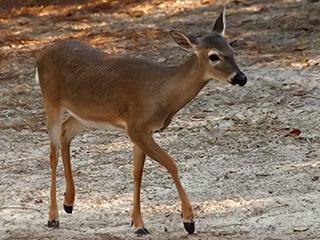
Florida Key White-tailed Deer
Image Source -> ZooTierListe
Walking past the deer, visitors come across a building facade, similar in appearance to the entrance to Zoo Miami's Florida: Mission Everglades, which acts as an airlock system into the first of two walkthrough aviaries in a row. Spanning 5.5m up above visitors' heads, and having a floor area of 2,750 sq. meters, the aviary is roughly half land area and half shallow water. The walkway through the aviary is an elevated boardwalk, another commonality in Everglades walking trails, allowing visitors to have birds on either side as well as below. The most common sighting on the water and underfoot would be our flock of American Wood Duck Aix sponsa (2.5), while along the shorelines, visitors will likely spot our pair of American Great White Egret Ardea alba egretta (1.1), and our flocks of American Wood Stork Mycteria americana (5.5) and Green Heron Butorides virescens (4.4). Meanwhile, amid the dense reeds on the shoreline, visitors may be able to spot either of our American Bittern Botaurus lentiginosus (1.1), a species more likely to be heard than seen by visitors.
Another facade separates the two aviaries, and upon passing through, two of the inhabitants are immediately noticed. This is due to the sheer size of the groups of American White Ibis Eudocimus albus (13.13) and Roseate Spoonbill Platalea ajaja (10.10), as well as their vibrant coloration and seemingly incessant presence in the shrimp-stocked shallows of this 2,450 sq. meter and 4.5-meter high aviary. As the boardwalk winds around the perimeter, this allows deeper water without forcing it to be beneath the visitors' footpath. As such, the zoo's bachelor pair of Anhinga Anhinga anhinga (2.0) can be seen darting throughout the water much more clearly than if the depths were under the planks of the boardwalk.

Mission Everglades Entrance
Image Source -> Exhibits | Zoo Miami

Possible Look of Walkthrough Aviaries
Image Credit -> @honeybadger


Top: American Wood Duck
Bottom: (American?) Great White Egret
Image Credit -> @KevinB

American Wood Stork
Image Credit -> @Ituri

Green Heron
Image Credit -> @red river hog

American Bittern
Image Credit -> @Mr. Bobcat

American White Ibis
Image Credit -> @Gab_1

Roseate Spoonbill
Image Credit -> @GiornoPizza

Anhinga
Image Credit -> @red river hog
Phew... with the sheer quantity of feathers in there, you couldn't possibly expect MORE birds, right? Well, briefly, we turn back to the furry side of things, with a 450 sq. meter habitat that is not meshed in, but contained by tall, inward-angled barriers which are not climbable. As is the case in many canine habitats, your eyes may immediately drift to the lower reaches of the space. For our brotherly trio of Florida Gray Fox Urocyon cinereoargenteus floridianus (3.0), the ground-dwelling nature of most canines misleads you. With the presence of trees with low-hanging limbs, visitors can just as often spot these canines somewhere most others will never attempt to venture: in the trees, or on elevated platforms strategically placed to give visitors the 'dog in a sunbeam' image with the foxes.

Possible View of Fox Habitat
Image Credit -> @geomorph

Florida Gray Fox
Image Credit -> @Andrew_NZP
Just when I said there had been an excess of birds (yes, the creator of this facility complaining about his excessive use of birds, but oh well), three aviaries round out the lead-up to the Everglades Alligator House (name is a work-in-progress, if not mentioned earlier). The first looks eerily familiar if we recall our trip to the Pantanal. This is because it was designed on the exact same blueprint (450 sq. meters, 4m high) as the aviary in the Pantanal for the same species, being the Snail Kite Rostrhamus sociabilis (0.2), with this space hosting the female counterparts to the males seen previously. This isn't the largest aviary in the row, however. Next door to them is a species many a visitor (myself included) has likely witnessed circling high above, scanning the ground for any potential food. I speak, of course, in reference to the Eastern Turkey Vulture Cathartes aura septentrionalis (4.4), with this flock of birds on a wide spectrum of physical conditions occupying a 650 sq. meter and 5m high aviary, stocked with numerous carrion tables to reduce risk of hostile confrontation, sandwiched by the kite aviary and the 250 sq. meter, 3m high aviary for a pair of Fish Crow Corvus ossifragus (1.1). The crows are given a large central tree and a marshier environment stocked with small fish and crustaceans as dietary enrichment.

Possible Look of Kite Aviary
Image Credit -> @Zoofan15

Snail Kite
Image Credit -> @savethelephant

Possible Look of Vulture Aviary
Image Credit -> @gulogulogulo

Eastern Turkey Vulture
Image Credit -> @Ituri

Possible Look of Crow Aviary
Image Credit -> @Pleistocene891

Fish Crow (poster was unsure of I.D.)
Image Credit -> @Elephantlover
And with that, we arrive at the doors to the complex named for its largest inhabitants (I'm going to stop using the temporary name until I come up with a better one), whose exterior is inspired primarily by both Zoo Knoxville's ARC Campus and Toronto's Australasia Pavilion. As one might expect, alligator warning signs are present on both sides of the buildings entrance, and will continue to be present throughout the building, varying from serious road signs to more comical signs (such as the ones found here and here). On that note, stay tuned and enjoy!
Example Road Sign
Possible Look of Deer Habitat
Image Credit -> @SusScrofa
Florida Key White-tailed Deer
Image Source -> ZooTierListe
Walking past the deer, visitors come across a building facade, similar in appearance to the entrance to Zoo Miami's Florida: Mission Everglades, which acts as an airlock system into the first of two walkthrough aviaries in a row. Spanning 5.5m up above visitors' heads, and having a floor area of 2,750 sq. meters, the aviary is roughly half land area and half shallow water. The walkway through the aviary is an elevated boardwalk, another commonality in Everglades walking trails, allowing visitors to have birds on either side as well as below. The most common sighting on the water and underfoot would be our flock of American Wood Duck Aix sponsa (2.5), while along the shorelines, visitors will likely spot our pair of American Great White Egret Ardea alba egretta (1.1), and our flocks of American Wood Stork Mycteria americana (5.5) and Green Heron Butorides virescens (4.4). Meanwhile, amid the dense reeds on the shoreline, visitors may be able to spot either of our American Bittern Botaurus lentiginosus (1.1), a species more likely to be heard than seen by visitors.
Another facade separates the two aviaries, and upon passing through, two of the inhabitants are immediately noticed. This is due to the sheer size of the groups of American White Ibis Eudocimus albus (13.13) and Roseate Spoonbill Platalea ajaja (10.10), as well as their vibrant coloration and seemingly incessant presence in the shrimp-stocked shallows of this 2,450 sq. meter and 4.5-meter high aviary. As the boardwalk winds around the perimeter, this allows deeper water without forcing it to be beneath the visitors' footpath. As such, the zoo's bachelor pair of Anhinga Anhinga anhinga (2.0) can be seen darting throughout the water much more clearly than if the depths were under the planks of the boardwalk.
Mission Everglades Entrance
Image Source -> Exhibits | Zoo Miami
Possible Look of Walkthrough Aviaries
Image Credit -> @honeybadger
Top: American Wood Duck
Bottom: (American?) Great White Egret
Image Credit -> @KevinB
American Wood Stork
Image Credit -> @Ituri
Green Heron
Image Credit -> @red river hog
American Bittern
Image Credit -> @Mr. Bobcat
American White Ibis
Image Credit -> @Gab_1
Roseate Spoonbill
Image Credit -> @GiornoPizza
Anhinga
Image Credit -> @red river hog
Phew... with the sheer quantity of feathers in there, you couldn't possibly expect MORE birds, right? Well, briefly, we turn back to the furry side of things, with a 450 sq. meter habitat that is not meshed in, but contained by tall, inward-angled barriers which are not climbable. As is the case in many canine habitats, your eyes may immediately drift to the lower reaches of the space. For our brotherly trio of Florida Gray Fox Urocyon cinereoargenteus floridianus (3.0), the ground-dwelling nature of most canines misleads you. With the presence of trees with low-hanging limbs, visitors can just as often spot these canines somewhere most others will never attempt to venture: in the trees, or on elevated platforms strategically placed to give visitors the 'dog in a sunbeam' image with the foxes.
Possible View of Fox Habitat
Image Credit -> @geomorph
Florida Gray Fox
Image Credit -> @Andrew_NZP
Just when I said there had been an excess of birds (yes, the creator of this facility complaining about his excessive use of birds, but oh well), three aviaries round out the lead-up to the Everglades Alligator House (name is a work-in-progress, if not mentioned earlier). The first looks eerily familiar if we recall our trip to the Pantanal. This is because it was designed on the exact same blueprint (450 sq. meters, 4m high) as the aviary in the Pantanal for the same species, being the Snail Kite Rostrhamus sociabilis (0.2), with this space hosting the female counterparts to the males seen previously. This isn't the largest aviary in the row, however. Next door to them is a species many a visitor (myself included) has likely witnessed circling high above, scanning the ground for any potential food. I speak, of course, in reference to the Eastern Turkey Vulture Cathartes aura septentrionalis (4.4), with this flock of birds on a wide spectrum of physical conditions occupying a 650 sq. meter and 5m high aviary, stocked with numerous carrion tables to reduce risk of hostile confrontation, sandwiched by the kite aviary and the 250 sq. meter, 3m high aviary for a pair of Fish Crow Corvus ossifragus (1.1). The crows are given a large central tree and a marshier environment stocked with small fish and crustaceans as dietary enrichment.
Possible Look of Kite Aviary
Image Credit -> @Zoofan15
Snail Kite
Image Credit -> @savethelephant
Possible Look of Vulture Aviary
Image Credit -> @gulogulogulo
Eastern Turkey Vulture
Image Credit -> @Ituri
Possible Look of Crow Aviary
Image Credit -> @Pleistocene891
Fish Crow (poster was unsure of I.D.)
Image Credit -> @Elephantlover
And with that, we arrive at the doors to the complex named for its largest inhabitants (I'm going to stop using the temporary name until I come up with a better one), whose exterior is inspired primarily by both Zoo Knoxville's ARC Campus and Toronto's Australasia Pavilion. As one might expect, alligator warning signs are present on both sides of the buildings entrance, and will continue to be present throughout the building, varying from serious road signs to more comical signs (such as the ones found here and here). On that note, stay tuned and enjoy!
 )
)


 ).
).