Part IX: Bear Enclosures to Exit
Having only two hours or so left before the zoo closed, and after discussing with Chris and Ang where they wanted to revisit so as to plan out which areas myself and Helly would leave until our second day at Zoo Berlin, we decided to have a look at the bear enclosures which were just opposite the Fasanerie and Bird House.
The first and largest of these was the sizable enclosure for
Polar Bear (
Ursus maritimus); this comprised a collection of high rock platforms and boulders, surrounded by a deep and wide water-filled moat, much like the equivalent enclosure at Tierpark Berlin. However, unlike our view of said enclosure the previous day, when we were viewing this enclosure the inhabitants were not using the moat, instead remaining on dry land. This said, it was still a very good enclosure for the species held within, giving the inhabitants plenty of space - although naturally nowhere near the amount of space given to the polar bears at Highland Wildlife Park. My only real reservation about the enclosure, truth be told, was the complete lack of any soft substrate within - but this is only a minor quibble.
We next came to a smaller enclosure, comprising a grassy and somewhat wooded scrub paddock for non-subspecific "Arctic"
Wolves (
Canis lupus). I have to admit I was somewhat disappointed that this enclosure did not hold a pure subspecies of wolf, particularly as the animals at Tierpark Berlin had also been non-subspecific hybrids, but it was nonetheless a very nice and spacious enclosure, which the inhabitants were making full use of. The living quarters for this enclosure, I am given to understand, are shared with the living quarters for the neighbouring
Brown Bear (
Ursus arctos) enclosure and the two species are able to intermingle in the wolf enclosure if they so wish; however I did not see this during my visit. The aforementioned Brown Bear enclosure unfortunately holds non-subspecific animals; considering the relative high supply of pure European animals this is something of an oversight in my eyes, considering how choice much of the rest of the Zoo Berlin species collection is. The bear enclosure itself comprised a series of elevated rock dens and platforms - nothing particularly unusual, barring the fact that it is one of the oldest surviving portions of the zoo, having been constructed in 1937, surviving the Second World War and remaining more or less unchanged in the decades since. In some regards this is quite appropriate, when one considers that the Brown Bear is a central figure on the coat of arms for the city of Berlin.
The next two enclosures were broadly speaking similar to that constructed for the Brown Bear, albeit being of rather more recent construction and having been recently renovated. As such these enclosures were somewhat larger than the Brown Bear enclosure, and included large areas of grass and vegetation along with areas of what looked like genuine rockwork. These enclosures held
Indian Sloth Bear (
Melursus ursinus ursinus) and
Asiatic Black Bear (
Ursus thibetanus), both of which were taxa I was particularly pleased to see. In the case of the former taxon, it represented a rather unusual lifetick - despite the fact that the Indian is the "common" subspecies within European collections, at this point in time I had only ever seen the unusual Sri Lankan subspecies held at Whipsnade. In the case of the latter taxon, although I had seen Asian Black Bear on a number of occasions in the past this had always been the extremely geriatric female "Inca" held at Dudley Zoo; as such it was quite pleasant to see an individual which was still young enough to be mobile and active!
We then decided to make our way to the collection of small rodent, baboon and macaque enclosures on the southern edge of the zoo; the only portion of the collection which Chris and Ang had yet to view. However, en-route myself and Helly briefly entered the Rhinoceros House - although we intended to view this house more fully on our second day at Zoo Berlin, we knew that this house held a single Baird's Tapir (Tapirus bairdii) - a taxon which neither of us had seen, and one which is in low enough numbers within Europe that we decided to see it sooner rather than later, on the admittedly slim chance the still-youthful animal would perish before our second visit. This house also held
Eastern Black Rhinoceros (
Diceros bicornis michaeli),
Indian Rhinoceros (
Rhinoceros unicornis) and
Lowland Tapir (
Tapirus terrestris). From our cursory look through the interior of the house, it was built very much along functional lines as a means of holding the inhabitants overnight, with the exterior paddocks quite obviously the primary intended means of viewing the taxa onshow. As such, it struck us as somewhat stark and a little undersized, but not *bad* per se.
After briefly revisiting the Carnivore House in an ultimately-unsuccessful attempt to spot the Cururo, and a more successful attempt to get further photographs of certain highlight taxa, we then made our way to the southern edge of the zoo, just southwest of the exterior enclosures for the Gorillas and Orangutans held within the Ape House. Here we came to the "Monkey Rock", another of the oldest surviving parts of the zoo having been built in 1932 to a plan designed by the then-director Lutz Heck and comprising two large rocky enclosures imitating cliff-faces with a handful of trees and wooden structures providing further climbing opportunity for the inhabitants; the larger of the two enclosures held a sizeable group of very active
Hamadryas Baboon (
Papio hamadryas) whilst the smaller contained a group of
Lion-tailed Macaque (
Macaca silenus), a species of which I am rather fond. The baboon group are particularly noteworthy as they are said to be direct descendants of the original group, some of the very few animals which survived World War II - if this claim is true, I wonder how many other taxa in European collections can be traced with as long a lineage whilst remaining in the original enclosure for the entire duration of time being discussed?
Just opposite from here were a collection of very pleasant rodent enclosures, each coming off a central rocky hub and following the same general plan; a combination of grass and sandy-scrub with scattered rockwork and logs, with the central enclosure being the largest. The first of these enclosures held
African Brush-tailed Porcupine (
Atherurus africanus); unsurprisingly, when one considers that this taxon is somewhat nocturnal in its tastes, we failed to see the inhabitants of this enclosure. However, the inhabitants of the second and - as already noted - largest enclosure were both numerous and active, comprising a large breeding group of
Coypu (
Myocastor coypus). This taxon represented a lifetick for us, as due to the invasive nature of the species and the successful campaign to exterminate them from the UK there are restrictions placed on the captive maintenance of Coypu within the UK. As a result, at the current time there are no public collections which keep this taxon. The final enclosure held
Southern African Porcupine (
Hystrix africaeaustralis), a species which although by no means uncommon I am always pleased to view.
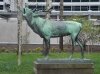
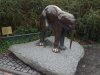
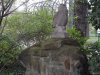
As we still had a little time remaining before we would have to depart, we elected to walk back to the Ibex Mountain enclosure, and view this portion of the collection along with the nearby collection of bird of prey aviaries before leaving the zoo. This took us along a path which ran behind the elephant house, and took us past a number of very attractive animal statues of the sort we had admired whilst at Tierpark Berlin.
As previously noted, the Ibex Mountain exhibit comprised a set of rocky cliffs and peaks very reminiscent in appearance to the Mappin Terraces at ZSL London Zoo, albeit in rather better condition and much more realistic, being apparently constructed with the use of real stone. However, this set of enclosures, unlike the Mappins, was still being used for the purpose to which end they had been designed. Moreover, they held rather more appealing taxa than the uninspiring wallabies and emu of said London exhibit - along with the aforementioned West Caucasian Tur which had very recently arrived, there was also a large group of
Siberian Ibex (
Capra sibirica) along with a number of small enclosures built into the rockwork for
Alpine Marmot (
Marmota marmota marmota) and
Woodchuck (
Marmota monax). Behind the mountain itself, there was an enclosure for
West Himalayan Tahr (
Hemitragus jemlahicus) - however as this was slightly out of our way we omitted this enclosure, resolving to view it on our second day of visiting Zoo Berlin. Unfortunately, our visit to Zoo Berlin was poorly timed as the two marmot species - both of which would have been lifeticks for myself - were both still in hibernation; although anticipated to awake anytime, they had not done so at the time of our visit.
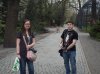
As previously noted, the Ibex and Tur were both making full use of their enclosures, demonstrating very well the prodigious ability of caprines to ascend near-vertical cliff-faces and slopes with ease - something which we all enjoyed viewing very much indeed, as enclosures for caprine taxa seldom provide such opportunities in my (admittedly limited) experience of such exhibits. However, our enjoyment was soon tempered with a note of outright amusement, as we noticed that one of the Tur had managed to escape its enclosure and was stood within the boundary hedge feeding from the hedge with very little notice taken of us! As we watched, it then exited the enclosure entirely and started feeding from the hedges whilst stood on the public path; however it did not get far, as it soon drew too close to the bird of prey aviaries - an alarm call from a King Vulture startled the animal, which promptly fled back into its enclosure.
This seems an appropriate point to break the narrative somewhat to note that in what I deem to be an incredibly hasty and foolish move, when this individual along with one or two others apparently continued to occasionally exit the enclosure over the following months - always during the last hour or so of visiting hours and the hours following when the zoo was closed and there were little to no visitors present - the new director of the two Berlin collections ordered the entire group of Tur shot for fear they would
all learn to escape, with the exception of two males who were spared and sent to Frankfurt. This represents the loss of approximately six or seven animals in total. This move strikes me as both hasty and foolish when one considers that from all I have heard since, the Cretan Goats that had previously been held in this enclosure also took to escaping in the year or so following their arrival, as had the Siberian Ibex in the neighbouring enclosure, but that as they settled into their new home this tailed off and ultimately ceased - in other words, as the Tur had only been at the collection roughly 9 months when they were shot, there was no reason not to believe this behaviour would also tail off as they grew comfortable. As the enclosure now holds Sichuan Takin - also notorious climbers, and rather more dangerous than the Tur - I fear that these will also be killed in time.
In any case, this all lay in the future when I visited, and thoroughly enjoyed viewing this exhibit. With little time remaining to us, we then made our way to the collection of bird of prey aviaries which lay slightly down the path from the Ibex Mountain. We were extremely pleased to find a collection of taxa which would put many falconry centres to shame, never mind other major zoological collections - as we rather expected by this point, having viewed the taxonomic variety and quality of so much of Zoo Berlin. This area of the collection held the following taxa:
White-headed Vulture (
Trigonoceps occipitalis)
Northern Caracara (
Caracara cheriway)
Western Egyptian Vulture (
Neophron percnopterus percnopterus)
Non-subspecific
Egyptian Vulture (
Neophron percnopterus)
Hooded Vulture (
Necrosyrtes monachus)
White-necked Raven (
Corvus albicollis)
King Vulture (
Sarcoramphus papa)
Northern Harris' Hawk (
Parabuteo unicinctus harrisi)
European Great Gray Owl (
Strix nebulosa lapponica)
African Wood-Owl (
Strix woodfordii)
Barred Eagle-owl (
Bubo sumatranus strepitans)
Sri Lankan Forest Eagle-owl (Bubo nipalensis blighi)
Spectacled Owl (
Pulsatrix perspicillata)
Palm-nut Vulture (
Gypohierax angolensis)
Snowy Owl (
Nyctea scandiaca)
African Fish-Eagle (
Haliaeetus vocifer)
Abyssinian Ground-Hornbill (
Bucorvus abyssinicus)
Pied Crow (
Corvus albus)
Bald Eagle (
Haliaeetus leucocephalus)
Eurasian Griffon (
Gyps fulvus)
Lammergeier (
Gypaetus barbatus)
Southern Ground-Hornbill (
Bucorvus leadbeateri)
Northern White-faced Owl (
Ptilopsis leucotis)
Ferruginous Pygmy Owl (
Glaucidium brasilianum)
Sri Lankan Wood Owl (
Strix leptogrammica ochrogenys)
Malayan Brahminy Kite (
Haliastur indus intermedius)
The highlights of this collection, it rather goes without saying, were the two unusual species of Eagle-owl, the Sri Lankan Wood Owl and the unusual subspecies of Brahminy Kite, all of which are very rare in European collections; in point of fact, with the exception of the Sri Lankan Forest Eagle-owl, these taxa can only be found at Zoo Berlin. As such, again with the exception of the Sri Lankan Forest Eagle-owl - a taxon I have seen at the World Owl Trust at Muncaster Castle - these taxa all represented life-ticks for myself. It was particularly interesting to view the difference between the Barred Eagle-owl and the Forest Eagle-owl, and to see a pure subspecific form of the Brown Wood Owl. It is also worth noting that the subspecies of Egyptian Vulture held here is different to that held at Tierpark Berlin. The aviaries in which these taxa were held were all very pleasant, well-vegetated and a decent size; something which along with the quality of taxa displayed meant I thoroughly enjoyed this area of Zoo Berlin.
We then left the Zoo, and made our way to Bahnhof Berlin Zoologischer Garten opposite; here we purchased some food before taking the S5 line to Berlin Hauptbahnhof with Chris and Ang. This served a number of purposes. Firstly, Chris and Ang had expressed a desire to visit Magdeburg with us, which meant that taking advantage of the Schönes-Wochenende-Ticket which we had been informed about prior to our trip would be the best option. This ticket, available only on weekends, costs 44 euro and is valid for up to 5 individuals, allowing those using the ticket an unlimited amount of travel on the regional Deutsche-Bahn services for 24 hours. As such, we wanted to discuss this option to ensure that the aforementioned pair still wished to visit Magdeburg before we bought the ticket. At the same time as I used the ticket machines to purchase the Schönes-Wochenende, I showed Chris and Ang how to use the machines in order to purchase advance train tickets. This meant that they were able to buy advance train tickets to Leipzig for the forthcoming Monday, when they planned to accompany Hel and myself to the zoo there.
The other purpose of our coming to the Hauptbahnhof with Chris and Ang was to perform a "dry run" locating and making our way to the train platform both for the trip to Magdeburg, but also for the trip to Leipzig. This was important as the trains we intended to catch for both days were departing rather early in the morning, and so knowing where they were located would prove advantageous to ensure we caught the trains on time. This was, of course, somewhat more of a consideration for Chris and Ang, as the former individual especially is somewhat loath to use trains and public transport, and historically is seldom on time!

Having bid Chris and Ang goodnight, we made our way back to the hostel and got an early night.
(
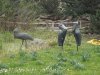
Attached are three images of statuework between the Monkey Rock and Ibex Mountain, an image of the Tur on the "Mountain", two Zoochatters being photobombed by an escaping Tur, and an image of a statue in the Bird of Prey area)


 and some species are found in multiple aviaries.