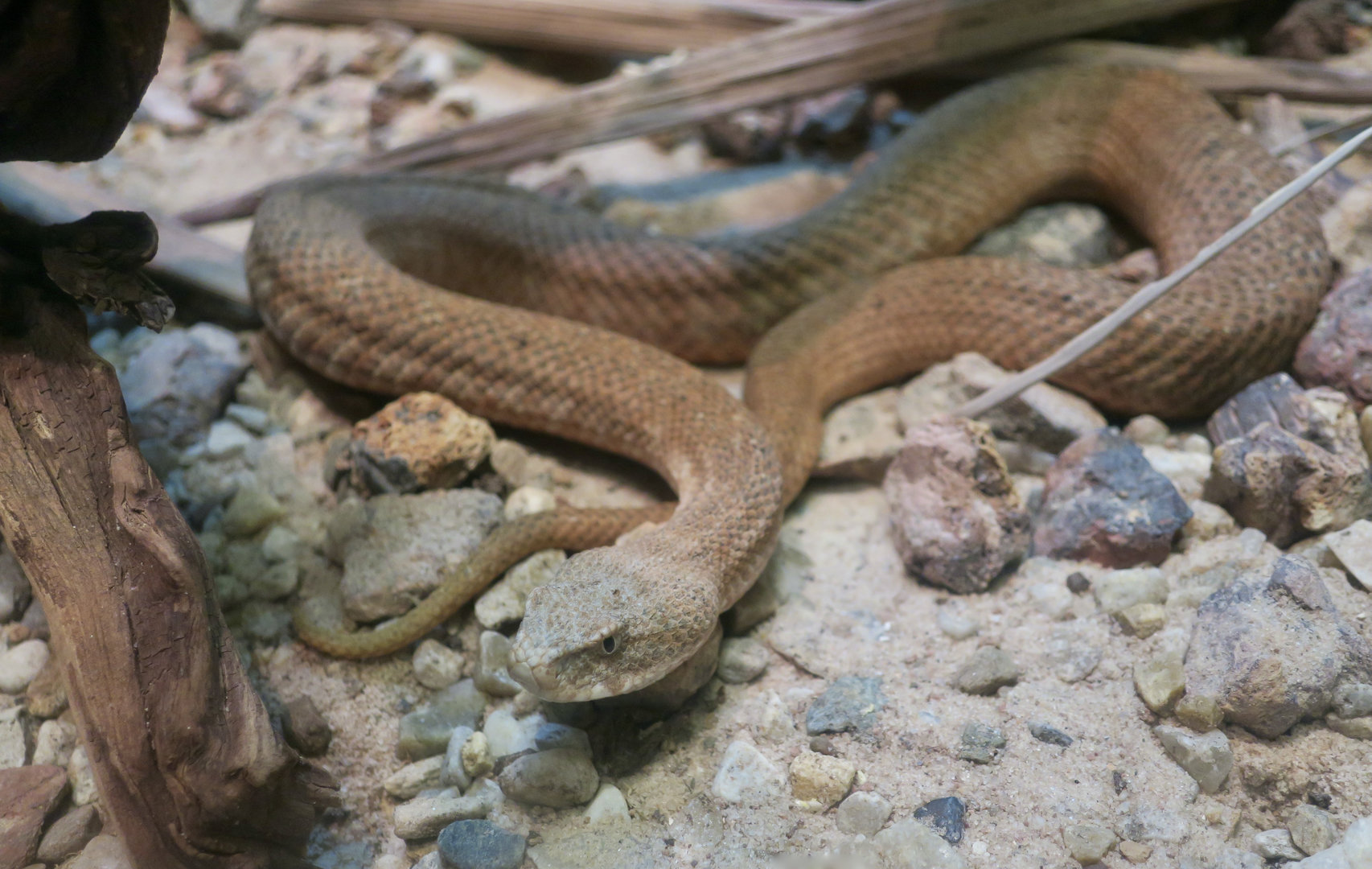
Bronx Zoo has Milos viper (Macrovipera schweizeri) on display now, seemingly the only ones onshow in North America.

While you shouldn't underestimate them, bush vipers are considerably more sluggish than saw-scaled vipers.Like the bush vipers, they have a fierce temper
The distribution of V. ammodytes is far more widespread, including Greece, Macedonia, Georgia, Turkey and even Austria. In regard to the severity of bite-related symptoms, the Macro/Montivipera species you mention in the following text are considered as generally even more dangerous. The red specimen on the picture is representative of the Lake Skutari region in Montenegro.Found in Italy and the Balkan states, the Long-nosed Viper’s name is self-explanatory. Found on rocky hillsides, it is generally considered the most dangerous European snake.

 I've made several edits to the European viper section based on all of this new information - as well as a quick aside about Vipera berus that I seem to have left out by accident.
In regard to the severity of bite-related symptoms, the Macro/Montivipera species you mention in the following text are considered as generally even more dangerous.

I'm surprised that no American zoo seems to house one of the smaller Bitis species such as Bitis cornuta.
 most cottonmouths will engage in a defensive display when cornered, and got their name from that habit of showing off their Dentyne-white mouth. Cottonmouths are the largest Agkistrodon vipers at 2 to 3 ft long, and range in color from black to golden overlaid with banding. They are commonly confused with the colubrid water snakes here, which is unfortunate for the latter since venomous snakes aren’t super popular in much of the Southeast.
Ringed Hognose Snake (Lystrophis semicinctus)
I also assume you split Colubridae into several other families that aren't yet covered?
The sign I had photographed back when it was present listed it as semicinctus.Thanks for the additions @SusScrofa.
Hmm. I had Miami as holding Tricolor Hognose (X. pulcher); might be the same animal but I got the wrong species? Either that or Miami has had two similar Lystrophis species recently.
Not intentionally. There are miscellaneous snakes still in waiting as with previous groups, maybe some of them have been considered colubrids in the past. What snakes were you expecting to see?
Referring to families like Homalopsidae and Lamprophiidae. They are well-recognized as split nowadays so I'm guessing you're planning on covering them at a different point.

I also remember Miami having X. pulcher during my 2021 visit, but I'm stupid and didn't take a picture of the sign as I didn't see the snake...The sign I had photographed back when it was present listed it as semicinctus.
Referring to families like Homalopsidae and Lamprophiidae. They are well-recognized as split nowadays so I'm guessing you're planning on covering them at a different point.
Xenodon is the current genus name instead of Lystrophis.So the common name on the sign is "Tri-colored Hognose Snake" but the scientific name is "Lystrophis semicinctus".
This week’s post will cover the other pitvipers, which actually make up over half the total species.
then rattlesnakes the week after. Thought I'd let people know so they're not confused as to why I suddenly stopped for a few days after Agkistrodon!
Interesting that viperids are the reptile family that's most speciose in US Zoos. It wasn't the one I'd expect, however looking at my lifelist it apparently is the family I've seen the most of, with a whole 31 species. That being said, 19 of those 31 species I saw only at Bronx and/or Staten Island Zoos, both of which I visited for the first (and only) time a few months ago. In fact, I've almost exclusively seen viperids at a total of four zoos: Bronx, Staten Island, Philadelphia, and Buffalo. Removing these four zoos, I've only seen three viperid species: Northern Copperhead at Roger Williams, Timber Rattlesnakes at multiple zoos, and Eastern Massasauga at Rosamond Gifford.
For comparison, the family I'd expect to be most common, the tortoises, I've only seen 22 species- yet only four of them were new at Bronx/Staten Island. Furthermore, the majority of zoos I have visited keep at least one tortoise species, unlike viperids. That majority is 19/31 zoos, however most of the twelve tortoise-less zoos are either aquariums or specialist collections (also Queens and Utica Zoos).
I'm really surprised you haven't seen them at more, I'd be pressed to find places with more than a couple herps that doesn't have one.Yeah, New England doesn't exactly have much for venomous snakes, and most of the other zoos I've been to happen to not have them either (Cleveland, DAK, the smaller WCS zoos, etc.) I don't doubt that they are fairly common at a lot of zoos, they just aren't something I've seen at very many facilities, partially because the northeast (excl. Bronx and Staten Island) is likely the least herp-dense part of the country zoo-wise. I should definitely see some more though in October when I hit a few major midwest zoos!You need to get out more
Interesting that viperids are the reptile family that's most speciose in US Zoos.
I don't doubt that they are fairly common at a lot of zoos,
Furthermore, the majority of zoos I have visited keep at least one tortoise species, unlike viperids. That majority is 19/31 zoos, however most of the twelve tortoise-less zoos are either aquariums or specialist collections (also Queens and Utica Zoos).
Saint Louis and Toledo in particular are fantastic for venomous snakes.
 There’s a lot of tree vipers in American zoos and most of them are uncommon or rare, so this post will cover some of the more prevalent ones briefly but mainly focus on cataloging species.