Animal Stereotypes That You Hate

I tend to hear the opposite - people are often quite surprised to learn Leopards - which they think of as an African animal - occur in Asia.

Yes I've heard the same, same as the popular all lions come from Africa.

Indeed according to a visitor proclaiming loudly at Whipsnade on my visit this week, the new lions there came from London and were there because London has a surplus of lions - it got them straight from Africa and ordered too many (London has Asiatic lions). Damn those no refund policies on lion purchases though. Should have kept the receipt.
 
From the perspective of human dimensions in wildlife conservation, and how perceptions of wildlife impact their populations in the wild, the stereotype I hate the most would easily be the "big bad wolf", as perceptions of wolves has decimated their populations throughout many parts of North America.

I'm also not a fan of the stereotype of gorillas being destructive, aggressive, killing machines, as they truly are (99% of the time) gentle giants. Yes, they can at times be aggressive towards conspecifics, but they are a lot more pacifistic than most people think they are.
 
From the perspective of human dimensions in wildlife conservation, and how perceptions of wildlife impact their populations in the wild, the stereotype I hate the most would easily be the "big bad wolf", as perceptions of wolves has decimated their populations throughout many parts of North America.

I'm also not a fan of the stereotype of gorillas being destructive, aggressive, killing machines, as they truly are (99% of the time) gentle giants. Yes, they can at times be aggressive towards conspecifics, but they are a lot more pacifistic than most people think they are.

And heck, the big bad wolf esc perceptions are still negatively affecting them.
 
Agreed. Wolves don't deserve such a bad reputation.
I did see another(unexpected) side to wolves recently, a very short Youtube clip of a small pack of about 6 wolves 'facing ' of two Spanish/Italian sheepdogs. The wolves advance at a run with their tails held completely vertical like slowly waving flags. They meet the dogs face to face and then slowly advance,snarling and driving them down the hill a way.There is no actual contact/ fighting in this particular case, but I'm so used to seeing wolves(on film) trotting, running, slinking, looking alert or wary,(all usually with tails relaxed or tucked 'furtive' looking between legs) howling, greeting each other, feeding etc but I have never seen this particular behaviour with such upright tail posture before. Of course its to be expected as wolves are canine ancesters so all their behavioural traits are the same, even if used with differing frequencies. Its the same as hearing wolves bark- its much rare than howling probably but just the same as a dog's bark and used similarly as a warning.

I've often wondered how/if wolves and these sheepdogs actually interact in those Meditteranean countries where dogs are still used to guard sheep flocks- now I think I know a bit better how it works. I presume it depends mainly on the ratio of the wolves and dogs. I guess in most cases enough dogs usually arrive to push the wolves back again by force of numbers, a single wolf would easily be chased away, but if numbers are roughly even initially it looks like a drawnout close encounter as it might be between two packs of domestic dogs.

... but that's just interesting behaviour and I agree they do get a bad press.
 
Last edited:
I did see another(unexpected) side to wolves recently, a very short Youtube clip of a small pack of about 6 wolves 'facing ' of two Spanish/Italian sheepdogs. The wolves advance at a run with their tails held completely vertical like slowly waving flags. They meet the dogs face to face and then slowly advance,snarling and driving them down the hill a way.There is no actual contact/ fighting in this particular case, but I'm so used to seeing wolves(on film) trotting, running, slinking, looking alert or wary,(all usually with tails relaxed or tucked 'furtive' looking between legs) howling, greeting each other, feeding etc but I have never seen this particular behaviour with such upright tail posture before. Of course its to be expected as wolves are canine ancesters so all their behavioural traits are the same, even if used with differing frequencies. Its the same as hearing wolves bark- its much rare than howling probably but just the same as a dog's bark and used similarly as a warning.

I've often wondered how/if wolves and these sheepdogs actually interact in those Meditteranean countries where dogs are still used to guard sheep flocks- now I think I know a bit better how it works. I presume it depends mainly on the ratio of the wolves and dogs. I guess in most cases enough dogs usually arrive to push the wolves back again by force of numbers, a single wolf would easily be chased away, but if numbers are roughly even initially it looks like a drawnout close encounter as it might be between two packs of domestic dogs.

... but that's just interesting behaviour and I agree they do get a bad press.

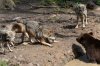
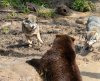
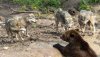
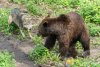
It certainly looks like a numbers thing where wolves are concerned. Not in the wild and obviously not ending in anything but I caught a bit of a sequence at Wild place in April this year of the bears and wolves in their shared enclosure.

One of the bears was alone, the wolves were following it so the bear chased a wolf and then ran into the water, the wolves then ganged up around the bear, there was a lot of noise and another bear came and shooed them off (you can see the postures and expressions of the wolves change across the photos). The threat postures etc from the wolves were quite something to see - I haven't seen much of it in a captiuve setting outside the wolves at CWP scrapping over food. Attached the photos for interest.

It is interesting behaviour. Though wolves do get a bad press, there can't be many zoo carnivores where keepers go into the enclosure (while the animals are out) to clean and place enrichment armed only with a broom!
 

Attachments

  • bearsandwolves1.jpg
    bearsandwolves1.jpg
    207.3 KB · Views: 13
  • bearsandwolves2.jpg
    bearsandwolves2.jpg
    235.8 KB · Views: 11
  • bearsandwolves3.jpg
    bearsandwolves3.jpg
    196.6 KB · Views: 10
  • bearsandwolves4.jpg
    bearsandwolves4.jpg
    256.3 KB · Views: 10
  • bearsandwolves5.jpg
    bearsandwolves5.jpg
    267.6 KB · Views: 11
It certainly looks like a numbers thing where wolves are concerned. Not in the wild and obviously not ending in anything but I caught a bit of a sequence at Wild place in April this year of the bears and wolves in their shared enclosure.

One of the bears was alone, the wolves were following it so the bear chased a wolf and then ran into the water, the wolves then ganged up around the bear, there was a lot of noise and another bear came and shooed them off (you can see the postures and expressions of the wolves change across the photos). The threat postures etc from the wolves were quite something to see - I haven't seen much of it in a captiuve setting outside the wolves at CWP scrapping over food. Attached the photos for interest.

It is interesting behaviour. Though wolves do get a bad press, there can't be many zoo carnivores where keepers go into the enclosure (while the animals are out) to clean and place enrichment armed only with a broom!

Good photos of an interesting stand-off. Obviously not the best of friends. But these wolves haven't got their tails standing perpendicular like the ones I saw in that video...I must try to see this exhibit sometime.
 
Good photos of an interesting stand-off. Obviously not the best of friends. But these wolves haven't got their tails standing perpendicular like the ones I saw in that video...I must try to see this exhibit sometime.

It was interesting to see them behaving like that vs trotting about or napping that’s for sure!

Definitely recommend seeing it, it’s a great looking space with excellent viewing and both groups make good use of it. The wolverine and lynx enclosures are also good with both able to climb high in their trees and be level with the different heights of the walkway.
 
I'm also not a fan of the stereotype of gorillas being destructive, aggressive, killing machines, as they truly are (99% of the time) gentle giants. Yes, they can at times be aggressive towards conspecifics, but they are a lot more pacifistic than most people think they are.

There seems to be a lot of counter-messages persuading people gorillas are gentle giants which are effective until you have a high profile incident like Travis the chimpanzee (people seem to lump gorillas and chimps together).

On two seperate occasions at Melbourne Zoo I heard people talking about the “gorilla that ate someone’s face.” :rolleyes::rolleyes:
 
There seems to be a lot of counter-messages persuading people gorillas are gentle giants which are effective until you have a high profile incident like Travis the chimpanzee (people seem to lump gorillas and chimps together).

On two seperate occasions at Melbourne Zoo I heard people talking about the “gorilla that ate someone’s face.” :rolleyes::rolleyes:
And of course perhaps the most famous depiction of a gorilla in the media is King Kong, so it's no surprise people may have the perception of gorillas as a violent creature. While they certainly aren't 100% peaceful (infanticide is common, and so is intra-group aggressive encounters), more so I just hate the notion they are violent, killing machines, when most of the time that's simply not true.
 
Leopards are not found in Africa. Are they associated highly with Asia?

I tend to hear the opposite - people are often quite surprised to learn Leopards - which they think of as an African animal - occur in Asia.

Although I agree with @birdsandbats, interestingly my dad seemed to believe the former—he saw me watching National Geographic’s Savage Kingdom and he was surprised to learn that leopards were native to Africa, being under the impression they were only an Asian animal maybe because of The Jungle Book.
 
Sharks are really dangerous
I mean...They are, as is expected of predators at the (near) top of the food chain. I think the main stereotype is that they're bloodthirsty terminators. As with most animals, show them a level of respect and they aren't as big a threat.

Owls apparently making ' hoo' noises

The ones keeping me up until the early hours on the Avon would be inclined to disagree. I'd wager most countries, at least in the Northern Hemisphere, have owls that do the classic twit-twoo (or kerwick-kerwoo).

I tend to hear the opposite - people are often quite surprised to learn Leopards - which they think of as an African animal - occur in Asia.

As others have noted this happens with lions too, but there's so many examples - hyenas, honey badgers, even antelope. It's a similar story with saltwater crocodiles, being such a categorically Australian animal means people don't seem to realise they have a much larger range.
 
I mean...They are, as is expected of predators at the (near) top of the food chain. I think the main stereotype is that they're bloodthirsty terminators. As with most animals, show them a level of respect and they aren't as big a threat.

The ones keeping me up until the early hours on the Avon would be inclined to disagree. I'd wager most countries, at least in the Northern Hemisphere, have owls that do the classic twit-twoo (or kerwick-kerwoo).

As others have noted this happens with lions too, but there's so many examples - hyenas, honey badgers, even antelope. It's a similar story with saltwater crocodiles, being such a categorically Australian animal means people don't seem to realise they have a much larger range.

They're not, though. A couple of species, out of ~500, are near the top of the food chain. Half of those ~500 don't even reach 3 feet in length, and most of the rest don't reach 7. Only three species have double digit fatalities - the great white, tiger, and bull. Unprovoked deaths have been recorded by just 7 other species. Even with great whites, only 17% are fatal. In the grand scheme of things, humans are a weird novelty to sharks, and those big enough to not be threatened sometimes get curious about what humans are.
 
Last edited:
Back
Top