Twycross Zoo Bonobos

Good to learn Diatou is pregnant once again and the cancerous tissue did not end her! It seems an unexplored opportunity though ...... to me :confused: Any chance that more bonobo females in any of the 2 groups might breed?

Can someone fill us in on which bonobos are in either group (names, sex and dates of birth)?

Obligingly, :D

Jelle
 
^^ Yes the groups where shuffled around after last Summer following the problems Keke was having as per your list.

Left hand group
Diatou (F) - 21/10/77 Wilhelma Zoo
Kichele (F) - 19/04/89 Wilhelma Zoo
Cheeka (F) - 18/03/96 Frankfurt Zoo
Kakowet II (M) - 07/06/80 San Diego Zoo
Luo (M - Son of Diatou) - 01/12/02 Twycross Zoo
Gemena (F - Daughter of Cheeka) - 07/11/05 Twycross Zoo

Right hand group
Banya (F) - 01/02/90 Cologne Zoo
Maringa (F) - 05/05/98 Berlin Zoo
Jasongo (M) - 02/09/90 Wuppertal Zoo
Keke (M) - 02/01/94 Twycross Zoo
Bokela (F - Daughter of Banya) - 14/10/03 Twycross Zoo

I don't have all their birthdates to hand at the moment but believe they have been listed on here somewhere already.

Jasongo has been making a lot of noise recently as he wants to mate and after much persuasion Maringa has given in several times so looks like she should be the next to fall pregnant (fingers crossed). I am not aware of any matings with Banya but as Bokela still seems to be very close (following her around and attempting to suckle at 4.5 years old) this may mean that she won't become pregnant for a while yet (speculation)

As for the other group, the females have now taken to picking on poor Kakowet - he was subject to a minor attack the other day leaving him with a minor wound on his foot so this may impact on matings, although as Diatou is pregnant and Cheeka is still caring for Gemena (only 18-24 months old) the only one left is Kichele, it would be nice if her and Kakowet would mate but she seems to be more interested in food and her toy car most of the time (she is definately the one I know least about as she seems to blend in to the background in my eyes & my behaviour study is focused on the other group).
 
Last edited:
As for the other group, the females have now taken to picking on poor Kakowet - he was subject to a minor attack the other day leaving him with a minor wound on his foot so this may impact on matings, although as Diatou is pregnant and Cheeka is still caring for Gemena (only 18-24 months old) the only one left is Kichele, it would be nice if her and Kakowet would mate but she seems to be more interested in food and her toy car most of the time (she is definately the one I know least about as she seems to blend in to the background in my eyes & my behaviour study is focused on the other group).

Do your studies suggest that perhaps Kakowet II is losing out in the dominance stakes? Can you tell us how this works in bonobos? I used to think that bonobos de-antagonise all conflicts with frequent back-to-back matings?

What age is Kakowet II? Do you think the above described behaviour is an indicator for a teamleader change? :confused:

I read earlier that 2 handreared offspring were taken out of their breeding group and sent on to Stuttgart nursery? Judging by the current family groupings and youngsters ... is it fair to assume Twycross has at least 2 reproducing bonobo groups in which the females raise their own offspring successfully? :confused:
 
In Bonobo society it is the females that are dominant, not the males - this is maintained primarily by increased social contact between females and the formation of "alliances", Diatou is the dominant animal in the group and with Kichele/Cheeka they form a 3 to 1 ratio that leaves Kakowet firmly at the bottom of the dominance hierarchy, generally speaking if one of the three has an issue then they all do and they will gang up.

Reconciliation is regularly carried out through sexualy contact (not neccessarily matings) and such contact has a number of roles in Bonobo society, when animals are excited or come accross a novel object for example, some form of sexual contact will almost certainly follow - they are by far the most sexually adventurous animal on the planet, every possible imaginable position/combination has been observed in bonobos, back to back, "doggy", face to face, oral, masturbation, contacts between male/female, m/m, f/f and adolescent animals with others in the group (of both genders including parents) have been witnessed. It is important to remember though that these contacts have an important social role and rarely "finish" in the traditional way, indeed many contacts would be incapable of creating offspring regardless.

Kakowet II is the oldest male in the group although I don't have his exact age to hand I can easily check tomorrow for you.

Yes definately, currently Cheeka/Gemena, Banya/Bokela, Diatou/Luo have all been reared successfully without human intervention to the best of my knowledge and all seem to be be caring and capable mothers.

On a side note I have discovered this site: Ape List Pongoland - Bonobo that details a femal Bonobo named Yasa that is the offsprinf of Kakowet II and Kichele that was moved to Leipzig zoo in 2004, so it seems that Kichele also has a history of breeding successfully although I do not know if this animal was hand reared or why it was moved to Leipzig.
 
Last edited:
MexPirate,

Thanks for the explanatory notes. Bonobo society certainly is very interesting. I believe there is a fine book on the market detailing bonobo biology (along similar lines as Frans de Waal's chimpanzee politics, but I am sure you know all about that).

Re: Kakowet II. Allright so the females are the dominant force. So how does that work breedingwise. What determines who mates with whom? You are suggesting other forces or bonobo perceptions are at work here that determine which male is the chosen on?

I assume that in bonobo groups the usual association is several adult males with a troupe of adult females and their youngsters. The males form loose alliances on the basis that the females are the deciding factor in every aspect of their society and their behaviour.

Coming back to Twycross's group 1 with Kakowet II; must we conclude from your remarks that perhaps Kakowet II's group is a little imbalanced with just the 1 adult male?
 
Believe the book you are reffering to is "Bonobo - The forgotten Ape" by Franz De Waal and Franz Lanting, its pretty much the only decent book available for the species and I do own a copy - very good read if you can get hold of one.

Breeding wise it's pretty much a free for all, Kakowet mates with all three of the females (Cheeka seems to get a little jealous of him mating others if she doesn't get some too) - because they are so promiscuous the males would normally have no idea if they are the father or not, which is probably the main reason why there is no evidence of infanticide at all in the species. If more males were present in the group they would almost certainly be getting a fair share of the action as well.

Usual association would indeed be an approximately even mix of males/females - the males would stay with their mothers whilst females will usually leave the group to join another when they reach maturity (making the presence of female alliances even more unusual as they are often unrelated to other females), for some reason unknown to me the males do not seem to form alliances in the same way. One thing I would mention is that in my view dominance is no where near as important in Bonobo society as with common Chimpanzees for example - the diversion of aggresion using sexual contact and comparitively placid nature of the species means that under normal circumstances there isn't really a need for animals to display or enforce their dominance - this seems to be supported by the relative lack of sexual dimorphism in bonobos. Basically the point I am trying to get accross is that whilst females are dominant, that is not to say that the males are ruled over and watched in the way that many females might be in other primate species.

"Chimps solve sexual issues with power, Bonobos solve power issues with sex" - sums it up in one line really - some excerpts from the book are on Wikipedia, it picks out many of the important points if you are looking for a bit more info: Bonobo - Wikipedia, the free encyclopedia

Having seen the changes in the males following the group change around I would have to say yes - Jasongo was previously the lone male and was distant from the group - usually being wherever they weren't, he seems to have found a friend with Keke and his confidence & social skills have improved greatly in my opinion. Kakowet on the other hand now seems reluctant to share space with the rest of the group, today he refused to come inside all day (meaning the other group couldn't go out) and only finally came in when offered his bed and tea (seperated from the rest of the group), I am asssuming that Luo will remain in the group so perhaps having a fourth male will allow for two to be in each group and ease some of the problems (although Keke and Luo would need to be housed seperately from Diatou to prevent them mating their mother).

I am going to update my post above with Dates/Places of birth for all the bonobos - also it would seem that the information Leipzig Zoo have on their website is incorrect as Yasa's mother was in fact also Diatou, this means that Kichele has never successfully bred (there are suspicions that she may be incapable, as her father is also her grandfather this may not be a bad thing)
 
I am going to update my post above with Dates/Places of birth for all the bonobos

Do you know if Kakowet 2 from San Diego is a son of their original pair - Kakowet x Linda - or was he just named after their first male?

Hair plucking- Do you know why Bonobos in zoos- not just at Twycross- are nearly always plucked around the arms and head? Is it because they have particularly nervous dispositions? Are they very stressed by captivity? (I don't think I've ever seen a Bonobo in a zoo which didn't have some form of hair plucking).
 
Yup, he is the famous Kakowet's son :) (Kakowet saved some young bonobos from drowning by recognising that the keepers were going to fill the moat with water whilst the babies were down there - he managed to alert the keepers before this happened) he is also the father of the first bonobo ever bred in the UK (Keke).

"Kakowet at the San Diego Zoo, the patriarch of captive N. American Bonobos was sitting by the moat surrounding their enclosure which had been drained for cleaning. After scrubbing the moat and releasing the apes, the keepers went to turn on the valve for refilling the moat when all of a sudden Kakowet started screaming and waving his arms at them. The keepers said it was almost as if he could talk. It turned out that several young Bonobos had entered the moat but were unable to get out. The keepers provided a chain for them to climb and all got out except for the smallest Bonobo, who was rescued by Kakowet." - from BONOBOS


I don't have a definitive answer with regards to plucking, but personally I would view it as over grooming, Cheekas baby Gemena is all but bald because she grooms her so much - when the animals are in a captive environment and don't need to spend virtually the entire day foraging for food I suppose it come naturally for them to exhibit other natural behaviours to fill the time and grooming is of course an essential behaviour for general hygiene and social bonding so is seen regularly in captivity.
 
Thanks for the information. I saw the original Kakowet,+ his mate Linda and some of their many offspring at San Diego many years ago. I think they produced about ten babies altogether as they were nearly all handraised...

Overgrooming- as opposed to self-plucking, would make sense (in captive conditions) in a very sociable species like this so I suspect that you are right on that....
 
As your studying them do you think they would benefit from a larger enclosure? Its quite a large group now so i would have thought a bigger enclosure may give them more space to get away from each other and there would be space for more enrichment rather than just a tree and a pool. At the end of the day you can't argue with the breeding record there as there always seems to be youngsters in the group
 
Not just a tree and a pool, also a fire hose cargo net loving crafted with my own hands!

But yes of course, I would love to see a larger enclosure for them - for starters something that would allow both groups access to an outdoor area throughout the day and additional climbing areas. There are plans to get the TA in to the zoo again to add additional climbing equipment for them (as their previous platform collapsed last Summer :() however there is no date for this and not sure exactly what will be constructed. As you mentioned it is important that the animals are able to seperate themselves from the group at times - the chimps and bonobos use the dry moats for this purpose regularly, but of course this is more of an issue when they are confined to their day areas (certain individuals have been known to have "quiet time" ie, spend some of the day in their bed area away from the rest of the group)
 
Bonobos at Twycross have been very successful.

Do the two groups alternate outside on a daily or on a half-daily basis(sorry if you already mentioned this somewhere...) And is the 'two groups' system of management likely to be permanent now?
 
The left hand group (Diatou's) have access in the morning and the right hand group (Jasongo's) get access in the afternoon (assuming the other group actually come in).

I don't see the situation changing any time soon as that would require exchanging animals to prevent inbreeding - have not heard of any plans to move Keke on, this would be less than ideal anyway as it is normal for males to stay with their birth group whilst females migrate to a new group. Even if he was moved Luo would then become a problem as he is fast approaching sexual maturity, moving Diatou (mother to both of them) would also be problematic as she is the dominant animal, the best breeder and as she is currently pregnant.
 
Sorry, this isn't about the Bonobos, but their close cousins... do you know what the policy is generally about breeding common chimps in the UK nowadays- both at Twycross and at other zoos too?. I believe there are recommendations to breed from only certain 'known' pure races, primarily West African, but this seems an almost impossible policy to follow.

For example; are any of the Twycross common chimps still allowed to breed or are they nowadays on contraceptives?
 
I know that at least some of the Chimps are on contraceptives (females given the pill) although the recent baby tuli mother was I think on the pill at the time of conception. I had asked if the chimps were kept as sub-species but nobody seemed to know which sub-species of chimp were at the zoo (possibly many hybrids) so at Twycross at least there is not as far as I know any effort to breed within sub-species, I will check on Sunday which animals if any are able to breed - I know the top chimp complex has a mixed group but unsure if contraception is given to all the females there or not.

As far as I am aware though, whilst the "common" chimpanzee is endangered I do not believe there is any shortage of them in captivity - this is shown pretty clearly at Monkey world that exclusively houses rescued animals and doesn't breed from their animals. I am not aware of anywhere in the UK that is actively breeding chimps for return to the wild (along the lines of howletts with their Gorillas) - Please if anyone has details of any chimp breeding going on post any info you have.

And for the record, when the hell will somebod revise the official names for the chimpanzee species, really pisses me off - there is nothing common about the more widely known species and describing bonobos as pygmy chimpanzees suggests that they are simply smaller versions of the more well known species, there is of course far more to them than that!
 
I'm not surprised no-one at Twycross knows what races the chimps are, I think this situation exists in most Uk zoos with chimps(probably in Europe too) as many of them were bred long before anyone gave any attention to what races they came from. (Its not dissimilar to the situation with Giraffes). Some zoos, e.g. Chester, Whipsnade, perhaps others, still have chimp babies from time to time- I'm not sure if these are deliberate or accidental births but as someone else has commented, even a single infant in a group makes for a social 'completeness'(like your two Bonobo groups) and interest that is lacking otherwise.

You also mentioned 'Monkeyworld' but I think even they have had a number of babies born in their groups where the female implants haven't worked.

What is interesting is to speculate what will happen to zoo chimp populations in future if the 'mixed race' groups are prevented from breeding. . For their new exhibit I believe Edinburgh may be getting some pure-race chimps to add to their existing mixed-race group- the purebreds being allowed to breed, the others not, so eventually they will phase themselves out.. Maybe in the longterm some other zoos will take this route. (sorry I've digressed from Bonobos here but its an interesting subject...)
 
I won't complain too much as long as you stick to apes :P

It's a difficult one, by splitting the management of Chimps in to the 4(?) sub-species you massively reduce the availble individuals, also I think you have to consider what the negative implications of breeding hybrids would be? sure it is not ideal to put hybrids back in the wild but is it really worse than crippling the captive population to an extent that population sizes may be to small to be sustainable without introducing wild caught animals? To the best of my knowledge the differences between the subspecies are limited and there may well be crossbreeding between some that appears naturally in the wild.

I must admit my personal view is that the importance of maintaining "pure" animals is overrated especially when divisions between subspecies can be blurry at best.
 
I won't complain too much as long as you stick to apes :P

I must admit my personal view is that the importance of maintaining "pure" animals is overrated especially when divisions between subspecies can be blurry at best.

No problem there...(I'll stay with this thread though)

I agree with your view in so much as wild chimpanzee populations are largely contiguous with each other, at least in some areas, so where do the divisions actually occur? As I said before, its a little bit like Giraffes, where it is largely a matter of different coat-patterning anyway. I hope this interest in 'races' doesn't become a reason zoos completely stop allowing their chimps to breed- I can understand the necessity when there are space or rehoming considerations though.

Now a couple of questions on the Gorillas;

1. I heard SamSam has been mating Biddy. Do you think there's any chance she could be pregnant by him? I know both are getting on in years but there's still a possibility of young and this would be excellent for SamSam in particular as his only existing relative is now his grandson' Matadi' in the other group.

2. Any more news about plans regarding the 2nd group?
 
The divide is somewhat blurry to some, there is talk of one of the sub-species being elevated to full species status (P. t. verus) following studies of mtDNA. There is also talk of the chimpanzees from Nigeria becoming a fourth subspecies (P. t. vellerosus).

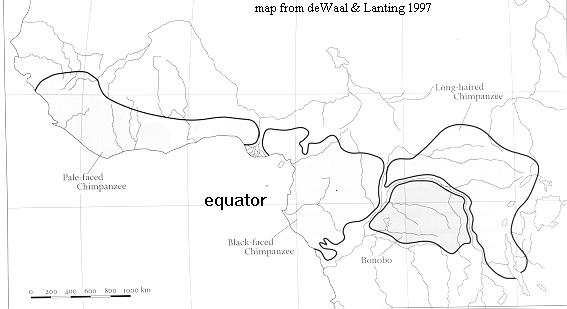
Apart from the above which at the present time isn't generally accepted there are three subspecies whose ranges historically would have met, this map gives an idea of their ranges before they became so massively fragmented in recent years:

ChimpMap.jpg


The suggested physical differences between the species is suggested by the common names used on the map, the central western (Black faced or P. t. troglodytes) is also slightly larger than the eastern (Long haired or P. t. schweinfurthii). There are also slight differences in behaviour (likely due to ecology) such as varying range sizes, slightly differing birth intervals, varying average group sizes and slightly varied diets.

Reference: Dean Falk, Primate Diversity (2000)

I don't know a great deal about the Gorillas at Twycross as I havn't worked on that section and never had a strong interest in them (until my recent visit to Howletts and subsequently meeting all the Twycross Gorillas :)) I shall ask if there is any news on the section but it just depends who is working when I am there - there is talk of getting at least a male in to the younger group, likely a black back as the zoo are keen to breed from the jeuvenile in the group in the future - no dates or further info at the moment though.
 
Back
Top