Chlidonias Goes To Asia, part seven: 2024-2025

"Lake Poyang National Wetland Park"
(quotation marks intentional...)

Lake Poyang is the largest freshwater lake in China, and it is the wintering grounds for something like 98% of the world's population of Siberian Cranes. Because I was going to be in Japan seeing other cranes in winter it had seemed silly not to add in Lake Poyang in China as well for an additional species, especially because who knows how long they are going to be around for in the future (both the lake and the cranes).

There are various eBird sites for the lake area, and I was intending to divide my time with a couple of days in the city of Nanchang (which is closest to sites like Baihezhou where large numbers of cranes winter) and a couple of days at the village of Wucheng at the northwest end of the lake.

The first day in Nanchang hadn't gone great - the first half of the day was good, with lots of birds found in the Xianghu Wetland Park near the hotel, but the second half fell apart completely. That was a tale told in the last post in this thread.

That was sort of a "general birding" day, and then I got down to the business of seeing Siberian Cranes. Or trying to. The second day went even worse than the first day. Looking back I think I was far more annoyed on this day than I should have been, but the two days combined were just abject failures. If you've seen my recent photos you'll know I did end up seeing Siberian Cranes really well, but it wasn't on this day!

............................................

On that first day I had gone to the train station, followed by the bus station, to try and find out how to get to the lake from Nanchang, without a lot of success. At the bus station they had said I should take a bus to the Poyang Bus Station which may or may not have been helpful.

The next morning I still hadn't settled on a firm plan of action. The two main options for the eastern end of the lake were to either just pay out for a taxi from Nanchang to Baihezhou, which would be expensive, or take the long-winded roundabout way of trying to find the way by bus which would be frustrating but cheap. I figured I had the time, so today I'd try the bus and if it didn't work out then no matter - I'd pay for a taxi the next day. So I'd go back to the bus station and see when the first bus to Poyang Bus Station was (I'd neglected to ask that yesterday, which was annoying) and - more importantly - how many hours it would take to get there. If it was more than, say, three hours in each direction there would be no point. If it was too far then I'd get a bus to Wucheng instead, which I knew was relatively close. I was planning on going to Wucheng anyway, so I could treat a day-trip as a gauge of whether I'd want to spend a couple of days there or not.

I got to the bus station at 8am but must have just missed a bus because the next one to Poyang Bus Station wasn't until 9.30am. Still, the lady at the counter said the ride was only two hours so I could make that work. The unknowns were how to get to the lake from Poyang Bus Station, and how to get back. However I had found some old information on the internet that from the Poyang Bus Station there was a bus to the Lake Poyang National Wetland Park, so that was hopeful. I also had a sort of alternative plan where if the bus passed some part of the lake full of birds, I could just get off there and figure out later how to get back to Nanchang.

Unfortunately the ticket lady had no idea what time the buses coming back to Nanchang from Poyang were. This is something I always find extraordinary, that at the bus stations they only know the buses which go from their station, not even knowing the return times of those same buses. She also said there was no bus to Wucheng, which I knew wasn't true because it has a bus station!

Once inside the waiting room I saw there was a big digital display board on the wall with all the bus schedules on it. You can't see this from outside, so you can't see the routes or schedules until you've already bought a ticket and are inside waiting for your bus. Is this helpful? Anyway, from this I could see that the buses for the Poyang Bus Station were on a weird spacing of times: 7am, 9.30am, 10.30am, 1pm, 2.25pm, 4.20pm, 5.20pm, and 7pm. No guarantees for anyone trying to use this information in the future, and I wouldn't recommend even going to the place I went today anyway so it'd be on your own head.

............................................

My half-formed idea of getting off the bus somewhere along the way came to nothing because almost the whole way was on a raised motorway, and almost none of the trip was passing the lake shore. However I did see a small group of Siberian Cranes at a distance in a field, identifiable by being huge and white. These were the only Siberian Cranes I saw this day! I also saw a family group of White-naped Cranes and a flock of Black Storks. All the other birds the bus passed were unidentifiable on account of being ducks and geese too far away to tell.

The ride took two hours as scheduled, and I then spent some time trying to find out the return times for the buses to Nanchang, and whether there was a bus to the Wetland Park. That green bus right outside the station goes to the Wetland Park I was told. Well, it wasn't that green bus, but another bus coming along shortly.

The timetables posted at bus stops in China have all the stops printed on them which is handy (the final stop for this bus was the Wetland Park itself) but they don't have any actual times on them. If you ask people what time the next bus is coming, you get either vague or contradictory answers. I could have taken a taxi but a) I didn't know how far the place was (there are multiple pins with that name scattered around the map of Lake Poyang), and b) I'm set in my ways that if there is a bus then I'm taking that bus! Also, with hindsight, if I'd had to pay for a taxi to get out there I would have been even more annoyed in the end than I was!

Eventually the bus arrived at 1pm. The cost for the half-hour ride to the Wetland Park was just 2 Yuan.

So far everything was going fine. Even the long wait for the bus wasn't a bother because there was still a lot of the day left, even if it meant I'd be getting back to Nanchang late in the evening.

At the reception of the Wetland Park I was surprised that the entry fee was 155 Yuan. That's about two nights accommodation for me. But the eBird list for the Lake Poyang National Wetland Park has 212 species on it, with counts of hundreds of individuals for many of the species, so I knew I was going to be seeing loads of birds, especially Siberian Cranes.

Once through the entrance building I came to a shuttle-bus area marked as a "sightseeing bus". I'm looking around but there aren't any maps to show where the bus goes - there is a map on the back of the ticket but it is illegible due to the tiny size. Would it be better for me to walk, or are the bird areas too distant? I went back to the entrance to ask if they have a map.

They did have a map, quite a large map, so I took a photo of it. Then I ran into the usual problem where when I ask where we are right now on the map, I get a different answer from everyone at the counter. I ask where the "sightseeing bus" goes and get confusing answers. Basically I don't understand the layout of the map because I've never been here before, and none of the people who work there understand the map either. I decided to just take the bus and see where it goes.

Where it goes, it turned out, is down a path for less than a minute where it stops at a dock. I get on a boat with a bunch of local tourists and it sets off onto the lake. There is a video playing showing all the birds and habitat one might expect when coming to a Wetland Park at Lake Poyang, but which it transpired one should absolutely not expect at this particular Wetland Park.

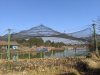
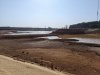
The lake was flat-calm and empty. Imagine taking a boat across a reservoir. It was as interesting as that. The ride was half an hour. Up ahead on the shore I could see a large structure which looked very much like an aviary. I had a look at my photo of the map. There was a picture of some cranes next to what I had thought was a bridge but now looked like an aviary. I had a bad feeling.

Sure enough, when the boat docked it was next to a giant walk-through aviary in which I could see domestic ducks, geese and doves. The other people from the boat excitedly headed for the aviary to feed the ducks. I walked past it, following the path, and found a locked gate blocking access to the road beyond. I asked a security guard if I could walk along the road and he gestured to a walkway which went overhead to the other side. Ah, excellent. Onto the other side I went, where I found a short loop of a path by a mudhole which had a couple of Mallards in it, and an expanse of dry lake bed with a large flock of domestic Chinese Geese being fed by more visitors. The road was also fenced off on this side. There was literally nowhere to go.

I wandered around the path a couple of times, feeling at a bit of a loss. There was a Long-tailed Shrike and a couple of White Wagtails. Way in the distance I could see some water but there was no way to get past the fences blocking me in here. I was pretty angry now, having spent all day getting here and then paying 155 Yuan just to take a boat for half an hour to an aviary.

I'm not someone who normally asks for their money back - usually I'm just like "oh well, that sucked" and move along while grumbling to myself - but this time I did. I was so ticked off that when I got back to the entrance I headed straight for the counter. It didn't do any good of course.

"There are swans and cranes" was the reply when I said there were no wetlands and no birds there.

"They're in an aviary!" I exclaimed (if exclaimed is the right word to use when I'm typing on a phone - it sort of reduces the impact!).

"That's all there is there"

"Then why do you call yourself the National Wetland Park?"

"A wetland is defined as a place with water" was the infuriating response.


There was really only one good thing which came from the day (well, I mean I did see some cranes from the bus on the way there, but they were too brief to be enthralling even if they were lifers - luckily I saw both species again the next day). The one good thing was that there was a family from Shanghai on the bus back to Poyang who spoke English and they informed me that to get to Baihezhou - one of the main viewing sites for Siberian Cranes - I could get a train from Nanchang to Yugan and then a taxi from there would be an hour, so considerably shorter and cheaper than if I took one all the way from Nanchang which had been going to be my plan for the next day.
 
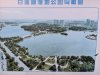
The map, the aviary, and the mud hole.

PXL_20250116_054259458.jpg
The two spots marked with rows of icons and labelled "Tourist Service Center" and "Poyang Lake Wetland Science Garden" - those are the only two places accessible at this "Wetland Park". Everything else on this map is just the general area and can be accessed if you have your own vehicle but not if you actually pay at the "Wetland Park". This is why the map was so confusing when I was trying to understand it - 99% of it doesn't relate to the "Wetland Park" at all.

PXL_20250116_063337233.jpg

PXL_20250116_064318703.jpg
 

Attachments

  • PXL_20250116_054259458.jpg
    PXL_20250116_054259458.jpg
    157.6 KB · Views: 102
  • PXL_20250116_063337233.jpg
    PXL_20250116_063337233.jpg
    190.1 KB · Views: 106
  • PXL_20250116_064318703.jpg
    PXL_20250116_064318703.jpg
    170.8 KB · Views: 101
Last edited:
Baihezhou

After yesterday's failure I didn't know how today was going to go. I knew Baihezhou would definitely have cranes - the winter eBird checklists for the site consistently have high-hundreds to low-thousands of Siberian Cranes and Swan Geese in particular. But would I simply fail to get there?

I had found out yesterday that the easiest way to get to Baihezhou with public transport was to take a train from Nanchang to Yugan, which cuts out most of the travel distance, and then taxi the last 45km from there. The train to Yugan takes less than twenty minutes, so it should be a quick start. Unfortunately the Yugan train only goes from the Nanchang East Railway Station. Mostly I have been using the Nanchang West Station which is on metro line 4, as is the Nanchang Station, so those are easy train stations to get to and from. The Nanchang East Station, though, only opened last year and doesn't yet have a connecting metro line. Instead you have to go to the Nanchang West Station and catch the line 10 bus, which then takes 45 minutes to get to Nanchang East.

Seeing I had to go to Nanchang West anyway I thought I may as well just check at the ticket office in case there was a sneaky train to Yugan from there. Nope. Then I asked if there were any connecting trains between the two stations to save time. No, said the ticket lady, I would need to take a taxi. I asked if there was a bus to the other station, and she said no. I went and caught the bus anyway.

I got a train at 9.28am, was in Yugan 17 minutes later, and at 9.55am was in a taxi on my way to Baihezhou. It was an hour's drive to get out there, the driver waited two hours for me and then drove me back to the train station, and I paid 400 Yuan (about NZ$100). Today was an absolute breeze.

The road out there from Yugan passes a lot of lake area, covered in geese and swans but not really that close. I didn't bother getting the driver to stop anywhere along the way because I wouldn't have been able to see the waterfowl close enough to tell the similar species apart, and I figured I'd see what I was missing after Baihezhou and then see if any spots looked likely on the way back. There were some species identifiable from the car though, including numerous Oriental White Storks and a few Siberian Cranes.

When we reached Baihezhou the driver was directed into a car-park and I had to walk about ten minutes further up from there to the end of the road. It's obviously a popular place and the car-park at that end, close to the area the cranes congregate at, was full. I don't know if the cranes and geese are specifically fed here, or if this is just the spot they traditionally prefer amongst the field stubble and so a visitor attraction was created around them.

full

Siberian Cranes and Swan Geese

It is a small area. There is a short walking road, a walkway covered in (pointless) camouflage netting, an open walkway through another part of the fields, and a sort of corridor alongside the road which has scopes pointing out over one field and the water beyond. The scopes are more like enormous binoculars - actually just like those ones you see on piers in American movies - and they were rubbish, like looking through a fish's eyeball, so I didn't bother with them. This was unfortunate because there were a ton of waterfowl and sandpipers out on the distant water.

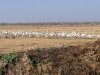
The bulk of the birds here were Siberian Cranes and Swan Geese, thousands of them collectively. Amongst the Swan Geese were Tundra Bean Geese, Taiga Bean Geese and Greylag Geese. A flock of White-fronted Geese flew past at one point but I couldn't tell which species (they were certainly Greater, but I didn't count them and I saw them at my next destination at Wucheng anyway so it doesn't matter). Lots of swans - there are two species here, Whooper and Bewick's, but most of them were too far back for me to tell them apart so the only ones I was satisfied with were Bewick's Swans. It took a while before they became obvious, but there were also hundreds of Pintails almost hidden in the grass amongst all the geese.

full

Siberian Cranes, Swan Geese, and a Bewick's Swan

full

Swan Geese

All sorts of little birds were roaming about as well, especially pipits, but they were almost all too hidden in the grass for me to tell what they were.

A distant field away from all the Siberian Cranes was hosting White-naped Cranes. Not the best of views through the heat haze but enough to see what they were. There were Common Cranes scattered through the Siberian Cranes also, but I didn't see any Hooded Cranes which is the fourth species often seen here.

full

Siberian Cranes

It's interesting to look at the eBird checklists and see the differences in numbers and species on each day (or even on the same days) and wonder if people are actually identifying all these birds or just making guesses at what the distant blobs are.

full

Swan Goose

Of the waterfowl I expected to see here, I was still missing the Greater White-fronted Geese and Whooper Swans (there are lots of ducks recorded there but you'd need a good scope to see them I guess). I was going to make some stops on the way back to Yugan where-ever it looked like the waterfowl might be close enough to the road, but when I said this to the driver he immediately said I was wasting his time, and that I might be paying him but his time is being wasted. I honestly couldn't tell if he was joking or serious, and the ride back was in awkward silence with no stops.

That last little quirk notwithstanding, it was a successful day (for a change!) with 35 species seen, of which five were lifers: Oriental White Stork, Swan Goose, Tundra and Taiga Bean Geese, and Bewick's Swan. And of course the main reason for coming to Lake Poyang in the first place, seeing lots of Siberian Cranes (which were only non-lifers because I had seen a family group from the bus yesterday).
 
PXL_20250117_034419575.jpg
Siberian Cranes feeding in the stubble.

PXL_20250117_070755957.jpg
The logo of the train station at Yugan is a Siberian Crane.

PXL_20250117_071122051.jpg
In other news, umbrellas have recently been made illegal in China.
 

Attachments

  • PXL_20250117_034419575.jpg
    PXL_20250117_034419575.jpg
    234.4 KB · Views: 113
  • PXL_20250117_070755957.jpg
    PXL_20250117_070755957.jpg
    57.5 KB · Views: 106
  • PXL_20250117_071122051.jpg
    PXL_20250117_071122051.jpg
    71.5 KB · Views: 112
Baihezhou

After yesterday's failure I didn't know how today was going to go. I knew Baihezhou would definitely have cranes - the winter eBird checklists for the site consistently have high-hundreds to low-thousands of Siberian Cranes and Swan Geese in particular. But would I simply fail to get there?

I had found out yesterday that the easiest way to get to Baihezhou with public transport was to take a train from Nanchang to Yugan, which cuts out most of the travel distance, and then taxi the last 45km from there. The train to Yugan takes less than twenty minutes, so it should be a quick start. Unfortunately the Yugan train only goes from the Nanchang East Railway Station. Mostly I have been using the Nanchang West Station which is on metro line 4, as is the Nanchang Station, so those are easy train stations to get to and from. The Nanchang East Station, though, only opened last year and doesn't yet have a connecting metro line. Instead you have to go to the Nanchang West Station and catch the line 10 bus, which then takes 45 minutes to get to Nanchang East.

Seeing I had to go to Nanchang West anyway I thought I may as well just check at the ticket office in case there was a sneaky train to Yugan from there. Nope. Then I asked if there were any connecting trains between the two stations to save time. No, said the ticket lady, I would need to take a taxi. I asked if there was a bus to the other station, and she said no. I went and caught the bus anyway.

I got a train at 9.28am, was in Yugan 17 minutes later, and at 9.55am was in a taxi on my way to Baihezhou. It was an hour's drive to get out there, the driver waited two hours for me and then drove me back to the train station, and I paid 400 Yuan (about NZ$100). Today was an absolute breeze.

The road out there from Yugan passes a lot of lake area, covered in geese and swans but not really that close. I didn't bother getting the driver to stop anywhere along the way because I wouldn't have been able to see the waterfowl close enough to tell the similar species apart, and I figured I'd see what I was missing after Baihezhou and then see if any spots looked likely on the way back. There were some species identifiable from the car though, including numerous Oriental White Storks and a few Siberian Cranes.

When we reached Baihezhou the driver was directed into a car-park and I had to walk about ten minutes further up from there to the end of the road. It's obviously a popular place and the car-park at that end, close to the area the cranes congregate at, was full. I don't know if the cranes and geese are specifically fed here, or if this is just the spot they traditionally prefer amongst the field stubble and so a visitor attraction was created around them.

full

Siberian Cranes and Swan Geese

It is a small area. There is a short walking road, a walkway covered in (pointless) camouflage netting, an open walkway through another part of the fields, and a sort of corridor alongside the road which has scopes pointing out over one field and the water beyond. The scopes are more like enormous binoculars - actually just like those ones you see on piers in American movies - and they were rubbish, like looking through a fish's eyeball, so I didn't bother with them. This was unfortunate because there were a ton of waterfowl and sandpipers out on the distant water.

The bulk of the birds here were Siberian Cranes and Swan Geese, thousands of them collectively. Amongst the Swan Geese were Tundra Bean Geese, Taiga Bean Geese and Greylag Geese. A flock of White-fronted Geese flew past at one point but I couldn't tell which species (they were certainly Greater, but I didn't count them and I saw them at my next destination at Wucheng anyway so it doesn't matter). Lots of swans - there are two species here, Whooper and Bewick's, but most of them were too far back for me to tell them apart so the only ones I was satisfied with were Bewick's Swans. It took a while before they became obvious, but there were also hundreds of Pintails almost hidden in the grass amongst all the geese.

full

Siberian Cranes, Swan Geese, and a Bewick's Swan

full

Swan Geese

All sorts of little birds were roaming about as well, especially pipits, but they were almost all too hidden in the grass for me to tell what they were.

A distant field away from all the Siberian Cranes was hosting White-naped Cranes. Not the best of views through the heat haze but enough to see what they were. There were Common Cranes scattered through the Siberian Cranes also, but I didn't see any Hooded Cranes which is the fourth species often seen here.

full

Siberian Cranes

It's interesting to look at the eBird checklists and see the differences in numbers and species on each day (or even on the same days) and wonder if people are actually identifying all these birds or just making guesses at what the distant blobs are.

full

Swan Goose

Of the waterfowl I expected to see here, I was still missing the Greater White-fronted Geese and Whooper Swans (there are lots of ducks recorded there but you'd need a good scope to see them I guess). I was going to make some stops on the way back to Yugan where-ever it looked like the waterfowl might be close enough to the road, but when I said this to the driver he immediately said I was wasting his time, and that I might be paying him but his time is being wasted. I honestly couldn't tell if he was joking or serious, and the ride back was in awkward silence with no stops.

That last little quirk notwithstanding, it was a successful day (for a change!) with 35 species seen, of which five were lifers: Oriental White Stork, Swan Goose, Tundra and Taiga Bean Geese, and Bewick's Swan. And of course the main reason for coming to Lake Poyang in the first place, seeing lots of Siberian Cranes (which were only non-lifers because I had seen a family group from the bus yesterday).

Wow I have to just say wow at all those cranes. Stunning. In such numbers. And the Geese and Storks the icing on the crane cake. That must have been such a wonderful moment! Beautiful birds all round - that's my favourite moment so far among all the lovely things you've seen... amazing stuff.
 
The Siberian Cranes are epic! Cranes are one of my favorite groups of birds and I would love to see all the species in the wild some day (2 down, 13 to go).
The cranes were great. Seeing all the species in the wild requires a lot of travel because there are only a few species but spread over such diverse parts of the world!

I had seen five species before this trip (Brolga, Sarus, Common, Demoiselle, and Black-necked). Over the last few days I have added another three (Siberian, White-naped, and Hooded). I should see a couple more in Japan.
 
Surely this has nothing to do with a political movement in a special administrative region a decade ago...
The reality is it is just a sign at a train station - i.e. don't use umbrellas on the platforms because they could blow onto the tracks.
 
  • Like
Reactions: CMP
Wow I have to just say wow at all those cranes. Stunning. In such numbers. And the Geese and Storks the icing on the crane cake. That must have been such a wonderful moment! Beautiful birds all round - that's my favourite moment so far among all the lovely things you've seen... amazing stuff.
It was nice to actually see some animals for a change :D

I'll be at Izumi in Japan in a couple of days time, where there will be even more cranes. The bulk of the cranes at Izumi are Hooded and White-naped, so I should see both species much better than I did at Lake Poyang. Almost 90% of the world's Hooded Cranes winter at Izumi - 15,000 birds. However seven species have been recorded at Izumi, some unlikely to be seen (e.g. a lone Siberian Crane which used to winter there, and very occasional Demoiselle and Red-crowned Cranes). However two other species are regular winter birds, just in small numbers, which are the Sandhill and Common Cranes.
 
The Siberian Cranes are epic! Cranes are one of my favorite groups of birds and I would love to see all the species in the wild some day (2 down, 13 to go).

The cranes were great. Seeing all the species in the wild requires a lot of travel because there are only a few species but spread over such diverse parts of the world!

I had seen five species before this trip (Brolga, Sarus, Common, Demoiselle, and Black-necked). Over the last few days I have added another three (Siberian, White-naped, and Hooded). I should see a couple more in Japan.

That geographical spread means I had a relative crane glut in 2013-2014 then no new ones since. :D

I find myself on an eclectic selection of four wild cranes - Common, Sandhill, Black-necked Crowned, and Wattled - but I have seen every species in captivity - a feat I also completed in 2013 during the Crane Heyday.
 
Yongxui and Wucheng

Given how poorly the Nanchang part of Lake Poyang had started out I wasn't sure going to Wucheng was still on the cards. I also didn't know how to get there. I knew it had the biggest bird list for the whole of Jiangxi province on eBird, and I knew it was self-titled as "Migratory Bird Town". From a couple of trip reports I knew it should have hotels, and from the map on my phone I knew it should have a bus station. I knew all the broad strokes but none of the actual details. No-one seemed to be able to tell me where the buses went there from, and I wasn't going to trek round all the stations in Nanchang trying to find out in person.

It was looking like I would need to take a taxi to get there. In the meantime I went on Trip to see which hotels were available for the next day. There were none. Not none with available rooms, just none. No hotels listed for Wucheng. That was odd. I widened the search and saw a nearby town called Yongxiu, and more particularly I saw the Yongxiu Railway Station. That'd work!

There was very little distance between Yongxiu and Wucheng, so I looked at the hotels near that train station and booked the Xinyi Boutique Hotel. It had already been reduced from 239 to 203 Yuan (for two nights), and I used my "Trip Coins" to reduce it further to 170 Yuan, making it 85 Yuan per night. It was a really nice room, would have been worth the full price easily. It definitely made a change from both of the last two hotels I stayed at in Nanning and Nanchang with their lack of windows, stinky toilets, and prostitute cards stuck in the room doors. Also of note, the convenience store directly next door to the hotel sells coffee!

There are trains between Nanchang West Station and Yongxiu Station about every half an hour, and the ride is only twenty minutes long. I got a train at 9.04am and was at the hotel at 9.30am (it's about 2km from the station, so I took a taxi there for 10 Yuan). The good thing with Chinese hotels is that they don't worry about check-in times. If you turn up at 9.30am they just check you in no problem, you don't need to leave your luggage somewhere until 2pm or whatever the "official" check-in time might be. Several of the hotels have also had official "100 yuan deposit required" on check-in, which they have never asked me for - I don't know if this is because I'm a foreigner or if it just stated to cover themselves so that they can ask for it.

I still didn't know if there were or were not buses to Wucheng, and the girl at the hotel didn't know either, so I walked back to the train station because I did know there were taxis there. It's easier to find your way back from somewhere than it is to find your way there initially, so I figured I'd take a taxi to Wucheng to keep it simple and then work out the return buses once there - and I'd have the taxi driver's contact details if I needed them.

I stopped along the way to the station to photograph some birds in the street. Silky Starlings are like Common Starlings here. Well, maybe not like Common Starlings in the UK, but like Common Starlings in New Zealand. There were flocks of them swooping back and forth between the fruiting trees lining the streets. Everywhere around the Lake Poyang area was alive with Silky Starlings.

full

Chinese Blackbird.

full

Silky Starlings

The taxi cost 70 Yuan on the meter, and took about 45 minutes to reach a place that seemed good for me. A lot of the way from Yongxiu was past flooded fields, and then you reach the so-called "Water Highway" which right now is high and dry above the grasslands but which in the rainy season sits just under the lake surface. At the far end of the Water Highway is a large island (when the lake is full), and Wucheng is at the far end of that island.

I got the driver to drop me at the end of the Water Highway, then I walked back a short distance along the boardwalk which runs parallel to the road (I think when the road is flooded the boardwalk is just clear of the water so can still be walked along). The dry grasslands on either side of the road were covered in flocks of feeding geese, most of which were Greater White-fronted Geese and Taiga Bean Geese. There were loads of pipits running everywhere, but they were mostly too quick and far away to get proper looks at them. However some record shots of the closer ones showed them to be Siberian Pipits with distinctive breast markings like heavy "necklaces".

full

Taiga Bean Geese

After spending some time on the grassland birds, I set off walking along the road to Wucheng village. The taxi driver had said it was 7 or 8 km from that point, which is probably about right. It took me four hours because of course I was stopping all along the way and making side-tracks.

It was surprisingly warm during the day in Wucheng. It wasn't hot but it was very warm, enough to sweat a bit while walking all day.

There were a couple of viewing points along the way - one directly at the roadside, with a boardwalk and hides with the giant-binocular-type scopes (which actually worked unlike the ones at Baihezhou) and the second about a kilometre down a side-road. At the first one the water's edge was still too far back to see the birds properly even with the scopes, which was annoying because there were a lot of waders feeding along the shore and a lot of ducks floating out on the surface. The Pied Avocets I could identify from their colour and behaviour, but not much else of the smaller birds. At the first viewing point there was a pair of Hooded Cranes with an accompanying Common Crane, which were walking about reasonably close and through the scope I could see them well. At the second viewing point there was a family of Siberian Cranes.

I ended up with 38 species for the first day from Wucheng, three of them lifers (Siberian Pipit, Greater White-fronted Geese, and Hooded Crane). When I reached the village I didn't continue on to the very end of the island, where my map said there was another "wetland park", because I was coming back tomorrow and it was late afternoon already.

I had seen buses all day long coming and going, so I just found the bus stop and caught one back to Yongxiu for 5 Yuan. It took about 40 minutes to the main bus station in Yongxiu and then (after a bit of confusion) I caught the number 1 bus from the other side of the road into the main part of town for 1 Yuan. The number 1 bus is a loop-bus, starting and ending at the bus station so you can catch it at any stop along its route, and it had a stop just near my hotel (and one quite near the train station too).

So I spent 70 Yuan getting to Wucheng and 6 Yuan getting back. I didn't mind paying for the taxi though, because the bus doesn't stop between the Water Highway and the village, and walking the road from where the taxi dropped me off meant I saw a lot of smaller birds and could also stop at the viewing points where I saw the cranes. Having said that, however, there did seem to be a second type of bus in Wucheng which did runs from point to point, so if you were to take the bus from Yongxiu to Wucheng, you could still get to the different spots without kilometres of walking.

............................................

My second visit to Wucheng was slightly different in that I took the bus all the way from Yongxiu, and then walked through the village to the end of the island. The village itself doesn't appear to have any restaurants or other places to eat, has only a few tiny stores that I saw, and may or may not have hotels. Staying in Yongxiu is definitely the way to go if coming to Wucheng for birding.

Coming here by bus isn't such a great idea though. During winter - which is when you come here for birds because that's when all the migrants are here - the whole area around Wucheng is dry so you don't have many options. The end of the village, labelled as "wetland park" on my map, was just busy channels for boats at this time of year. I saw an Oriental White Stork there, a Mongolian Gull flew past, and there was a Common Greenshank feeding along the river edge, but otherwise it's not really somewhere you'd likely be seeing many water birds.

There were buntings and such in the grassy patches near the channels - I saw Black-faced, Yellow-browed and Little Buntings, as well as Oriental Greenfinches - but again it was difficult finding anywhere that looked good for birds. I wasn't really getting much out of today, and I didn't want to walk to the other end of the island again, so after a couple of hours I got on the bus and headed back to Yongxiu. I saw 22 species around Wucheng village, but mostly just regular birds (only the Little Buntings and Common Greenshank were "new" for the trip).

In Yongxiu I paid an afternoon visit to the Jiangxixiuhe National Wetland Park, which seems to be what is called White Lotus Lake Wetland Park on eBird. This is a large lake surrounded by a park, which is just up the road from my hotel. It also runs past the train station - from the platforms you are looking directly across at the lake.

Going here bumped the day-list up to 40 species, including a lifer Brownish-flanked Bush Warbler which I even managed to photograph. Bush warblers are typically secretive birds which you hear "ticking" away inside dense vegetation but only get brief glimpses of. This one kept popping in and out of the open on the edge of the lake.

full

Brownish-flanked Bush Warbler

The lake itself had numerous Great Crested Grebes and a few Common Moorhens and Coots, and on an island in the middle a large colony of Black-crowned Night Herons. Berries on the trees in the park were attracting the usual Silky Starlings, Yellow-billed Grosbeaks, and the like. Interestingly, when in Nanchang's Xianghu Wetland Park the most common thrushes were Dusky Thrushes but I haven't seen a single one since then. The thrushes I see now are (apart for the ubiquitous Chinese Blackbirds) all Grey-backed Thrushes, like this female one:

full
 
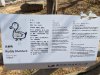
An identification sign at one of the viewing points at Wucheng - the photo had come off so someone had kindly replaced the picture; and a photo showing the size of the Jiangxixiuhe Wetland Park in Yongxiu.PXL_20250118_052819358.jpg PXL_20250119_065845399.jpg
 

Attachments

  • PXL_20250118_052819358.jpg
    PXL_20250118_052819358.jpg
    187.4 KB · Views: 105
  • PXL_20250119_065845399.jpg
    PXL_20250119_065845399.jpg
    174.7 KB · Views: 102
It was nice to actually see some animals for a change :D

I'll be at Izumi in Japan in a couple of days time, where there will be even more cranes. The bulk of the cranes at Izumi are Hooded and White-naped, so I should see both species much better than I did at Lake Poyang. Almost 90% of the world's Hooded Cranes winter at Izumi - 15,000 birds. However seven species have been recorded at Izumi, some unlikely to be seen (e.g. a lone Siberian Crane which used to winter there, and very occasional Demoiselle and Red-crowned Cranes). However two other species are regular winter birds, just in small numbers, which are the Sandhill and Common Cranes.

Excellent, I am looking at a Japan trip as I really want to see wild cranes there and it's somewhere I have never been, so it will be great to hear about Izumi (while I also gaze at the other threads on here about wildlife / Japan zoos).
 
I haven't exactly had much in the way of good luck finding new mammals on this trip but I had my fingers crossed for this one. Outside Nanning is a town called Chongzuo, and outside Chongzuo is a reserve specifically for White-headed Langurs. It has had (and seemingly still does have) numerous variations on its name but the Chongzuo White-headed Langur National Nature Reserve is the main one I think (or maybe first-equal with the Chongzuo White-headed Langur Eco-Park).

It's a late reply (I was travelling in Yunnan last week) but glad to know that you got to see the langurs! Technically the white-headed langur reserve is much bigger than the ecopark. The reserve consists of four separate pockets of Karst Forest, which covers more than 90 percent of all known habitat of the species, while the ecopark is just a small area located in the "experimental zone" of Banli Habitat. Of course for tourists the two are synonyms as both the core zone and the buffer zone of the reserve are off-limits.

Even the White-headed Langur Reserve itself, a place specifically set aside to protect the langurs, just has several outcrops with a bit of forest around the base of each, and then all the connecting areas - which are inside the reserve - are used for growing sugarcane. I'm walking around there thinking, what is going on? Why is this not all being ploughed up and replanted in trees?

It seems counterintuitive but the sugarcane fields are actually part of the efforts to save the species. Before these sugarcane fields the local villagers normally burned down part of the forests to create new farmlands every year, so the government encouraged the villagers to switch to sugarcanes from traditional crops. As sugarcanes generate more income per acre, the destruction of forests was halted and some of the old farmlands were replanted with trees that provide food for the langurs.
 
Wuyuan

The town of Wuyuan is to the east of Lake Poyang, and it is known to birders mostly for two things - Scaly-sided Mergansers and Blue-crowned Laughing Thrushes. I only had enough time left before Japan to either go to Wuyuan for these birds, or to go south to Emei Feng for Cabot's Tragopan. I do like me a pheasant but I haven't exactly been doing well with getting to where they are (the only identified species I've seen this trip is a common old Ring-necked Pheasant), so I went with the mergansers.

It didn't take long to get there from Yongxiu, with a 20 minute train to Nanchang West, followed by a one-hour train to Shangrao and then a half-hour train from there to Wuyuan (there are direct trains between Nanchang West and Wuyuan but they were all booked).

I had been expecting Wuyuan to be a village because every trip report from birders talks about the "little village", but it isn't - the merganser site is at a little village, actually a pair of very little villages, but Wuyuan itself is a reasonable-sized town. It's not huge but you need buses to get around. It also gets pretty smoggy at night. I was trying to remember when the last noticeably-polluted city was. Chengdu certainly - you don't so much notice the pollution there as have to cut your way through it with a machete. Xi'an was very much so in the centre of the city, but not where I was staying. I think that was it - I don't remember Nanning as being smoggy and Nanchang wasn't. Apart for Chengdu and Xi'an these are smaller cities, but that's why Wuyuan being like this is surprising.

I caught the number 520 bus from the train station to the middle of town where my hotel was. At the station a taxi driver himself had told me to take the bus because it goes right past there and it would save me the money. A girl from the train who was also on the bus gave me some help getting to the right stop - one of the things with booking hotels on Trip is that they all have English names on the booking site, but very rarely on the hotel itself, so you need to walk along trying to compare the Chinese characters on your address to the ones on the buildings, and every so often asking someone if you're going in the right direction.

While on the bus looking at the Alien motion tracker on my phone-map I noticed a marker for the Raoheyuan National Wetland Park, a name which sounded familiar. When I got to the hotel I looked up my notes and found that I had it down as a site for the Blue-crowned Laughing Thrush, which is an extremely range-restricted bird found only in the Wuyuan area and mostly found in forest. This spot on the map was a strip along the river in the middle of the city. That seemed suspect, but it was close so that's where I decided to head first.

I caught the same bus back there (with the same driver) but it turned out to not be a suitable place for the laughing thrushes at all, just a narrow strip of brown grass with a few trees. Lots of Little Egrets and Little Grebes though. Double-checking later online I found out that the "actual" Raoheyuan National Wetland Park is on Moon Bay Island to the north of the town. I don't know if they are both called that, or if the marker is misplaced on the Trip map, but there definitely wouldn't be laughing thrushes there. The mix-up with that place name had wasted time that I should have used going to one of the good sites and there wasn't really a lot of time to go far afield today, so I got back on the next 520 bus and rode it to the end of its route where the stop was called the Wunuzhou Scenic Area, because that sounded like it would have trees and birds. It was instead a hotel resort with an amusement park inside. I had a wander around the streets to the river nearby but saw nothing of interest. I got the bus back to the hotel, again with the same driver who must have wondered what the heck I was doing.

............................................

For the next morning I had decided to go for the mergansers before the laughing thrushes. I didn't really know if I'd even see the latter, and one report said they were only on Moon Bay Island in the breeding season anyway (although I didn't know if that was true or not given that most birders must come here in winter). I figured the mergansers were more likely and there were other birds at the same site I wanted to see as well, so I'd try them first and if I didn't see them I'd use my second day to try for them again over the laughing thrushes.

It was surprisingly difficult to find a taxi in the morning but I got one eventually. The merganser village name used in most reports is Kengkou, but the site name on eBird is Shijian Village. There are actually two Kengkous and two Shijians, both to the north and the south of Wuyuan. The one you want is Kengkoucun which is about 10km south. This is at a junction by the Le'An River, with the dead-end road leading upriver from it going to a bridge at Shijian village. I thought the competing names might cause confusion when trying to get there, but when I said Kengkou the driver knew immediately that I was "going to shoot the Chinese Merganser duck" and knew exactly where to go.

It cost me 60 Yuan for the taxi (on the meter), and I took his contact details in case I couldn't find a bus back. There is a road up either side of the river from Shijian, but the recommended one is on the opposite side across the bridge. Oddly there was a big sign on that side saying something about this being a restricted area of the national park and entry is forbidden - but it is just a road which leads to some more villages. I went up there anyway.

From the bridge I had a good scan to see if there were any Long-billed Plovers on the riverbed. The "long bill" is not a noticeable feature, and they basically look like really big Ringed Plovers. They are also well-camouflaged as the bad photo below shows.

full

Long-billed Plover

Other birds on the river were Common Greenshank, Little Egrets, Black-crowned Night Herons, Grey Heron, Spot-billed Ducks, and - almost missed them! - Scaly-sided Mergansers. I was looking at the Grey Heron and then just on the edge of the view in the lens saw a merganser just next to the far bank. I swung the binoculars right and saw a flock of eight - four pairs - tucked up next to the shore. They looked so insignificant I felt like I would have actually missed them if I hadn't been looking at the heron. They were very flighty though, and quickly took to the wing as soon as I tried to move closer to the river from the road.

full

Scaly-sided Mergansers

The road goes for maybe a kilometre from the bridge before forking, with the left fork going uphill through some poor forest filled with bamboo which is good for one of the two birds I particularly wanted to see here, the Pale-billed Parrotbill (the other being the Grey-sided Scimitar-Babbler). Lots of signs of tree-cutting all through here and despite this area supposedly being protected I can't see it lasting much longer.

It was quite hot up here and there was little bird activity. I did not see any parrotbills (I gather lots of people miss them) but I did fortunately see some scimitar-babblers foraging through the thick undergrowth on one of the hillsides next to the road. They are very difficult to see, apparently more so than most scimitar-babblers which are fast but you can usually at least see them as they dash about. The Grey-sided Scimitar-Babbler seems to prefer creeping through the denser parts of the vegetation. One of the individuals here, however, chose to perch in the open where I got some okay photos.

full

Grey-sided Scimitar-Babbler, facing the wrong way

full

Grey-sided Scimitar-Babbler, facing the right way but behind a stick

I walked back to Kengkou, where I was told that if I wait outside this shop here then a "car" will come by which I can ride to Wuyuan. The "car" was a truck which acts like the local bus. Unfortunately I don't know how you would catch it in the other direction (i.e. if trying to go to Kengkou from Wuyuan) because the driver dropped me in town by the "pedestrian street" rather than at whichever his terminus was.

While waiting outside that shop with a little crowd of people who weren't waiting for the truck - they were just hanging out - I found out why my long beard seems to be well-received in China. One of the men pulled up a photo on his phone of Confucius!

............................................

Having successfully seen the mergansers and the scimitar-babblers, I went for the laughing thrushes next day. All I knew is that they were apparently found on Moon Bay Island, which is in the river north of Wuyuan (called Moon Bay simply because the island is crescent-shaped). One report said there was a bridge across to the island, but that was also the report which said the laughing thrushes are only there when breeding and then disappear for parts unknown.

The driver from yesterday was busy so I found another driver who did not know anything about the "yellow throat" (as yesterday's driver translation app had called the Blue-crowned Laughing Thrush). He did know where Moon Bay was, so off we went. We did get to Moon Bay but on the wrong side of the river. My understanding was that the bridge (if it existed) was at the north end of the island, from the left bank, and we were on the right bank. The driver said this was the place. I said I wanted to get onto the island. He said that wasn't possible. I asked can he just take me around to the other bank. He said no, then got fed up with me, and so I stayed at this place while he left. I'm paying him to drive me - I don't see why it's a big deal for him to take me where I ask - even if I'm wrong he's still getting paid to take me there.

Anyway, it was too far to walk to reach a bridge to get around to the other bank, so I walked along this bank which (as it happens) is the Moon Bay Scenic Area and from the map-boards I found is part of the Wetland Park which covers both sides of the river as well as the whole island. I still don't know if the laughing thrushes are only seen by birders on the island itself (which seems unlikely) or if they aren't here in winter (which also seems unlikely), but the end result was that I did not see any.

full

Chinese Blackbird

full

Blue Whistling Thrush (some subspecies have black bills and some have yellow bills)

full

Eurasian Jay

Down the other end of the walkway I found a car park in which there was a number 2 bus. That was handy. The taxi had only cost 23.50 Yuan because it is close to town, but the bus only cost 1 Yuan.

I came back here early the next morning on that bus, for about an hour or so before I left for Shanghai. I saw a Maritime Striped Squirrel, but no laughing thrushes. There's always some birds that are going to get away. I mean, I haven't seen 10,000 birds, so I don't get too bothered when I don't see one. And that's what I keep telling myself.


And thus endeth my tales from China (for now). I had found that there were some trains direct from Wuyuan to Shanghai which meant I didn't need to backtrack to Shangrao or Nanchang. I saw some Collared Crows from the train and they were the last birds for me in China. I got into Shanghai at around 4pm and because it was too late to bother trying to go anywhere I just went straight to the airport to wait for my flight tomorrow morning. I am now in Japan. I'll do a sort of round-up post for China next, and then after that it will be all Japan all the time baby.
 
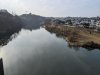
View of Wuyuan along the river - looking very like India with the brown everything and women washing clothes by the shore.

PXL_20250121_072916863.jpg


Entrance at the Moon Bay Scenic Area, with laughing thrushes on the signs and on that big circle.

PXL_20250122_054616128.jpg


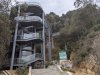
Tower going up to a metal walkway that led through forest along the ridge of the hill at Moon Bay for something like a kilometre - but was closed for entry...

PXL_20250122_041325410.jpg
 

Attachments

  • PXL_20250121_072916863.jpg
    PXL_20250121_072916863.jpg
    97.4 KB · Views: 82
  • PXL_20250122_054616128.jpg
    PXL_20250122_054616128.jpg
    263.4 KB · Views: 84
  • PXL_20250122_041325410.jpg
    PXL_20250122_041325410.jpg
    250.4 KB · Views: 81
Back
Top