Karuizawa
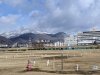
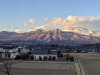
Karuizawa is in the Japanese Alps, within easy reach of Tokyo - you could even do it as a day-trip with the high-speed trains - and is a major birding destination in Japan. I was expecting this to be one of the highlights of my trip, but it turned out to be my least favourite place in Japan so far.
In my head I was thinking it would be more wilderness - kind of like Bukit Fraser, a little central hub but with other residences and hotels scattered through forest - but it is a town and is all built up. More importantly, the forest felt dead and empty. Pretty much the only good results I got were in the last few hours of the last day. To give an idea of how quiet it was there, on my morning walk along the river in Nagano the day before going to Karuizawa I saw 33 species of birds. My total number of birds seen at Karuizawa over four days was also just 33 species.
Most of the birding locations I had seen referenced were nearest to Naka-Karuizawa Station (which is roughly 4km from Karuizawa Station), and the hotel I had booked was closest to there as well, so I caught a train from Nagano to that station.
I had booked the cheapest hotel listed on Trip, the fancily-named Resort Villa Shiozawasanso Karuizawa, which was 6210 Yen per night - all others were in the tens of thousands of Yen per night! I didn't want to risk winging this one given the cost of all other listed accommodations there! It is in an inconvenient location though, being 2.5km from the station and on the wrong side of the tracks - all the bird sites are about 2km from the station but in the other direction, so almost 5km walk each way. (There are buses but they don't start running early enough in the morning and they usually had already stopped running when I was coming back in the evening).
I popped into the information centre at the Naka-Karuizawa station when I arrived to check on bus timetables and get some maps. There I found out that there is a bus from Karuizawa Station which goes right by the hotel, so it would have been easier to go there after all! Today there was no bus from Naka-Karuizawa which went that close. Instead I caught a bus to the closest stop, which was 1.3km away but with a downhill walk.
The hotel looks really run-down from the outside, but the room was fine and I could check in right away instead of having to wait for the actual check-in time. When I got back to the hotel in the evening I couldn't work the heating and there was no-one at reception so I had none that night. On the second night I worked out the controls for the heat-pump but there were frequent power outages so I ended up with no heat anyway for the whole stay.
Somehow it was much colder here than in Hokkaido. I don't know what the temperature was on any of the days (apart for the morning I left for Tokyo, when it was minus seven degrees) but on my first morning, literally as soon as I walked out the door, frost starting forming on my beard from my breath. On the third day there was ice in my water bottle, which was inside my bag! I had to wear on an extra layer which I hadn't needed in Hokkaido.
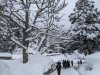
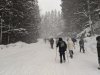
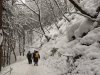
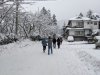
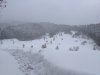
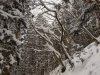
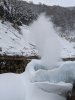
It was snowing on and off on the first day after arrival, and quite windy at times; clear and still on my second full day; clear and warmer (but still very cold) on the third day - this day was the only one where my beard wasn't stiff with ice all day. There were really random changes in temperature as well, depending on where you are - on the Kose Forest Road some parts would be completely free of any snow whatsoever, then you come round the bend and suddenly the road would be a just a thick sheet of ice with the surrounding hills covered in snow.
On the first afternoon after checking in to the hotel, I then walked back to station and on to the Wild Bird Sanctuary, which took almost an hour. It's a confusing area when first trying to find your way around - it's easy once you know where everything is, but when you've just got there and only know the sites from written reports, it seems very difficult. It also turned out that most of the sites people mention ("the Hoshino area", "the Stone Church", "the Wild Bird Sanctuary", "the Forest Road") are actually all in roughly the same place - the Hoshino area is where those other places are, the road up to the Stone Church and the entrance area for the Wild Bird Sanctuary are basically on opposite sides of the road from one another, and the Kose Forest Road runs off the same road as the Wild Bird Sanctuary.
This first afternoon was more of a recce, so the only place I visited properly was the Stone Church which was built in 1988 and was not some ancient relic as I had expected. This particular spot is supposed to be good for Japanese Green Woodpecker and Green Pheasant, but I saw no birds there at all (I have eight birds listed today for Karuizawa, but all were just on the walk from the hotel). There were burrows in the forested bank opposite the church, some of which had fresh soil outside and presumably were made by either badgers or raccoon dogs, and there were roosting-boxes for Giant Flying Squirrels in the trees in the car park. I waited until after dark but saw nothing - I didn't have my torch or night-vision camera with me, so didn't wait too long once it got dark. There is a nature tour company here called Picchio who do night tours for the flying squirrels but obviously I wanted to avoid paying money for something which I can (in theory) do myself.
The whole of the second day was spent at the Wild Bird Sanctuary and along the Kose Forest Road. It was two hours before I saw my first bird! Then I saw a bunch of birds all in one spot, including a Coal Tit, Willow Tits, Great Spotted and Japanese Pigmy Woodpeckers, a Red-flanked Bluetail, and also a Japanese Squirrel. This squirrel was scampering about on the forest floor and didn't hang around long. It turned out to be the
only Japanese Squirrel I saw in Japan! Only four additional birds were seen along the Forest Road, the best of which was a Brown Dipper. Total birds for the day was only 16 species. My torch failed at night so again no flying squirrels were seen.
The third day was spent along the Kose Forest Road again. It was a bit better than yesterday, with 19 species of birds seen, but nothing out of the ordinary. I was looking out for Serow the whole time. I felt like they should be here, but when I'd tried googling about it the results were invariably about Mount Asama (which is where Picchio does their Serow tours). However I found what I'm sure were Serow tracks through the snow - I had seen deer tracks in snow almost every day in Hokkaido so I was familiar with how they looked, and these were not the same.
More exciting, because they seemed more fresh, were marten tracks. I actually smelled the marten first, and while following my nose trying to pinpoint where it might be, I saw the tracks in the snow below the road. I traced the line of them and found that they came up onto the road itself - but the road was covered in ice so the tracks disappeared as soon as they left the snow. I couldn't find any on the opposite side, so I think the marten had probably run along the road and gone off the side somewhere else.
By my last day I was done with Karuizawa. I wasn't seeing anything, it was really cold all the time, and I was sick of walking the 10km return every day between the hotel and Hoshino. On this morning I started the day instead by catching a bus over to Kumoba Pond which is near the Karuizawa Station. I had been told this was a good spot for the Japanese Green Woodpecker and Japanese Accentor, both of which I still hadn't seen, and for Japanese Squirrel, of which I wanted to see more. From the pond itself, where there were Little Grebes and various ducks (and a nice male Red-flanked Bluetail), there is a grid of straight roads which lead through old gardens with large trees. I saw some Eurasian Jays, Goldcrest, Coal Tit, Nuthatches, and suchlike, but no Green Woodpeckers or accentors.
For the remainder of the afternoon I caught the bus from Karuizawa station back over to Hoshino. I finally found the Picchio Nature Tours office (it is at the counter for the ice skating pond) where I asked them about their night tours for the Giant Flying Squirrels, only to find that they don't do them in winter because it is too cold, and they also don't monitor the roost-boxes when they aren't doing tours so they couldn't even tell me which ones were occupied.
I headed up the Kose Forest Road on the lookout for Copper Pheasant, a male of which had been seen here this very morning. A little flock of Long-tailed Rosefinches were the first I'd seen at Karuizawa (I had seen them recently at Nagano), and I managed a passable photo of one of them.
Long-tailed Rosefinch
Where the Copper Pheasant had been seen there was a trail heading up a valley. I followed that for a bit, then had a sit-and-wait session on a likely-looking patch of hill. Still nothing, and (as of writing this) I haven't yet managed to see a wild Copper Pheasant. I came back down the valley, and just as I was almost back on the Forest Road I happened to look up to one side and saw a big old tree stump which, to the unwary and in certain circumstances, could have resembled a Serow. Hang on, that actually
was a Serow!
Japanese Serow
I snapped a few photos even though the animal was mostly obscured by the bushes. It was on top of a bank, but there was a track leading up that bank a little to the side. If I could get up behind then I might be able to get a clear shot. In hindsight I should have just waited for the Serow to move but generally animals don't move
into the open after they have seen you, they tend to do the opposite thing. By the time I got up there - with the Serow watching me the whole time - I discovered that the bushes were too thick to see across to where it was, and in the meantime it had snuck away and vanished.
Japanese Serow, watching me trying to sneak up behind it.
I had perused a few of the flying squirrel roost-boxes which are dotted along the Forest Road and, without actually knowing which ones were and weren't occupied, had chosen one which had a lot of fresh-looking gnaw-marks around the opening. Almost all the boxes had gnaw-marks, but the amount on this box made it look like it was a preferred box. The only thing I could do now was wait for dark and see if a squirrel emerged.
The box was situated right by the entrance to one of the Wild Bird Sanctuary trails. While I was standing there waiting, some small birds darting through the undergrowth by the roadside drew my attention - Japanese Accentors! Finally. It is only technically not a Japanese endemic because it is found also on Sakhalin Island which is right next to Japan (off the north of Hokkaido) but which politically belongs to Russia.
The accentors had moved on, but some other bird was calling noisily on the other side of the road. What was that? I thought it was going to be a thrush of some sort, but then a woodpecker flew out and landed on a tree trunk. A Japanese Green Woodpecker! Both the birds I had been looking for that morning at Kumoba Pond I was now seeing while waiting for a squirrel.
Dusk came and went. No wonder Picchio doesn't do night tours in winter - standing in one spot in these freezing temperatures was not fun! It was black now. What was I looking at? Could I see something white at the entrance of the roost-box? I turned on my torch (with a red filter on it) and two glowing eyes were staring back at me. I switched on my night-vision camera. The squirrel had climbed out of the hole and was perched on top of the box. I've seen giant flying squirrels before, of several species, but it still never fails to amaze how big they actually are. The squirrel didn't hang around long, running quickly up to the very top of its very tall tree. I waited for a while to see it fly, but it was so cold that eventually I gave up.
I had rolled my foot on a stone yesterday and for some reason my shoe had started rubbing the back of my ankle so that foot also had a sore there, making the long walk back to the hotel a painful chore. I didn't mind though - the last three hours of this final day were the best part of the entire four days combined!