Okinawa
The ticket counter at the Naze ferry terminal in Amami is only open in the very early morning, closing at some time after the ferry departs at 5.50am. I had, of course, only discovered this when I went in there during the day to try and buy a ticket. I went back early the next morning on the way to the forest, and then discovered that only one ticket counter is open each morning (there are two ferry companies which alternate the days), so the "wrong" counter was open - i.e. I couldn't buy a ticket for the next morning because that ticket counter wouldn't be open until the next morning. Luckily the previous morning I had randomly passed the Amami Tourist Service when walking between the ferry terminal and the road to the forest track, so I went there later that afternoon and got my ticket from them. There would have been no problem getting it on the morning of departure but I wanted to make sure I definitely had it before booking a hotel.
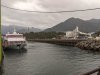
The ferry comes from Kagoshima, leaving there at 6pm and travelling overnight to Amami where it arrives at 5am, and then sailing on to Okinawa during the day, arriving there at 4.40pm. There are three stops between Amami and Okinawa, at the small islands of Tokunoshima, Okinoerabu and Yoronjima. On Okinawa it stops first at Motobu Port in the north and then Naha Port in the south. All three of Okinawa's endemic birds are restricted to the forests in the north of the island (the south of the island is now mostly covered in city), so I disembarked at Motobu and took a bus from there to the town of Nago.
It was a perfect sort of day for sailing - no clouds, no rain, flat sea - but that isn't the perfect sort of day for seabirds. The only ones I saw were some shearwaters which were too distant for ID.
There are three endemic birds on Okinawa - a rail, a woodpecker, and a robin. The last one is a fairly recent split from the Ryukyu Robin which breeds on the islands further north. The Ryukyu Robin is a short-distance migrant, sending winter in the southern Ryukyus and returning in spring to breed in the northern Ryukyus, whereas the Okinawa Robin is sedentary. Both species can therefore be seen on Okinawa, depending on the time of year.
All three of these endemic birds are now found only in the north of the island, in the mountain forests of the Yanbaru National Park (or Yambaru - the name is variably spelled). The south of the island is basically one big city now - when I was going to the zoo in Naha (a bit later in the trip) I was travelling by bus for an hour to get there, and it was through the city the entire way. Not only are the birds threatened by habitat loss - the woodpecker in particular needs old-growth forest and is critically-endangered - but the island is also infested with mongooses and cats. Amami has successfully eradicated its mongooses (apparently the largest island this has been accomplished on) and are now working on their feral cats. Okinawa has not managed this - in fact I saw a mongoose while I was there (at the zoo).
Despite being restricted to just one part of the island there is, handily for birdwatchers if not for the birds themselves, a road which cuts right through the middle of that forest. Less handily, for non-driving birdwatchers there is little in the way of public transport in Okinawa. In fact, if you read some websites it is impossible to visit Okinawa without hiring a car. This is, of course, total nonsense, so long as you don't mind some walking here and there.
It's easy enough to get a bus from Nago north to Hentona, but then some walking is required. There
are a couple of bus routes heading north from Hentona - including right along the road I wanted to be on - but they only run
into Hentona in the morning, and
out of Hentona in the late afternoon, so the reverse of what I needed.
Instead it looked like I would have to catch the first bus from Nago at 7.35am, getting to Hentona at 8.35am, then continue on foot from there to Yona, c.4km north, then turn onto the cross-island road and walk up that into the hills for c.6km to a side-road which is good for the endemic birds. Not ideal, and a later start than would be preferred, but I do what I can.
The bus from Nago costs 1210 Yen to Hentona, and takes an hour. I saw a Chinese Bulbul on the way to Hentona - it was a bit startling to see after months of only seeing Brown-eared Bulbuls.
I got to Hentona at 8.35am and found that there was a local minivan (the village bus) leaving across the island at 10am. It was a little bit of a wait but it would still be quicker than walking. I took it to Fungawa Dam which is c.11.5km from Yona, because that was easier to explain than where a random side-road was, and it cost 400 Yen.
The road from Hentona to Yona is all flat, runs beside the sea, and it has a footpath the whole way so it's a very easy walk when there is no bus. The road up into the hills has no footpath, so you need to just walk on the side of the road itself but it is perfectly safe - there is a lot of room and the road isn't busy.
I got dropped at Fungawa Dam at 10.15am. The dam and the nearby bridge is a recommended site for both the rail and woodpecker, although for the first one you need to be there in the early morning. Woodpeckers are active all the time, so I spent time scanning all the trees from the bridge, but without seeing or hearing anything other than the usual birds (Brown-eared Bulbuls, Japanese White-eyes, Japanese Bush Warblers, etc).
Japanese White-eye
I headed back up the road and after an hour a car pulled up with some birders in it, going towards Yona. They asked where I was parked and seemed a little flabbergasted that I was just walking. They said they had seen the woodpecker by the dam just now.
There was nothing for it but to walk back to the dam again - it was all downhill so only took about half an hour. No sign of any woodpeckers. I walked up and down that stretch of road for an hour without even a hint of a woodpecker. Eventually I gave up on that and re-continued on up to the side-road at the 7.5km mark.
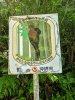
The good thing with having been able to get the bus all the way to the dam was that I had seen where all these locations were along the way and by the landmarks knew roughly how far between each one it was. I quickly abandoned this particular side-road however, because it immediately started going steeply downhill and I didn't want to walk back up it, and instead carried on to the 6km side-road which had been my initial plan anyway. These two side-roads (the 7.5km one and the 6km one) are around the crest of the road, so it would be all downhill back to Yona. Both of these roads are also clearly marked as birding routes, each having a big Okinawa Woodpecker sign at the entrance.
It was 3pm by the time I reached the 6km side-road, and I still hadn't seen any of my target birds.
About 100 metres along the road, a dark bird flew up from the ground just inside the forest. There were lots of Brown-eared Bulbuls calling and flying all about but this didn't seem like one, and being on the ground inside the forest was not a characteristic of them. I got my binoculars on it and saw an Okinawa Woodpecker! I got a decent look at it as it moved up a slanting log, but as soon as I tried to take a photo it flew back into the forest. Any photos wouldn't have been much good anyway - the log was about ten metres in, and the forest was so thick it made Cambodia look like Kansas. As soon as it flew I lost sight of it. I hung around there for a while but eventually moved on.
Further up the road, I saw ferns moving on the forest floor and thought that had to be a rail. But instead another woodpecker popped out of them and climbed a sapling - this one I got some photos of.
I ended up seeing four woodpeckers pretty well, plus a few others not at all well which I had to assume were woodpeckers, and all of them were either on the ground or on the bases of trees. Not what I expected! In two cases I could here them foraging through the leaf-litter and (again) thought it must be rails, until they flew up and away.
I looked this up afterwards and it turns out that they typically forage on the ground, especially on trapdoor spiders, and often have their beaks covered in dirt from digging. No wonder I hadn't seen any when scanning tree canopies!
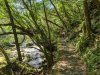
I had a habit of checking out all the gullies and little streams when passing, because those were the favoured haunts of the robins, and that paid off with an Okinawa Robin. I was genuinely not expecting to see one at all, because everything I read said that if you didn't see them early morning then you wouldn't see them at all. This one I saw at about 4pm. I didn't even attempt a photo because it was a very small bird in a dim gully in a thick rainforest. I'd encourage you to Google a photo of one though.
No rails were seen.
I wasn't sure how long it would take me to walk back to Hentona, and I didn't want to miss the last bus to Nago (at 7.20pm), so left earlier than I should have done. It turned out it took about exactly as long as expected - an hour for the 6km to Yona, and 40 minutes for the 4km to Hentona. Annoyingly, I arrived at the bus stop at 6.10pm, missing a bus by 4 minutes. I got some food from the 7-eleven up the road and waited an hour for the next bus.
....................................................
It had started drizzling when on that return bus, and during the night it started pouring down. The next morning it was still raining - not extremely heavily but persistently, and walking into the hills would be unpleasant. I checked the weather forecast and it said that tomorrow would be fine. So I made today the aquarium day (I had been going to leave it for when I came back through Okinawa after Ishigaki and Iriomote). The aquarium is actually quite close to Nago, and quite far from Naha (the capital city in the south of the island), and there is a bus directly there from Nago, so going here now made most sense anyway.
The Okinawa Churaumi Aquarium was easily the best aquarium I've been to in Japan. It has excellent signage, with lots of information about the scientific research the aquarium does. This isn't just a "look at the pretty fish" aquarium.
There is a Whale Shark here - the third Aquarium I've been to with this species. It is a big specimen which has been here for thirty years! The tank it is in has, according to the sign, over seventy species of fish in it, including two species each of manta and devilfish. Even though I had visited the shark-filled Aquarium at Oarai in Honshu which had almost forty species on display, there were still a number of sharks here which were new for me - Blacktip Shark, Silvertip Shark, Sandbar Shark, Silky Shark, and Spot-tailed Shark.
Kuroshio Sea tank
Silky Shark
Silvertip Shark
Spot-tailed Shark
There is a great display of little tanks for deepsea invertebrates, and another for interesting little inhabitants of coral reefs which included the inch-long Pigmy Squid. At the end is an exhibit dedicated to endemic and invasive species of Okinawa.
Some of the deepsea invertebrates. That spiky thing in the middle is a worm! The thing on the right is a coral!
Northern Pigmy Squids, the smallest squid in the world.
And then there is this, not a snake but a sea cucumber. It is, cleverly enough, called a Snake Sea Cucumber.
Interestingly, the pools for manatees, sea turtles, Bottlenose Dolphins and False Killer Whales are all outside in the public park so anybody can see all of those for free. According to their signage they breed several species of sea turtles every year and release the babies. They had five or so of the False Killer Whales, the first I've ever seen. They are such peculiar-looking beasts!
False Killer Whales
After almost four hours at the aquarium I looked at my watch and it was 12.15pm. The bus, I thought, was at 12.30 so I better get going. Just as I reached the short path to the bus stop, a bus went past. It looked like a tour bus rather than passenger bus. But when I looked at the timetable at the stop it said 12.23. It was now 12.25. Just missed it! It was over an hour to the next one. I was about to go back to the aquarium - there were food stands in the park there - but then I considered that the road was lined up with cars for the aquarium so, despite the punctuality of Japan's public transport systems, maybe the bus was just held up. I waited a few minutes and sure enough along it came.
At the end of the day I was walking to the 7-eleven to get some food, and I heard the screech of a fruit bat from across the road. I waited and one came flying out of a low fig tree, across the road, and then past me flying in the direction I was heading. Round the bend ahead were a few very low trees by the roadside, and there were a couple of Ryukyu Flying Foxes hanging in them. Annoyingly, because I was just going to the shop, I didn't have my camera. I took some photos zoomed in with my phone which meant they were awful.
....................................................
The next morning was clear - not a cloud in the sky. I still needed to see the Okinawa Rail, and this was the last day I had (when coming back from Ishigaki I would be staying in the south of the island in Naha for my last couple of days in Japan, and as I had found out the infrequent bus schedules would not allow a return to Yanbaru very easily).
I checked the trees by the road near the bus station where I had seen the bats the evening before but, as suspected, they were too low to be day-roost trees and there were no bats to be seen.
I got the bus up to Hentona and then walked to Yona and on up the cross-island road. The village minibus passed me at 11am when I was almost at the forest road at the 6km mark, so I think it probably does go every "morning" in that direction, but not at regular times. Walking up the road took about 50% longer than coming down. It was quite hot as well, with no clouds to keep the sun at bay.
It was a very quiet day. I saw two woodpeckers but with no photos. Even though one posed very nicely it was just too dark inside the forest where it was.
I spent most of the time along the 6km road, imagining that around each bend I would see a rail walking across. That's one of the annoying things with looking for an animal which is regularly reported - you can imagine exactly what it would look like in this spot, but you just keep on not seeing any.
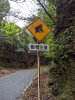
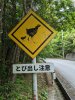
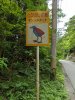
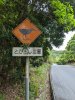
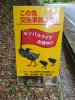
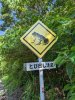
Finally I had to call defeat and head back to Hentona. I was still keeping an eye out all the way down the road, because there were rail road-signs all the way down so they must be around. And, at about the 3km mark (ish) a rail suddenly bolted from out of the aroids by the roadside. It was an absolutely terrible sighting, about the worst possible, but I'm taking it.
I had expected the rails to be more like Weka in New Zealand - a flightless rail on an island with no natural predators, so not bothered by humans - or even like the Banded Rails on Pacific islands where they walk about through village gardens like chickens. However it seems they are just as secretive and skittish as mainland rails. Most sightings do appear to be of birds just running across the road, hence (I guess) why early morning is the suggested time to try and see them, which would be before there was much traffic going along there.
Back in Nago I had a look in the trees by the side of the street where I'd seen the bats yesterday, and found one hanging there. I generally don't use flash on nocturnal animals (it varies with the animal and the specific situation), but this was a city bat which must be used to bright light and noise, so I took a couple of photos and then left it to its devices.