A lot changes in a few months! There were no lizards and the weather was cool and very wet back in January! I'll have to post my account soon, it's a bit embarrassing you got to it first. For what it's worth, I had a similar experience at Fuyang, although no Giant Huntsman spiders were out.Datongshan (Taipei)
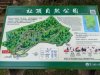
Just outside Taipei, on the way to the hot-springs village of Wulai - itself a well-known birding spot - is a place called Datongshan which was brought to my attention by @CMP. The area is titled on eBird as "Xindian Shikanshui (WBST Birdwatching Route". There are a number of endemics found here, including Swinhoe's Pheasant, so it seemed like a good location to visit.
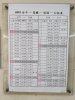
There is a free bus from Xindian metro station to the top which showed up on Google's map directions. It doesn't have a number or English name so I wasn't sure how I'd find it so I got to the station early. I looked at all the bus timetables on the boards and couldn't see it, and the bus station is really just a place where the buses stop, there doesn't seem to be an office or anyone to ask. I went to the metro station's counter and asked them. They were confused as well, until I said it was the Guishan Line and then the guy was like "oh, I know" and he left the counter to take me outside and down the street to the stop, which is not where all the regular buses stop and is only marked with a little sign so I never would have found it on my own.
The bus only runs a few times a day, with the first one at 7.50am. It was late - buses in Taiwan are not as punctual as in Japan! - and so I wasn't even sure it was the right bus when it arrived at 8am. I asked one of the other people getting on (I had put Datongshan into my phone's translation app to show them), and she said no. I thought I better double-check with the driver, who didn't seem to know, and there was a bit of discussion amongst the passengers. One guy said yes this is the bus, so I sat down and the bus left.
Then the guy wanted to check my phone again, and said that no this wasn't the right bus. I was getting stressed out now because there wasn't another bus until something like 10.30am and I was getting further and further away from the bus stop. I showed him the map on the phone and he looked at it carefully, and then declared that this was the correct bus after all, and that the last stop was Datongshan, which sounded right. The Alien Tracker on my map was already moving along the road out of town towards Datongshan, so I decided to see how it played out.
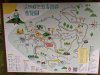
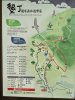
Luckily the bus was the right one. It passes through the village of Guishan which is at a junction by a bridge, and continues on the other side of that bridge up an extremely narrow - almost single lane - road up the mountain. At the last stop, about half an hour from Xindian metro station, there is a little side-road marked for "Mt Datong" (shan means mountain). From here you can either walk up to the end of that track (and back down), or just walk straight back down the road to Guishan which I think is about three or four kilometres.
The alternative way to do this trip is to catch the #849 bus from Xindian metro station. This also doesn't stop where the other buses stop, but it is easier to find because it is just on the other side of the plaza by the stairs (i.e. behind you if facing the main bus stops) and it has a proper sign with a number. This is a much more regular service, running every 15 to 20 minutes through the day, starting at 5.30am. You would catch this bus to Guishan, getting off at the Taipower Company Training Center and then walking across the bridge and up the mountain road. The #849, incidentally, is the same bus which runs on to Wulai.
On this day I combined the two - catching the free bus to the top, walking up the Datongshan track, and then back down and all the way to Guishan, and then catching the #849 bus back to Xindian station. This has the advantage that you start at the top and are walking downhill, but it is a late start and I saw almost no birds (it was extremely hot), so probably the best idea is to use the #849 both ways so you can start really early.
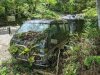
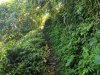
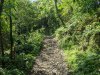
When I got off the bus one of the other passengers told me that if I was walking to the top to make sure I took the left path further ahead and not the right, because that one leads to a farm. So when I came to a fork, which had a van sitting there overgrown with ferns, I took the left path which ended a minute later at someone's gate. But beside that was a narrow foot-track, so I thought this must be it. I went up the track and after a couple of minutes it joined onto a rough path which was the actual path to the top. Coming back down later I just followed that path all the way down to the van. I think the fork she meant was the one just after the van, where the left path is fairly obviously the correct track so I wouldn't have gone the wrong way anyway.
![]()
Dung Beetle on the track
There was a lot of bird noise coming from the forest right beside the path, where the narrow foot-track joined to it, but I couldn't see anything. This happened repeatedly. A couple of times there were birds calling which must have literally been a couple of feet from me and I couldn't see them at all because the undergrowth was so dense. I wasted a lot of time on these invisible birds.
It was almost an hour before I actually saw any birds, firstly a Grey-faced Buzzard and then just after that a Morrison's Fulvetta, which is another one of the endemic birds. Just one. Not a pair, not a flock, not a bird-wave, just one single bird. I hung around that spot for a bit, thinking where there was one bird there must be others, but all that showed up were a pair of Black Bulbuls.
![]()
Morrison's Fulvetta
I continued on, and the path suddenly came out into the open at a tea field. I thought it must keep going on the other side but no, this appeared to be the end of the track. I saw a Grey Treepie up here, and fly-overs from Large-billed Crow and Black Kite. On the way back down I passed a fellow walking up who asked if I had seen the "tea garden", so I guess that really is the point of the track. Although it took me over an hour to go up the track - spending so much time trying to see birds which refused to be seen - it isn't really very long. Coming down took almost no time at all.
Then I walked back down to Guishan, again seeing very little. At the river I was surprised to see an Osprey bathing, and even more surprised to see a very late Arctic Warbler.
I saw a few other birds either in the forest or along the road on the way down (Blue Magpies and White-bellied Erpornis were the main ones of note), but the Morrison's Fulvetta turned out to be the only "new" bird seen today. I blame the weather. Both yesterday at Erbazi and today were mid- to high-30s which in the tropics with the high humidity feels much hotter than 30s in a dry climate. Even the bulbuls and barbets I saw were often just sitting on branches with their beaks open trying to cool down.
The hot weather was good for reptiles though. There were a lot of lizards by the roads, although most were too nippy to even see before they disappeared let alone photograph. My favourite one of the day was the Taiwan Japalure which looks like a little dragon.
![]()
Taiwan Japalure
![]()
Indian Forest Skink
Fuyang Eco Park (Taipei)
This one will just be a short entry.
The Fuyang Eco Park is a recommended place in Taipei to try and see Taiwan Red Giant Flying Squirrels (Petaurista grandis, a split from the widespread P. philippensis). Flying squirrels are nocturnal of course, so an evening visit is required. It is an easy park to get to - just take the metro to Linguang station and the park is less than ten minutes walk away.
It is just a small park, and there are boardwalks along the hillsides in a few places so you can be at mid-tree level, even tree-top level in some spots where the trees are shorter.
I went here twice but did not see - or even hear - any flying squirrels, although they are supposed to be "easy" and "reliable" here. I suspect that there are only a few individuals living here because it's not a large area, so they would be easy and reliable if they decide to feed in a nicely-viewable spot, but not if they decide to feed in one of the places not by a boardwalk.
Luck, basically.
I'll be going back there when I return to Taipei though, so hopefully I'll have some success then.
I did see a few Pallas' Squirrels there on my first visit before it got dark (I'd also seen one earlier in the day at the Erbazi Botanic Gardens), and my second Taiwanese mammal was seen on the second visit to the park. On the first night I had seen "something" sizeable rushing through the canopy of a tree but got no eye-shine and then it vanished. I thought it was probably a civet rather than a flying squirrel, and on the second night I went back to that spot. I wasn't too surprised that I couldn't find anything up there but I hung around under the same trees hoping whatever it was might pass by again.
While waiting I heard movement in the leaf litter on the ground nearby, and sweeping the torch got me a pair of eyes in the dark. I hoped it would come out to be identified, and luckily it did, trotting through the undergrowth and fallen branches right past me - well, not right past me, but "quite close" past me, back in the forest a bit. I could see it perfectly well though, even getting a look at it through the binoculars under the torchlight.
It was a Taiwan Ferret-Badger.
I knew they were here, in the general area at least, but I didn't expect to actually see one here and it definitely wasn't what I expected the first endemic mammal I saw on the island to be!
![]()
This is the sort of terror I have to submit myself to when spotlighting! Is a Taiwan Ferret-Badger worth it? Fifty-fifty.
It's possible but they have (at least until recently) been quite scarce. With rare exceptions (e.g. the Brown Bear tours in Hokkaido) seeing bears in Asia isn't like in North America. Here they typically live in deep forest, are shy due to hunting pressure (either currently or historically, depending on country), and are encountered randomly. So you can go to where bears live, but seeing them would usually be a matter of luck rather than planning.Was seeing black bears in Taiwan ever a possibility? Or are they in really remote and inaccessible areas?


Formosan Golden Bat's Home (Beigang)
Some mammal-watchers really like bats and rats, or as they are also probably known, the list-padding mammals. I like giant rats because they're cool, but I don't go out of my way to see most rats or mice. Similarly, I like flying foxes but otherwise I don't chase after most bats. However there is one particular little bat in Taiwan which is not only attractive and interesting, but also readily viewable and identifiable.
The Formosan Golden Bat Myotis formosus flavus is, despite its name, not an endemic species of Taiwan (although at one point the Taiwanese subspecies flavus was treated as distinct). Instead it is a widespread bat, found from Central Asia and northern India across China to Taiwan. In most of its range it is called the Hodgson's Bat or the Black-and-Orange Myotis (for it's strikingly-patterned wings). It wasn't even originally described from Taiwan, as it's scientific name might imply, but rather from Nepal - formosus in this context just means "beautiful".
In Taiwan the species is a seasonal migrant. They spend the winters in caves in the mountains above 2000 metres, and in April they move to the lowlands to breed. Over the summer they roost in trees, and nowadays most of these roosts are in parks and schoolyards. Fortunately bats are quite readily accepted as guests in Taiwan, unlike in most countries where there would be panic and people would be crying "won't somebody please think of the children!?"
The famous site for the bats - it gets 15 to 20 thousand visitors a year! - is the Formosan Golden Bat's Home, which is in the grounds of a little school in Shulin Township which is just near the larger town of Beigang, which itself is quite near the big city of Chiayi.
I was heading southwards from Taichung to Hengchun which is in the far south of Taiwan, and then doubling back up to go to Alishan when there were cheaper rooms there. Chiayi is not exactly halfway between Taichung and Hengchun, but it is on the way, about a third of the way there, so I thought it made sense to stop off on the way to try and see the Golden Bats because that would give me the chance to return there after Alishan later, if it should happen that I couldn't see any bats on the first attempt.
I had looked up the local bus timetables for how to get there and, as usual, they were infrequent - although in this case there were a few choices of infrequent buses, as opposed to there just being a single infrequent bus. I had been going to stay in Beigang, because obviously that would be closer, but there was nothing on the booking site so I got a hotel right by the Chiayi train station called the Yes Hotel. It was an okay hotel, a bit old but the rooms are clean. Oddly, they parked cars inside the foyer in the evening, backing them in through the doors.
I left my pack at the hotel reception and went back to the bus station, which is basically just the street outside the train station. From here I could catch the #7325 bus at 11.41am to the Beigang bus station, arriving there at 12.30pm which was just in time to catch the #7220 bus at 12.40pm which has a stop (called the Beimen stop) 1.7km from the Formosan Golden Bat's Home.
The different buses in the area all have only a few runs each, so how close you can get to the school where the bats roost depends on what time you can get to Chiayi or Beigang to start with. There is one bus (the Y03) which stops directly outside the school, for example, but only has two runs a day. The other option from Beigang bus station is the #7221 bus for which the closest stop is Haoshou at 3km from the school (the Beimen stop is the next one after the Haoshou stop, but the 7220 and 7221 buses go down different roads after Haoshou).
It's only 15 minutes ride from the Beigang bus station to the Beimen stop, and then you just walk straight through the rice fields to the school. This was a nice walk because although the rice was quite high I did see a few extra birds for the year with Lesser Coucal and Plain Prinia.
There was no difficulty in seeing the bats when I arrived. There was a huddle of them in the tree right above the gate, and there was a scope set up for people to look through.
![]()
A guy came out and took me into the school ground to show me the other roosts. One was another little colony and the other two were bats roosting individually. They had only arrived back at the school recently from their winter caves. I was told that if I'd been here two weeks earlier I wouldn't have seen any.
![]()
![]()
I wasn't actually sure if any of the photos would even turn out - they all looked like rubbish on the back of my camera. The problem was that while the bats weren't high up, they were quite small and they have sort of fuzzy faces, so when looking through the camera lens I couldn't really tell if they were in focus or not. I just took loads of shots to try and get one or two that might be okay!
![]()
This is my favourite photo, with some of the bats yawning.
I walked the 3km back to the Haoshou stop for the #7221 bus. On the way I saw a little flock of Indian Silverbills which have been introduced to Taiwan. I had missed the bus by ten minutes so had almost an hour to wait. Luckily there is a 7-eleven beside the bus stop so I could get some coffee and food.