Myrtle Beach Zoological Park - A 'New' Project

We continue on into the depths of the abandoned mineshaft where the last portion of the tour concluded. This mineshaft, wide enough to sufficiently have two-way traffic running through it (if absolutely necessary) hosts nine species of smaller inhabitants to these harsh landscapes. With four tanks to the left, and five to the right, eight of the nine tanks (all the left-hand tanks and four of the right-hand tanks) have the same dimensions (1.5x2x1.5, in feet), and same general landscaping, with a false-sandstone backdrop, and drier plants and cacti scattering a sandy floor, the inhabitants of each tank (as well as the details of the ninth) are included below.
*Note* Species inside spoilers will be included in a media round-up after this post is completed.

full

Possible Look of Mineshaft Terrariums
Image Credit -> @CMP

Tank #1 - currently home to 0.0.1 Arizona Blond Tarantula Aphonopelma chalcodes, 0.0.1 individuals held off-display
Tank #2 - currently home to small group of 0.0.4 Striped Bark Scorpion Centruroides vittatus
Tank #3 - currently home to 0.0.1 Giant Desert Centipede Scolopendra heros
Tank #4 - currently home to colony of 0.0.20 Blue Death-feigning Beetle Asbolus verrucosus
Tank #1 - currently home small group to 0.0.4 Arizona Bark Scorpion Centruroides sculpturatus
Tank #2 - currently home to lone female 0.1 Southern Black Widow Latrodectus mactans, 2.1 individuals kept off-display
Tank #3 - the only aquatic display in this complex; 2x2x3 feet for the dimensions; the sandy and rocky environment does not halt, with only small patches of aquatic plants growing; currently home to school of 0.0.20 Desert Pupfish Cyprinodon macularius
Tank #4 - currently home to 0.0.1 Giant Hairy Scorpion Hadrurus arizonensis, 0.0.1 individuals kept off-display
Tank #5 - currently home to 0.0.1 Mexican Red-kneed Tarantula Brachypelma smithii, 0.0.1 individuals kept off-display

Visitors exit the mineshaft to a naturally-lit atrium where visitors can find six open-topped reptilian habitats which act as the conclusion to the indoor portion of this zone. Each display is 4 sq. meters in floor space, with barriers of sheer false sandstone reaching roughly 4m high. The animals in each habitat still have climbing enrichment, it is just placed away from the walls to prevent an escapee of one of the more venomous reptiles. The first two habitats, both along the right-hand side of the path, host respective groups of Western Diamondback Rattlesnake Crotalus atrox (3.3) and Mojave Desert Sidewinder Crotalus cerastes cerastes (3.3). Their neighbor, in the last habitat on the right, is a group of Reticulate Gila Monster Heloderma suspectum suspectum (2.6). The final three habitats, all on the left-hand side of the path, respectively host a family group of Texas Horned Lizard Phrynosoma cornutum (1.1.6), a mixed habitat for Desert Iguana Dipsosaurus dorsalis (1.1) and Baja Blue Rock Lizard Petrosaurus thalassinus (3.3), and a mixed habitat for Common Chuckwalla Sauromalus ater (1.1) and Western Side-blotched Lizard Uta stansburia elegans (3.3).

full

Possible Look of Larger Herp Habitats
Image Credit -> @JigerofLemuria
full

Western Diamondback Rattlesnake
Image Credit -> @KevinB
full

Mojave Desert Sidewinder
Image Credit -> @Baldur
full

Gila Monster
Image Credit -> @SivatheriumGuy
full

Texas Horned Lizard
Image Credit -> @RatioTile
full

Desert Iguana
Image Credit -> @Julio C Castro
full

Baja Blue Rock Lizard
Image Credit -> @Andrew_NZP
full

Common Chuckwalla
Image Credit -> @Prochilodus246
Lizard-1.png
Western Side-blotched Lizard
Image Source -> National Park Service Website (Species Spotlight: Western Side-Blotched Lizard (Uta stansburinia) - Cabrillo National Monument (U.S. National Park Service) for those interested)

Visitors exit the building and return to the South Carolina air, while staying right in the heart of the American desert. Much like the last walking garden, a mosaic path leads visitors through a succulent garden, which in itself wraps around a 175 sq. meter aviary for a species we've already seen, being the Burrowing Owl Athene cunicularia (3.5), last seen as the near-conclusion of the Southern Tip. As these birds as a whole are found across drier habitats on both continents, the zoo decided to keep one of our non-subspecific flocks there, and one here in the American deserts. As such, the design premise remains the same, with plastic tubing and staff-dug burrows provided to the owls.
Their neighbors this time, unlike the Southern Tip's pudu and anteater habitats, are found in a much larger space. Viewed from atop a 1.5m-high sandstone ridge, this open plain of 0.75 acres is home to a pack of canines which many a North American know the sounds of, being the Coyote Canis latrans (1.5). In the current state of the pack, two of our five females are rehabbing animals, set to be released into a suitable home in the wild upon becoming healthy again, while the other four are animals who could not remain in their former homes due to the encroachment of people onto their habitat, in turn leading to an increase in human-coyote interactions. On this ridge, alongside the visitor viewing to the coyotes, is a 200 sq. meter mesh-enclosed habitat for a smaller but equally cunning hunter, being the Ringtail Bassariscus astutus (3.2), with our breeding pair having recent breeding success resulting in the birth of 2.1 individuals, while an additional 0.2 older individuals have been retired from on-display life.

full

Possible Look of Burrowing Owl Aviary
Image Credit -> @pachyderm pro
full

Burrowing Owl
Image Credit -> @KevinB
full

Possible Look of Coyote Habitat
Image Credit -> @Gavial
full

Coyote
Image Credit -> @Brayden Delashmutt
full

Possible Look of Ringtail Habitat
Image Credit -> @felis silvestris
full

Ringtail
Image Credit -> @Julio C Castro

The final two habitats in the area come just after leaving the coyote viewing area. Both aviaries which round out the area are on the right of the visitor path, with the first being smaller, at 200 sq. meters and 3m tall, while the second is 600 sq. meters and 4m tall. The smaller aviary features a large tree with many small spiky branches, sometimes adorned with the corpses of food items given to our Eastern Loggerhead Shrike Lanius ludovicianus (1.1) pair, a species well-known for their behavior of impaling food items on the branches both to kill and store the prey. They even use this tactic with normally toxic insects, leaving them in the desert sun for a few days to cook the toxins out, leaving a fine-to-eat insect when they return.
Their neighbors, on the other hand, are less picky when it comes to their food choices. These birds, being a breeding pair of Chihuahuan Raven Corvus cryptoleucus (1.1), are on the smaller side by the standards of the raven family, being sizewise comparable to a crow.

full

Possible Look of Shrike and Raven Aviaries
Image Credit -> @geomorph
full

Eastern Loggerhead Shrike
Image Credit -> yours truly, @Van Beal
full

Chihuahuan Raven
Image Credit -> @Coelacanth18

And with that, we conclude the American Deserts region of the zoo, bringing us to the transitionary point between this and the Grasslands and Mountains area of the North American zone. But we will touch on that next time, with the next post simply being a media roundup from the mineshaft terrariums we saw earlier.
Stay tuned, and enjoy!
 

Attachments

  • Lizard-1.png
    Lizard-1.png
    887 KB · Views: 336
Media Roundup for Desert Mineshaft Invertebrates
full

Arizona Blond Tarantula
Image Credit -> @Arizona Docent
images.jpeg
Striped Bark Scorpion
Image Source -> Striped Bark Scorpion - Field Guide to Common Texas Insects
full

Giant Desert Centipede
Image Credit -> @UngulateNerd92
full

Blue Death-feigning Beetle
Image Credit -> @RatioTile
full

Arizona Bark Scorpion
Image Credit -> @SusScrofa
full

Southern Black Widow
Image Credit -> @Batto
full

Possible Look of Pupfish Tank
Image Credit -> @geomorph
full

Desert Pupfish
Image Credit -> @BerdNerd
full

Giant Hairy Scorpion
Image Credit -> @arcticwolf
full

Mexican Red-kneed Tarantula
Image Credit -> @KevinB
 

Attachments

  • images.jpeg
    images.jpeg
    10.3 KB · Views: 297
We return at the entrance to the zoo's display based around American mountains and grasslands, combined into one solely because so many of the species found in these environments in the wild are lacking in captive holders. And so, they've been combined into one comprehensive display.
The area begins with about as typical a grassland habitat as one could imagine up for a North American area, being a 4.75-acre plain dedicated to the Plains Bison Bison bison bison (4.16) and Common Pronghorn Antilocapra americana americana (5.15). The space is rolling, with slight hills providing a bit of differentiation across the space, while the only breaks in the horizon are the lone trees and bushes dotting the space. The barn for these species is accessible to the animals at all times, though not guest-viewable, and is where the animals spend their nights and days of inclement weather.

full

Possible Look of American Plains Exhibit
Image Credit -> @Breckenridge
full

Plains Bison
Image Credit -> @KevinB
full

Pronghorn
Image Credit -> @birdsandbats

While the view of the ungulate paddock continues for quite a length along the left-hand side of the visitor path, the right-hand side has a series of five attention-grabbing habitats, with the first two being home to avian species, and the last three being mammalian habitats. Beginning with the first aviary to the right, visitors get a look into a 450 sq. meter, 5m-high cliffside aviary. Conifers encroach on the sides of the aviary, while a man-made perch is located front and center, intended to draw the adults of our American Golden Eagle Aquila chrysaetos canadensis (3.1) toward the visitors' line of vision, though the rearing of two fledglings (2.0) likely spoils that possibility, as the eagles have constructed their own nest near the back of the aviary amid the trees. The neighbors to these impressive raptors is a more diminutive species, and as such is separated from the eagles by a grove of trees to ensure the presence of a predator doesn't cause stress among these smaller groundfowl. At 200 sq. meters and 2m high, the aviary is built in a forest clearing planted with incredibly long grass, replicating the long grass prairies which the Greater Prairie-Chicken Tympanuchus cupido pinnatus (2.10) are often found in. During the breeding season, this flock will typically be divided in half, with half on-display and the other half off-display to ensure limited aggression within the group.
The three mammalian habitats which follow give a true predator-prey dynamic, with two of the prairie's smaller predators sandwiching a very common prey animal for species in the region. The first of the predatory displays is a 200 sq. meter replication of an abandoned prairie dog town, now inhabited by a family of Black-footed Ferret Mustela nigripes (2.4), made up of the mother and her five pups, while the father (1.0) is held off-display. Next door to the ferrets, visitors look into a 300 sq. meter prairie dog town inhabited by its maker, being a colony of Black-tailed Prairie Dog Cynomys ludovicianus (4.12.10), which recently produced 10 juveniles yet to be sexed. The final display is mid-way between the two others in terms of size, at 250 sq. meters. The habitat features multiple large burrows, with the main burrow being one located beneath the roots of a false dead tree. Here, visitors can find a breeding pair of American Badger Taxidea taxus (1.3) alongside their two female juveniles.

full

Possible Look of Eagle Aviary
Image Credit -> @Zookeeper Diego
full

Possible Look of Prairie-Chicken Aviary
Image Credit -> @snowleopard
full

American Golden Eagle
Image Credit -> @Zoological Point
full

Greater Prairie-Chicken
Image Credit -> @pachyderm pro
full

Possible Look of Prairie Dog Towns
Image Credit -> @Chlidonias
full

Possible Look of Badger Habitat
Image Credit -> @cubsmaster
full

Black-footed Ferret
Image Credit -> @Andrew_NZP
full

Black-tailed Prairie Dog
Image Credit -> @SivatheriumGuy
full

American Badger
Image Credit -> @StellarChaser

After viewing the badger habitat, viewing on the left-hand side for the hoofstock paddock officially comes to an end, and visitors stand before the entrance to a walkthrough aviary replicating the conifer forests of the lower Rockies, which will be where our tour continues in the next post.
For now, enjoy, and stay tuned!
 
Last edited:
Short post today, given I started this about an hour before I had to leave for work, and will have to get some good sleep for a mysterious trip I'm going on for my 18th birthday (which was yesterday), a trip which I speculate involves a zoo that isn't my near-and-dear Toronto :D. Anyway, to the tour...

Visitors are transitioned from the grasslands to the mountains, as they enter an aviary just over 2,000 sq. meters, and standing 4m high at the highest point. The cobbled-stone path winds between rocky ridges, where only smaller shrubs and bushes grow. Dead trees are sparse, but present in the back areas of the space, providing a perch or nesting area for the songbirds away from the visitors. Seed bins are provided along the path, allowing visitors to feed the flocks of Mountain Bluebird Siala currucoides (2.6), Indigo Bunting Passerina cyanea (4.8) and Black-capped Chickadee Poecile atricapillus (10.10), while a small group of Mountain Quail Oreortyx pictus (3.3) wanders the rocky ground. Also visible while still in the main aviary is a smaller off-shooting aviary of 75 sq. meters and identical height. This aviary hosts a breeding pair of the striking Steller's Jay Cyanocitta stelleri (1.1), who are kept separated from the others due to their tendency to bully smaller species for their food.

full

Possible Look of Walkthrough Aviary
Image Credit -> @ZooElephantMan
full

Possible Look of Jay Aviary
Image Credit -> @Philipine eagle
full

Mountain Bluebird
Image Credit -> @Ituri
full

Indigo Bunting
Image Credit -> @RatioTile
full

Black-capped Chickadee
Image Credit -> @savethelephant
full

Mountain Quail
Image Credit -> @vogelcommando
full

Steller's Jay
Image Credit -> @Arizona Docent

The final exhibit prior to the area's quaint vivarium is a 450 sq. meter habitat ranging up the cliffs to the right of the visitor path. These cliffs provide nearly 6m of elevation change in the habitat, with gradual slopes connecting the many rock shelves across the space. Burrows of both the natural and man-made varieties dot the landscape, protruding from under trees, between rocks, or even just being a pile in the middle of a small meadow. The natural burrows are the evidence of our colony of Yellow-bellied Marmot Marmota flaviventris (7.13), who are meshed-in to ensure that none of our marmots are taken by birds of prey that frequent the skies over the zoo.

full

Possible Look of Marmot Habitat
Image Credit -> @Philipine eagle
full

Yellow-bellied Marmot
Image Credit -> @Giant Eland

And with that, we arrive at the doors of the area's vivarium (or, more accurately, herpetarium), coming in the form of a quaint log cabin. Entering this building will await for now, as I leave you to your own speculations and comments. Stay tuned, and enjoy!
 
The entryway to the herpetarium is an automatic sliding door, utilized given the lack of free-flying creatures in this building which could possibly trigger such a door and allow escapees. This herpetarium is a singular atrium, with a total of ten herptile displays (four larger tanks at 4x2x3 feet on the left-hand wall; five smaller tanks on the right hand wall, the first measuring 3x2x2 feet, the others 2x2x2 feet; and an open-topped semi-interactive 40 sq. meter habitat). Also located on the right-hand wall, past the last of the terrarium displays, is a 3.5m-long viewing window into the penultimate outdoor habitat in this smaller area (which may be explained in larger detail later in this post).
First, the tanks on the left. As previously mentioned, each of the tanks is 4 feet long by 2 feet wide and 3 feet high. The three closest to the entrance all replicate the montane forests of the Rocky Mountains, while the fourth returns to the prairies of the American Midwest. The inhabitants of each tank are as follows:
  • 0.3 Western Terrestrial Garter Snake Thamnophis elegans
  • 2.0 Gopher Snake Pituophis catenifer
  • 1.1 Western Hognose Snake Heterodon nasicus (additional 1.1 off-display for ambassador purposes)
  • 1.5 Prairie Rattlesnake Crotalus viridis viridis
Now, across the atrium we go, but first, a look into the 40 sq. meter habitat which was also mentioned earlier. The habitat itself is quite generic, with a mulch/soil floor, and a few small ferns and other plants throughout the space, while heat lamps hang from the ceiling, ensured to be out of reach of the visitors. The habitat is signed as being "periodically interactive," which is meant to be a deterrent to children and simply means that unless a keeper is present, the group of Ornate Box Turtle Terrapene ornata ornata (4.4) should not be touched, or removed from the space. With that in mind, the only times a keeper won't be present will be within the first and last of the zoo's open hours.

full

Possible Look of Montane Forest Terrariums
Image Credit -> @biggiesmalls
download (2).jpeg
Western Terrestrial Garter Snake
Image Source -> Wikipedia
Pacific gopher snake 2.jpg
Pacific Gopher Snake
Image Source -> ZooTierListe
full

Western Hognose Snake
Image Credit -> @RatioTile
full

Possible Look of Rattlesnake Tank
Image Credit -> @ralph
full

Prairie Rattlesnake
Image Credit -> @RatioTile
full

Possible Look of Turtle Habitat
Image Credit -> @Milwaukee Man
full

Ornate Box Turtle
Image Credit -> @Coelacanth18

Now we finally make our way to the right-hand side of the building. On this side, as mentioned, we can view five tanks, with the first and last two in the row being the smallest in dimensions (2 feet by 2 feet and 2 feet high) while the middle tank is 3 feet by 2 feet and 2 feet high. This larger tank is centered around a rotting picket fence, a decoration choice which plays on the name of the inhabiting Eastern Fence Lizard Sceloporus undulatus (3.6), kept as a representation of their western relatives, which are rather difficult to find in captivity. The smaller tanks replicate the Pacific Northwest's temperate rainforests, with each being quite humid and having small flowing streams through them. While the condensation on the windows may make it difficult to see into the tanks, visitors will be looking in for the following species:
  • 1.3 Pacific Giant Salamander Dicamptodon ensatus (remaining 4.2 kept off-display)
  • 5.5 Pacific Tree Frog Pseudacris regilla
  • 3.3 California Newt Taricha torosa
  • 0.3 Western Tiger Salamander Ambystoma mavortium
After the tiger salamander display, visitors are given a window out from the top of a roughly 4.5m-high cliff face, sharply descending to the shelf of rock before dropping another 4m to the ground below. This habitat, covering an acre overall, is home to a species well-known for being synonymous with the Rockies, being the Rocky Mountain Goat Oreamnos americanus (3.9), who are also viewable the entire way down to the ground level of their habitat after exiting the herpetarium.
full

Possible Look of Fence Lizard Exhibit
Image Credit -> @Ggrarl
full

Eastern Fence Lizard
Image Credit -> @Austin the Sengi
full

Possible Look of Smaller Terrariums
Image Credit -> @Moebelle
download (3).jpeg
Pacific Giant Salamander
Image Source -> California Herps
full

Pacific Tree Frog
Image Credit -> @Ituri
full

California Newt
Image Credit -> @CMP
full

Western Tiger Salamander
Image Credit -> @Andrew_NZP
full

Possible View from Indoor Window
Image Credit -> @DevinL

And with that, as we exit the herpetarium, this portion of the tour will come to a close. Just two habitats remain in the Mountains and Plains region, with the first of those two already viewed at least in part. So for now, stay tuned, and enjoy!

full

Teaser...
Image Credit -> @Pleistohorse
 

Attachments

  • download (2).jpeg
    download (2).jpeg
    17.8 KB · Views: 233
  • Pacific gopher snake 2.jpg
    Pacific gopher snake 2.jpg
    17.3 KB · Views: 242
  • download (3).jpeg
    download (3).jpeg
    16.1 KB · Views: 224
Shorter post today, just concluding the Mountains and Plains region of our North American Trail.

We left off just as we exited the herpetarium, with a steep cliff off to the left of the pathway. The winding and gently sloping path, a direct contrast to the habitat off to the left, brings you first to a shelf of land roughly halfway between the top and bottom of the habitat's total height. This shelf of land allows an elevated vantage point for a species visible from a secondary viewing area within the herpetarium, being the Rocky Mountain icon that is the Rocky Mountain Goat Oreamnos americanus (3.9). This elevated vantage point is roughly half of the habitat's acre of land, with the other half is the area of land at what is considered "ground level" for the next portion of the trail. The cliff that backdrops this elevated area is able to be traversed by the goats, however a slight outcropping prevents them from climbing out.
A third viewing area, considered to be the main viewing area, is located at the bottom of the habitat, and allows a full view of the entirety of the display, putting into perspective the height differences throughout the habitat.

full

full

Possible Views into Mountain Goat Habitat
Top Image Credit -> @KevinB
Bottom Image Credit -> @snowleopard
full

Rocky Mountain Goat
Image Credit -> @SivatheriumGuy

Beyond the cliffs, visitors are returned to the forested foothills of the Rockies, where they enter the playfully named "Hundred-Acre Forest," a play on the fictional forest from Winnie the Pooh, the reason being partially based around the inhabitants of the next habitat(s), and partially because the zoo runs an annual scavenger hunt, themed around the adventures of Christopher Robin and his animal friends, on the spring equinox. The inhabitants of the two viewable habitats and the third off-display space are, as one might expect, American Black Bear Ursus americanus (3.3). All three spaces are approx. 2,450 sq. meters, and contained by 5m high walls, constructed from materials which the bears cannot scale. In the first of the viewable habitats, visitors can find two sub-adult females, dubbed "Winny" and "Pooh," alongside their elderly mother "Foxglove." Living along in the second viewable habitat is the father of the sisters, named "Kris." The final space, not on display, houses a pair of unnamed males planned to breed with the sisters.

full

Possible Look of First Black Bear Habitat
Image Credit -> @SusScrofa
full

Possible View of Second Black Bear Habitat
Image Credit -> @snowleopard
full

American Black Bear
Image Credit -> @Brayden Delashmutt

And with that, we transition into the third, and largest, of the five subsections on the North American Trail: the Temperate and Taiga Woodlands. Unlike many of the areas so far, this area begins with species which many would view as "cornerstones" or "headliners," but what they are will have to wait for the next post. For now, enjoy and stay tuned!
 
Welcome to the Temperate and Taiga Woodlands, an area that, if ever I attach the Google Slides document which is the home to this project, is going here in a manner which is the exact reverse of how I have it on my slideshow. This was a decision made after I made the area, so I have not gotten around to rearranging everything just yet. Regardless, we start in what was meant to be the star-studded conclusion to the area, instead acting as an opening. For this portion of the tour, our focus will be on the area's "Big Three" of large mammalian species.

The first display visitors come across is one which is quite simplistic in appearance. With just 3/4 of an acre within the paddock, the landscape is flooded by a source which will be visible soon enough. The hodge-podge log wall along the side and rear boundaries of this near-rectangular plot stands 3m tall and is designed to allow natural growth of ivy and other climbing plants, while the steel-mesh which allows visitor viewing is separated from our herd of Alaskan Moose Alces alces gigas (2.6) by a dry moat. The current on-display herd is made up of three breeding females and five juveniles (two rescued and three born in our facility). The breeding bull is kept off-display until breeding is attempted again.

full

full

Possible Looks of Moose Habitat
Top Image Credit -> @KevinB
Bottom Image Credit -> @ralph
full

full

Female Moose (top) and Male Moose (bottom)
Top Image Credit -> @Pleistohorse
Bottom Image Credit -> @Jakub

A short walk up the hill, and visitors are standing on a shelf of rock raised 2.5m above the floor of a whole acre contained in a man-made valley. This is Grizzly Valley, so named for the inhabitants, rotating between male and female trios of Grizzly Bear Ursus arctos horribilis (3.3), with only the males being truly related to one another. In both cases, the individuals were raised together as a result of being orphaned in the wild. The space itself is expansive and immersive, with a roaring waterfall tumbling down the rocks into a river below, which flows down through the bear habitat and into the pond in the moose habitat. The space is surprisingly well-planted, though much of the large growth comes in the form of artificial trees outfitted with bark and other scratching-post materials. This habitat is one which often sees staff in the space (without the bears) throughout the day, making repairs or restorations to the landscape, and maintaining enrichment items throughout the habitat. In the case of the bears, enrichment items which stimulate numerous behaviors are of utmost importance to ensure stereotypic behaviors, which I myself have witnessed more and more recently at my home zoo, are kept to a minimum. The habitat's naturalistic design, paired with the constant uses of diverse enrichment options, are meant to combat the growing issue of stereotypic or repetitive behaviors in our bears.

full

full

full

Possible Looks of Grizzly Habitat
Top Image Credit -> @DevinL
Middle Image Credit -> @Dhole dude
Bottom Image Credit -> also @Dhole dude
full

Grizzly Bear
Image Credit -> @TheGerenuk

The final of the "Big Three" for the area's opening region is also a species which, between two display habitats, has access to an acre of total land area, as was the case of the grizzlies. In this habitat, the path shoots off to the right, bringing visitors around into the cliff which backdrops the first and larger (2/3 of an acre) habitat. In the cliff viewing area, the view comes through what I've only heard referred to as "guitar-string" fencing, such as is seen in Zoo Leipzig's amur leopard habitat.

full

The barrier in question... also unironically a possible view of the cougar habitats
Image Credit -> @devilfish

Regardless of what this barrier is called, visitors look through it into either of the two habitats, with the second being 1/3 of an acre total and only viewable from within this cliff. For this reason, and the reason of experiencing this unique barrier, visitors are prompted by signage to take this path first. The habitats are each meshed-in, to ensure the arboreal felines which inhabit the spaces do not find their way out. The barriers around the habitats vary from the false stone cliffs to glass and, of course, steel mesh. Dense foliage partially conceals shelters in the undergrowth and climbing structures throughout the space, both allowing our Oregon Cougar Puma concolor oregonensis (1.2) to conceal themselves and showcase their impressive arboreal skillset. The 2/3-acre habitat displays a sisterly pair, while the 1/3-acre habitat displays a male.

full

full

Possible Looks of Cougar Habitats
Top Image Credit -> @ralph
Bottom Image Credit -> @LycaonSekowei
full

Cougar
Image Credit -> @RatioTile

And with that, we arrive at the edge of a much denser woodlands, where the journey continues in the next post. But for now I leave, so stay tuned, and enjoy!
 
As the woods encroach, tightening around the path which has gone from being drab grey concrete to a more mulch-like pattern. The dense undergrowth of ferns and bracken conceal the sides of a 250 sq. meter habitat, though the viewing area reveals that the space is meshed-over, spanning roughly 5m above the heads of visitors. The barrier which visitors can look over is constructed of wood and glass, with a concrete foundation reaching roughly 2m below the ground to prevent escapes from the more fossorial of the two inhabitants. Of course, signage explains the complexity of burrows found in communities of Eastern Cottontail Sylvilagus floridanus (2.2), who have numerous staff-made and rabbit-made entrances to their burrow system concealed by the undergrowth. As a small group currently, the population in the habitat should boom in the future. However, these common backyard visitors aren't alone in the habitat. To spot their roommate, visitors will need to look to the trees. The reason for the mesh comes in the form of our North American Porcupine Erethizon dorsatum (2.1), with two rescued females and the juvenile male of the one female. The male was playfully dubbed "Peter Quill," and is intended to become an on-exhibit ambassador animal once he becomes independent from his mother.

full

Possible Look of Porcupine and Cottontail Habitat
Image Credit -> @KevinB
full

Eastern Cottontail
Image Credit -> @red river hog
full

North American Porcupine
Image Credit -> @EagleScout610

The forest begins to loosen the chokehold it has on the pathway, though it doesn't thin out just yet. The mesh which encloses the next two habitats, each at 400 sq. meters, blends into the canopy of the trees which fill each habitat. The height drops slightly from the porcupine habitat, down to about 4m from the floor of each space to the mesh ceiling above. The bushes below and the trees above combine to shroud the artificial climbing structures in each space, providing both species with privacy. In the first space, visitors can find signage regarding species found in our own backyards, alongside the signage for our bachelorette group of Common Raccoon Procyon lotor (0.7). Their neighbors, less commonly spotted, are a pair of Canada Lynx Lynx canadensis (1.1), dubbed the ghosts of the northern forests.

full

Possible Look of Raccoon Habitat
Image Credit -> @KevinB
full

Common Raccoon
Image Credit -> @JigerofLemuria
full

Possible Look of Lynx Habitat
Image Credit -> @CMP
full

Canada Lynx
Image Credit -> @Moebelle

The forest opens ahead, and comes to a panoramic, and slightly elevated, perspective onto a 3.5-acre pond for native waterfowl. While many wild flocks spend time on the shores of the pond, as well as the islands in the center, visitors can also view five zoo-managed flocks of rehabilitating individuals, though a pair of the Trumpeter Swan Cygnus buccinator (1.7) females are permanently managed by the zoo, as their injuries prevent them from being able to return to the wild. The other individuals will be able to fly off upon returning to health, as is the case with the zoo's managed flocks of North American Green-winged Teal Anas crecca carolinensis (2.10), Northern Shoveler Anas clypeata (3.9), Northern Pintail Anas acuta (2.10), and Bufflehead Bucephala albeola (3.11). Common wild frequenters of the pond include Mallard, wintering Canada Goose, and even some inland-wandering sandpipers and gulls.

full

Possible Look of Waterfowl Pond
Image Credit -> @Hix
full

full

Top - Trumpeter Swan
Bottom - Bufflehead
Image Credit -> @evilmonkey239
full

American Green-winged Teal
Image Credit -> @red river hog
full

Northern Shoveler
Image Credit -> @NathanTheAsian
full

Northern Pintail
Image Credit -> @Jakub

Walking along the pond, visitors will spot the Woodlands Vivarium just peeking above the treeline. Along the way, visitors will come along four aviaries, which will be detailed in the next post. For now, we leave with one final look back to the native waterfowl pond, before crossing a bridge over a stream which flows into the pond, and watch the water fade behind the treeline.
So, I leave for now, so stay tuned and enjoy!

full

full

What's to come...
Top Image Credit -> @Philipine eagle
Bottom Image Credit -> @SwampDonkey
 
Short post to conclude the first half of the Temperate and Taiga Woodlands, leading up to the Woodlands Vivarium.
Visitors come across the four aviaries (mentioned above) which lead up to the doors of the vivarium, with three of the four being well-planted with trees, while the last is well-planted with marsh plants like cattail reeds. The first is the smallest of the four aviaries, being just 300 sq. meters and 3m high. Fallen trees, shattered stumps, and limited ground cover provide an optimal environment for a trio of American Kestrel Falco sparverius sparverius (3.0), brothers rescued as fledglings. Their neighbors nest nearly a full meter above the ceiling of the kestrel aviary, given their 550 sq. meter aviary is 5m tall. Dense trees allow one of the animal kingdom's largest arboreal nest structures to maintain intergrity, as its boughs currently hold three juveniles to our breeding pair of Bald Eagle Haliaeetus leucocephalus (3.2), who are often seen scanning the horizon, acting as the area's eyes. Next door to the eagles is the largest of the four aviaries, spanning over 1,200 sq. meters, but only reaching 3.5m high. As mentioned, this aviary is significantly more open, replacing the dense forest with thin forest around the perimeter, and a marshy, reed-dotted area in the center. This ecosystem is well-suited to the zoo's breeding flock of Whooping Crane Grus americana (4.4). The final aviary returns to the dense woodland environment, with 400 sq. meters and 4m height for a bird of legend, our older and Cyclopean Eastern Great Horned Owl Bubo virginianus virginianus (1.0), one of the few animals which is the sole representative of their species in the collection (including on and off-display animals).

full

Possible Look of Forested Raptor Aviaries
Image Credit -> @pachyderm pro
full

Possible Look of Crane Aviary
Image Credit -> @Pleistohorse
full

American Kestrel
Image Credit -> @pangolin12
full

Bald Eagle
Image Credit -> @evilmonkey239
full

full

Whooping Crane (top) and Great Horned Owl (bottom)
Image Credit -> @RatioTile

As visitors arrive at the entrance of the vivarium, a fifth aviary is visible to the right. Partially indoor, and partially outdoor, a total of 450 sq. meters and 2.5m high, densely planted with conifers to conceal nest boxes built onto the aviary walls, visitors can look in on an all-female group of Northern Saw-whet Owl Aegolius acadicus (0.5). This habitat is also viewable from inside the vivarium, but this view is to be discussed at a later time. For now, I leave you, so stay tuned and enjoy!

full

Possible Look of Saw-whet Owl Aviary
Image Credit -> @felis silvestris
full

Northern Saw-whet Owl
Image Credit -> @ThylacineAlive
 
Apologies for my longer-than-intended hiatus. With school ramping into exams and ever-important assignments the last couple months, it was incredibly difficult for me to find time to continue this project. However, we forge on into the Woodland Vivarium.

We left off just outside the vivarium doors, looking in on our group of Northern Saw-whet Owl Aegolius acadicus (0.5). As we enter the vivarium, the aviary remains visible, still through mesh. This view isn't into any indoor quarters, but rather just another perspective on the same 450 sq. meter space. Viewable directly across from the indoor owl viewing is a much smaller habitat, one which is just 4 sq. meters and 1.5m high. A tangle of branches, shrubs, and creeping plants create a diverse and enriching climbing landscape for the White-throated Woodrat Neotoma albigula (1.1.14), with the current inhabitants being a breeding pair and their offspring. These rodents have access to a series of elevated and ground-level tunnels which connect to a second habitat, a little ways down the hall and directly across from another of our smaller species. The smaller species in question is the Northern Scorpion Paruroctonus boreus (0.0.2), found in a tank which is only 1 sq. meter and 1 foot high, but the majority of the overall floor space is cut down by the false-rock valley walls, while the soil and loose bark and rocks allow these smaller invertebrates to conceal themselves from the visitors.

full

Potential Look of Woodrat Habitat
Image Credit -> Gab_1
full

White-throated Woodrat
Image Credit -> @Giant Eland
full

Potential Look of Scorpion Habitat
Image Credit -> @TinoPup
download (4).jpeg
Northern Scorpion
Image Source - Wikipedia

The last exhibit we will be covering today is one which directly neighbors the scorpion tank. The tank is 2 sq. meters and 2m high to compensate the ornate displays this species is known for. A number of branches stand along the walls of the tank, and across, allowing for the female Golden Orb-weaver Trichonephila clavipes (0.1) to display her incredible web-weaving abilities. The floor of the tank is rather basic, with simple soil, grass, and a log.

full

Potential Look of Orb Weaver Tank
Image Credit -> @geomorph
full

Golden Orb-weaver
Image Credit -> @BerdNerd

And with that, we arrive at the first of two rotundas dedicated primarily to reptiles and amphibians, but also feature some of the more notable aquatic and semi-aquatic species of North America's freshwater regions. But for now, we conclude this walkthrough.
Stay tuned, and enjoy!
 

Attachments

  • download (4).jpeg
    download (4).jpeg
    7.1 KB · Views: 138
We return at the entrance of the first rotunda, though the corridor does allow visitors to skip this set of displays if they'd rather head on to the second rotunda. Entering this first rotunda, dead ahead is an 8m-long and 2.5m high glass pane. Roughly 1.5m of the glass pane is underwater, as well as half a meter below the base of the window. The window itself gives a look into a pair of 450 sq. meter habitats, divided by a thin wall of false logs and rocks. This wall, intended to blend into the environment, prevents the mammalian inhabitants of the space from crossing over, while mesh prevents them crossing over in the water, while it allows the crossing of a school of Yellow Perch, a species not included in the official animal inventory, despite the fact their population is maintained. This is because they are maintained strictly as dietary enrichment for the group of North American River Otter Lontra canadensis (1.3) living in the left-hand habitat. The ability for these fish to pass across is maintained as extra intrigue to the North American Beaver Castor canadensis (1.0) habitat, currently home to a lone male dubbed "Nickel" for his presence on the Canadian five-cent coin.

full

full

Top: Potential Look of Semi-Aquatic Mammal Habitats
Bottom: North American River Otter
Image Credits -> @KevinB
full

North American Beaver
Image Credit -> @Gab_1

Given the sheer quantity of exhibits on either wall in the rotunda, there will not be a great level of detail given to their description. Each display and their inhabitants can be seen below:

Right Wall:
Twin tanks, 5 sq. meters and 2m high, viewable from both this rotunda and the next; arboreal and terrestrial space adapted for the respective inhabiting Eastern Garter Snake Thamnophis sirtalis sirtalis (1.1.12) and Smooth Green Snake Opheodrys vernalis (3.3)

Left Wall:
Layered tanks; three 2 sq. meter tanks on top, five 1 sq. meter and 0.3m high tanks on bottom, 1 sq. meter and 1m high tank directly adjacent to otter viewing window
Top Layer: middle tank is a marshy environment home to a breeding pair of American Bullfrog Lithobates catesbeianus (1.1); others are more aquatic, home to groups of Rough-skinned Taricha granulosa and Broken-line Newt Notophthalmus viridiscens dorsalis (2.2 each)
Lower Layer: four tanks similar in environment to bullfrog tank, fifth much drier and home to American Toad Anaxyrus americana (1.1); marshier tanks host respective bachelorette groups of Seal Desmognathus monticola, Blue-spotted Ambystoma laterale, Northern Slimy Plethodon glutinosus, and Spotted Dusky Salamander Desmognathus conanti (0.5 each)
Taller tank (adjacent to underwater viewing window) is arboreally-focused, displaying a group of Gray Tree Frog Dryophytes versicolor (4.4)

Due to the sheer quantity of species and exhibits displayed on these walls, images will be compiled in a media roundup post which will come shortly. For now, we head onward to the second rotunda, so stay tuned, and enjoy!
 
Media Roundup
full

Possible Look of Snake Terrariums
Image Credit -> @KevinB
full

Eastern Garter Snake
Image Credit -> @RatioTile
full

Smooth Green Snake
Image Credit -> @Ding Lingwei
full

Possible Look of Newt Tanks
Image Credit -> @CarnotaurusSastrei
full

Rough-skinned Newt
Image Credit -> @DesertTortoise
full

Eastern Newt (not necessarily N. v. dorsalis)
Image Credit -> @biggiesmalls
full

Possible Look of Bullfrog and Salamander Tanks
Image Credit -> @TinoPup
full

American Bullfrog
Image Credit -> @DesertTortoise
full

Seal Salamander
Image Credit -> @dsimmons917
download (5).jpeg
Blue-spotted Salamander
Image Source -> Wikipedia
full

Northern Slimy Salamander
Image Credit -> @Crotalus
download (6).jpeg
Spotted Dusky Salamander
Image Source -> Wikipedia
full

Possible Look of Toad Habitat
Image Credit -> @TinoPup
full

American Toad
Image Credit -> @red river hog
full

Possible Look of Tree Frog Tank
Image Credit -> @felis silvestris
full

Gray Tree Frog
Image Credit -> @SusScrofa
 

Attachments

  • download (5).jpeg
    download (5).jpeg
    7.8 KB · Views: 132
  • download (6).jpeg
    download (6).jpeg
    9.3 KB · Views: 129
After a hiatus which ultimately ended up wayyyyyy longer than I intended, we return with the second rotunda in the Woodland Vivarium, as well as the building's concluding habitats, which will follow.

We left off with a view into a series of small terraria, a pair of snake tanks, and a window into the shared realms of the North American River Otter and North American Beaver. From here, just around the wall which houses the snake tanks, we quickly enter the second rotunda. In the left-hand wall, the view into those same two snake tanks is continued, as is the aquatic nature of the 'centralized' viewing window. But first, we address a simplistic 10 sq. meter glass-enclosed habitat, with a soil and mulch floor and a shallow pool for the inhabitants to soak in. Despite the open-topped nature of the display, staff supervise to ensure that this exhibit remains hands-off (in case the signage isn't enough), for the sake of our inhabiting Eastern Box Turtle Terrapene carolina carolina (2.3) and the hopeful breeding of the species.

full

Potential Look of Box Turtle Habitat
Image Credit -> @TinoPup
full

Eastern Box Turtle
Image Credit -> @Mr. Bobcat

Now we turn our attention to the fish tank. The tank spans 7.5m in length, with a 3m-high viewing window, and 4m from the front to the back, and an additional 2m of height below the visitors' feet. This change in height, paired with the rocky caverns in the back wall, allow ample space for the more aggressive Flathead Catfish Pylodictis olivaris (0.4) to avoid one another, while also allowing the docile Lake Sturgeon Acipenser fulvescens (0.5) the necessary space to effectively maneuver the space.
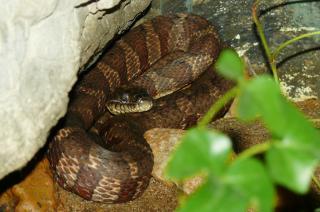
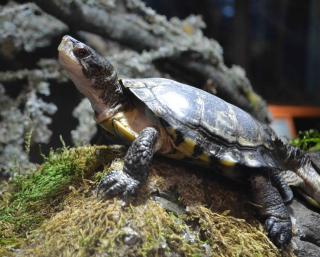
The theme of more aquatic species continues on the wall to the right of the large fish, with a pair of 8 sq. meter paludarium displays (roughly 3/4 water reaching 0.5m deep, 1/4 land) standing 1.5m tall. While both habitats feature large clusters of basking rocks, the closest to the fish tank is also planted with a small cluster of reeds, suited to the elusive Common Watersnake Nerodia sipedon (0.4). Next door, visitors can enjoy the playful antics of the Blanding's Emydoidea blandingii (4.4) and Northern Map Turtle Graptemys geographica (3.3).

full

Potential Look of Mixed Fish Tank
Image Credit -> @snowleopard
Pylodictis olivaris Jenks kl.jpeg
Flathead Catfish
Image Source -> ZooTierListe
full

Lake Sturgeon
Image Credit -> @evilmonkey239
full

Potential Look of Watersnake Habitat
Image Credit -> @Moebelle
Nerodia%20sipedon.JPG

Common Watersnake
Image Source -> ZooTierListe (Northern Watersnake)
full

Potential Look of Turtle Tank
Image Credit -> @pachyderm pro
full

Blanding's Turtle
Image Credit -> @MeiLover
full

Northern Map Turtle
Image Credit -> @RatioTile

With that, visitors are invited down a corridor where the last five habitats stand. On the right, three tanks, and on the left, one tank and one open-topped display. The smallest of the tanks, on the left, is one for a species which is temporarily housed here with the intent of swapping it with one of the species in either the herpetarium in the Great Plains and Mountain Ranges area of the zoo, or the main pavilion of the North American Deserts complex. As such, the design of this 2 sq. meter habitat seems out of place alongside a pair of more green habitats, as our group of California Red-legged Frog Amerana draytonii (1.3) are found in a drier but still slightly damp habitat. Next to this rarity is a window that looks out onto the 100 sq. meter home to our pair of Common Snapping Turtle Chelydra serpentina (1.1).
On the opposite wall, visitors are treated to three primarily aquatic displays. The first is a 3m-long, 1.5m-wide and 1m-high tank, rocky by nature, and home to the American equivalent of the Andrias salamanders, being the Eastern Hellbender Cryptobranchus alleganiensis alleganiensis (1.1). Located directly above this tank are the other two tanks, an 5 sq. meter and 1.5m high tank dedicated to the petite and endangered Spotted Turtle Clemmys guttata (2.2), and the other, a 3 sq. meter tank, home to a decent group of Common Mudpuppy Necturus maculosus (0.4).

full

full

Top: Potential Look of Frog Tank
Bottom: California Red-legged Frog
Image Credit -> @splendens
full

Possible Look of Snapping Turtle Habitat
Image Credit -> @Dhole dude
full

Common Snapping Turtle
Image Credit -> Myself, @Van Beal
full

Potential Look of Hellbender Tank
Image Credit -> @Dhole dude
full

Hellbender
Image Credit -> @biggiesmalls
full

Potential Look of Turtle Tank
Image Credit -> @Dhole dude
full

Spotted Turtle
Image Credit -> @splendens
full

Possible Look of Mudpuppy Tank
Image Credit -> @Moebelle
full

Mudpuppy
Image Credit -> @gentle lemur

And passing by these tanks, we exit the building, and can now view beneath the surface in the Common Snapping Turtle tank. As we breathe in the fresh air, the sounds of chirping birds seems to be louder and more varied than is typical for this region, but the cause of this pleasant cacaphony of avian whistles will have to remain hidden for now.
Until next time, enjoy, and stay tuned!
 

Attachments

  • Pylodictis olivaris Jenks kl.jpeg
    Pylodictis olivaris Jenks kl.jpeg
    16.4 KB · Views: 93
Having exited the Woodland Vivarium, visitors can walk the winding path through a small patch of natural forest, which leads up to a two-part walkthrough display which concludes the Temperate and Taiga Woodlands, and brings us more than halfway through the larger North American Trail.

As previously mentioned, the sounds of native avians, of both the wild and zoo-managed varieties, can be heard echoing through the forest. But before we surround ourselves with the feathered avian species, we first visit those whose wings are less feathery, but equally breathtaking. As we enter the first portion, we are immersed into a natural garden, with light butterfly netting reaching nearly 5m overhead of this 600 sq. meter space. The horticultural team has arranged a large array of beautiful native flowers around a set of benches, where visitors can sit and admire a 30 sq. meter pond planted with lilies, which supplies a home to a group of Northwestern Pond Turtle Actinemys marmorata marmorata (7.7). Meanwhile, overhead and among the many flowering plants, visitors can spot four beautiful species of butterfly, specifically the Orange Sulfur Colias eurytheme (0.0.30), Monarch Danaus plexippus (0.0.20), Mourning Cloak Nymphalis antiopa (0.0.30), and Eastern Tiger Swallowtail Papilio glaucus (0.0.20). With the ever-present risk of accidental harm to the butterflies or caterpillars in the space, the main ground area of the aviary is slightly raised above the level of the path, with a small staircase leading up to the aforementioned bench seating and turtle viewing.

full

Possible Look of Turtle Pond (without netted guardrail)
Image Credit -> @SivatheriumGuy
full

Possible Look of Butterfly Garden
Image Credit -> @Breckenridge
Clemmys%20maromorata.jpg

(North)Western Pond Turtle
Image Source -> ZooTierListe (Pacific Pond Turtle)
full

Orange Sulfur Butterfly
Image Credit -> @CMP
full

Monarch Butterfly
Image Credit -> @Julio C Castro
full

Mourning Cloak Butterfly
Image Credit -> @UngulateNerd92
full

Eastern Tiger Swallowtail
Image Credit -> @Breckenridge

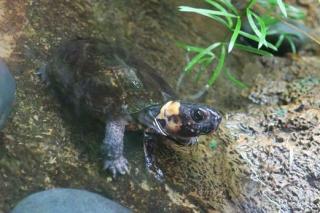
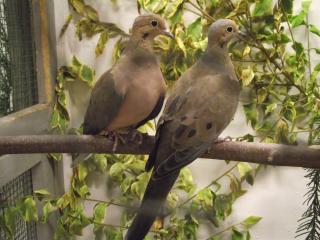
After navigating the elevated flower beds and pond viewing in this first space, a double set of doors (well-watched by staff members) lead into the second portion of this walkthrough. This space, while more natural around the perimeter, is centred around a very clearly artificial pond, built in the style of a classical birdbath. This 45 sq. meter "cistern" doubles as a home for groups of Bog Glyptemys muhlenbergii (4.4) and Midland Painted Turtle Chrysemys picta marginata (5.7), with a gentle slope in the back leading to a sheltered beach area for the turtles, inaccessible for visitors. Meanwhile, dancing among the tree limbs above the heads of the visitors are six vibrant species, being the Northern Cardinal Cardinalis cardinalis (1.4), Rose-breasted Grosbeak Pheucticus ludovicianus (1.4), Red-winged Blackbird Agelaius phoeniceus (2.4), American Goldfinch Spinus tristis (5.5), American Robin Turdus migratorius (3.3), and Eastern Mourning Dove Zenaida macroura carolinensis (6.6). And, while the arborealists might be striking in coloration, the ground-dwelling Eastern Wild Turkey Meleagris gallopavo silvestris (1.5) is sure to draw attention with the impressive showing of the male.

full

Possible Look of Walkthrough Aviary
Image Credit -> @ralph
bog_turtle_5.jpg

Bog Turtle
Image Source -> ZooTierListe
full

Midland Painted Turtle
Image Credit -> @RatioTile
full

Northern Cardinal
Image Credit -> @KevinB
full

Rose-breasted Grosbeak
Image Credit -> @RatioTile
full

Red-winged Blackbird
Image Credit -> @Grizzly Hound
full

American Goldfinch
Image Credit -> @Moebelle
full

American Robin
Image Credit -> @CarnotaurusSastrei
DSCF1106.JPG

Eastern Mourning Dove
Image Source -> ZooTierListe

And with that, *sigh* we conclude the third of five parts to the greater North American Trail, and get that much closer to finishing the second of the five continental trails. So for now I leave you, on the verge of visiting some of North America's most intriguing but overlooked ecosystems: the coasts! So until we begin this journey, stay tuned and enjoy!

Now, as a bit of a side tangent, I would like to travel back to the beginning of the zoo (briefly), and give you all a rundown on the species makeup of each section. So, here are the three smaller non-continental regions we have already explored:
Galapagos Ecotarium: 13 total species; 4 birds, 5 fish, 4 reptiles
Nocturnia - A World Without Light: 28 total species; 1 amphibian, 2 birds, 3 fish, 2 invertebrates, 17 mammals, 3 reptiles
Central America: 40 total species; 4 amphibians, 6 birds, 8 fish, 7 invertebrates, 1 mammal, 14 reptiles
And now the larger South American Trail, divided into its parts:
The Southern Tip: 32 total species; 3 amphibians, 14 birds, 2 invertebrates, 10 mammals, 3 reptiles
Andes Mountain Trail: 15 total species; 2 amphibians, 7 birds, 6 mammals
Pantanal Preservation Project: 21 total species; 1 amphibian, 10 birds, 6 mammals, 4 reptiles
Amazon and Atlantic: 72(!) total species; 8 amphibians, 14 birds, 13 fish, 16 invertebrates, 10 mammals, 11 reptiles
SOUTH AMERICAN TRAIL: 140 total species; 14 amphibians, 45 birds, 13 fish, 18 invertebrates, 32 mammals, 18 reptiles
And so, without factoring in our first three portions of the North American Trail, our sub-total looks like this:
221 total species
19 amphibians
57 birds
29 fish
27 invertebrates
50 mammals
39 reptiles
*Note: this math was done using figures on my Google Sheets which, while slightly difficult to manage due to the sheer quantity of species overall, should be accurate. If there are any inconsistencies in the math above with what was presented previously in this thread, please bring them to my attention so I can correct them to give you all an accurate understanding of the species inventory of this (albeit speculative) zoo. Thank you for taking the time to read this if you did.
Tl:dr, lemme know if any of the math doesn't add up with anything I've already said, and I'll do my best to fix it.
 
We return to the North American Trail, where we venture from the Temperate and Taiga Woodlands to the Atlantic and Pacific Coasts, the fourth of five stops on this trail.
As the woodlands thin out into the rocky northwestern coasts of the continent, specifically those of the Bering Strait and Alaskan islands, visitors find themselves alongside a curving 12m long underwater viewing window, standing 3m high, while the water spans an extra 1m below the base of the window. This aquatic space makes up roughly 2,000 sq. meters of the 3,000 sq. meter habitat supplied, viewable from above the water as you venture further along the perimeter of this (relatively) round habitat. The above-ground viewing allows a view of a spectacular rock face which, while not used to the full extent by our harem group of Northern Fur Seal Callorhinus ursinus (1.7), does serve a purpose on its opposite face.

full

Possible Look of Fur Seal Habitat
Image Credit -> @Mr Gharial
full

Northern Fur Seal
Image Credit -> @Northwest_FIsh_Keeping

Walking around the large cliff, it may become quickly evident what the purpose of this cliff face truly is. A mesh ceiling extends 5.5m above the heads of visitors, while the habitat is contained by a similar mesh structure. Roughly half of this 2,000 sq. meter habitat is covered by water, ranging in depths from 3m at its deepest point, to mere inches in the sandy shallows. Visitors can get an underwater view, albeit much shallower than that for the seals, at just 1m water depth. Along the shallows, eyes can be drawn to our flock of Dunlin Calidris alpina (8.8) or our small breeding group of North American Black Oystercatcher Haematopus bachmani (1.3). Meanwhile, the underwater viewing window and the rest of the pool are often graced with our flocks of Surf Scoter Melanitta perspicillata (2.4) and Long-tailed Duck Clangula hyemalis (2.10). Lastly, the rocky cliffs, which supply roosting grounds for the (slightly) lesser-known Tufted Puffin Fratercula cirrhata (13.13) and the petite Rhinoceros Auklet Cerorhinca monocerata (9.9), two species who also zip past the underwater viewing window from time to time, likely with baitfish clutched in their beaks.

full

Possible Look of Pacific Seabird Aviary
Image Credit -> @Dhole dude
full

Dunlin
Image Credit -> @Eddie Seb
full

North American Black Oystercatcher
Image Credit -> @Flyer.Nick
full

Surf Scoter
Image Credit -> @Sicarius
full

Long-tailed Duck
Image Credit -> @evilmonkey239
full

Tufted Puffin
Image Credit -> @Brayden Delashmutt
full

Rhinoceros Auklet
Image Credit -> @Pleistohorse

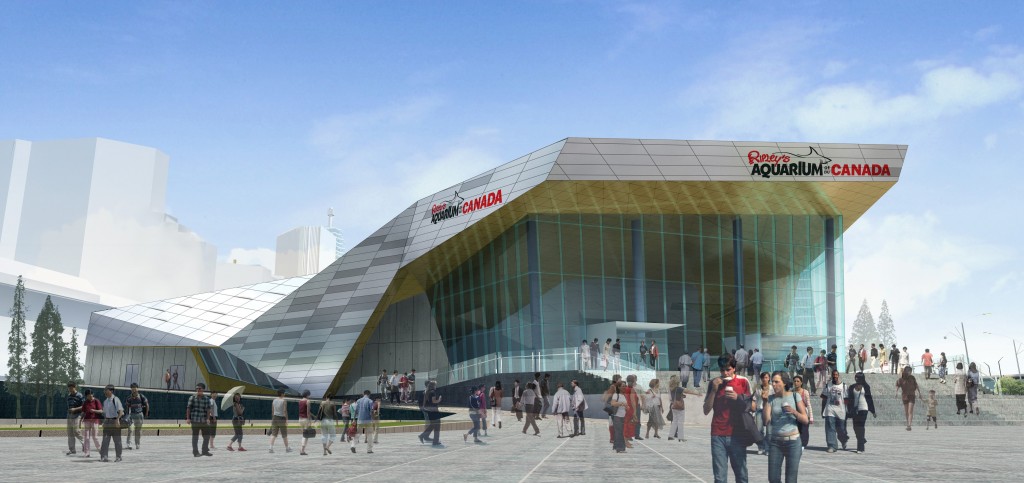
As we wrap around this aviary, visitors come to the entrance of a building, intended to blend the slightly utilitarian look of the Alaska SeaLife Center and the modern look of Ripley's Aquarium of Canada, which acts as the site of the Coastline Aquarium, a two-storey building hosting the aquatic species of both coasts. The entrance visitors view at the moment brings them into the second storey, which is the intended pathway should you reach the building from this direction. As such, that is the direction we will forge onward through in the next post, which will (hopefully) conclude the building as a whole, and leave us with just the habitats after this building before we venture out of this small section of the North America Trail.
I leave for now, so stay tuned, and enjoy!

Center-in-Summer-Chamber_58FF335D-EF84-4CA5-9B48FF005CCBD549_7f6827bc-b039-4d04-9cbfe4831d9a6980.jpg

Image Source -> Alaska SeaLife Center
Exterior-Plaza-View1-1024x483.jpg

Image Source -> Ripley’s Begins Building $130-Million World-Class Family Aquarium in Toronto - CanadianSpecialEvents.com
 
Our journey into the Coastline Aquarium begins on the second level, where a total of six aquatic spaces can be viewed. The first of these spaces comes a short walk from the doors, on the left-hand side. The area itself is a 450 sq. meter cylindrical space, with 1m of underwater viewing available from this perspective. Of the 450 sq. meters, roughly 100 sq. meters is terrestrial space, with the rest being water which spans an additional 6m down to a floor-to-ceiling underwater viewing window on the lower level (more on that later). With the sheer lack of land area, visitors might think the space is unsuited to anything which warrants an above-water view. This, however, proves not to be the case, with our group of Southern Sea Otter Enhydra lutris nereis (2.6), made up of 5 adult females and three juveniles, darting to the bottom of the pool for the pre-stocked shellfish. Our breeding male (1.0) is kept off-display to reduce potential for aggression toward both the pups and the females.

full

Possible Upper View of Sea Otter Habitat
Image Credit -> @BlobfishBoy
full

Southern Sea Otter
Image Credit -> @Northwest_FIsh_Keeping

Directly across from the sea otters, visitors come across a 5m-long, 1m-tall, and 0.5m-wide tank for a species which has a reputation for being a serial escapist, and one of the more intelligent animals under the waves. This, of course, refers to a currently unsexed Giant Pacific Octopus Enteroctopus dofleini (0.0.1), a species which the facility constantly supervises, whether with a physical keeper or with surveillance cameras positioned around the tank. The lengthy design, paired with a rocky and all-around diverse environment, intends to keep the cephalopod enriched enough that it does not attempt any daring escapes.
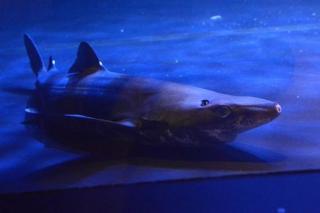
A short walk from the crafty cephalopod provides a view into the second tank which extends across both levels. Unlike the previously-seen otters, this tank is totally underwater, with a grand total of 9m of standing height (3m viewable from the upper level, and another 6m down to the floor of the lower level). With the 8m diameter of the tank (4m radius), the volume totals around 119,500 gallons. With a combination of false and live kelp in this tank, aided by a current being supplied mechanically, visitors can view our groups of North Pacific Spiny Dogfish Squalus suckleyi (1.11) and Leopard Shark Triakis semifasciata (4.4) navigating a kelp forest that, while not as impressive as those found in other aquariums, provides an educational and immersive experience for visitors.

full

Potential Look of Octopus Tank (and Giant Pacific Octopus itself)
Image Credit -> @SwampDonkey
full

Possible Upper View of Kelp Forest Tank and Leopard Shark
Image Credit -> @snowleopard
Squalus%20suckleyi%20(2).jpg

North Pacific Spiny Dogfish
Image Source -> ZooTierListe

Before heading down to the ground level, visitors can find a trio of tanks alongside the staircase which will lead down to the lower floor. These three smaller tanks (two roughly 500 gallons and rectangular, the other rectangular but 1,585 gallons) host species which are more suited to life amid the rocks at the bottom of the Atlantic ocean. The two smaller tanks, dominated by rock formations suited to concealing these animals, respectively host a lone American Lobster Homarus americanus (0.0.1) and a small school of Atlantic Wolffish Anarhichas lupus (0.0.4). While similar in design, a more colorful cluster of corals and rocks creates a more appealing/interesting environment for a lone Green Moray Eel Gymnothorax funebris (1.0). Passing by these tanks, visitors walk a blue-lit staircase which, while not featuring any live species, does provide a decorative school of menhaden, a silvery forage fish found in the Atlantic Ocean and often found as prey for other larger fish species and seabirds. Signage on the wall at a landing halfway down the stairs provides further educational information regarding the importance of fish like these in maintaining balance in marine ecosystems.

full

Possible Look of Lobster/Wolffish Tanks
full

full

American Lobster
Image Credit -> @NNM.
full

Atlantic Wolffish
Image Credit -> @twilighter
full

Possible Look of Moray Tank
Image Credit -> @Moebelle
full

Green Moray Eel
Image Credit -> @dsimmons917

After venturing down the stairs, visitors first come to the lower view of the sea otter habitat, with a better look at the rocky, shellfish-littered pool floor which provides a semi-natural enrichment option for the otters. Also viewable a short ways past, heading the same direction from the otters as you did upstairs, is the lower level look of the kelp forest. Before you reach the mixed shark tank, however, you come across a tank of roughly half the volume (approximately 53,000 gallons and 5m deep), with less high-growing kelp, instead opting for low-growing seagrass and rocky formations along the sandy tank bottom. This design allows keepers to deposit shellfish, crabs, and small fish to pair with the seagrass as the total diet of our inhabiting Bonnethead Shark Sphyrna tiburo (3.7).
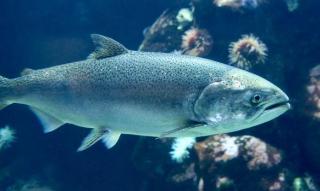
The final two tanks in the area flank the visitor path following the lower view of the kelp forest. To the left, a tank which volume-wise (~114,200 gallons) dwarfs both tanks, while being shallower than the bonnethead tank (4m to the bonnetheads' 5m), the tank is also longer, at 16.25m, and wider, at 8.5m, than both tanks. In this tank, visitors can find a school of Atlantic Salmon Salmo salar (0.0.90) alongside a pair of Atlantic Sturgeon Acipenser oxyrinchus oxyrinchus (1.1). Across from this is a slightly smaller tank (~50,850 gallons, ~11m long, ~6m wide, same 4m height), which provides a home to a school of Chinook Salmon Oncorhynchus tshawytscha (0.0.95).

full

Possible Lower View of Sea Otter Habitat
Image Credit -> @KevinB
full

Possible Lower View of Kelp Forest Tank
Image Credit -> @Northwest_FIsh_Keeping
full

Possible Look of Bonnethead Tank
Image Credit -> @Zooish
full

Bonnethead Shark
Image Credit -> @Brayden Delashmutt
full

Possible Look into Salmon Tanks
Image Credit -> @German Zoo World
full

full

Top: Atlantic Salmon
Bottom: Atlantic Sturgeon
Image Credit -> @RatioTile
Chinook%20salmon%202.jpg

Chinook Salmon
Image Source -> ZooTierListe

And with that, visitors pass through an exit which, much like the entrance (in a detail I forgot to include), features copper-plated handles shaped to resemble the very Atlantic Sturgeons just seen prior to exiting the building. And in exiting the building, visitors return outside in front of... a suspiciously familiar rocky formation, with mesh covering one side. Coincidence? No, not at all. While the details are to be found in the next post, this area opens and closes in a very similar (near-identical, in fact) fashion in terms of species, and as such, it seems fitting that the means of containment remains the same. With that in mind, our tour halts once again, with this final display marking the end of the Atlantic and Pacific Coasts portion of the trail.
Until next time, stay tuned and enjoy!
 
And we're back (I know, quite the halt in the tour :p). Unlike previous posts, images of the enclosures will be omitted from this portion, seeing as the designs for the two habitats are identical to those seen before entering the Coastline Aquarium two posts before this one. Anyway, onward we forge.

As mentioned, the habitats are identical in appearance, but both are slightly larger. Unlike last time, however, in this scenario visitors come across the aviary first. At 2,900 sq. meters, this aviary is roughly 50% larger than the other, and this extra size is almost entirely based in the water. Where the other aviary had two species of anseriforme and wading shorebird, this aviary features just one of each, being the Eastern Harlequin Duck Histrionicus histrionicus (2.8) and Marbled Godwit Limosa fedoa (3.3) respectively. Meanwhile, the roosting cliffs and deeper waters are a bit more crowded in this case, as alongside the Atlantic Puffin Fratercula arctica (10.10), visitors can find two alcids, being the Razorbill Alca torda (7.7) and Common Murre Uria aalge (6.6), and another diving bird in the Common Tern Sterna hirundo (10.10). Once again, the pool is stocked with baitfish, and reaches depths of roughly 5m, about 2m deeper than that found in the previous aviary.

full

full

Top: Harlequin Duck
Bottom: Common Murre
Image Credit -> @RatioTile
full

Marbled Godwit
Image Credit -> @Great Argus
full

full

Top: Atlantic Puffin
Bottom: Razorbill
Image Credit -> @Maguari
full

Common Tern
Image Credit -> @Lafone

Around the other side, visitors come across the slightly expanded 3,500 sq. meter area for pinnipeds. The land area remains the same size as that for the fur seals, while the added space goes entirely to the aquatic space, and for good reason. Rather than a single pinniped species, visitors are treated to a direct side-by-side comparison of eared seals and earless seals, as our pair of Harbor Seal Phoca vitulina (1.1) lives alongside a decent colony of California Sea Lion Zalophus californianus (1.9).

full

Harbor Seal
Image Credit -> @Pleistohorse
full

California Sea Lion
Image Credit -> @olhl.animal.photography

And with that, a short runthrough of our final habitats has us exiting the Atlantic and Pacific Coasts it seems just as fast as we started it. And so we venture down the coast into one of the more iconic wetland ecosystems in the world: the Everglades.
For now, stay tuned and enjoy!
 
Back
Top