The German Adventures Of A Tea-Loving Dave - April 2014

Part IX: Final Areas, Overall Thoughts On Magdeburg And Return To Berlin

As we made our way to the tapir enclosure, we briefly took a look at the indoor viewing for the Giant Anteater. Within, we saw a pair of rooms, each of which contained a number of logs and branches along with a large amount of vegetation, but rather bare stone flooring. The two anteaters were visible curled up in the corner of one of the rooms, which helped to provide some level of scale. As such, it was evident that the indoor enclosure was spacious enough to be suitable for the taxon it contained, although it could have benefited from a more appealing-looking substrate on the floor of the enclosure.

We then once more reached the large outdoor paddock for Lowland Tapir and Ring-tailed Coati which we had viewed a small portion of earlier in the day. The enclosure was, as noted previously, rather large and very thickly planted, and contained a great number of mature trees which may well have been in-situ when the zoo was originally constructed. In point of fact, when viewed from where we were now located it was apparent that the enclosure was substantially larger than we had initially estimated; something which was, of course, very pleasing from the point of view of animal welfare but which - when combined with the high number of trees and thick vegetation - meant we had trouble spotting the coati which we knew to be within the enclosure. However, a little patience paid dividends, and a rather unexpected surprise; as we observed the group of animals moving between trees and bushes within the enclosure, we rapidly realised that although a number of individuals were indeed Ring-tailed Coati, others were in fact Whitenosed Coati (Nasua narica), a much more unusual and attractive taxon. In point of fact, I had been aware that these animals had arrived at Magdeburg, part of an import from Cuba which had entered Europe a few weeks prior, but had been under the impression they were still in quarantine and that the arrival was as yet undeclared; certainly the signage on the enclosure had not been updated to reflect the new inhabitants, something which was rather unusual considering the high quality of the signage and enclosure labels in the collection as a whole. As such, seeing these animals was a very pleasant and unexpected surprise; they were very active and looked rather different to the only other member of the species I had seen to date, an elderly male at Paignton Zoo a year or so prior. As these animals represent a new import of known origin, I would be unsurprised if it transpired they are a different subspecies to those held in Europe already.

We then reached the crossroads where we had previously seen the Dhole; ahead of us lay the Dhole and Snow Leopard enclosures, and the path towards the exit, whilst to the left of us was the path towards the Tapir House and the main body of the zoo. However, to our right was the final section of the collection which we had not, as yet, visited. As such we made our way along this portion of the path. The first enclosure we came to was a large and rather pleasant-looking one holding Yellow Mongoose (Cynictis penicillata), a herpestid taxon with which I am rather fond. The enclosure was similar in many ways to the enclosures for the Dwarf Mongoose and Cape Ground Squirrel which we had seen earlier in the day writ large; sandy substrate with a mix of raised rockwork, tree stumps and concealed heatlamps, something which both looked very attractive and seemed to work very well for the inhabitants of the enclosure. A similar enclosure, albeit slightly smaller, was placed immediately beside it, containing a group of Common Cusimanse(Crossarchus obscurus). This taxon is the most seldom-seen of the five "common" mongoose species in European collections, and also one of the most unusual looking; in point of fact Magdeburg is the only collection in Germany which holds the species.

Around the corner from these two enclosures, in a short little cul-de-sac, we came to a larger enclosure of a similar basic design, with a few significant differences. Foremost among these was a great increase in the quantity and scope of the rockwork, which formed stone walls and ridges building on top of one another, forming a central plateau against the back wall of the enclosure, with further stone formations building up from the plateau. Furthermore, the level of tree trunks and branches was significantly reduced. This enclosure contained a breeding group of Indian Crested Porcupine (Hystrix indica), a taxon which until my visit to Tierpark Berlin I had never seen, and as such one which I still thoroughly enjoyed being able to observe. We were rather amused to note that the sound of our camera shutters were startling a young "porcupette" sufficiently for the adults to repeatedly enter defensive postures.

Beyond here, the path crossed over a small stream, swinging back up towards the Children's Zoo; however there were a pair of aviaries some way up this path which we had yet to observe - the last such enclosures for us to visit in Zoo Magdeburg. The first and larger of these contained Eurasian Great Grey Owl (Strix nebulosa lapponica), a species with which we were very familiar due to the high incidence of the taxon in UK collection. The aviary was quite sparsely vegetated, with a handful of young trees held within, but due to the large size of the aviary the inhabitants had more than enough space to move around if need be. The second aviary was of rather more interest to us; the inhabitants were South European Ural Owl (Strix uralensis macroura), a subspecies which is entirely absent from UK collections and as such entirely new to us. This aviary was also rather more thickly vegetated with small trees and bushes, which I suspect is partially due to the more reclusive nature of the Ural Owl compared to the Great Grey.

Having seen the entirety of the onshow collection at Zoo Magdeburg, we decided to revisit a handful of enclosures dotted around the zoo in order to get better photographs of certain species, including the Tataupa Tinamou and the Pied Tamarin, before making our way to the exit of the enclosure. This would be a suitable point to briefly discuss my thoughts on Zoo Magdeburg as a whole, considering the fact that these posts have partially been written as a guide for any Zoochatters who may wish to visit the collection in the future.

I was seriously impressed by the quality of the collection, both in terms of the enclosures and animal houses, and the number of rare and unusual taxa held within the zoo. Among the highlights in the first regard were the row of woodland enclosures containing native Eurasian wildlife, the area surrounding the Rhinoceros House, and the external paddock of the Tapir House, all of which were designed in such a way that they were entirely suited to the animals held within, striking the balance between giving the inhabitants privacy and scope to escape the public gaze, whilst still permitting visitors to view the inhabitants with relative ease. A facet of the enclosure design at Zoo Magdeburg as a whole which very much pleased me was the use that had been made of the natural environment; the woodland and streams which had already been present on the site prior to the zoo have in many cases been integrated into the animal enclosures, or alternatively tended to improve the general feel of the zoo as a whole. This meant that the collection felt very pleasant to walk around as a location in and of itself, even disregarding the animals held there - something which I feel to be very important for zoological collections.

Quite apart from some of the unusual species held at the collection - taxa like the Dusky Padamelon, Marbled Polecat, Angolan Colobus and Golden Jackal - it should also be observed that the number of taxa held for groups such as carnivorans and callitrichids was incredibly high for such a small collection, representing a very comprehensive selection of the variation found within these groups.

Upon leaving the zoo, we made our way back to Magdeburg-Neustadt, where we caught our train back to Berlin-Hauptbahnhof. After double-checking our plans for meeting on the Monday morning and bidding farewell to Chris and Ang, Hel and myself caught the S75 to Alexanderplatz. As it was still reasonably early in the day - approximately 5pm - we elected to walk back to our hostel rather than catch the U-Bahn. We then took the opportunity to drop our bags off at the hostel, before leaving again and walking down Schwedter Straße to the corner of Kastanieallee, where we had arranged to meet up with Hel's parents and Claire, with the intention of going out for an evening meal. We eventually elected to visit a very nice Italian restaurant called Pasta & Passione, which we all thoroughly enjoyed and which I highly reccommend. The food was very reasonably priced with large portion sizes, and the staff were incredibly helpful and friendly. I particularly recommend the salmon pasta, incidentally :)

Italienisches-Italian Restaurant

After finishing our meal, myself and Hel said goodnight to her family and made our way back to our hostel, looking forward to our second day of visiting Zoo Berlin on the Sunday.

(Follow this link for images of part of the Lowland Tapir and White-nosed Coati outdoor enclosure, the Yellow Mongoose enclosure, the Cusimanse enclosure, the Indian Crested Porcupine enclosure, the Great Grey Owl aviary and the South European Ural Owl aviary)
 
Last edited by a moderator:
Some photographic highlights from Magdeburg Zoo.....

http://www.zoochat.com/883/east-african-striped-hyena-hyaena-hyaena-370364/
http://www.zoochat.com/883/marbled-polecat-vormela-peregusna-pallidor-zoologischer-370365/
http://www.zoochat.com/883/marbled-polecat-vormela-peregusna-pallidor-zoologischer-370366/
http://www.zoochat.com/883/marbled-polecat-vormela-peregusna-pallidor-zoologischer-370369/
http://www.zoochat.com/883/golden-spiny-mouse-acomys-russatus-zoologischer-370371/
http://www.zoochat.com/883/temminck-s-tragopan-tragopan-temminckii-zoologischer-370372/
http://www.zoochat.com/883/cape-ground-squirrel-xerus-inauris-zoologischer-370373/
http://www.zoochat.com/883/persian-onager-equus-hemionus-onager-zoologischer-370374/
http://www.zoochat.com/883/mona-monkey-cercopithecus-mona-zoologischer-garten-370375/
http://www.zoochat.com/883/gabon-talapoin-miopithecus-ogouensis-zoologischer-garten-370376/
http://www.zoochat.com/883/european-golden-jackal-canis-aureus-moreotica-370378/
http://www.zoochat.com/883/european-golden-jackal-canis-aureus-moreotica-370379/
http://www.zoochat.com/883/black-lion-tamarin-leontopithecus-chrysopygus-zoologischer-370380/
http://www.zoochat.com/883/indian-crested-porcupine-hystrix-indica-zoologischer-370381/
http://www.zoochat.com/883/cape-turtle-dove-streptopelia-capicola-zoologischer-370384/
http://www.zoochat.com/883/midas-tamarin-saguinus-midas-zoologischer-garten-370377/
http://www.zoochat.com/883/dusky-pademelon-thylogale-brunii-zoologischer-garten-370385/
http://www.zoochat.com/883/white-nosed-coati-nasua-narica-zoologischer-370386/
http://www.zoochat.com/883/peters-angolan-colobus-colobus-angolensis-palliates-370383/
http://www.zoochat.com/883/south-european-ural-owl-strix-uralensis-370387/

Next: Day 2 of Zoo Berlin

(These will, naturally, be freshly written posts - as such I won't be posting with *quite* as much rapidity as I have these Magdeburg posts ;) )
 
Last edited:
April 6th 2014 - My second day at Zoo Berlin

Part I: Ibex Mountain and Swine House

The following morning, we chose to have a slight lie-in as we did not expect to require the whole day in order to see the last few areas of Zoo Berlin we had failed to see, and revisit those areas which we desired to see once again. As such, myself and Hel set off from our hostel at about 9.20am, with a view to arriving at Zoo for approximately 10am. We were once again able to get a direct train between U Senefelderplatz and S+U Zoologischer Garten on the U2 line, as we had on the Friday morning, and arrived at roughly 10.15am. Unlike our prior visit, we elected to enter the collection via the Löwentor, opposite the Bahnhof - once again, of course, using our WelcomeCard discount.

We immediately made our way to the Ibex Mountain on the off-chance the two species of Marmot held in this area - as discussed in my review of our first day at the collection - were visible. Unfortunately the animals in question were still evidently in hibernation; however we did take the opportunity to take photographs of their enclosures and view the other taxa held within this area once again. As the light conditions were somewhat better than they had been on the Friday evening, we also took the opportunity to take further photographs of the Ibex and Tur enclosures before ascending the path which led between the two enclosures. At the summit of the public path through the Ibex Mountain, we were able to obtain very good views of both enclosures, as well as the enclosure for West Himalayan Tahr (Hemitragus jemlahicus) which lay behind the mountain.

We had been forced to omit this particular enclosure during our prior visit, and as such this was the first enclosure of the day to which we paid close attention. Much like the enclosures holding the Siberian Ibex and West Caucasian Tur, this enclosure was designed to take full advantage of the high capability which caprine hoofstock have in coping with rocky, cliff-like environments. As such, there was a high degree of focus given to the use of both mock-rock and real stonework in emulating a sparsely vegetated mountain slope. Although not unduly uncommon in European captive collections, until this point I had only seen this taxon at Highland Wildlife Park and as such, considering my strong soft spot for caprine taxa, I rather enjoyed watching the inhabitants of this enclosure - much as I had enjoyed viewing the Ibex Mountain exhibit as a whole.

We then decided to make our way towards the Swine House, one of the few remaining large portions of the collection which we were yet to view. En-route to this area of the zoo, we took the opportunity to have another look at the bird of prey enclosures which lay between the Ibex Mountain and the Swine House, in order to take further photographs of certain taxa held within.

The Swine House at Zoo Berlin is another of those now-rare and historically precious structures which predate the destruction inflicted upon the collection by World War II - in point of fact it was constructed in 1909, prior even to the Great War, and as such is one of the oldest buildings remaining on the site. Only the Antelope House and some of the houses within the "Deer Territory" are older, to my knowledge. As such, as a piece of zoological history this area of Zoo Berlin was worth close consideration, quite distinct from the consideration due as a result of the taxa held within the house and its environs. Unfortunately, unlike the experiences of certain members of this site whose photos within the gallery attest to access within the house itself having been possible at one point in the recent past, we found entry to the Swine House barred. We were unable to discover, then or since, whether this is a permanent change in the public accessibility of the house or a temporary event which happened to take place during our visit.

The taxa held in the Swine House and surrounding enclosures at the time of our visit were as follows:

Southern White-lipped Peccary (Tayassu pecari albirostris)
Collared Peccary (Pecari tajacu)
Sulawesi Babirusa (Babyrousa celebensis)
Bornean Bearded Pig (Sus barbatus barbatus)
Visayan Warty Pig (Sus cebifrons negrinus)
Red River Hog (Potamochoerus porcus)

The enclosures surrounding the Swine House were all very pleasant, quite sizable and each varied in precise design and layout according to the taxa displayed within.

For instance, the Babirusa enclosure comprised a relatively bare but clean paddock, with a few small trees and bushes dotted throughout and a small shelter for the inhabitants; in point of fact it was one of the most well-kept enclosures for this taxon I have seen - as with most pig species, Babirusa are extremely good at making even the most aesthetically pleasing enclosure into a wallow given much of an opportunity! This tendency has quite obviously been an issue at Zoo Berlin in the past, as both the enclosure for the two Peccary taxa - which were mixed on our visit - and the enclosure for the Red River Hogs had been covered liberally by significant quantities of sand. This has no doubt been in order to fill in, and dry out, large wallows and unsightly areas where the inhabitants of the enclosures have dug and rooted deeply into the paddocks and caused standing areas of water. As it stands, when we visited none of the swine enclosures displayed this kind of problem, although the enclosure for the Bearded Pigs - which stood opposite the Swine House proper - did look as if this was an issue liable to arise in the near future.

One other notable feature of these enclosures which must be discussed is the fact that a number of the taxa held within represented large and successfully breeding groups - most strikingly the White-lipped Peccaries, which represented the largest group of any peccary taxon I had ever seen to that point, with individuals covering the entire spectrum of age and sex; in point of fact, during the time of our visit there were multiple very young peccary "piglets" present within the enclosure. The group - which as noted above included a small handful of Collared Peccary - were making full use of their enclosure, which was the largest of all the swine enclosures in this area of the zoo.

Having observed the inhabitants of these enclosures, we then made our way to the Hippo House.

(Attached are images of the Woodchuck enclosure, the Siberian Ibex enclosure, the Egyptian Vulture aviary, the Babirusa enclosure, the Swine House and the Red River Hog enclosure)
 

Attachments

  • DSCF0919.jpg
    DSCF0919.jpg
    1.9 MB · Views: 23
  • DSCF0924.jpg
    DSCF0924.jpg
    1.7 MB · Views: 20
  • DSCF0941.jpg
    DSCF0941.jpg
    2 MB · Views: 20
  • DSCF0950.jpg
    DSCF0950.jpg
    2 MB · Views: 17
  • DSCF0954.jpg
    DSCF0954.jpg
    2 MB · Views: 18
  • DSCF0969.jpg
    DSCF0969.jpg
    1.9 MB · Views: 21
Unfortunately, unlike the experiences of certain members of this site whose photos within the gallery attest to access within the house itself having been possible at one point in the recent past, we found entry to the Swine House barred. We were unable to discover, then or since, whether this is a permanent change in the public accessibility of the house or a temporary event which happened to take place during our visit.

The swine house was open when I visited a few weeks after you; it was only my first time to find it open.
 
Unfortunately, unlike the experiences of certain members of this site whose photos within the gallery attest to access within the house itself having been possible at one point in the recent past, we found entry to the Swine House barred. We were unable to discover, then or since, whether this is a permanent change in the public accessibility of the house or a temporary event which happened to take place during our visit.

I think that you were just unlucky; the Swine House has invariably been open on all my visits to Berlin Zoo over the last thirty years, including in June of last year, only a couple of months after you were there.

(I think access to the interior of this building depends on the of time of day; in my experience it is likely to be closed when the pigs and peccaries are outside but then opened later in the day when they are indoors.)
 
Some of the swine house enclosures are dire... I saw a pair of collared peccary in a tiny exhibit

I'd be interested to hear when you visited - as noted above the two female collared peccary were mixed with the white-lipped when I visited in April 2014.
 
They have previously been in the enclosure that was only half visible from the birds of prey, which is next to one of the Babirussa enclosures. When they just moved there from the Tierpark it was indeed a small enclosure for the then medium sized group of about 7 animals...
 
They have previously been in the enclosure that was only half visible from the birds of prey, which is next to one of the Babirussa enclosures. When they just moved there from the Tierpark it was indeed a small enclosure for the then medium sized group of about 7 animals...

If ZTL is to be believed, only three individuals were received from Tierpark Berlin in 2012 - it may be possible that there was a third animal in the large peccary enclosure which I did not spot, so the fact I noticed only two does not mean the third has died of course.

Zootierliste said:
Abgabe der Gruppe nach PL und 3 Tiere in den Zoo Berlin

I do not know what the "PL" referred to in the ZTL post is - but I would assume, then, that not all seven of the former Tierpark animals went to Zoo Berlin?
 
We found the swine house open, can't recall which day but think it was our second day/your first day
 
If ZTL is to be believed, only three individuals were received from Tierpark Berlin in 2012 - it may be possible that there was a third animal in the large peccary enclosure which I did not spot, so the fact I noticed only two does not mean the third has died of course.

Oke maybe it was only 3, my memory is failing me, although I am sure about the enclosure they were initially kept in :p
 
Good thing they have been moved into the larger enclosure, then :)

I've got another report post well underway, by the by; this one discusses the hippo house, a few little bits and pieces and revisits and then gives a summary of my overall feelings about Zoo Berlin - and then that's another day finished!
 
Part II: Hippo House, Revisits And Overall Thoughts On Zoo Berlin

We next made our way towards the Hippopotamus House, the last large animal house which we were yet to investigate at all. En-route, we stopped at the outside paddock for the Baird's Tapir (Tapirus bairdii) housed within the Rhinoceros House, which as previously noted represented the first of his taxon which myself and Helly had ever seen. As such, considering we had only seen this individual in poor light indoors on our first day of visiting the collection, we wanted to observe him at further length. We found him to be an impressive animal, having something of the size and bulk of a Malayan Tapir and somewhat more appealing colouration when compared with the Lowland Tapirs with which we are so familiar. He, along with the other inhabitants of the Rhinoceros House, was housed in a reasonably large and well-vegetated paddock, with large areas where the mature tree cover led to shady areas where he was able to escape the direct sunlight - although during the time we observed him, he was quite happy to bask in the sunlight and only occasionally move position!

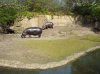
As we approached the Hippopotamus House, we first came to a pleasant-looking - if slightly bare in places - grassy paddock which contained Western Pygmy Hippopotamus (Choeropsis liberiensis liberiensis). This enclosure was surrounded by a deep moat, which ran around and behind the paddock, leading to an archway in the rockwork surrounding the Hippopotamus House itself. The top of this archway was mere inches above the surface of the water, and marked the presence of an underwater tunnel leading from the outside enclosure and into the interior of the house - a very interesting way of dealing with the issue of how best to provide indoor and outdoor access whilst keeping a certain naturalistic aesthetic.

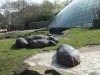
We then entered the house itself, being presented with a *very* attractive sight indeed; one half of the house comprised a spacious public area, looking towards two glass-fronted enclosures, separated from one another by copious mock-rockwork and vegetation. The roof of the "enclosure" half of the house comprised a glass dome, akin to a half-hemispherical greenhouse, with further mature vegetation planted around the edges of the enclosure. The enclosures themselves comprised scattered areas of dry land, surrounded by deep pools and moats which came up to the glass viewing windows to a height of approximately 5 feet, with the barriers continuing up for roughly another 4 feet into the air. The pools themselves extended below floor level, and as such were roughly 6-8 feet deep.

As a result, this extremely-appealing interior housing allowed underwater viewing of both species of hippopotamus held within; the Pygmy Hippopotamus enclosure covered approximately a third of the enclosure space whilst the enclosure for Common Hippopotamus (Hippopotamus amphibius) covered the remaining two-thirds. As previously noted, the moat we had seen surrounding the external enclosure for the Pygmy Hippopotamus led seamlessly into the internal pool; the same held true for the internal pool for the Common Hippopotamus, which led out of the house and towards the external paddock for this species.

This external paddock was much more spacious than the one given to the Pygmy Hippopotamus, and much more lushly vegetated with open wide areas of grass, aquatic vegetation and scattered trees, with the moat originating from the internal enclosure winding its way through much of the enclosure. The reason for the amount of open grass and dry land was apparent, as this paddock was shared with Nyala (Tragelaphus angasii), although this taxon also had an area of the enclosure which they could access and which, it appeared, the Hippopotamus could not. As I had never seen a mixed enclosure which included the latter species, this was an unusual and appealing surprise - although it struck me that Sitatunga would have been more accurate for the habitat in question.

Having seen everything "new" which we wanted to look at, we then decided to spend some time revisiting enclosures and exhibits which had particularly appealed to us, or which contained taxa we desired further observation and photography of.

The first such area was - as may not come as a great surprise - the Bird House and Fasanerie, both of which contained a few taxa which we had failed to spot on our prior visit, along with some which we merely wanted to see again. Chief among the latter category were the Trumpet Manucode, Kagu and Purple-throated Fruitcrow within the Fasanerie; although there is a chance we will be able to view the latter two taxa elsewhere in Europe at some point in the future, we were all-too aware that our observations of the former taxon would very likely be the last we would ever make. Within the Bird House, barring a few species we had failed to spot previously, there were no species which we greatly yearned to see again - in this case it was the experience of walking through, and observing, the house itself that we primarily wanted to enjoy one more time. It goes without saying, of course, that although we knew it would be futile we also checked to see if the Kiwi within the Fasanerie was visible!

Following our swan-song trip around these two houses, we chose to walk towards the pinniped enclosures; however we did so in a slightly roundabout fashion, so as to view the various bear taxa again - this was primarily due to the fact we were dissatisfied with the quality of our photographs of the Sloth Bear in particular. On reaching the pinniped enclosures we were pleased to note we had arrived in time for the feeding of the Harbour Seals - despite substantial crowds we were able to get a good view of this appealing taxon on dry land. Granted this is a taxon with which we are more than familiar, having observed them off the coast of Northumberland on many occasions, but the chance to see this particular native species at such proximity, and for such duration, seldom comes and must be cherished!

We next revisited the Carnivore House - initially returning to the nocturnal basement in the hope of finally seeing a Cururo, only to find our search a fruitless one. However, our time spent within the Carnivore House proper was not wasted, as we were able to obtain copious video and photography - much of it high quality - of a juvenile Narrow-striped Boky along with its mother. As is well-known by this point, I have a distinct partiality for unusual small carnivores; as such the opportunity to view an unusual taxon such as this, and a young individual at that, was one I took full advantage of.

Our final stop before leaving Zoo Berlin was the Ape House; although we had not failed to view any taxon in particular, and our photographs from our prior visit had all been high-quality and meeting our standards of satisfaction, our reason for returning to this particular area of the collection was much more personal. Although we knew we were due to see Hamlyn's Guenon again the following day at Zoo Leipzig, we equally knew that if the current rate of decline for this taxon within European collections continued, the odds were very good indeed that by the time we would eventually return to Zoo Berlin - as we fully intend, in the fullness of time - the taxon would be gone forever. As such, we chose to make a point of viewing the individuals held at Zoo Berlin again, in case they were to be the last we would ever see. I am not entirely certain why, of all the guenon taxa disappearing from European collections, I have taken this one to my heart so much; it is not the most attractive of the guenon species I have seen, nor is it the most interesting taxonomically. The best guess I can come up with is the fact it is the first guenon taxon within the United Kingdom whose loss I experienced at first hand; I have seen a thriving group at Edinburgh, then visited Twycross days after their last animal joined the former group, before ultimately and in the fullness of time seeing the last individual held at Edinburgh days before it departed the collection and the UK, and with it the taxon.

We then left Zoo Berlin; a bittersweet feeling to be sure, as though we fully intend to return, we equally knew that with the change in management the collection *will* be different when we do return. At this point, prior to continuing to discuss the rest of our day, it seems opportune to discuss my overall thoughts about Zoo Berlin, much as I have already done for Zoo Magdeburg. The question, of course, is where to begin for such a massive and world-famous collection!

First things first - I loved Zoo Berlin. Not to break the continuity of my posts *too* much, but by the end of my trip in Germany both Zoo Berlin and Tierpark Berlin had usurped the first-place position in my mental ranking of zoological collections previously held by Chester Zoo. When I finish my discussion of Tierpark with my account of my second day there, I will go into more detail comparing the two - for now let it be noted that they are separate but equal; completely different in some ways and pleasingly alike in others.

Returning to Zoo Berlin in particular, until I had visited this collection I really had no inkling of just how *full* of treasures a city-centre zoological collection could really be - reading about the collection at length on Zoochat and elsewhere cannot compare to experiencing them. I don't merely mean taxonomic treasures, of course, although there are sufficient of those at Zoo Berlin to sate the greediest of zoonerds - but architectural treasures like the Antelope House, no longer used for the original purpose nor to the original scale, but standing as an achievement in just how beautiful a zoo building can be. Historical treasures like the Aquarium, and the Swine House, and a myriad other features which have withstood the toll of time and war, and which now represent key primary resources in the understanding of zoo history.

In many ways, I feel that when walking around Zoo Berlin I was directly comparing it to my experience of ZSL London Zoo, another collection constrained by a city centre location, and one of the few collections with as long-standing a historical legacy..... and it is damning to say that in almost every single way, Zoo Berlin leaves London in the dust. Where the nocturnal house at London has become a hollow shell of what it once was, the nocturnal basement at Zoo Berlin still displays many zoological treasures and - just as importantly - displays them well, and in enclosures which are well-suited to their inhabitants needs. Where the Snowdon Aviary and Blackburn Pavilion now feel somewhat empty and lacking in a certain something - especially the former! - the Shorebird Aviary, Bird House and Fasanerie display a strong commitment to the celebration of all the diversity of form and function found in the bird kingdom. Even the taxonomic highlights of London - the Reptile House, the aquarium under the Mappins and the invertabrate collection within B.U.G.S. - pale in comparison to all that can be found within the Zoo Berlin Aquarium.

This is not to say, of course, that I found Zoo Berlin without fault; there *are* areas in which the enclosure quality and size could meet with significant improvement. Probably the most egregious of these is the indoor housing for the larger carnivores within the Carnivore House; whilst the smaller species seem to be housed within well-themed and suitably designed enclosures, the lions and leopards and so forth seemed almost an afterthought. Equally, I felt that the Bird House, as discussed previously, seemed a little soulless when compared with the Fasanerie opposite; this, I hope, is something that will improve over time as the vegetation and planting within the house has a chance to mature. But overall, I felt that Zoo Berlin has much more to applaud than it does to denigrate; all the moreso for achieving all that it has on a site not well-placed for expansion.

I do, however, fear for how the collection - and Tierpark Berlin - will develop over the coming few years; as one may have gathered in a few of my previous posts I already have reservations about the direction in which the new director is taking both collections..... however this is a discussion for another post, and another time, as to do the topic merit it is best left for my concluding posts summarizing my feelings about the trip as a whole. As such, I shall now return to discussing the rest of our day after we left the zoo.

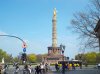
As we still had some hours left of the afternoon, and it was a pleasant and fine day, we decided that rather than get the train back towards our hostel we would walk the 3.5 kilometres back into the city centre through the Tiergarten until we reached the Brandenburg Gate, before reassessing our plans there; this would allow us some time to relax and see this historical part of Berlin at our leisure, an escape from our busy schedule thus far. As such we walked along the footpaths running more or less parallel with Straße des 17. Juni, the main road running east-west through the Tiergarten; this was a very pleasant walk indeed, with the lush trees and vegetation all around us and the sound of traffic almost entirely muffled even when the path took us within tens of metres from the road itself. After about 20 minutes or so we reached the famous Siegessäule, the Victory Column erected in the 1860's to mark the Prussian victory in the Danish-Prussian War. Originally this marble pillar, standing almost 60 metres and topped with a 8 metre high bronze statue of the goddess Victoria, stood not far from the Reichstag. However in 1939 the Nazi regime chose to re-erect the Column approximately 1.5 kilometres away, where it now stands at the Großer Stern intersection near the centre of the Tiergarten.

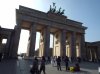
As a historian and someone with a penchant for fine art as well as a zoonerd, I was extremely taken with the Siegessäule; we were both sorely tempted to climb the column, as it is now possible to do, but chose instead to continue our walk. After approximately another 20 minutes we reached the Brandenburg Gate; our first sight of this historical site in daylight, having visited it in the evening following our first day at Tierpark Berlin. Again, it appealed to us on both a historical and aesthetic level; we took particular note of the decoration in the pavements and roads in front of the gate marking the site of where the Berlin Wall ran, something which bore particular significance to myself as the news coverage of the fall of the Wall happens to be one of my very first memories as a child.

We then decided we would walk a little further, along the River Spree to Bahnhof Berlin Friedrichstraße. From here, we caught an S5 train to Alexanderplatz, connecting there to the U2 line which took us back to Senefelderplatz. There was a street market taking place opposite our hostel, which passed the time pleasantly until we were contacted by Hel's parents and Claire in the early evening, arranging to meet for a meal.

Having dropped our bags off in our room, we walked along Schwedter Straße to the corner of Kastanieallee, where we had again arranged to meet up - this time we visited a Mediterranean resterant on Kastanieallee called Zaim, which specialised in North African and Middle-Eastern cuisine.

Zaim Restaurant

There we discussed our day with Claire and Hel's parents, along with our plans for the following morning. As we had another early start, we bid farewell at about 8.30pm whilst they remained at the restaurant for another coffee, and fell asleep more or less as soon as we reached our room.

(Attached are images of the Pygmy Hippo exterior enclosure, the Common Hippo interior enclosure, the Common Hippo exterior enclosure, the Siegessäule, an informational signpost regarding the Siegessäule and the Brandenburg Gate)
 

Attachments

  • DSCF0982.jpg
    DSCF0982.jpg
    1.9 MB · Views: 17
  • DSCF1001.jpg
    DSCF1001.jpg
    1.6 MB · Views: 16
  • DSCF8876.jpg
    DSCF8876.jpg
    2 MB · Views: 16
  • DSCF1419.jpg
    DSCF1419.jpg
    1.7 MB · Views: 13
  • DSCF1424.jpg
    DSCF1424.jpg
    1.8 MB · Views: 11
  • DSCF1426.jpg
    DSCF1426.jpg
    1,011 KB · Views: 10
Some photographic highlights from my second day of Zoo Berlin.....

http://www.zoochat.com/59/west-himalayan-tahr-hemitragus-jemlahicus-zoo-402816/
http://www.zoochat.com/59/southern-white-lipped-peccary-tayassu-pecari-402817/
http://www.zoochat.com/59/northern-carmine-bee-eater-merops-nubicus-402818/
http://www.zoochat.com/59/common-hoopoe-upupa-epops-zoo-berlin-402819/
http://www.zoochat.com/59/black-necked-aracari-pteroglossus-aracari-zoo-402820/
http://www.zoochat.com/59/trumpet-manucode-manucodia-keraudrenii-zoo-berlin-402821/
http://www.zoochat.com/59/brown-hooded-kingfisher-halcyon-albiventris-zoo-402822/
http://www.zoochat.com/59/javan-pond-heron-ardeola-speciosa-zoo-402823/
http://www.zoochat.com/59/east-african-white-bellied-bustard-eupodotis-402824/
http://www.zoochat.com/59/laughing-dove-streptopelia-senegalensis-zoo-berlin-402825/
http://www.zoochat.com/59/purple-throated-fruitcrow-querula-purpurata-zoo-402827/
http://www.zoochat.com/59/ring-tailed-vontsira-galidia-elegans-zoo-402828/
http://www.zoochat.com/59/tayra-eira-barbara-zoo-berlin-6th-402829/
http://www.zoochat.com/59/sulawesi-babirusa-babyrousa-celebensis-zoo-berlin-402830/
http://www.zoochat.com/59/baird-s-tapir-tapirus-bairdii-zoo-402831/
http://www.zoochat.com/59/white-backed-magpie-gymnorhina-tibicen-hypoleuca-402832/
http://www.zoochat.com/59/ocellated-turkey-meleagris-ocellata-zoo-berlin-402833/
http://www.zoochat.com/59/purple-throated-fruitcrow-querula-purpurata-zoo-402834/
http://www.zoochat.com/59/crested-quail-dove-geotrygon-versicolor-zoo-402835/
http://www.zoochat.com/59/black-throated-finch-poephila-cincta-zoo-402836/

Next: Zoo Leipzig.....
 
Great review of what some (including you now!) consider the world's best zoo TLD, definitely worth the wait :p. Its been very interesting following your progress around the zoo, and just how aware you were of it before you visited. I certainly didn't really know what to expect when I got to Berlin, I hadn't planned a route, or established "must-see" species or historical features, and just explored as I would have any other zoo, and therefore feel I missed out on some of the things you experienced. Possibly had I visited with the information you had (or in summer), Berlin Zoo would rank higher in my favourite or best zoo lists, but while the collection was one of the most amazing I've seen, the exhibits were rarely inspiring and regularly disappointing. It will be interesting to see what the future hold for the Berlin collections, while I share your concerns with the current direction, I do think some of the diversity at the Zoo is unsustainable.

Incidentally, I don't remember being able to access the Swine House at all when I visited, but that was one of the last places we visited, so its entirely possible we rushed past and didn't notice.

Looking forward to your thoughts on Leipzig!
 
Great review of what some (including you now!) consider the world's best zoo TLD, definitely worth the wait :p.

Joint best :p

I'd be very interested in hearing any feedback or discussion any other Zoochatters have of my overall review of Zoo Berlin posted above, incidentally; do you agree with me? Do you think I was too lenient? Do you think I'm completely and utterly wrong? If any of these, why?

Basically, if anyone has something to contribute to the topic, feel free :)

On another note: I have now posted a thread for my upcoming trip to Bavaria and Austria - at the moment it is designed for collecting as much feedback and advice as possible, but after my trip it will become another report thread like this one.

http://www.zoochat.com/109/bavarian-adventures-tea-loving-dave-april-402856/#post855522

We really should have a sub-forum for threads such as these, and those posted by Hix, Chlidonias, zooboy28 and so forth......
 
First off, I have lurked your thread for a long while and your posts have been absolutely brilliant! The amount of detail is incredible.

For your thoughts on the Berlin Zoo; it was the only zoo allowed on my Germany trip in 2012 (the significant other only allows 1 zoo per trip so I had to be choosy!). I was very impressed by the size of the collection and seeing so many animals that were unique. I to can get ring tailed lemur, meerkat, otter, wallaby overloaded. I also feel Berlin feels very different then zoos I am used to in the US and Canada. For an innovative exhibit standpoint it doesn't have anything truly significant. And some exhibits are plain. And my SO and other non-zoo nerds it can get boring (actual SO quote "Oh look another monkey, and another one, oh look another monkey...).
I do enjoy the immersion aesthetic (like Masola or Congo); but just like I don't believe every zoo should have the same collection; I don't think every zoo should look or feel the same. Berlin Zoo has history, is incredibly convenient to visit while in the city and has (for now) an incredible collection. I wouldn't put it as number #1 (not even for European Zoos I have seen); but it is a collection I will visit again.

I am very excited for your visit to Bavaria and Austria. I wish you were stopping in Vienna though; I thoroughly enjoyed the Schonbrunn Zoo, talk about history!!
 
Although we all agree that the collection is fantastic, I am not too blown away by both Berlin zoos anymore. I certainly was at my first visit, just because of the sheer size and all the new species I saw back then (which is a number only my Walsrode visit came close to...). However I find that most enclosures are lacking in structure and in enrichment opportunities. For example the new outdoor enclosure for orang utan and lion-tailed macaque only have very few trees and other structures for climbing and many enlosures are just a lawn with a log. Imo most of the enclosures in the carnivore (including the night house) and monkey house are too small.

I feel sorry for you that the only other really old city zoo you can compare Berlin Zoo with is London (and maybe Bristol), as there are many zoos on the European mainland that show just as Berlin how to integrate old buildings in a modern zoo. Vienna is the best example, but also Amsterdam, Antwerpen and Paris are doing this better than Berlin Zoo imo. London is just full of missed opportunities and I was slightly disappointed about it when I visited in 2012....

And although I am quite critical about both Berlin zoos and wouldn't rank them too high, I always love returning to Berlin.... Not only because I like the city, but a visit to these collection is somehow always thrilling and they always surprise with some nice species. It feels a bit like a guilty pleasure :p
 
I am very excited for your visit to Bavaria and Austria. I wish you were stopping in Vienna though; I thoroughly enjoyed the Schonbrunn Zoo, talk about history!!

I've travelled Europe more than once with American / Canadian /Australian friends, but your ingenuous attitude when it comes to travelling longer distances in Europe always takes me by surprise and makes me smile. ;)
Vienna (or Paris, Rome or Warsaw...) might look quite close to Munich on the map for eyes used to travelling on long linear highways. But unless you've got a herd of cash cows allowing you to fly back and forth on one day, it's not very reasonable to do a day trip to Vienna from Munich and back. Viable with a good driver and good driving conditions-yes. Reasonable-no. Austria and Vienna in particular are meant to be enjoyed at your own leisure and pace, not to be rushed around.

I'd rather recommend visiting Vienna on another occasion and go to Prague or Budapest from there.
 
Back
Top