Part IX: Final Areas, Overall Thoughts On Magdeburg And Return To Berlin
As we made our way to the tapir enclosure, we briefly took a look at the indoor viewing for the Giant Anteater. Within, we saw a pair of rooms, each of which contained a number of logs and branches along with a large amount of vegetation, but rather bare stone flooring. The two anteaters were visible curled up in the corner of one of the rooms, which helped to provide some level of scale. As such, it was evident that the indoor enclosure was spacious enough to be suitable for the taxon it contained, although it could have benefited from a more appealing-looking substrate on the floor of the enclosure.
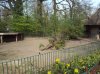
We then once more reached the large outdoor paddock for Lowland Tapir and Ring-tailed Coati which we had viewed a small portion of earlier in the day. The enclosure was, as noted previously, rather large and very thickly planted, and contained a great number of mature trees which may well have been in-situ when the zoo was originally constructed. In point of fact, when viewed from where we were now located it was apparent that the enclosure was substantially larger than we had initially estimated; something which was, of course, very pleasing from the point of view of animal welfare but which - when combined with the high number of trees and thick vegetation - meant we had trouble spotting the coati which we knew to be within the enclosure. However, a little patience paid dividends, and a rather unexpected surprise; as we observed the group of animals moving between trees and bushes within the enclosure, we rapidly realised that although a number of individuals were indeed Ring-tailed Coati, others were in fact Whitenosed Coati (Nasua narica), a much more unusual and attractive taxon. In point of fact, I had been aware that these animals had arrived at Magdeburg, part of an import from Cuba which had entered Europe a few weeks prior, but had been under the impression they were still in quarantine and that the arrival was as yet undeclared; certainly the signage on the enclosure had not been updated to reflect the new inhabitants, something which was rather unusual considering the high quality of the signage and enclosure labels in the collection as a whole. As such, seeing these animals was a very pleasant and unexpected surprise; they were very active and looked rather different to the only other member of the species I had seen to date, an elderly male at Paignton Zoo a year or so prior. As these animals represent a new import of known origin, I would be unsurprised if it transpired they are a different subspecies to those held in Europe already.
We then reached the crossroads where we had previously seen the Dhole; ahead of us lay the Dhole and Snow Leopard enclosures, and the path towards the exit, whilst to the left of us was the path towards the Tapir House and the main body of the zoo. However, to our right was the final section of the collection which we had not, as yet, visited. As such we made our way along this portion of the path. The first enclosure we came to was a large and rather pleasant-looking one holding Yellow Mongoose (Cynictis penicillata), a herpestid taxon with which I am rather fond. The enclosure was similar in many ways to the enclosures for the Dwarf Mongoose and Cape Ground Squirrel which we had seen earlier in the day writ large; sandy substrate with a mix of raised rockwork, tree stumps and concealed heatlamps, something which both looked very attractive and seemed to work very well for the inhabitants of the enclosure. A similar enclosure, albeit slightly smaller, was placed immediately beside it, containing a group of Common Cusimanse(Crossarchus obscurus). This taxon is the most seldom-seen of the five "common" mongoose species in European collections, and also one of the most unusual looking; in point of fact Magdeburg is the only collection in Germany which holds the species.
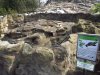
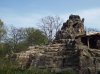
Around the corner from these two enclosures, in a short little cul-de-sac, we came to a larger enclosure of a similar basic design, with a few significant differences. Foremost among these was a great increase in the quantity and scope of the rockwork, which formed stone walls and ridges building on top of one another, forming a central plateau against the back wall of the enclosure, with further stone formations building up from the plateau. Furthermore, the level of tree trunks and branches was significantly reduced. This enclosure contained a breeding group of Indian Crested Porcupine (Hystrix indica), a taxon which until my visit to Tierpark Berlin I had never seen, and as such one which I still thoroughly enjoyed being able to observe. We were rather amused to note that the sound of our camera shutters were startling a young "porcupette" sufficiently for the adults to repeatedly enter defensive postures.
Beyond here, the path crossed over a small stream, swinging back up towards the Children's Zoo; however there were a pair of aviaries some way up this path which we had yet to observe - the last such enclosures for us to visit in Zoo Magdeburg. The first and larger of these contained Eurasian Great Grey Owl (Strix nebulosa lapponica), a species with which we were very familiar due to the high incidence of the taxon in UK collection. The aviary was quite sparsely vegetated, with a handful of young trees held within, but due to the large size of the aviary the inhabitants had more than enough space to move around if need be. The second aviary was of rather more interest to us; the inhabitants were South European Ural Owl (Strix uralensis macroura), a subspecies which is entirely absent from UK collections and as such entirely new to us. This aviary was also rather more thickly vegetated with small trees and bushes, which I suspect is partially due to the more reclusive nature of the Ural Owl compared to the Great Grey.
Having seen the entirety of the onshow collection at Zoo Magdeburg, we decided to revisit a handful of enclosures dotted around the zoo in order to get better photographs of certain species, including the Tataupa Tinamou and the Pied Tamarin, before making our way to the exit of the enclosure. This would be a suitable point to briefly discuss my thoughts on Zoo Magdeburg as a whole, considering the fact that these posts have partially been written as a guide for any Zoochatters who may wish to visit the collection in the future.
I was seriously impressed by the quality of the collection, both in terms of the enclosures and animal houses, and the number of rare and unusual taxa held within the zoo. Among the highlights in the first regard were the row of woodland enclosures containing native Eurasian wildlife, the area surrounding the Rhinoceros House, and the external paddock of the Tapir House, all of which were designed in such a way that they were entirely suited to the animals held within, striking the balance between giving the inhabitants privacy and scope to escape the public gaze, whilst still permitting visitors to view the inhabitants with relative ease. A facet of the enclosure design at Zoo Magdeburg as a whole which very much pleased me was the use that had been made of the natural environment; the woodland and streams which had already been present on the site prior to the zoo have in many cases been integrated into the animal enclosures, or alternatively tended to improve the general feel of the zoo as a whole. This meant that the collection felt very pleasant to walk around as a location in and of itself, even disregarding the animals held there - something which I feel to be very important for zoological collections.
Quite apart from some of the unusual species held at the collection - taxa like the Dusky Padamelon, Marbled Polecat, Angolan Colobus and Golden Jackal - it should also be observed that the number of taxa held for groups such as carnivorans and callitrichids was incredibly high for such a small collection, representing a very comprehensive selection of the variation found within these groups.
Upon leaving the zoo, we made our way back to Magdeburg-Neustadt, where we caught our train back to Berlin-Hauptbahnhof. After double-checking our plans for meeting on the Monday morning and bidding farewell to Chris and Ang, Hel and myself caught the S75 to Alexanderplatz. As it was still reasonably early in the day - approximately 5pm - we elected to walk back to our hostel rather than catch the U-Bahn. We then took the opportunity to drop our bags off at the hostel, before leaving again and walking down Schwedter Straße to the corner of Kastanieallee, where we had arranged to meet up with Hel's parents and Claire, with the intention of going out for an evening meal. We eventually elected to visit a very nice Italian restaurant called Pasta & Passione, which we all thoroughly enjoyed and which I highly reccommend. The food was very reasonably priced with large portion sizes, and the staff were incredibly helpful and friendly. I particularly recommend the salmon pasta, incidentally
Italienisches-Italian Restaurant
After finishing our meal, myself and Hel said goodnight to her family and made our way back to our hostel, looking forward to our second day of visiting Zoo Berlin on the Sunday.
(Follow this link for images of part of the Lowland Tapir and White-nosed Coati outdoor enclosure, the Yellow Mongoose enclosure, the Cusimanse enclosure, the Indian Crested Porcupine enclosure, the Great Grey Owl aviary and the South European Ural Owl aviary)
As we made our way to the tapir enclosure, we briefly took a look at the indoor viewing for the Giant Anteater. Within, we saw a pair of rooms, each of which contained a number of logs and branches along with a large amount of vegetation, but rather bare stone flooring. The two anteaters were visible curled up in the corner of one of the rooms, which helped to provide some level of scale. As such, it was evident that the indoor enclosure was spacious enough to be suitable for the taxon it contained, although it could have benefited from a more appealing-looking substrate on the floor of the enclosure.
We then once more reached the large outdoor paddock for Lowland Tapir and Ring-tailed Coati which we had viewed a small portion of earlier in the day. The enclosure was, as noted previously, rather large and very thickly planted, and contained a great number of mature trees which may well have been in-situ when the zoo was originally constructed. In point of fact, when viewed from where we were now located it was apparent that the enclosure was substantially larger than we had initially estimated; something which was, of course, very pleasing from the point of view of animal welfare but which - when combined with the high number of trees and thick vegetation - meant we had trouble spotting the coati which we knew to be within the enclosure. However, a little patience paid dividends, and a rather unexpected surprise; as we observed the group of animals moving between trees and bushes within the enclosure, we rapidly realised that although a number of individuals were indeed Ring-tailed Coati, others were in fact Whitenosed Coati (Nasua narica), a much more unusual and attractive taxon. In point of fact, I had been aware that these animals had arrived at Magdeburg, part of an import from Cuba which had entered Europe a few weeks prior, but had been under the impression they were still in quarantine and that the arrival was as yet undeclared; certainly the signage on the enclosure had not been updated to reflect the new inhabitants, something which was rather unusual considering the high quality of the signage and enclosure labels in the collection as a whole. As such, seeing these animals was a very pleasant and unexpected surprise; they were very active and looked rather different to the only other member of the species I had seen to date, an elderly male at Paignton Zoo a year or so prior. As these animals represent a new import of known origin, I would be unsurprised if it transpired they are a different subspecies to those held in Europe already.
We then reached the crossroads where we had previously seen the Dhole; ahead of us lay the Dhole and Snow Leopard enclosures, and the path towards the exit, whilst to the left of us was the path towards the Tapir House and the main body of the zoo. However, to our right was the final section of the collection which we had not, as yet, visited. As such we made our way along this portion of the path. The first enclosure we came to was a large and rather pleasant-looking one holding Yellow Mongoose (Cynictis penicillata), a herpestid taxon with which I am rather fond. The enclosure was similar in many ways to the enclosures for the Dwarf Mongoose and Cape Ground Squirrel which we had seen earlier in the day writ large; sandy substrate with a mix of raised rockwork, tree stumps and concealed heatlamps, something which both looked very attractive and seemed to work very well for the inhabitants of the enclosure. A similar enclosure, albeit slightly smaller, was placed immediately beside it, containing a group of Common Cusimanse(Crossarchus obscurus). This taxon is the most seldom-seen of the five "common" mongoose species in European collections, and also one of the most unusual looking; in point of fact Magdeburg is the only collection in Germany which holds the species.
Around the corner from these two enclosures, in a short little cul-de-sac, we came to a larger enclosure of a similar basic design, with a few significant differences. Foremost among these was a great increase in the quantity and scope of the rockwork, which formed stone walls and ridges building on top of one another, forming a central plateau against the back wall of the enclosure, with further stone formations building up from the plateau. Furthermore, the level of tree trunks and branches was significantly reduced. This enclosure contained a breeding group of Indian Crested Porcupine (Hystrix indica), a taxon which until my visit to Tierpark Berlin I had never seen, and as such one which I still thoroughly enjoyed being able to observe. We were rather amused to note that the sound of our camera shutters were startling a young "porcupette" sufficiently for the adults to repeatedly enter defensive postures.
Beyond here, the path crossed over a small stream, swinging back up towards the Children's Zoo; however there were a pair of aviaries some way up this path which we had yet to observe - the last such enclosures for us to visit in Zoo Magdeburg. The first and larger of these contained Eurasian Great Grey Owl (Strix nebulosa lapponica), a species with which we were very familiar due to the high incidence of the taxon in UK collection. The aviary was quite sparsely vegetated, with a handful of young trees held within, but due to the large size of the aviary the inhabitants had more than enough space to move around if need be. The second aviary was of rather more interest to us; the inhabitants were South European Ural Owl (Strix uralensis macroura), a subspecies which is entirely absent from UK collections and as such entirely new to us. This aviary was also rather more thickly vegetated with small trees and bushes, which I suspect is partially due to the more reclusive nature of the Ural Owl compared to the Great Grey.
Having seen the entirety of the onshow collection at Zoo Magdeburg, we decided to revisit a handful of enclosures dotted around the zoo in order to get better photographs of certain species, including the Tataupa Tinamou and the Pied Tamarin, before making our way to the exit of the enclosure. This would be a suitable point to briefly discuss my thoughts on Zoo Magdeburg as a whole, considering the fact that these posts have partially been written as a guide for any Zoochatters who may wish to visit the collection in the future.
I was seriously impressed by the quality of the collection, both in terms of the enclosures and animal houses, and the number of rare and unusual taxa held within the zoo. Among the highlights in the first regard were the row of woodland enclosures containing native Eurasian wildlife, the area surrounding the Rhinoceros House, and the external paddock of the Tapir House, all of which were designed in such a way that they were entirely suited to the animals held within, striking the balance between giving the inhabitants privacy and scope to escape the public gaze, whilst still permitting visitors to view the inhabitants with relative ease. A facet of the enclosure design at Zoo Magdeburg as a whole which very much pleased me was the use that had been made of the natural environment; the woodland and streams which had already been present on the site prior to the zoo have in many cases been integrated into the animal enclosures, or alternatively tended to improve the general feel of the zoo as a whole. This meant that the collection felt very pleasant to walk around as a location in and of itself, even disregarding the animals held there - something which I feel to be very important for zoological collections.
Quite apart from some of the unusual species held at the collection - taxa like the Dusky Padamelon, Marbled Polecat, Angolan Colobus and Golden Jackal - it should also be observed that the number of taxa held for groups such as carnivorans and callitrichids was incredibly high for such a small collection, representing a very comprehensive selection of the variation found within these groups.
Upon leaving the zoo, we made our way back to Magdeburg-Neustadt, where we caught our train back to Berlin-Hauptbahnhof. After double-checking our plans for meeting on the Monday morning and bidding farewell to Chris and Ang, Hel and myself caught the S75 to Alexanderplatz. As it was still reasonably early in the day - approximately 5pm - we elected to walk back to our hostel rather than catch the U-Bahn. We then took the opportunity to drop our bags off at the hostel, before leaving again and walking down Schwedter Straße to the corner of Kastanieallee, where we had arranged to meet up with Hel's parents and Claire, with the intention of going out for an evening meal. We eventually elected to visit a very nice Italian restaurant called Pasta & Passione, which we all thoroughly enjoyed and which I highly reccommend. The food was very reasonably priced with large portion sizes, and the staff were incredibly helpful and friendly. I particularly recommend the salmon pasta, incidentally
Italienisches-Italian Restaurant
After finishing our meal, myself and Hel said goodnight to her family and made our way back to our hostel, looking forward to our second day of visiting Zoo Berlin on the Sunday.
(Follow this link for images of part of the Lowland Tapir and White-nosed Coati outdoor enclosure, the Yellow Mongoose enclosure, the Cusimanse enclosure, the Indian Crested Porcupine enclosure, the Great Grey Owl aviary and the South European Ural Owl aviary)
Last edited by a moderator:
 )
)