Cape Kiritappu
One of my primary "target" mammals in Hokkaido was the Sea Otter. They were heavily hunted in the past for their fur and had consequently been rendered extinct in Japan by the start of the 1900s. In the early 1980s individual otters started being seen at certain spots around the Nemuro Peninsula, especially at Cape Ochiishi and Cape Kiritappu, having drifted over from "nearby" Russian islands. They are now breeding around the peninsula and are not such a rare sight any more, although it is still not a large population. There are estimated to be about fifty animals living off Hokkaido.
Cape Ochiishi was intended to be my main site to look for them, with Cape Kiritappu a back-up if I failed there, but because the latter cape seemed like it would be a good option as a day-trip from Kushiro - being less than 1.5 hours by train - I went there first.
The train from Kushiro to Nemuro (the main town on the Nemuro Peninsula) stops at the stations of Akkeshi (for Lake Akkeshi, which I never visited in the end) and Chanai (for Cape Kiritappu) and also Ochiishi (for Cape Ochiishi). It leaves Kushiro at 5.35am, then 8.21am, and then the next one not until 11.15am. I knew I wouldn't get the 5.35am one so went for the 8.21am which reaches Chanai at 9.41am.
There were snowy landscapes all the way. Lots of Sika Deer as well. I took this train several times to different towns, and every ride there were dozens of Sika seen. They are very common here. After a number of attempts I gave up trying to photograph them from the moving train because it just wasn't working.
Not far before Chanai I saw my first Steller's Sea Eagle - what a gigantic bird! I knew they would be big, but seeing one perched in a small tree is like seeing a gorilla sitting on a child's swing set. Then immediately after, about ten more of them all sitting in a loose group in trees by the track.
At Chanai Station there is a royal blue mini-bus which meets the train's arrival and for 200 Yen goes to Kiritappu town. My train arrived at 9.41am and the bus left at 9.45am. It reached the terminus stop, 3km from the cape, at 10.20am. The return times at 2pm, 4.50pm, and 7.45pm, are likewise timed to be able to catch the train going back to Kushiro.
I was expecting to be walking to the cape through snowdrifts but there is a road with a pavement alongside all the way to a parking lot just near the lighthouse, and in fact there wasn't really much snow lying out here anyway.
The snow had been coming and going on the train ride, but it decided to set in properly once I got off the bus. It wasn't heavy snow, although it was very persistent, so it was more or less melting as soon as it hit the ground. However because I was walking towards the cape the wind was coming straight at me off the ocean, and so for the whole walk the snow was being driven horizontally into my face like shards of ice (well, I guess it literally
was shards of ice!).
There aren't a lot of passerines and other small birds around Hokkaido in the winter - or at least not in the places I'm at - so when I saw a big flock of sparrowy-looking things near a house on the way to the cape I had to stop to investigate. They were very flighty, so I had to stand some way back and try to avoid scaring them, but even then any sudden movement would cause the whole flock to take off and go swirling around above the fields before returning to the bushes by the house. They proved to be Asian Rosy Finches, with black fronts, pink flanks, and distinctive golden napes. Very much more attractive than their photos on eBird!
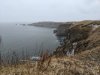
Just before reaching the end of the road was a viewing area above the cliffs with a glass-sided shelter - a welcome respite from the freezing wind, although you couldn't see anything when inside it. Standing on the edge of the cliffs scanning for Sea Otters, with the razor-snow pelting my face, I saw a pair of Harlequin Ducks floating on the ocean below. What a spectacular bird the male Harlequin Duck is, if I can say that without sounding sexist. I'd earlier mentioned the Falcated Ducks and Baikal Teal as my most-wanted ducks in Japan, but the Harlequin Duck was my
real most-wanted duck. I just didn't want to jinx it. It seemed like such a fabulous almost-mythical bird to me that I didn't really expect to see any, but they turned out to be common all around the coastlines of eastern Hokkaido.
That wasn't the only new bird seen from the cliffs, albeit none coming anywhere near close to being as superb as the Harlequin Ducks. There were Slaty-backed Gulls gliding about, and down on the sea with the Harlequin Ducks were Red-necked Grebes and Red-breasted Mergansers.
Then I saw a Kuril Seal. Such a weird beastie. It points its nose skywards and floats with just the top of its face above the water, so you're wondering what you're even looking at. Then it pops its head right out to look around, before pointing its nose upwards again and just sinking straight downwards and disappearing. No roll and dive, just reverse.
I continued on to the end of the cape. From the car parking area there is a track along a narrow peninsula - sort of a peninsula off the peninsula, which itself is off a peninsula (and so on, like fleas). It was very cold out there! Then I saw a pair of Sea Otters. They are huge! Like the Steller's Sea Eagles I knew they would be big but I had no idea they would be
that big! I had been checking out every dark shape on the ocean, which were all ducks and grebes and cormorants, but it turned out that the otters are so big that there's no mistaking what they are, even from the cliffs.
I had imagined they would just be floating about on their backs and when swimming they would do it like a normal otter, but they seem to use their tail and hind feet to propel themselves backwards across the surface. Really fast too, like they have outboard motors, which I guess they sort of do with that tail.
I couldn't photograph these first animals from where I was because the wind was driving sleet-like snow straight into my face and my camera lens would have been instantly iced up. Later I managed to find a position where I could have my back to the wind to take some photos. The water was a fair distance below me and I couldn't actually see through the snow to tell whether anything was in focus, so I just hoped for the best. You can't even really see the snow in the photos though.
I think I saw three Sea Otters. First a pair, then a single animal on the other side of the little peninsula which was definitely a different animal, and then what was probably the same pair again - these are the ones of which I got the "better" photos (the single otter was too far out so the photos were more like a black blob than an otter). There are apparently only about ten animals at this location.