Part X: Assorted Areas En-route To The Exit
We proceeded to head towards the pheasantry – a collection of assorted enclosures and aviaries which held a rather choice selection of largely cold-climate birds. Before reaching the pheasantry area itself, we came to a large enclosure which held Black-necked Crane (Grus nigricolis), a very nice species which is rather uncommon in European collections.
As noted above, the pheasantry at Tierpark Berlin contains a wide selection of bird species, many being unusual in European collections or indeed unique to Tierpark Berlin. Many of these taxa represent members of the Phasianidae, but a number of unusual passerines are also found in this area. One of the particular highlights are the following three taxa:
Cabot's Tragopan (Tragopan caboti)
Satyr Tragopan (Tragopan satyra)
Temminck's Tragopan (Tragopan temminckii)
Very few European collections hold all three of these species; as such it is a pleasant and unusual experience to be able to observe the three taxa and note the similarities and differences between them. However, with the exception of the Cabot's Tragopan these species cannot be termed particularly unusual in captivity when judged on their individual merits. A selection of the more unusual and attractive species held in this area follows:
Scintillating Cooper Pheasant (Syrmaticus soemmerringii scintillans)
Grey-headed Goldfinch (Carduelis carduelis caniceps)
Red-tailed Laughingthrush (Trochalopteron milnei)
Black-throated Laughingthrush (Dryonastes chinensis)
Brown-cheeked Laughingthrush (Trochalopteron elliotii)
Chinese Grosbeak (Eophona migratoria)
Arabian Chukar Partridge (Alectoris melanocephala)
Siberian Thrush (Zoothera sibirica)
Brown-eared Pheasant (Crossoptilon mantchuricum)
Himalayan Snowcock (Tetraogallus himalayensis)
It may come as some surprise to learn that of these selected taxa, the one I was most pleased to see was actually the Goldfinch, this being due in very large part with my familiarity with the goldfinches found in the United Kingdom; as such, I found it very interesting to observe a closely related taxon at close range for a prolonged period of time. Overall I was very impressed by the pheasantry, which was in a very quiet corner of the Tierpark which I suspect is often bypassed by visitors; due to the seclusion and quiet, the species found within the various aviaries here were rather showy and unafraid to come into plain view, unlike many species of bird I had seen previously in such aviaries.
After leaving the pheasantry, we walked through the Karl-Foerster-Garten and past the enclosure for Ring-tailed Lemur (Lemur catta) in order to reach an area containing several more highlights of the Tierpark collection; first we reached aviaries containing Harpy Eagle (Harpia harpyja) and Turkmenian Eagle-owl (Bubo bubo omissus) before arriving at two neighbouring paddock enclosures which held Mishmi Takin (Budorcas taxicolor taxicolor) and Shensi Takin (Budorcas taxicolor bedfordi). Although seeing the Harpy Eagle was very interesting, considering the fact that along with the Steller’s Sea Eagle and the Philippine Eagle it represents one of the largest birds of prey in the world, the highlight of this area was of course the two species of Takin, both of which had produced calves in the week or so immediately prior. I was, of course, already familiar with the Mishmi Takin but the Shensi, along with the Sichuan I had seen earlier in the afternoon in the highland area of Tierpark, were entirely new taxa for me. I found it extremely interesting to be able to visually compare these two forms of Takin, and compare them to my recent experience with the Shensi – as such, the fact that Tierpark holds three out of the four extant subspecies of Takin is one of the particular highlights of the collection, and something which I suspect even those zoonerds who are not unduly interested in hoofstock would find themselves attracted by.
A little further on from here, we came to an aviary which was marked on the map as an Ibis house; however, when we investigated the house we found it contained a rather nice selection of wading and semi-aquatic birds from a number of groups, rather than merely ibis species. None of the species were new to Hel or myself – in point of fact, I recently saw one, the Glossy Ibis (Plegadis falcinellus), in the wild – but the selection of taxa was nonetheless rather choice. Two species in particular, the Little Pied Cormorant (Phalacrocorax melanoleucos) and White-faced Heron (Egretta novaehollandiae), are almost entirely absent from collections within the UK. The final two species in this aviary were Maned Wood Duck (Chenonetta jubata) and Straw-necked Ibis (Threskiornis spinicollis). We rather liked this aviary, as all the species within were rather active and – as noted previously – it gave us the chance to observe species which we have little chance to see in the UK. The aviary structure itself was nothing out of the ordinary, being fit for the purpose but not representing anything unduly impressive or dissimilar to enclosures and aviaries we were familiar with from the United Kingdom.
Opposite the ibis house were a collection of owl aviaries, which led towards a circular area dedicated to birds of prey, holding a great number of rare and unusual taxa, along with a handful of more common species – with further species, from what Markus told us, held permanently offshow in this area. However, even those species which were on display represented a rather good selection showing the range and variety of the species of birds of prey found across the world, including the selection of owl taxa in aviaries leading to the central area. A number of species here represented lifeticks, whilst others were species I had seen only once or twice previously. The species held in this area, and the owl aviaries leading towards it, were as follows:
Spotted Eagle-Owl (Bubo africanus)
Mackinder's Eagle-Owl (Bubo mackinderi)
Verreaux's Eagle-Owl (Bubo lacteus)
Rusty-barred Owl (Strix hylophila)
Oriental Bay Owl (Phodilus badius)
Rufous-legged Owl (Strix rufipes)
----------
Striated Caracara (Phalcoboenus australis)
White-tailed Eagle (Haliaeetus albicilla)
Bald Eagle (Haliaeetus leucocephalus)
Steppe eagle (Aquila nipalensis)
Black-chested Buzzard-eagle (Geranoaetus melanoleucus)
Ferruginous Hawk (Buteo regalis)
Eastern Imperial Eagle (Aquila heliaca)
After leaving this area, and with less than an hour of zoo opening hours remaining, we decided to quickly return to the area of the Tierpark containing the hyena enclosures, as we had yet to spot the Striped Hyena (Hyaena hyaena) and thought it would be worth checking the area in the hope they were active. The route to this area took us through a portion of the Tierpark we had not seen thus far, containing a number of hoofstock taxa – largely comprising various species of deer, but also including enclosures for Watusi, Nellore Zebu and Gayal. Unfortunately, many of the species in this area had already been shut inside their housing for the night, but we did see two rather nice deer taxa; Hog Deer (Axis porcinus porcinus) and Myanmar Thamin (Rucervus eldii thamin), each in reasonably-sized enclosures.
However, any disappointment we may have felt as a result of the large number of taxa in this area which were not visible was more than compensated for by the next enclosure we came to; a rather nice aviary for a variety of heron taxa, somewhat akin in feel and design to the ibis aviary we had encountered a short time prior. However, unlike the aforementioned aviary, this enclosure contained a number of species which neither Hel nor myself had seen in the past; when taken together with the fact that I have quite a strong fondness for herons as a group, this meant we enjoyed observing the species in this enclosure rather a lot. The highlight, of course, was the Philippine Rufous Night-heron (Nycticorax caledonicus manillensis), a species which is very seldom seen in European collections when compared to the much more common Black-crowned Night Heron, but in my opinion is much more interesting to observe, being much more striking in appearance and a very active animal. This said, I was also very pleased by the presence of a number of both Indian Pond-heron(Ardeola grayii) and Javan Pond-heron (Ardeola speciosa), species which although present in collections within the United Kingdom I had never seen up until that point, and which are rather attractive species in their own right. The final species found in this aviary was Western Cattle Egret (Bubulcus ibis ibis), a pleasant enough taxon but one which pales in comparison to those it shares an enclosure with.
After leaving the area of the heron aviary, we continued towards the carnivore area. However, our attempt to see the Striped Hyena, although permitting us further views of the other hyena taxa, proved to be fruitless – as such, we decided to make one last detour before leaving the Tierpark. We made our way around one side of the very substantial group of camel paddocks which is found more or less in the centre of the Tierpark, portions of which we had passed a number of times throughout the day without paying a great deal of attention to the inhabitants, and which have as yet remained unremarked upon. However, as our route was now taking us – for the first time - past the portion of the paddocks which held a species of some interest to me, it strikes me as appropriate to discuss the paddocks as a whole here.
The camel paddocks take up a not insubstantial portion of the Tierpark as a whole, covering a similar area to the entirety of the highland area. The main attraction of the paddocks - somewhat appropriately for a collection which displays a number of groups in their full range of diversity - is without a doubt the fact that they hold a complete set of camelids, each species being found in paddocks which come close to representing the largest in the whole Tierpark. I have been told that many on the continent familiar with the Tierpark somewhat dislike this area of the collection, believing that the amount of space taken up by these species - which are, I believe, numerous in continental collections – could better be used in the display of more unusual species, or taxa in greater need of conservation and protection. Although I can understand this point of view, I was rather taken with this area of the Tierpark due in large part to the fact that although common on the continent, the Dromedary (Camelus dromedarius) is almost entirely absent from UK collections – as such, this was the first time I had ever seen the species. Moreover, the fact that all six species of camelid are represented in the one location – much like the previously mentioned array of equine taxa held by the Tierpark – allows for an understanding of the full range of variation found in the group, something which I would argue more than compensates for the use of these enclosures for species some would deem commonplace in captivity. This area also contains a small area containing a flock of Caribbean Flamingo (Phoenicopterus ruber), immediately next to the Bactrian Camel (Camelus bactrianus) enclosure.
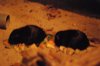
After passing the portion of these paddocks containing the Dromedary, we reached a pair of enclosures which held Eurasian Wild Boar (Sus scrofa scrofa) and Chacoan Peccary (Catagonus wagneri), both of which were very visible and active despite the darkening skies. Although the former species is rather common in zoological collections, I was rather pleased to see the latter, which -barring a brief period of time in the 1970’s where it was held at Zoo Berlin shortly after the species was rediscovered - had not held in European collections until it arrived at the Tierpark in 2012. Despite this, the species has since bred on a few occasions and will hopefully be able to gain a foothold in zoological collections in the coming decade or so; I suspect that when one considers the fact that this species is much less-known and in significantly lower numbers in the wild when compared to the other species of peccary, a move towards further captive holdings of the species is rather likely. Whilst in the area, we took the opportunity to walk up a path running between the camel paddocks to a small house where a rapidly growing colony of Chacoan Mara (Dolichotis salinicola) can be found. This species is another relatively recent arrival into Tierpark Berlin, having arrived in 2011 and proving itself to be a regularly breeding taxon. The house appeared to hold something in the range of a dozen animals, of varying ages.
We then finally made our way towards the exit, choosing to leave through the Bear Gate. Our route towards the gate led us past one side of the various deer paddocks which run from close to this gate to the canals where the pelican colony can be found outside the winter months. Although we observed a number of species here, full discussion of these paddocks and the species within will come when I discuss the second day we visited Tierpark Berlin, as we did not see the paddocks in their entirety at this point in time.
We left the Tierpark feeling somewhat tired, but having thoroughly enjoyed our day. We made arrangements to meet Markus once again the following morning, this time at Zoo Berlin, before heading towards the Tierpark U-Bahn. As we awaited the U5 back to Alexanderplatz, we contacted Hel’s parents and Claire to let them know we were now available to meet up for a meal, and arranged to meet at 8pm outside the Hackescher Markt S-Bahn. To this end, we then took the S75 from Alexanderplatz to Hackescher Markt, and there went to a rather nice restaurant called Barist. We then discussed our visit to Tierpark Berlin with Hel’s family, along with the places they themselves had visited, over our meal.
After the meal, we bid Hel’s parents and Claire farewell before heading back to our hostel, tired from our busy day and eagerly awaiting our first experience of Zoo Berlin the coming morning.
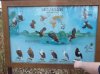
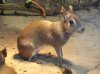
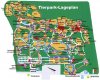
Attached are a photo of a Golden Takin calf, a noticeboard discussing the various species of Sea Eagle, a Chacoan Mara and a copy of the Tierpark Berlin map which has been annotated with red denoting the route we walked with Markus, Sven and Katja, and purple denoting the route we walked with Markus only.
We proceeded to head towards the pheasantry – a collection of assorted enclosures and aviaries which held a rather choice selection of largely cold-climate birds. Before reaching the pheasantry area itself, we came to a large enclosure which held Black-necked Crane (Grus nigricolis), a very nice species which is rather uncommon in European collections.
As noted above, the pheasantry at Tierpark Berlin contains a wide selection of bird species, many being unusual in European collections or indeed unique to Tierpark Berlin. Many of these taxa represent members of the Phasianidae, but a number of unusual passerines are also found in this area. One of the particular highlights are the following three taxa:
Cabot's Tragopan (Tragopan caboti)
Satyr Tragopan (Tragopan satyra)
Temminck's Tragopan (Tragopan temminckii)
Very few European collections hold all three of these species; as such it is a pleasant and unusual experience to be able to observe the three taxa and note the similarities and differences between them. However, with the exception of the Cabot's Tragopan these species cannot be termed particularly unusual in captivity when judged on their individual merits. A selection of the more unusual and attractive species held in this area follows:
Scintillating Cooper Pheasant (Syrmaticus soemmerringii scintillans)
Grey-headed Goldfinch (Carduelis carduelis caniceps)
Red-tailed Laughingthrush (Trochalopteron milnei)
Black-throated Laughingthrush (Dryonastes chinensis)
Brown-cheeked Laughingthrush (Trochalopteron elliotii)
Chinese Grosbeak (Eophona migratoria)
Arabian Chukar Partridge (Alectoris melanocephala)
Siberian Thrush (Zoothera sibirica)
Brown-eared Pheasant (Crossoptilon mantchuricum)
Himalayan Snowcock (Tetraogallus himalayensis)
It may come as some surprise to learn that of these selected taxa, the one I was most pleased to see was actually the Goldfinch, this being due in very large part with my familiarity with the goldfinches found in the United Kingdom; as such, I found it very interesting to observe a closely related taxon at close range for a prolonged period of time. Overall I was very impressed by the pheasantry, which was in a very quiet corner of the Tierpark which I suspect is often bypassed by visitors; due to the seclusion and quiet, the species found within the various aviaries here were rather showy and unafraid to come into plain view, unlike many species of bird I had seen previously in such aviaries.
After leaving the pheasantry, we walked through the Karl-Foerster-Garten and past the enclosure for Ring-tailed Lemur (Lemur catta) in order to reach an area containing several more highlights of the Tierpark collection; first we reached aviaries containing Harpy Eagle (Harpia harpyja) and Turkmenian Eagle-owl (Bubo bubo omissus) before arriving at two neighbouring paddock enclosures which held Mishmi Takin (Budorcas taxicolor taxicolor) and Shensi Takin (Budorcas taxicolor bedfordi). Although seeing the Harpy Eagle was very interesting, considering the fact that along with the Steller’s Sea Eagle and the Philippine Eagle it represents one of the largest birds of prey in the world, the highlight of this area was of course the two species of Takin, both of which had produced calves in the week or so immediately prior. I was, of course, already familiar with the Mishmi Takin but the Shensi, along with the Sichuan I had seen earlier in the afternoon in the highland area of Tierpark, were entirely new taxa for me. I found it extremely interesting to be able to visually compare these two forms of Takin, and compare them to my recent experience with the Shensi – as such, the fact that Tierpark holds three out of the four extant subspecies of Takin is one of the particular highlights of the collection, and something which I suspect even those zoonerds who are not unduly interested in hoofstock would find themselves attracted by.
A little further on from here, we came to an aviary which was marked on the map as an Ibis house; however, when we investigated the house we found it contained a rather nice selection of wading and semi-aquatic birds from a number of groups, rather than merely ibis species. None of the species were new to Hel or myself – in point of fact, I recently saw one, the Glossy Ibis (Plegadis falcinellus), in the wild – but the selection of taxa was nonetheless rather choice. Two species in particular, the Little Pied Cormorant (Phalacrocorax melanoleucos) and White-faced Heron (Egretta novaehollandiae), are almost entirely absent from collections within the UK. The final two species in this aviary were Maned Wood Duck (Chenonetta jubata) and Straw-necked Ibis (Threskiornis spinicollis). We rather liked this aviary, as all the species within were rather active and – as noted previously – it gave us the chance to observe species which we have little chance to see in the UK. The aviary structure itself was nothing out of the ordinary, being fit for the purpose but not representing anything unduly impressive or dissimilar to enclosures and aviaries we were familiar with from the United Kingdom.
Opposite the ibis house were a collection of owl aviaries, which led towards a circular area dedicated to birds of prey, holding a great number of rare and unusual taxa, along with a handful of more common species – with further species, from what Markus told us, held permanently offshow in this area. However, even those species which were on display represented a rather good selection showing the range and variety of the species of birds of prey found across the world, including the selection of owl taxa in aviaries leading to the central area. A number of species here represented lifeticks, whilst others were species I had seen only once or twice previously. The species held in this area, and the owl aviaries leading towards it, were as follows:
Spotted Eagle-Owl (Bubo africanus)
Mackinder's Eagle-Owl (Bubo mackinderi)
Verreaux's Eagle-Owl (Bubo lacteus)
Rusty-barred Owl (Strix hylophila)
Oriental Bay Owl (Phodilus badius)
Rufous-legged Owl (Strix rufipes)
----------
Striated Caracara (Phalcoboenus australis)
White-tailed Eagle (Haliaeetus albicilla)
Bald Eagle (Haliaeetus leucocephalus)
Steppe eagle (Aquila nipalensis)
Black-chested Buzzard-eagle (Geranoaetus melanoleucus)
Ferruginous Hawk (Buteo regalis)
Eastern Imperial Eagle (Aquila heliaca)
After leaving this area, and with less than an hour of zoo opening hours remaining, we decided to quickly return to the area of the Tierpark containing the hyena enclosures, as we had yet to spot the Striped Hyena (Hyaena hyaena) and thought it would be worth checking the area in the hope they were active. The route to this area took us through a portion of the Tierpark we had not seen thus far, containing a number of hoofstock taxa – largely comprising various species of deer, but also including enclosures for Watusi, Nellore Zebu and Gayal. Unfortunately, many of the species in this area had already been shut inside their housing for the night, but we did see two rather nice deer taxa; Hog Deer (Axis porcinus porcinus) and Myanmar Thamin (Rucervus eldii thamin), each in reasonably-sized enclosures.
However, any disappointment we may have felt as a result of the large number of taxa in this area which were not visible was more than compensated for by the next enclosure we came to; a rather nice aviary for a variety of heron taxa, somewhat akin in feel and design to the ibis aviary we had encountered a short time prior. However, unlike the aforementioned aviary, this enclosure contained a number of species which neither Hel nor myself had seen in the past; when taken together with the fact that I have quite a strong fondness for herons as a group, this meant we enjoyed observing the species in this enclosure rather a lot. The highlight, of course, was the Philippine Rufous Night-heron (Nycticorax caledonicus manillensis), a species which is very seldom seen in European collections when compared to the much more common Black-crowned Night Heron, but in my opinion is much more interesting to observe, being much more striking in appearance and a very active animal. This said, I was also very pleased by the presence of a number of both Indian Pond-heron(Ardeola grayii) and Javan Pond-heron (Ardeola speciosa), species which although present in collections within the United Kingdom I had never seen up until that point, and which are rather attractive species in their own right. The final species found in this aviary was Western Cattle Egret (Bubulcus ibis ibis), a pleasant enough taxon but one which pales in comparison to those it shares an enclosure with.
After leaving the area of the heron aviary, we continued towards the carnivore area. However, our attempt to see the Striped Hyena, although permitting us further views of the other hyena taxa, proved to be fruitless – as such, we decided to make one last detour before leaving the Tierpark. We made our way around one side of the very substantial group of camel paddocks which is found more or less in the centre of the Tierpark, portions of which we had passed a number of times throughout the day without paying a great deal of attention to the inhabitants, and which have as yet remained unremarked upon. However, as our route was now taking us – for the first time - past the portion of the paddocks which held a species of some interest to me, it strikes me as appropriate to discuss the paddocks as a whole here.
The camel paddocks take up a not insubstantial portion of the Tierpark as a whole, covering a similar area to the entirety of the highland area. The main attraction of the paddocks - somewhat appropriately for a collection which displays a number of groups in their full range of diversity - is without a doubt the fact that they hold a complete set of camelids, each species being found in paddocks which come close to representing the largest in the whole Tierpark. I have been told that many on the continent familiar with the Tierpark somewhat dislike this area of the collection, believing that the amount of space taken up by these species - which are, I believe, numerous in continental collections – could better be used in the display of more unusual species, or taxa in greater need of conservation and protection. Although I can understand this point of view, I was rather taken with this area of the Tierpark due in large part to the fact that although common on the continent, the Dromedary (Camelus dromedarius) is almost entirely absent from UK collections – as such, this was the first time I had ever seen the species. Moreover, the fact that all six species of camelid are represented in the one location – much like the previously mentioned array of equine taxa held by the Tierpark – allows for an understanding of the full range of variation found in the group, something which I would argue more than compensates for the use of these enclosures for species some would deem commonplace in captivity. This area also contains a small area containing a flock of Caribbean Flamingo (Phoenicopterus ruber), immediately next to the Bactrian Camel (Camelus bactrianus) enclosure.
After passing the portion of these paddocks containing the Dromedary, we reached a pair of enclosures which held Eurasian Wild Boar (Sus scrofa scrofa) and Chacoan Peccary (Catagonus wagneri), both of which were very visible and active despite the darkening skies. Although the former species is rather common in zoological collections, I was rather pleased to see the latter, which -barring a brief period of time in the 1970’s where it was held at Zoo Berlin shortly after the species was rediscovered - had not held in European collections until it arrived at the Tierpark in 2012. Despite this, the species has since bred on a few occasions and will hopefully be able to gain a foothold in zoological collections in the coming decade or so; I suspect that when one considers the fact that this species is much less-known and in significantly lower numbers in the wild when compared to the other species of peccary, a move towards further captive holdings of the species is rather likely. Whilst in the area, we took the opportunity to walk up a path running between the camel paddocks to a small house where a rapidly growing colony of Chacoan Mara (Dolichotis salinicola) can be found. This species is another relatively recent arrival into Tierpark Berlin, having arrived in 2011 and proving itself to be a regularly breeding taxon. The house appeared to hold something in the range of a dozen animals, of varying ages.
We then finally made our way towards the exit, choosing to leave through the Bear Gate. Our route towards the gate led us past one side of the various deer paddocks which run from close to this gate to the canals where the pelican colony can be found outside the winter months. Although we observed a number of species here, full discussion of these paddocks and the species within will come when I discuss the second day we visited Tierpark Berlin, as we did not see the paddocks in their entirety at this point in time.
We left the Tierpark feeling somewhat tired, but having thoroughly enjoyed our day. We made arrangements to meet Markus once again the following morning, this time at Zoo Berlin, before heading towards the Tierpark U-Bahn. As we awaited the U5 back to Alexanderplatz, we contacted Hel’s parents and Claire to let them know we were now available to meet up for a meal, and arranged to meet at 8pm outside the Hackescher Markt S-Bahn. To this end, we then took the S75 from Alexanderplatz to Hackescher Markt, and there went to a rather nice restaurant called Barist. We then discussed our visit to Tierpark Berlin with Hel’s family, along with the places they themselves had visited, over our meal.
After the meal, we bid Hel’s parents and Claire farewell before heading back to our hostel, tired from our busy day and eagerly awaiting our first experience of Zoo Berlin the coming morning.
Attached are a photo of a Golden Takin calf, a noticeboard discussing the various species of Sea Eagle, a Chacoan Mara and a copy of the Tierpark Berlin map which has been annotated with red denoting the route we walked with Markus, Sven and Katja, and purple denoting the route we walked with Markus only.