Bonus post #15 Warsawa Zoo Birdhouse and species lists
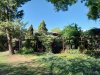
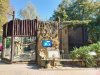
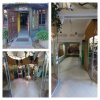
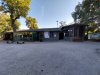
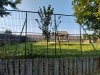
And there it is, Warsaw’s thrilling hightlight, hardly visible between the trees and other greenery. The
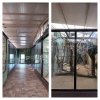
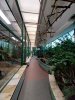
Birdhouse looks form the outside a bit scruffy and neglected, but inside it’s aviaries are bright, shining and simply briljant. It’s an old building and it has nothing of Wroclaw’s architectural details and high window panels, and it also exudes none of the history so typical of Vienna’s famous Birdhouse, but it’s packed with rare and interesting species in extremely well designed enclosures.

It’s start outdoors with a couple of aviaries for European roller, Eurasian curlew and European Thick-knee and the very little shown but adorable Collared pratincole. Inside it starts with a corridor along 3 aviaries : wading birds (Ruff, Blackwinged Stilt, Common Redshank and the very rarely displayed Eurasian Golden Plover), a cosy garden aviary (Rosy starling and Eurasian Hoopoe) and a final one for African Pygmy-falcon. Good already, but it can be better.
After that follows a room with 5 aviaries and an entrance to the free-flight hall. The single non bird species to be found in this section are Black-and-rufous elephant shrew, which could easily be accompanied by one or more birds. The 4 other aviaries lie in a straight line:
1. Pink-headed fruit-dove, Blue-crowned Hanging parrot, White-rumped Shama
2. Wompoo Fruit-dove, Cinnamon Ground-dove
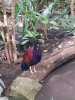
 Wompoo Fruit-dove (Ptilinopus magnificus)
3. Guira cuckoo and Elegant crested tinamou
4. Kea
None of these are very large but certainly those for the fruit-doves are well designed with detailed attention to plant life.
Not a bad section, but it gets even better. A corridor leads past 7 other aviaries:
1. Collared trogon
 Pair of Collared trogon (Trogon collaris)
2. Blue-headed quail dove, Turquoise tanager, Yellow-billed cardinal, Spangled cotinga, red siskin and Cuban grassquit
 Yellow-billed Cardinal (Paroaria capitata) and Blue-headed Quail-dove (Starnoenas cyanocephala)
3. Grey-winged trumpeter
4. Congo peafowl, Bruce green pigeon and Golden-breasted Starling
5. Visayan hornbill, Tataupa tinamou and Southern 3-banded armadillo
6. Crimson-rumped toucanet, Linnaeus’ two-toed sloth and Southern 3-banded armadillo
 Crimson-rumped toucanet (Aulacorhynchus haematopygus) and Linnaeus' Two-toed sloth (Choloepus didactylus)
7. Java Banded pitta, Yellow-breasted fruit-dove and Java Mouse deer
 Javan Banded Pitta (Hydrornis guajanus) and Javan Chevrotain (Tragulus javanicus)
I have seen every species indicated, although it took me 2 visits. The decoration of each of these aviaries is of very high quality. Sometimes this is simply done by appropriate planting and occasionally there is a subtle temple-themed addition. These seven aviaries alone contain eight species that can be seen in fewer than 10 European zoos, and of these, the specimen of the pitta and the cardinals are even the only representatives.
 Red Siskin (Spinus cucullatus) and Spangled Cotinga (Cotinga cayana)
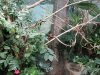
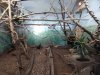
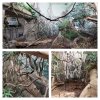
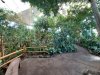
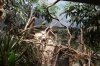
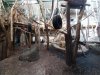
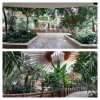
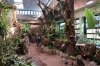
It is often very surprising to what extent birds (or other animals) can hide in aviaries that are not even that big. Especially when, as here in Warsaw, they are very well planted, it takes patience and some luck to find each species. This is certainly the case for the last section of the birdhouse, a vibrant walk-through tropical rainforest, with dense mature planting. I think I spent about an hour in this hall and as time went on, it was incredible how many more species could be found compared to when I walked through the first time.
 Birdhouse - Rainforest walk-through
Most of these species were not signed, so there could be more, but this is what I saw (bold = signed):
Violet turaco,
Victoria crowned-pigeon,
Green-naped pheasant-dove,
Nicobar pigeon, Red Fody,
Red-whiskered bulbul, Bearded barbet, Gray-capped emerald dove, Spangled cotinga,
Sunbittern, Chestnut-naped Imperial-pigeon, Pied Imperial-pigeon,
Eurasian golden oriole,
Brahminy starling, Cinnamon Groud-dove,
Malay Peacock-pheasant, Superb Fruit-dove, Black-faced go-away bird and Bluebacked grassquit.
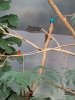
 Birdhouse - Rainforest Walk-through - Sunbittern (Eurypyga helias) watching out for Zoochatters - Spangled Cotinga (Cotinga cayana)
As some of you remember from my previous trip report, rainforests are my favourite type of zoo exhibit, especially when many species of birds thrive in them. Give me a rainforest, keep the predictable white-bearded saki out, and you will definitely see me passing by.
 Green-naped Pheasant-pigeon (Otidiphaps nobilis)
Waw, the birdhouse in Warsaw is as good as all the Zoochatters have described before. The visitor areas could indeed use a refresh, it looks (and smells) a bit like the past there. But the aviaries themselves are of extraordinary beauty. And walking through the dense rainforest with its mature trees is an exciting experience for those who like to take their time looking for all those birds hidden in this hall. It is exactly what I would love to see at my favourite Belgian (Antwerp) zoo with its stately historical winter garden.
To conclude: Warsaw Zoo is a very average zoo: there is nothing really dramatically bad, but the general feeling is still that it should be able to do better. I certainly enjoyed Warsaw’s vast zoo grounds, the felid terraces, the aquarium, insect house and the Elephant house, that stately avenue and the terrific birdhouse. If enough funding is found, it could grow into an excellent city zoo. It has all the space and enough mature trees to create large multi-species enclosures and combining this with a lot of interesting accessible buildings. Many of the enclosures for ungulates are already the right size and just need a little tlc. Nothing stands out here, which is a bit of a shame for the capital zoo. I personally feel that it lags a bit behind compared to the modern, vibrant and beautiful city that is Warsaw. But if you love birds, this is your premier destination in Poland: the Bird House is one of the best in Europe and there are also many interesting species hidden elsewhere in the garden.
Species lists as of september 2024
Species list Insect House
1. Chilean Rose tarantula (Grammostola rosea)
2. Mexican Red rump tarantula (Brachypelma vagans)
3. Wessel’s tiger ornamental tarantula (Poecilotheria tigrinawesseli)
4. Mexican redknee tarantula (Brachypelma hamorii)
5. Curlyhair tarantula (Tliltocatl albopilosus)
6. Brazilian Salmon Pink Bird-eating tarantula (Lasiodora parahybana)
7. Indian Ornamental tree spider (Poecilotheria regalis)
8. Unknown and unsigned, completely covered in web
9. Hispanolian tarantula sp. (Phormictopus atrichomatus)
10. Mexican Fireleg tarantula (Brachypelma boehmei)
11. Trinidad Chevron tarantula (Psalmopoeus cambridgei)
12. Red-legged golden orb-weaver spider (Trichonephila inaurata)
13. Pink-winged Stick Insect (Sipyloidea sipylus)
14. Thorny Devil Stick insect (Eurycantha calcarata)
15. Giant African Oliva millipede (Telodeinopus aoutii)
16. Phasmids genus stick insect (Phaenopharos khaoyaiensis)
17. Two-spotted assassin bug (Platymeris biguttatus)
18. Turkestan cockroach (Periplaneta lateralis)
19. Giant African mantis (Sphodromantis viridis)
20. Black Beauty Stick Insect (Peruphasma schultei)
21. Giant Prickly Stick Insect (Extatosoma tiaratum)
22. Jungle Nymph (Heteropteryx dilatata)
23. Peppered cockroach (Archimandrita tessellata)
24. Six-spotted cockroach (Eublaberus distanti)
25. Death’s head cockroach (Blaberus craniifer)
26. Warty Glowspot cockroach (Lucihormetica verrucosa)
27. Australian red claw crayfish (Cherax quadricarinatus)
28. Pomacea sp.
Species list Reptile House
Turtle section
1. Roti Island Snake-necked turtle (Chelodina mccordi)
2. Southeast Asian Box turtle (signed as Amboina box turtle) (Cuora amboinensis)
3. Red-bellied Short-necked turtle (Emydura subglobosa)
4. Annam leaf turtle (Mauremys annamensis)
5. Chinese pond turtle (Mauremus reevisii)
6. Empty
7. Red-footed tortoise (Chelonoidis carbonarius)
8. 2 seen but unlabled
9. 1 seen but unlabled
Snake section
10. Radiated Ratsnake (Coelognathus radiatus)
11. Mandarin Ratsnake (Eurprepiophis mandarinus)
12. Amazon Tree boa (Corallus hortulana)
13. Green tree boa (Morelia viridis)
14. Vampire crab (Geosesarma dennerle)
15. Carpet python (Morelia spilota)
Lizard section
17. Gila monster (Heloderma suspectum)
18. Dumirell’s boa (Acranthopis dumerili)
19. Fiji Iguana (Brachylophus bulabula)
20. North-African mastigure (Uromastyx acanthinura)
21. Sudan Plated lizard (Broadleysaurus major) and Leopard tortoise (Stigmochelis pardalis)
22. Empty
23. Cuban tree boa (Chilabothrus angulifer)
24. Yellow anaconda (Eunectes notaeus)
Crocodile section
25. Spectacled caiman Caiman crocodilus)
26. Dwarf crocodile (Osteolaemus tetraspis tetraspis)
27. Siamese crocodile (Crocodylus siamensis)
28. Cuban crocodile (Crocodylys rhombifer)
Second floor amphibian section
29. Golfodulcean poison dart frog (Phyllobates vittatus)
30. Vietnamese or Tonkin bug-eyed frog (Theloderma corticale)
31. Yellow-banded poison dart frog (Dendrobates leucomelas)
32. Green pricklenape (Acanthosaura capra) and Oriental file-bellied toad (Bombina orientalis)
33. Cane toad (Rhinella marina)
34. Australian Green tree frog (Ranoidea caerulea)
35. Empty
36. File-eared tree frog (Polypedates otilophus) and HongKong whipping frog (Polypedates megacephalus)
37. Sambava tomato frog (Dyscophus guineti) and Standing day gecko (Phesulma standingi)
Species list Aquarium
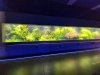
1. Coral reef tank
Pajama Cardinalfish (Spheararnia nematoptera)
Giant clam (Tridacna maxima)
Common surgeon or Blue tang (Paracanthurus hepatus)
Powder-blue, Chocolate, Striped Surgeon fish (Acanthurus leucosternon/pyroferus/lineatus)
Purple, Yellow and Sailfin Tang (Zebrasoma xanthurum/flavesens/velifer)
Copperband Butterflyfish (Chelmon rostratus)
Flame-tailed Blenny (Encheylurus flavipes)
Royal Dotterback (Pictichromis paccagnellorum)
Neon and Yellowtail Damselfish (Pomacentrus coelestris and Chrysiptera parasema)
Picturesque Dragonet (Synchiropus picturatus)
Bristletail Filefish (Acreichthys tomentosus)
Sea Goldie (Pseudanthias squamipinnis)
Tomato Clownfish (Amphiprion frenatus)
Yellow Coral Goby (Gobiodon okinawea)
Lamarck’s Angelfish (Genicanthus lamarck)
Six Line Wrasse (Pseudocheilinus hexataenia
)
2. Amazon tank
Emperor, Glowlight, Rummynose Tetra (Nematobrycon palmeri/ Hemigrammus erythrozonus /Petitella rhodostomus)
Common Hatchetfish
Whiptail Catfish (Farlowella acus)
Golden Otocinclus (Otocinclus affinis)
Black Phantom, Flame, Bentos, Lemon, Red Phantom, Ember, Red Minor and Black Neon Tetra
(Hyphessobrycon megalopterus, Hyphessobrycon flammeus, Hyphessobrycon bentosi, Hyphessobrycon pulchripinnis, Hyphessobrycon sweglesi, Hyphessobrycon amandaeis, Hyphessobrycon eques, Hyphessobrycon herbertaxelrodi)
Hockeystick Pencilfish (Nannostomus eques)
Blackline Penguinfish (Thayeria boehlkei)
Glass Bloodfin Tetra (Prionobrama filigera)
Sterbai’s corydoras (Corydoras sterbai)
Loricaria ssp (armored catfish)
Silvertip Tetra (Hasemania nana, wrongly signed as Hemmigrammus nanus)
Agassiz’ Dwarf Cichlid (Apistogramma agassizii)
X-ray Tetra (Pristella maxillaris)
3. Piranha tank
Red-bellied piranha (Pygocentrus nattereri)
4. Coral reef
Ocelarris Clownfish (Amphiprion ocellaris)
Blue Tang (Paracanthurus hepatus)
unidentified (surgeon?) black fish
5. Razor fish tank
Jointed razor-fish (Aeoliscus strigatus)


 ).
).







 W komentarzu na Facebooku i w relacji udostępniamy link dla Wykonawców zainteresowanych zrealizowaniem tego wspaniałego projektu. Posiadłość pingwinów będzie wyposażona m.in. w dostępny przez cały rok basen zewnętrzny z podglądem na ptaki pływające pod wodą, filtrację wody i rozległe zaplecze hodowlane. Nasi mieszkańcy zyskają dużo komfortu, a sam wybieg będzie jednym z najnowocześniejszych takich obiektów w Polsce!
  Krok po kroku odhaczamy kolejne punkty realizacji projektu, teraz czas na oferty Wykonawców. Mamy nadzieję, że wszystkie elementy tej układanki uda się złożyć w zakładanych terminach i wybieg zostanie otwarty zgodnie z planem w przyszłym roku. Trzymajcie kciuki, będziemy Was informować o postępach prac! Building of our Cape penguins' new enclosure is getting closer! Until December 4th, the Capital Board of City Development is waiting for construction offers.